


More news on this day
The 2026 Thanksgiving travel rush is beginning under pressure from multiple fronts, as U.S. travelers contend with lingering disruption from a major Delta Air Lines technology outage, the aftereffects of a recent nationwide FAA ground stop and an unsettled weather pattern that is forecast to bring storms to both coasts during one of the busiest travel weeks of the year.
Get the latest news straight to your inbox!
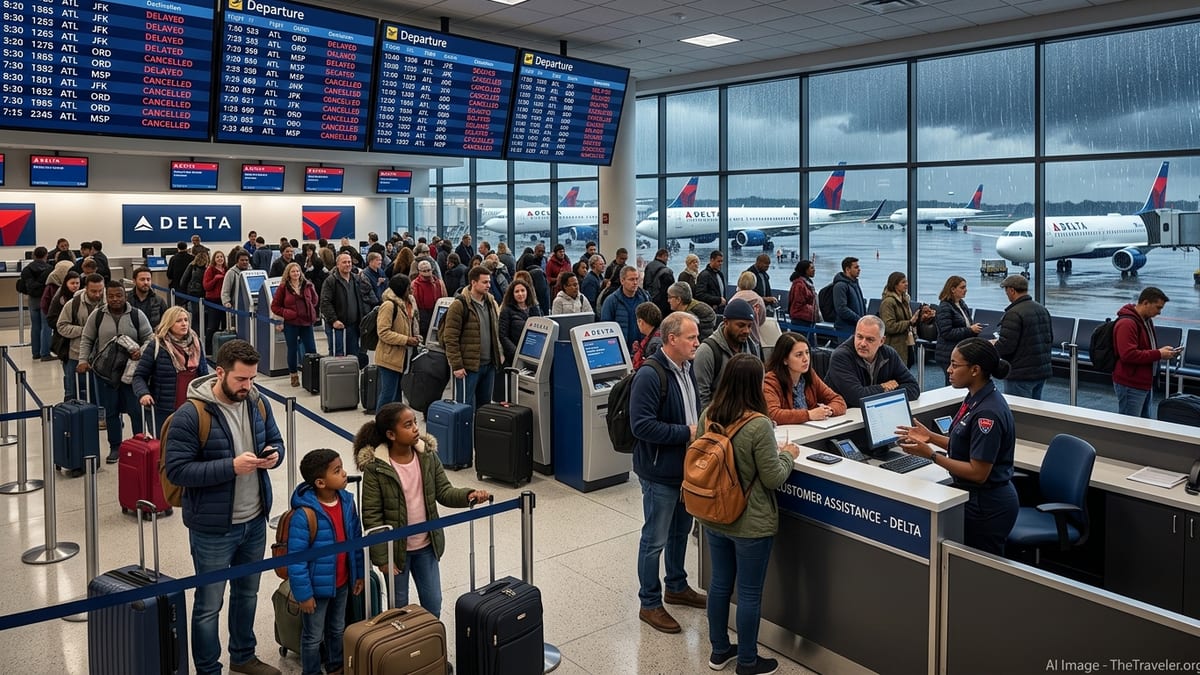
Delta outage delays more than 1,600 flights as peak travel begins
Delta Air Lines passengers entered Thanksgiving week facing residual disruption from a significant technology failure that hit the carrier on Sunday, November 22, just as many early holiday travelers were beginning their trips. According to statements from the airline and U.S. broadcast reports, an outage affecting one of Delta’s weight and balance systems, which is used to calculate safe loading for each aircraft, led to widespread delays across the network. Good Morning America and other outlets reported that more than 1,600 Delta flights were delayed on Sunday, with the Federal Aviation Administration (FAA) implementing a ground delay program for Delta services while the carrier worked through the issue.
By Monday, November 23, Delta said the technology problem had been resolved and that flights were operating, but the knock-on effect meant the airline was still canceling some services and working through backlogs at key hubs. Flight-tracking data cited by national and local news outlets indicated that a smaller but still notable share of Delta’s schedule was experiencing delays on Monday as aircraft and crews were repositioned. For travelers, that translated into longer lines, rebooked itineraries and a higher likelihood of same-day schedule changes as the week’s heavier volumes approached.
The timing of the outage magnified its impact. The disruption followed, by about a week, an FAA-mandated nationwide ground stop on November 13 that affected all U.S. airlines for several hours and created operational challenges that some carriers were still unwinding as recently as November 17. Delta, which operates large hubs at Atlanta, Detroit, Minneapolis–St. Paul and Salt Lake City among others, was already working to stabilize its network after that systemwide event. The latest issue concentrated at Atlanta, the world’s busiest airport by passenger numbers, increased the risk that residual delays would spill into the core Thanksgiving travel window from Tuesday through Sunday.
Stormy Thanksgiving forecast raises risk of further flight and road delays
Compounding the operational strain is an unsettled Thanksgiving week weather pattern that forecasters say could disrupt both air and road travel on multiple days. Outlooks from the National Weather Service and private meteorological services point to a series of systems affecting different regions, including a coastal storm expected along the Eastern Seaboard around Thanksgiving Day itself and strong Pacific storms coinciding with unusually high tides along parts of the West Coast. These systems are expected to bring periods of heavy rain, gusty winds and, in some interior and higher-elevation areas, wintry precipitation.
Weather-focused travel analyses published on November 23 highlight particular concerns for the Northeast, where a Thanksgiving Day storm could generate low clouds, strong winds and bands of rain that elevate the risk of air-traffic control delays at major hubs such as New York, Boston and Philadelphia. Forecasters note that even if conditions remain within safe flying limits, a combination of low ceilings and high winds at one or more large hubs often translates into miles-in-trail spacing, ground delay programs and cascading schedule disruptions across the national network as aircraft and crews miss their planned slots.
On the West Coast, separate forecasts warn that a powerful Pacific storm tracking inland could coincide with king tides and localized coastal flooding in parts of California and the Pacific Northwest. While the primary effects will be felt in low-lying coastal communities and along shoreline roads, high winds and heavy rain could also affect operations at airports such as San Francisco, Oakland and Seattle at times during the week. Inland, the same system and its trailing fronts may bring periods of rain and thunderstorms across sections of the southern Plains and lower Mississippi Valley, potentially affecting hubs such as Dallas–Fort Worth and Houston during peak departure periods.
Record travel volumes increase sensitivity to glitches and storms
The combination of technology failures and unsettled weather is occurring against the backdrop of near-record Thanksgiving demand. AAA’s national forecast for the 2026 holiday period projects that about 81.5 million people in the United States will travel at least 50 miles from home between Tuesday, November 24 and the Monday after Thanksgiving. Within that total, roughly 6 million people are expected to fly domestically over the period, a figure that is comparable to or slightly below last year’s estimate but still near historic highs. Separate FAA planning figures reported this week suggest that U.S. airlines are scheduled to operate more than 417,000 flights during the nine-day window from November 23 to December 1, which would mark the busiest Thanksgiving period for air traffic in roughly 16 years.
High volumes mean that relatively modest interruptions can have outsized effects. During the 2025 holiday period, federal data analyzed by news organizations showed that close to a quarter of U.S. airline flights arrived at least 15 minutes late in November and December, with weather, air traffic control constraints and carrier-related issues all contributing. Delays at a handful of major hubs are often enough to push national statistics higher, as aircraft arriving late to one airport then depart late from another, triggering a chain reaction that can ripple through the system for many hours.
The 2026 Thanksgiving week begins with airlines and regulators particularly sensitive to those dynamics. The recent FAA nationwide ground stop highlighted vulnerabilities in the agency’s communications infrastructure, while technology outages at multiple large carriers over the past week, including the latest Delta incident, underscored the dependency of modern operations on complex software and networking systems. Industry officials have emphasized that safety margins remain robust and that the majority of flights still operate on time, but they have also cautioned travelers that punctuality can deteriorate quickly when busy schedules meet constrained capacity and challenging weather.
Where and when travelers are most likely to feel the impact
Travelers’ experiences this week will vary significantly by route, region and mode of transport. On the aviation side, early indications from airport authorities and local travel forecasts point to the heaviest passenger volumes on Wednesday, November 25, as well as on Saturday and Sunday for the return journey. Major hubs including Atlanta, Dallas–Fort Worth, Denver, Chicago O’Hare, New York area airports, Los Angeles and San Francisco are all preparing for peak or near-peak throughput, with some, such as Dallas–Fort Worth, expecting well over 100,000 departing passengers on the busiest days.
Delta customers are likely to feel the residual effects of Sunday’s outage most acutely at the airline’s core hubs. At Hartsfield–Jackson Atlanta International Airport, where the disruption originated, customers on Sunday and Monday reported long queues at check-in counters and service desks as staff worked to rebook passengers from canceled or heavily delayed flights. While Delta has said that operations are stabilizing and that flights are moving safely across the network, the process of rebalancing aircraft rotations and crew schedules means that some sporadic delays and equipment swaps could extend into Tuesday, particularly on connecting itineraries relying on tight layovers.
On the roads, the greatest impacts are expected in corridors that intersect with the forecast storm tracks. In the Northeast and Mid-Atlantic, heavy rain and gusty winds from the anticipated Thanksgiving Day coastal storm may complicate driving along major routes such as Interstate 95, especially in urban stretches near New York, Philadelphia, Baltimore and Washington. Farther inland, where colder air may mix with the system, some higher-elevation roads in the Appalachians and northern New England could encounter wet snow or slush, prompting advisories from state transportation departments. In the West, coastal flooding and high surf could temporarily close or restrict access on low-lying coastal roads, while heavy rain increases the risk of localized flash flooding and reduced visibility on highways.
What travelers can do now and what to watch in the days ahead
With the main Thanksgiving departure days still ahead, travelers have a limited but meaningful opportunity to reduce their exposure to disruption. Airline passengers booked on Delta in particular are being advised by travel agencies and consumer advocates to monitor their bookings closely over the next 24 to 48 hours and to keep the carrier’s mobile app or website handy for real-time updates. When large operational events occur, Delta and other major airlines sometimes introduce temporary travel waivers for affected dates and regions, allowing customers to change flights within certain windows without paying standard change fees or fare differences. As of early Tuesday, no broad new waiver had been publicly announced specifically for the Sunday outage, but customers are encouraged to check Delta’s travel advisory page and to review any flexibility offered in their individual bookings.
Across all airlines, passengers traveling through hubs that are forecast to be affected by storms later in the week may see carriers adjust schedules proactively, including through advance cancellations or route changes designed to preserve overall network reliability. When such schedule changes occur, passengers are generally entitled to rebooking at no additional cost on the same airline, and in some cases may be eligible for refunds if their flights are significantly altered or canceled. Because policies vary by airline and situation, travelers should verify the latest rules directly with their carrier and, where relevant, review the protections attached to their credit card or travel insurance coverage.
Road travelers can also take practical steps as forecasts evolve. Those planning to drive along the East Coast or across mountain passes during the height of the storms may wish to consider shifting departure times to avoid the heaviest precipitation or strongest winds, particularly on Thanksgiving Day and the morning after. Checking updated forecasts from the National Weather Service and state transportation alerts on the day of travel can help identify problem areas such as flooded coastal routes, snow-affected summits or stretches with reduced visibility. Given AAA’s projection of more than 80 million holiday travelers, leaving additional time for congestion, rest breaks and detours is likely to be prudent, even where the weather remains relatively benign.
In the days ahead, the key factors to watch will be the pace of recovery in Delta’s operation, any additional technology or infrastructure issues that arise across the system, and the exact track and intensity of the forecast storms on both coasts. Travelers who remain flexible, stay informed using official channels and are prepared for longer-than-usual queues and travel times will be better positioned to navigate what is shaping up as a challenging but manageable Thanksgiving travel period.