


Hubbard Glacier is one of the great showpieces of Alaska cruising, but the experience you have will depend heavily on where you stand once your ship reaches Disenchantment Bay. Passengers debate endlessly about port versus starboard and whether a balcony cabin is worth the premium, yet the best views are usually from forward-facing open decks and large panoramic lounges. The ideal spot still depends on your ship’s individual deck plan, how the captain maneuvers in the bay, the weather, and how much you are willing or able to move around during the approach.
Get the latest updates straight to your inbox!
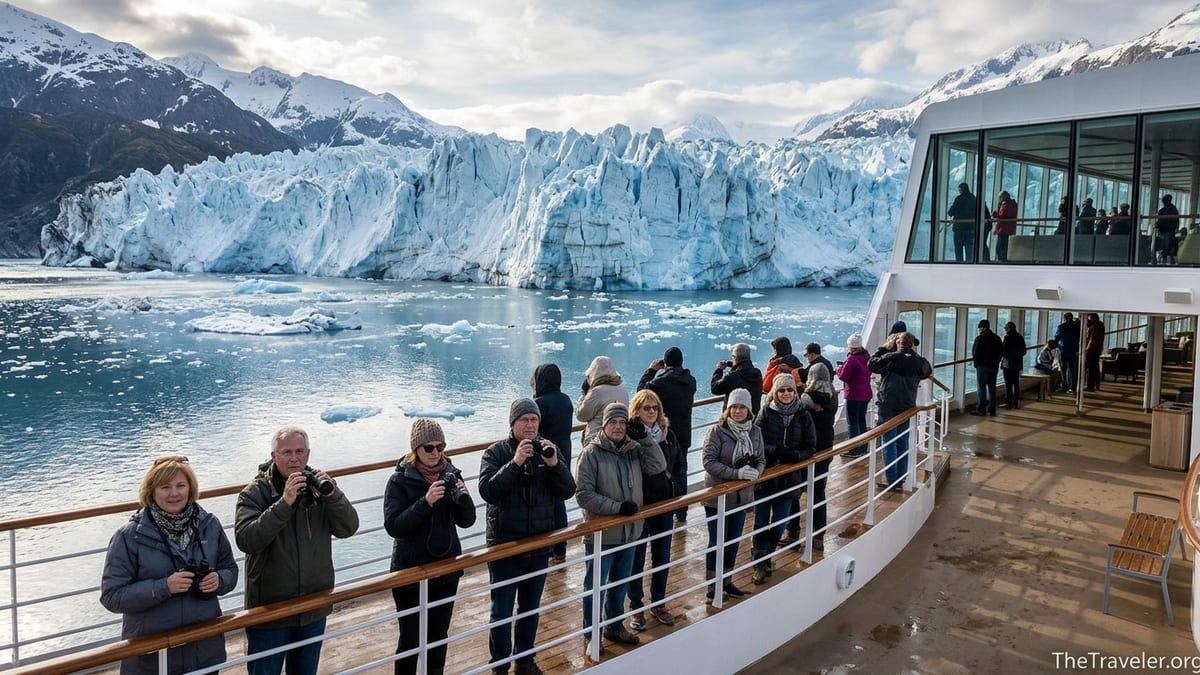
The Bottom Line: Where You Should Be When Hubbard Comes Into View
If your single priority is the strongest possible Hubbard Glacier experience, aim first for unobstructed forward observation areas, accessible open decks, and large indoor lounges with floor-to-ceiling windows. These areas give you a head-on view of the glacier during the approach through Disenchantment Bay, and they make it easy to switch sides as the captain rotates the ship to share the view between port and starboard. On many big-ship Alaska sailings, the bow or forward upper decks open specifically for glacier viewing, and experienced repeat cruisers start lining up 30 to 60 minutes before arrival.
A balcony cabin can be wonderfully comfortable for warming up, enjoying quieter moments, and shooting photos once the ship is stationary. However, balcony views are restricted to one side, affected by railings and privacy dividers, and vulnerable to missing key moments if the ship rotates quickly. Because captains usually turn the ship at least once or twice so both port and starboard see the face of Hubbard Glacier, neither cabin side can honestly be called “the Hubbard side.” For most travelers, shared public decks still deliver the most dramatic and flexible views.
That said, the ideal viewing spot is not identical on every ship. A Solstice-class Celebrity ship has a very different forward layout from a Royal Caribbean Quantum-class vessel, and Princess and Holland America ships offer their own promenades and lounges. Before you sail, it is worth spending ten minutes with your specific deck plan to locate any forward indoor lounges, wraparound promenades, and accessible outdoor decks where railings are not lined with lifeboats or heavy overhead structures. Bring those notes with you on glacier day so you are not scrambling once the announcement comes over the PA system.
Ultimately, think of a balcony as a bonus, not a requirement. If your budget is tight, you can confidently book an interior or oceanview cabin for a Hubbard Glacier itinerary and still enjoy world-class viewing from the ship’s shared decks, provided you are willing to dress for the elements and arrive early in the right place.
Understanding the Approach: How Ships Enter Disenchantment Bay
On Hubbard Glacier days, ships enter Yakutat Bay from the Gulf of Alaska and then continue into Disenchantment Bay, the narrower inlet that leads to the glacier face. Cruise lines and independent Alaska cruise resources describe this as scenic cruising rather than a port call. There is no pier, no tendering and no town; everyone stays on board while the ship navigates among scattered ice and positions in sight of the glacier. Announcements about the approach usually begin one to two hours before the scheduled scenic cruising time, often with the cruise director or an onboard naturalist explaining where to stand and what to expect.
From the moment the first pale blue wall of ice appears around a headland to the time the captain holds position at the closest point, the approach through Disenchantment Bay can easily take 60 to 90 minutes, depending on ice conditions and visibility. As the ship nears the head of the bay, it threads between “bergy bits” and smaller growlers, and may slow to a crawl for safety. Under favorable conditions, some ships pause roughly a quarter to half a mile from the glacier face, while in heavier ice fields or in line with updated wildlife guidance the captain may stay farther away. The exact distance is a judgment call, but you can still feel the scale of Hubbard’s six to seven mile wide ice wall even from noticeably farther back.
Once the captain is satisfied with the position and any local guidelines on harbor seal and wildlife disturbance, the ship enters its primary viewing period. Many cruise reports and line descriptions suggest this close viewing window typically lasts about one to two hours. During that time, the captain may rotate the vessel 180 degrees or slowly swing the bow and stern back and forth so that both sides of the ship have extended time facing the glacier. It is this deliberate rotation that makes choosing “the right side” cabin far less important than many first-timers assume.
As the viewing window ends, the ship retraces its path out of Disenchantment Bay and Yakutat Bay and continues along the coast. The glacier remains visible, shrinking slowly behind you for another 20 to 30 minutes. If you are on an aft balcony or at the stern rail, this is one of the quieter, more contemplative moments of the day, with the icy face framed between the bay’s mountains as the ship glides away.
Port Versus Starboard: Why Cabin Side Matters Less Than You Think
For Hubbard Glacier itself, neither port nor starboard guarantees the superior view. Because the glacier lies at the head of Disenchantment Bay, not off to one side, a captain has several options for positioning: holding bow-on and pivoting gently so each side gets a turn, parking slightly angled to one side and then rotating, or doing a slow, continuous turn during the viewing period. Line descriptions of Alaska glacier cruising and recent passenger accounts consistently describe some form of rotation so that both sides of the ship look directly at the face for at least part of the time.
Confusion often comes from mixing up two different questions: which side is better for viewing the coastline on a northbound or southbound itinerary, and which side is better when the ship is stopped at a glacier. If you are sailing northbound from Vancouver or Seattle toward Seward or Whittier, some travelers like port side balconies for more continuous views of the mainland coast, while southbound passengers sometimes favor starboard. Those preferences are about sea days and general scenery, not about Hubbard Glacier itself, where the captain’s rotation is the decisive factor.
From a practical standpoint, passengers in balcony cabins often spend the approach moving between their veranda and shared decks rather than staying fixed in one place. You might, for example, watch the initial walls of ice appear from the forward open deck, return to your balcony while your cabin side faces the glacier, then head to the promenade or aft rail as the ship begins to turn away. Interior and oceanview passengers do the same circuit, just without the private outdoor space.
If you are choosing a cabin primarily for Hubbard, you can treat side choice as a tie-breaker after you have considered deck height, location relative to noisy venues, and your budget. Focus instead on learning which public decks give you the flexibility to switch sides as the ship moves, and be ready to take advantage of that mobility regardless of where your stateroom sits.
Ship-Specific Viewing Spots: Celebrity, Royal Caribbean, Princess and Holland America
Certain ships currently scheduled to visit Hubbard Glacier have especially useful observation spaces. On Celebrity Solstice, whose deck plans show Alaska sailings with scenic cruising in Hubbard, the key public viewing areas include the Sky Observation Lounge at the very front of Deck 14, an indoor venue with floor-to-ceiling glass facing forward. This lounge is a prime choice in cold or rainy weather. Forward portions of the open pool deck and higher sun decks also offer strong views, though part of the very top forward area is now reserved for suite guests in The Retreat sundeck. Passengers in standard cabins should still find ample space along both sides of the main pool deck and at other outdoor rails.
Celebrity Summit, a smaller Millennium-class ship that has also operated Hubbard itineraries, has an indoor forward lounge and a classic wraparound promenade deck. The promenade’s lower height sometimes brings you closer to wildlife like seals and seabirds, while the forward lounge gives weather-protected glacier views through a wall of windows. On both Solstice and Summit, it is worth walking from bow to stern early in the voyage so you can spot tucked-away forward doors that are opened only for scenic cruising days.
Royal Caribbean’s Anthem of the Seas, a Quantum-class ship, has its own set of viewing tools for Hubbard. At the bow, the indoor Two70 lounge spans the stern with towering windows, but for glacier approaches many passengers gravitate to the open decks that wrap around the front of the ship above the navigation bridge. Anthem is also famous for the North Star observation capsule, which can rise on a mechanical arm to give aerial views. On Alaska sailings, lines have at times treated North Star glacier rides as timed activities, not walk-up viewing, so if that experience is important to you, check whether Hubbard day rides can be reserved and be prepared for limited capacity.
Princess and Holland America, two lines that market Alaska heavily and advertise Hubbard Glacier and Glacier Bay itineraries in their brochures, tend to excel at traditional promenade decks and open bow spaces. Many Princess ships that visit Hubbard offer a wraparound promenade on a mid-level deck, sometimes partially covered and lined with classic teak loungers. This promenade is a particularly good spot for travelers who want some shelter from the wind while retaining an easy walk to either side of the ship. Holland America’s Alaska-focused ships often add a forward viewing area above the bridge and extensive open decks at the bow, and the line emphasizes on-deck commentary and ranger-style talks during glacier days. In all cases, the message is the same: identify the forward-facing lounges and any wraparound decks on your specific vessel, then plan to be there well before the ship reaches the head of Disenchantment Bay.
Balconies Versus Public Decks: Comfort, Limitations and Photography
Balcony cabins along the sides of the ship are attractive on paper for Hubbard Glacier, and on a calm, bright day they can be a delight. You can sit comfortably with a blanket and hot drink from room service, avoid crowds at the rail, and step inside quickly if you get cold. Balconies are also helpful for travelers with limited mobility who may find prolonged standing on a windy deck difficult. In shoulder-season months like early May or late September, that private, sheltered vantage point can feel especially valuable when temperatures dip and rain or sleet sweeps across the bay.
Yet every balcony has built-in limitations. The railings, sometimes topped by a glass panel, cut off the extreme downward angle for photographing floating ice close to the hull. Privacy dividers between cabins block any view forward or aft beyond a narrow diagonal, and overhead structures can partially obstruct upward shots of mountains and sky. On some ships, lifeboats or structural elements sit directly beneath lower decks, so your line of sight is more side-on than panoramic. If the captain rotates the ship briskly, you may have only a few minutes of direct, face-on viewing of the glacier from your balcony before the ship moves on and the opposite side gets its turn.
Aft-facing balconies, especially those stacked above the ship’s wake, offer a very different experience. You will not get the intense, head-on view of calving ice that bow-facing decks enjoy, but once the ship begins to withdraw from Disenchantment Bay, the view from the stern can be exceptional. Hubbard Glacier remains framed in the distance, the bay stretches out in front of you, and the receding ice wall feels almost like a moving painting behind the ship. Aft balconies can be among the quietest places to reflect on what you have just seen, particularly later in the evening when most passengers have gone indoors.
For photographers, public decks nearly always provide the most flexible shooting environment. On an open rail, you can move freely to adjust angles, swap from wide-angle to telephoto lenses, and step across to the opposite side of the ship as light changes. You are less constrained by privacy dividers or neighborly etiquette when leaning or kneeling for a low-angle shot. Serious photographers often carry a small microfiber cloth to wipe spray from camera lenses, something that is harder to manage through cabin windows or around balcony glass. Even for smartphone shooters, the ability to shift position ten meters left or right can make the difference between a flat snapshot and a well-composed panorama of the ice wall.
Practical Strategies: Beating the Crowds and Finding Quiet Corners
On a clear Hubbard Glacier day, prime viewing rails can fill quickly. Many experienced Alaska cruisers treat the glacier approach like a shore excursion and arrive early, sometimes 30 to 45 minutes before the ship is expected to enter Disenchantment Bay’s inner section. If an onboard naturalist or the cruise director announces recommended viewing areas, note these and head there sooner rather than later. Early arrivals have their pick of positions at the bow of upper decks, at the most sheltered spots on the promenade, or in front-row chairs inside observation lounges.
If crowds at the most obvious rails become uncomfortable, consider exploring slightly overlooked alternatives. On some ships, side promenades one or two decks below the pool are noticeably quieter than the top sun deck. On others, a small forward terrace outside the gym or spa offers clear views with fewer people, particularly because it may be accessed by a tucked-away interior corridor. Aft open decks, while not facing the glacier during the closest approach, can be excellent for photos as the ship arrives or departs, framing the glacier between wake and mountains in a way few passengers think to shoot.
Flexibility is crucial. Once the ship begins its primary viewing period in front of Hubbard Glacier, ignore any temptation to stay rooted on a single side for fear of “missing something.” If conditions allow, be ready to cross from port to starboard as the captain turns the vessel, and do not hesitate to move between decks to find a better angle or smaller crowd. Listen carefully to bridge announcements about which side of the ship will face the glacier next; officers often share this information explicitly so passengers have time to reposition.
For travelers with limited mobility or those traveling with small children, a hybrid strategy often works best. Secure seats in a forward lounge with large windows early, then send a more mobile family member outside to capture photos and videos from the open deck when the ship rotates. Agree on a simple meeting point so no one gets lost in the crowd, and take advantage of any accessible viewing platforms or reserved spaces provided for wheelchairs and scooters on upper decks.
Photography Tips for Smartphones and Cameras at Hubbard Glacier
Hubbard Glacier’s bright ice and deep shadows can challenge cameras from smartphones to professional mirrorless bodies. For phone photographers, choosing the standard wide lens rather than the ultra-wide often yields better detail on the ice wall. Tap on the glacier face to expose for the bright ice rather than the darker water; this prevents blown-out highlights and keeps the subtle blue tones visible. If your phone offers a “pro” or manual mode, slightly lowering exposure before shooting can help preserve texture in the sunlit portions of the glacier.
Mirrorless and DSLR shooters might pair a wide-angle lens, in the 16 to 35 millimeter range on a full-frame body, with a moderate telephoto such as 70 to 200 millimeters. The wide lens captures the full sweep of the glacier across the bay, while the telephoto isolates crevasses, seracs and calving events. Image stabilization, whether in-body or in-lens, is extremely helpful when shooting from a moving ship or in wind, so consider enabling it even at faster shutter speeds. Keep a lens hood on to reduce flare from low-angle light, and pack a small dry bag or camera cover if drizzle is in the forecast.
Condensation can be an issue when moving repeatedly between warm interiors and chilly outdoor decks. Before you step outside, keep your camera or phone in a pocket near the outside temperature for a few minutes so the transition is not as abrupt. If your lens does fog, resist wiping immediately, as that can smear moisture; instead, let the glass acclimate or gently use a clean microfiber cloth. Through windows in lounges, watch for internal reflections from ceiling lights or bright clothing. Holding the lens close to the glass and cupping a hand around it can dramatically cut these reflections.
Calving events at Hubbard can be sudden and explosive, but safety and stability should come first. Rather than leaning out dangerously over a rail to capture the splash, use a slightly wider framing than you think you need and rely on cropping later. Continuous burst mode on many cameras helps capture a sequence of images as the ice breaks away and falls, increasing your odds of freezing the most dramatic moment. Batteries, especially in mirrorless cameras and phones, drain faster in cold wind; bring a fully charged spare battery and a compact power bank in an inside pocket to keep them warm and ready.
What to Wear: Staying Comfortable in Wind, Rain and Cold
Conditions in Disenchantment Bay can feel markedly colder than the ambient forecast for Juneau or Ketchikan on the same day. You are standing still on a moving ship, often in strong wind with chilled air flowing off the glacier. Layering is essential. Start with a moisture-wicking base layer, add an insulating mid-layer such as a fleece or light down jacket, and top it with a windproof and waterproof shell. Pack a warm hat that covers your ears, a neck gaiter or scarf, and gloves thin enough to operate a camera or smartphone while still providing insulation.
Footwear matters more than many passengers expect. Deck surfaces can be wet from spray or drizzle, and temperatures near the glacier make thin sneakers uncomfortable. Waterproof hiking shoes or boots with good grip are ideal, worn with wool or thermal socks. If you plan to stay at the rail for the full approach and viewing period, consider toe warmers or an extra pair of socks; it is hard to enjoy the show if your feet are numb. On wetter days, rain pants or a longer waterproof coat that covers your thighs can make standing in a breeze far more bearable.
Families with children should assume kids will get cold faster than adults. Dress them in one extra layer compared with what you are wearing, include waterproof mittens or gloves, and bring a backup hat in case the first blows away. Snacks and a small thermos of hot chocolate or tea can work wonders for morale during the approach. For travelers with limited mobility, strategically balancing outdoor and indoor time is key: spend shorter intervals at the rail for the most dramatic moments, then retreat to a nearby lounge or sheltered deck where you can sit while still enjoying a forward view.
Many ships run hot drinks stations near popular viewing decks on glacier days, serving coffee, tea and sometimes broth or mulled beverages. These are a welcome bonus, but they are not guaranteed or always close to the rail. Bringing your own insulated mug with a secure lid lets you fill up once and then return to your preferred vantage point without juggling small disposable cups in the wind.
Balcony Versus Interior Prices: Is the Premium Worth Paying?
For 2027 Alaska sailings that include Hubbard Glacier, publicly listed fares show a noticeable but variable gap between interior and balcony cabins. On some early-season itineraries, an interior cabin might price in the range of a few hundred dollars per person less than a standard balcony on the same sailing, while peak July and August departures often show a larger difference. Suite-grade accommodations, including large aft balconies, can add a substantial premium beyond that again. Exact figures change with promotions and demand, so it is essential to check current pricing for your specific dates rather than relying on an average.
When evaluating whether the balcony premium is justified, focus on how much time you realistically expect to spend in your cabin during scenic cruising. If you are a traveler who tends to be out on deck from dawn to dusk, joining commentary sessions and roaming between viewing platforms, then paying significantly more solely for Hubbard Glacier may not be necessary. Shared decks, especially on lines like Princess and Holland America with strong promenade designs, deliver more complete panoramic coverage and easier movement between sides, all at no additional cost beyond your base fare.
On the other hand, if privacy, ease of access and the ability to step outside without navigating stairs or ramps are high priorities, the higher fare for a balcony can feel worthwhile. This is particularly true for travelers managing mobility issues, parents with nap-age children and anyone who knows they are sensitive to cold wind. In those cases, think of the balcony as your personal retreat for part of the day, not as a replacement for time on the bow or observation deck. You might reasonably divide your glacier time between the balcony and shared spaces to avoid feeling you have paid for a feature you barely used.
One compromise is to target shoulder-season sailings or midweek departures where the interior-to-balcony price gap narrows. If the additional cost per person drops to a modest level and you value the flexibility of a private outdoor space for Hubbard and other scenic cruising days, upgrading can make sense. If the difference climbs into several hundred dollars per person and your budget is tight, it is easier to recommend booking a well-located interior or oceanview and investing the savings in quality cold-weather clothing, binoculars or a well-reviewed shore excursion later in the itinerary.
Comparing Viewing Locations: Pros, Cons and Comfort
Forward open decks sit at the top of most viewing rankings for Hubbard Glacier. Their primary advantages are unobstructed, head-on views of the ice wall during the approach and closest viewing period, the ability to switch from port to starboard quickly as the ship turns, and a strong sense of immersion in the landscape. The trade-offs are exposure to wind and weather, variable seating and the likelihood of crowds during peak minutes. Photographers love these decks for their flexibility and clear sightlines, but families with young children and travelers who tire easily may find standing here for long stretches demanding.
Panoramic indoor lounges, such as Celebrity Solstice’s Sky Observation Lounge or other ships’ forward-view lounges, provide a very different balance. They offer large windows, comfortable seating and climate-controlled shelter, which is ideal in rain, sleet or early spring cold snaps. Reflections on glass and limited ability to avoid window frames can slightly reduce photographic opportunities, but for many travelers the trade-off is worthwhile. Crowding can still be an issue, especially for the front-row seats, so arriving early remains important even indoors.
Side promenade decks, especially those that wrap fully around the ship, are often the hidden gems of Hubbard Glacier days. Their mid-level height gives a different perspective than the sky decks, they tend to be less windy thanks to partial overhead cover, and the width of the promenade allows passengers to stroll rather than stand shoulder to shoulder. For photography the angle is more side-on, but you can easily move between port and starboard as the captain rotates the ship. Seating along the ship’s side also gives you a place to rest between bursts of intense viewing.
Balconies, whether standard or aft, rank highly for comfort and privacy but lower for all-around coverage and flexibility. They are superb for quiet reflection, warm drinks and leisurely observation when your cabin side faces the glacier, but structural constraints and the ship’s movement mean you will see only part of the show unless you supplement balcony time with visits to public decks. For travelers whose main goal is maximizing photography options and panoramic drama, shared decks remain the stronger choice; for those prioritizing comfort and accessibility, a balcony can be a welcome complement to, rather than a replacement for, time at the bow.
Glacier Day Action Plan and Key FAQs
A simple action plan can help you get the best from Hubbard Glacier day without stress. The night before, review the printed or app-based daily schedule for the estimated arrival time in Disenchantment Bay and any notes on which decks will open for scenic cruising. Lay out your layers, hat, gloves and camera gear so you are not scrambling in the morning. Have an early, light meal so you are free to secure a viewing spot 45 minutes to an hour before the ship is due to reach its closest position.
Once announcements begin about entering Yakutat Bay, head for your chosen primary vantage point: a forward open deck if the weather is reasonable, or a front-row seat in a panoramic lounge if conditions look rough. As the glacier first appears, resist the urge to chase every new angle. Spend some time simply watching the approach, listening for low rumbles of calving and letting your eyes adjust to the immense scale of the ice wall. When the captain announces a rotation or indicates which side will face the glacier next, move calmly to the appropriate rail, switching between outdoor decks and quieter promenades as needed.
Several common questions arise before almost every Hubbard sailing. Passengers ask whether binoculars are worth packing; for this glacier, the answer is yes if you already own a compact pair. They add a great deal when scanning for harbor seals on ice floes or inspecting crevasses and blue caves in the glacier face. As for best deck, there is no single correct answer, but forward open decks and any wraparound promenade usually outrank all others for flexibility and perspective. Check the ship’s announcements and daily program, which often name specific decks that will be opened or staffed by naturalists for glacier viewing.
Perhaps the most reassuring answer is that travelers without balconies do not miss anything essential. Hundreds of passengers on every sailing enjoy spectacular views of Hubbard Glacier from shared decks, and many balcony guests leave their cabins during the approach because they prefer the atmosphere at the bow. With thoughtful preparation, warm clothing and a willingness to move between vantage points, an interior or oceanview cabin guest can have an experience every bit as powerful and photogenic as someone staying in a high-end suite. The glacier does not belong to one side of the ship or one fare category; it rewards those who step outside, look up and give it the time and attention it deserves.