


Arriving at Mactan Cebu International Airport can be disorienting, especially after a long flight or a late-night arrival. The good news is that Cebu’s main airport has a straightforward taxi system, with clearly signed bays for white and yellow cabs and airport staff who manage the queues. Still, knowing how the system works, what fares to expect, and how taxis compare to Grab will help you start your Cebu trip smoothly and avoid common overcharging pitfalls.
Get the latest updates straight to your inbox!
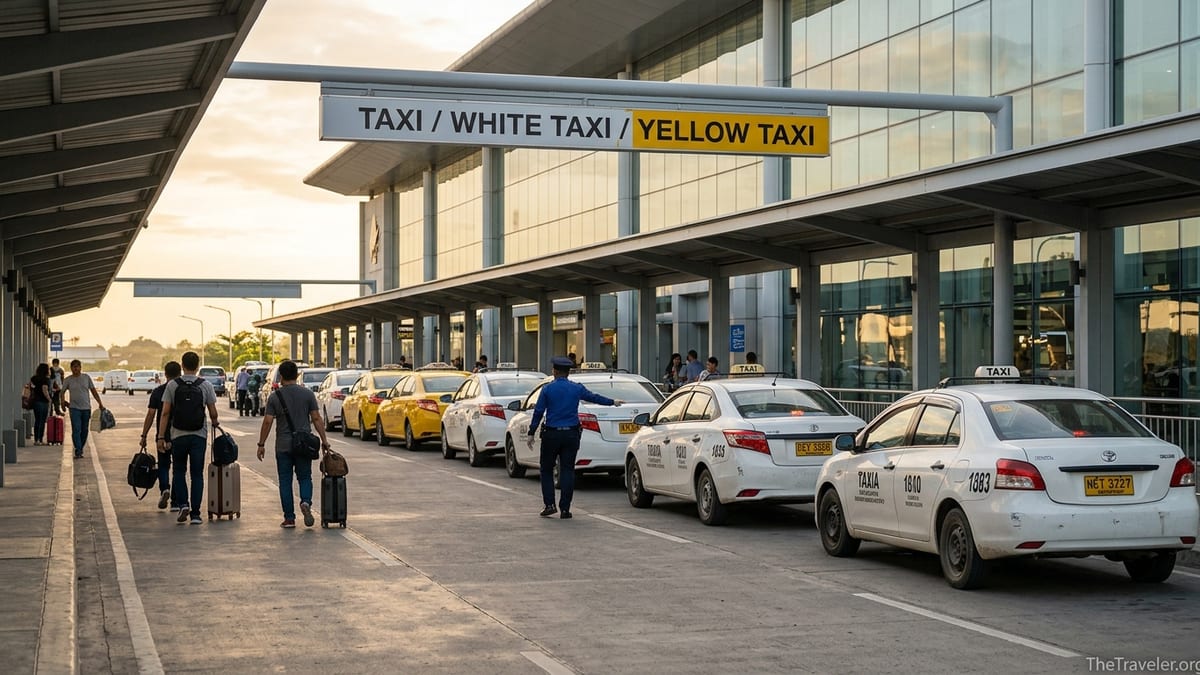
Airport Layout: Where to Find White and Yellow Taxis
Mactan Cebu International Airport has two passenger terminals: Terminal 1 for most domestic flights and Terminal 2 for many international routes. Both terminals are on Mactan Island in Lapu-Lapu City, about 13 to 20 kilometers from central Cebu areas like IT Park and the historic downtown, depending on your exact destination. Travel time to Cebu City can be as short as 25 minutes in light traffic, but in rush hour it can easily stretch to 45 minutes or more as cars funnel toward the two main bridges to the city.
On arrival at Terminal 1, you exit baggage claim into the public arrivals hall and follow the overhead signs marked “Taxi,” “White Taxi,” and “Yellow Taxi.” These lead outside to a fenced-off taxi area where airport staff queue passengers. White taxis and yellow airport taxis have separate, clearly signed lines. Staff will usually ask where you are going, then direct you to the correct bay and hand you a small slip with the taxi plate number or operator details.
At Terminal 2, you again follow “Taxi” signs past the arrival hall doors. Depending on current airport arrangements, you may be directed to taxi bays just outside the terminal or slightly farther along the curb. The same separation applies: a dedicated lane for yellow airport taxis and another for white city taxis. If you arrive internationally and want the full range of taxi options, it is sometimes only a short walk to the domestic terminal area where more white taxis circulate, but for most travelers the official bays at your arrival terminal are sufficient and easiest.
Importantly, you no longer need to step outside the terminal perimeter or walk to the highway to find a metered taxi. The airport’s official taxi bays are the safest option: they are monitored by guards, there are CCTV cameras, and taxi plate numbers are logged as they enter the queue. This has significantly reduced the kind of aggressive touting that used to be common at some other Philippine airports.
White Taxis: Cheapest Option and How They Work
White taxis are regular city cabs licensed to serve Cebu and Mandaue. They are typically older models such as Toyota Vios or similar sedans and are almost always the cheapest four-wheel airport option. Fares are metered according to the national schedule, with a fixed flagdown plus a distance rate per kilometer and a small time charge for waiting in traffic or at stoplights. Following a series of fare adjustments in recent years, most white taxis in Cebu now start around 50 pesos on the meter, with distance adding roughly in the low-teens pesos per kilometer and a small per-minute charge in heavy traffic. Because meters are being updated gradually, you may still encounter slightly different flagdown displays, but your total for a typical ride from the airport to Cebu City center usually falls in the 250 to 400 peso range in moderate traffic.
For example, a daytime white taxi ride from the airport to SM City Cebu, a major mall and transport hub near the port area, will usually cost around 250 to 300 pesos if traffic on the bridge is moderate. A trip farther inland to Cebu IT Park, a popular area for hotels and BPO offices, might land around 300 to 350 pesos. If you are staying near the Ayala Center Cebu mall, expect something in between. Nighttime rides when the roads are clearer may come out slightly cheaper because less time is spent idling in traffic, even though Cebu does not impose a formal night surcharge.
At the airport taxi bay, boarding a white taxi is simple: wait for the attendant to wave you forward, load your luggage into the trunk, and confirm that the driver will use the meter. As soon as you drive off, make sure you see the meter reset to the flagdown rate and then increment as you move. Many drivers will start the meter automatically, but if it is not running, politely say “Meter lang, boss” or “Please use the meter.” In Cebu this is widely understood and usually not controversial, especially when you are coming from the airport where security and CCTV are present.
White taxis are generally a good balance of cost and convenience for solo travelers and couples. They are widely used by locals, relatively easy to find until late evening, and flexible if you need a quick stop on the way such as at a convenience store in Lapu-Lapu City. The main downside is that sedans can be tight on luggage space: with two large 23 kg suitcases and carry-ons, you may need some bags in the back seat or to partially prop the trunk, which is common practice but something to be aware of in heavy rain.
Yellow Airport Taxis: When You Might Choose Them Instead
Yellow taxis at Mactan Cebu International Airport are airport-accredited cabs that operate on a special tariff. They are often newer vehicles, sometimes compact SUVs or well-maintained sedans, and they can pick up only from the airport. Their meters start higher than white taxis and charge more per distance unit. Recent published scales show a flagdown of about 70 pesos with around 4 pesos for roughly every 250 to 300 meters traveled, which works out to noticeably more per kilometer than a white taxi on the same route.
In practice, this means a yellow taxi from the airport to the Waterfront Cebu City Hotel in Lahug or nearby hotels often costs around 250 to 350 pesos in light traffic and can reach 400 pesos or more in heavy congestion. Routes into Cebu IT Park or Ayala Center Cebu are similar. Compared with the same journey in a white taxi, you might pay an extra 50 to 100 pesos, depending on exact distance and traffic. For very short hops, such as from the airport to nearby Mactan resorts along Punta Engaño Road, the price difference is smaller but still present because the higher flagdown makes up a larger portion of the fare.
Why pick a yellow cab if it costs more? Some travelers prefer them because they are dedicated airport vehicles, often perceived as slightly better maintained, and they are stationed immediately outside the arrival doors. If you are arriving at a busy time and the queue for white taxis is very long while the yellow queue is short, paying a little more to save 20 or 30 minutes waiting can be worth it, especially after a red-eye flight. Families with young children or elderly passengers may also value the shorter wait and the perception of a more regulated service.
Yellow taxis operate with meters just like white taxis, and the rules are the same: the driver should switch on the meter as you depart, and you pay what is shown at the end, optionally rounding up a small amount as a tip if you are happy with the service. Many yellow taxi drivers are adept at explaining the fare structure to visitors and will show the printed rates posted on the side doors if you ask, which can be reassuring if it is your first time riding from a Philippine airport.
Fares, Luggage, and Late-Night Arrivals
For most visitors, the key question is how much to expect to pay. From Mactan Cebu International Airport to central Cebu City or IT Park, a realistic range in 2026 is about 250 to 400 pesos in a white taxi and about 300 to 500 pesos in a yellow taxi, assuming your destination is within the main city areas. Going only as far as Mandaue City or the North Reclamation area near SM City Cebu is usually at the lower end of those ranges. On the other hand, if you are heading farther south toward Cebu City’s uptown area or north toward Consolacion, fares can climb closer to the top of the band.
Luggage handling at the airport taxi bays is straightforward. There is no separate per-bag fee at the meter, and drivers do not charge extra just for putting suitcases in the trunk. For two travelers with one large suitcase each plus carry-ons, a regular white or yellow sedan is perfectly fine. If you are a family of four with several large suitcases, you may find the trunk and back seat quite packed. It is common in Cebu to travel with the trunk slightly ajar and secured with a bungee cord or rope if bags are oversized, but during heavy rain this is less ideal, and in those cases some travelers opt for an app-based 6-seater or a van service instead of a taxi.
Late-night and early-morning arrivals require a bit more planning. Between around midnight and 4 a.m., the overall number of taxis on the road in Cebu drops, and white taxis in particular may be less frequent at the airport bays. Yellow airport taxis and pre-booked car services usually cover most of the demand in those hours. Travelers landing around 1 or 2 a.m. report that queues can be thin but you might wait a little longer for the next taxi batch to arrive. Fares at night are still metered as usual, with no official night surcharge, but the lighter traffic can make trips slightly cheaper and faster than in the daytime rush hours.
If you are landing very late with bulky luggage, it can be worth stepping out of the arrival hall promptly and going straight to the taxi queues rather than stopping for coffee or money exchange first. This increases your chances of catching a newly arrived batch of taxis before other flights land. In the rare case that white taxis are unavailable and yellow taxis are queued, choosing a yellow cab at 2 a.m. is generally safer and more comfortable than trying to walk to the highway to flag a random cab or motorcycle taxi in the dark with suitcases.
Scams and Issues to Watch For (and How to Respond)
Cebu’s airport taxis have a better reputation than those at some larger airports in the country, but problems do occur. The most common issue is drivers refusing to use the meter and instead quoting a flat fare that is significantly higher than what the meter would show. For example, someone going from the airport to IT Park might be quoted 600 or 700 pesos as a “special price,” even though the metered fare in normal traffic is usually nearer 300 to 400 pesos. Sometimes drivers justify this by citing “heavy traffic,” “late-night surcharge,” or claiming that meters are “broken.”
When this happens at the airport taxi bays, you are in a strong position. Politely insist on using the meter and mention that you can report plate numbers to airport security and the Land Transportation Franchising and Regulatory Board if needed. Simply saying “Meter lang, please” and standing your ground resolves most situations. If the driver refuses, you can step out, walk back to the guard or dispatcher at the bay, and ask for assistance. Because plate numbers and operator details are recorded as taxis enter the queue, airport staff can intervene or reassign you to another cab. This oversight is exactly why it is smarter to use the official taxi bays rather than accept offers from anyone approaching you in the arrivals hall.
Another problem reported occasionally in Cebu and other Philippine cities is meter tampering, where the tick rate per kilometer or per minute has been illegally increased. Visitors may notice the meter jumping unusually quickly, such as adding more than 10 pesos in a very short stretch or climbing at a rate that seems inconsistent with distance traveled. While some spikes can be explained by slow, stop-start traffic where the time component is adding up, consistently fast increases may indicate a tampered meter.
The best defense is to have a rough idea of expected fares before you ride. For example, if you know the airport to your city hotel should normally be in the 300 to 400 peso band, and your meter already shows 500 pesos while you are still crossing the bridge, something is off. In that case, calmly ask the driver why the meter is so high and tell them the typical fare you expected. If their explanation sounds unconvincing and you feel unsafe, prioritize your security: you can ask to be dropped in a busy, well-lit area like a major mall or hotel and then speak to security staff there about the incident.
Less common, but worth noting, are attempts by unlicensed drivers in the arrivals hall to sell over-priced “van transfers” as soon as you exit customs, sometimes for amounts several times a normal taxi fare. Unless you specifically want a private van for a large group, it is usually cheaper and safer to ignore these offers and head straight to the official taxi or app-based pickup points. As a rule, anyone who approaches you insisting that “there are no taxis” or “Grab is not allowed at this airport” is trying to steer you toward a more expensive unregulated ride.
Taxi vs Grab: Which Is Better at Cebu Mactan Airport?
Grab, the dominant ride-hailing app in Southeast Asia, is active in Cebu and serves Mactan Cebu International Airport through designated pickup points. Official information from Grab and local travel guides indicates that GrabCar pickup bays are located near the arrival areas of both terminals, and airport staff can direct you if you cannot spot the signs. Fares from the airport to central Cebu areas typically fall in a similar band to taxis: around 300 to 450 pesos for a standard GrabCar to IT Park or Ayala Center in normal conditions, sometimes higher during peak demand or bad weather when surge pricing kicks in.
The choice between taxi and Grab depends on your priorities. For pure cost, a white taxi on the meter is usually slightly cheaper than a GrabCar when there is no surge, and both are often cheaper than yellow airport taxis over the same route. For predictability, Grab can be attractive because you see an estimated fare up front in the app and can choose vehicle size. If you are a group of four with multiple large suitcases, a Grab 6-seater such as an MPV or van may comfortably fit everyone and luggage in one go, whereas squeezing into a standard sedan taxi would be cramped.
Connectivity is a practical concern. To use Grab right away at the airport, you need mobile data or airport Wi-Fi that is strong enough to complete the booking. Many international travelers do not yet have a local SIM when they step out of immigration. In that case, taking a taxi for the first leg into Cebu City and then using Grab for later trips from your hotel is often simpler. Once you have a local SIM from one of the telecom booths in the arrival hall, booking Grab becomes easier, and you might then compare its prices with taxis for your next journeys.
In late-night and off-peak hours, Grab availability can be patchy around the airport. While there are usually some drivers online in Lapu-Lapu City, you might face longer wait times or struggle to get a match at 2 or 3 a.m., especially if several flights arrive close together. At those times, the taxi bays remain the most reliable option. On balance, many travelers use a hybrid approach: taxi from the airport on arrival, then Grab for city trips once settled, shifting back to a taxi or pre-booked car for the return to the airport if traveling at odd hours.
Practical Tips for a Smooth Taxi Ride
A bit of preparation goes a long way toward making your first taxi ride from Cebu’s airport stress-free. Before you fly, save your hotel’s name and address in your phone, ideally with a screenshot of its location on a map. Cebu has several hotels with similar names, and showing the driver a map pin or local landmark speeds things up and reduces the risk of ending up at the wrong branch. If your hotel is tucked inside a smaller side street, mentioning a prominent nearby mall, office building, or intersection is helpful. For instance, instead of just saying the hotel name, you might say “near Ayala Center, on Cardinal Rosales Avenue.”
Once you are in the taxi, keep your valuables close and your bags organized. Place small backpacks or handbags on the floor between your feet or on your lap rather than on the seat beside an open window. When you arrive and start to unload, do a quick visual sweep of the back seat and door pockets for passports, phones, or wallets. Many travelers leave items behind in the rush of check-in, and while some drivers return them, it is far easier to avoid the problem in the first place.
Payment is almost always in cash Philippine pesos. A few taxi operators have experimented with QR code payments or links to wallet apps, but you should not rely on this. Before heading to the taxi bays, withdraw or exchange enough pesos to cover your ride plus a bit extra. For a typical airport-to-city ride in a white taxi, having at least 500 pesos in small bills is sensible. Drivers can usually break 500 peso notes, but they may struggle with 1,000 peso bills, especially late at night. There is no strict tipping culture for taxis in Cebu, but many travelers round up to the nearest 20 or 50 pesos if the driver is helpful or patient in traffic.
Finally, consider sharing basic ride details with a friend or family member, particularly if you are traveling solo at night. Sending a quick message with the taxi plate number and your destination, or using your smartphone’s live location sharing, is simple extra security. If anything feels off during the journey, such as the driver deviating from a clearly logical route without explanation, politely ask why. Sometimes diversions are due to roadworks or one-way systems, but your question signals that you are paying attention.
FAQ
Q1. How much does a taxi from Cebu Mactan Airport to Cebu City usually cost?
For most central Cebu City destinations like Ayala Center or IT Park, expect around 250 to 400 pesos in a white taxi and roughly 300 to 500 pesos in a yellow airport taxi, depending on traffic and exact distance.
Q2. Are white taxis safe to use at Cebu Mactan Airport?
Yes, white taxis from the official airport taxi bays are generally considered safe. The area is monitored, plate numbers are logged, and most drivers are used to carrying both locals and visitors. As with any city, basic precautions such as watching the meter and sharing ride details are sensible.
Q3. What is the difference between white and yellow taxis at the airport?
White taxis are regular city cabs with lower meter rates and can operate throughout Metro Cebu. Yellow taxis are airport-accredited, can only pick up from the airport, and have higher flagdown and per-distance charges, making them slightly more expensive for the same route.
Q4. Do taxis at Cebu Mactan Airport charge extra for luggage?
No, there is no official extra charge per bag. Fares are based on the meter’s distance and time. Very large or numerous suitcases may affect comfort and how bags are arranged but not the meter rate itself.
Q5. Will taxi drivers turn on the meter automatically, or do I need to ask?
At the airport bays, most drivers will start the meter as soon as you depart, but it is still wise to glance at the display. If it is not running, politely ask the driver to use the meter before you get too far from the terminal.
Q6. Is Grab available at Cebu Mactan Airport, and is it cheaper than a taxi?
GrabCar operates at the airport with designated pickup points. Prices are usually in the same general range as taxis and can be a little higher or lower depending on surge pricing and demand. White taxis are often slightly cheaper in normal conditions, while Grab offers better fare predictability and vehicle choice.
Q7. What should I do if a taxi driver refuses to use the meter or quotes a very high fixed fare?
If this happens at the airport, stay calm and firm. Ask again for the meter to be used and, if the driver still refuses, request to get out and return to the taxi bay staff or security guard. They can help you find another taxi and may record a complaint against the driver.
Q8. Are taxis available late at night or very early in the morning at Cebu Mactan Airport?
Yes, but numbers are lower during the small hours. Yellow airport taxis and some white taxis still serve overnight arrivals, though waiting times may be longer than during the day. If you land around 1 or 2 a.m., go directly to the taxi bays to catch the next batch of vehicles.
Q9. Can I pay for taxis with a credit card or mobile wallet?
Most taxis in Cebu are cash-only. While a few may accept local wallet payments, you should not rely on this. Withdraw or exchange enough pesos in the terminal before heading to the taxi bays so you can comfortably cover your fare.
Q10. When is it better to take a taxi instead of Grab from Cebu Mactan Airport?
A taxi is usually better if you do not yet have mobile data, if Grab shows long waiting times, if you arrive very late at night, or if you simply want to step out of arrivals and go straight to a monitored queue. Once you are in the city with a working SIM, you can compare Grab and taxi for later trips.