


More news on this day
Ryanair passengers are reporting being stranded at Greek airports weeks after the European Union’s new biometric border system went live, as slow passport queues and rigid airline departure policies combine to leave travelers missing flights and scrambling for alternatives.
Get the latest news straight to your inbox!
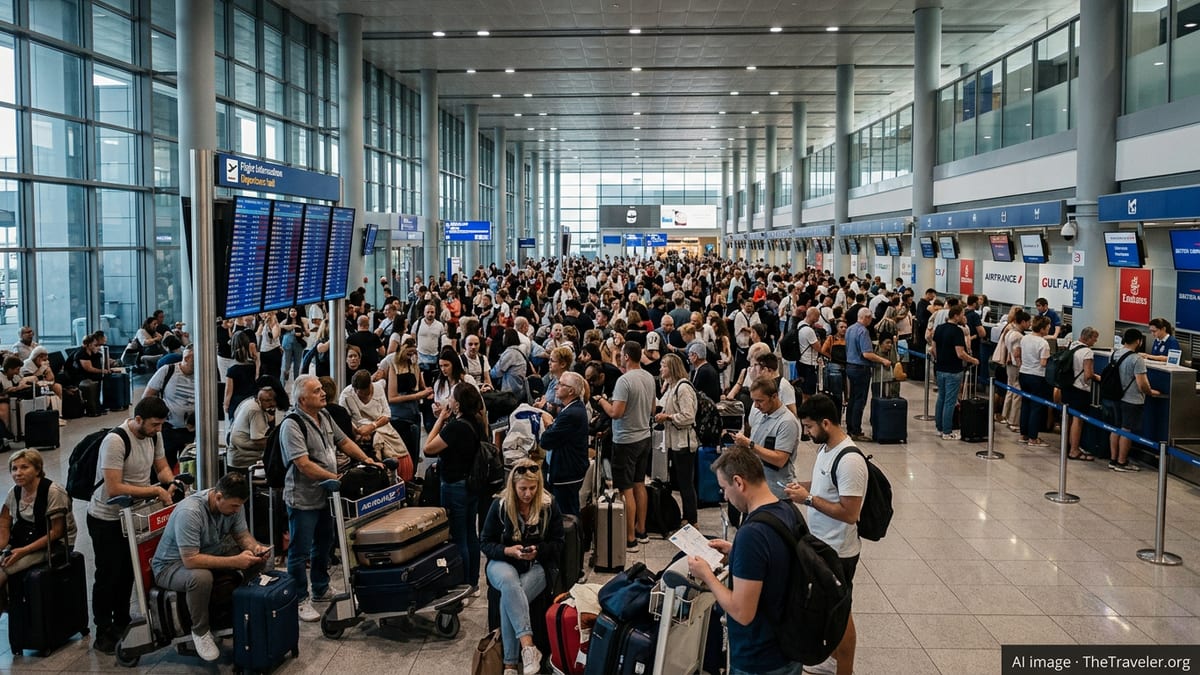
New EU biometric checks collide with peak summer travel
The European Union’s Entry/Exit System, a large-scale biometric database for non-EU nationals entering and leaving the Schengen area, moved from testing to full operation this spring. The change means many travelers to Greece now face fingerprinting and facial scans in addition to standard passport checks, adding extra minutes to each border inspection at already busy airports.
Airports across Greece, including key holiday gateways such as Athens and Santorini, have been updating passenger guidance to explain that all third country nationals must be enrolled into the new system on arrival and departure. Public information from Greek airports indicates that data capture is being phased in across border points, with full use of the system required by EU deadlines and subject to local operational decisions.
Although the technology aims to strengthen border security and track short-stay visits more accurately, initial reports from travelers suggest that implementation has not kept pace with summer demand. The combination of new equipment, staff training needs and heavy passenger volumes has produced longer queues at passport control, particularly for non-EU visitors heading home after holidays on the Greek islands.
Travel industry coverage across Europe has highlighted concerns that the Entry/Exit System could strain airports that were already operating close to capacity. Aviation groups and passenger advocates had warned that if border facilities were not fully staffed and tested before the main holiday season, queues could spill into departure halls and push more travelers into the risk zone for missed flights.
Reports of missed flights and stranded Ryanair passengers
Against this backdrop, Ryanair travelers using Greek airports have shared accounts of missed departures after spending long periods in queues for the new checks. Social media posts and online forums include reports from passengers who say they arrived several hours early, only to be held up at passport control and then refused boarding once the gate had closed.
Some accounts describe confusion over where to queue for biometric enrollment, with non-EU travelers directed between different lines as staff tried to manage a mixture of first-time EES registrations and regular checks. By the time passengers cleared the bottleneck, they found that boarding for their Ryanair flight had ended, leaving them to rebook at their own expense or seek later flights from other airlines.
Consumer advice shared online notes that such situations fall into a grey area under EU air passenger rules, because boarding is typically denied on the grounds of late arrival at the gate rather than a schedule change by the airline. Travelers attempting to claim compensation or refunds have been encouraged to keep documentation showing their time of arrival at the airport and any evidence of exceptional delays in border control.
While these cases appear scattered across different Greek airports, they follow a pattern seen in other countries where the Entry/Exit System has been rolled out at busy hubs. Delays at border points can quickly cascade, especially at terminals dominated by low cost carriers that work to tight turnaround times and short boarding windows.
Ryanair’s hard line on departure times intensifies disruption
Ryanair’s operating model is built around punctual turnarounds and high aircraft utilization, leaving little flexibility at the gate. Recent coverage of the airline’s policies indicates that it does not plan to delay flights for passengers caught in lengthy EES queues, stressing that travelers are responsible for reaching the gate before boarding closes, regardless of conditions at passport control.
Guidance from European airports, including Athens, similarly warns that late arrival at the gate may result in denied boarding, and urges travelers to allow extra time at busy periods. Combined with Ryanair’s focus on on-time performance, this approach effectively shifts the risk of border-control disruption onto passengers, even when delays stem from the new EU system rather than from their own planning.
Aviation commentary notes that this tension is particularly acute in leisure markets such as Greece, where flights often cluster into narrow evening peaks and many passengers are unfamiliar with local airport layouts. When queues for biometric checks surge, there may be little slack in the schedule to recover, and low cost flights can close doors even as stranded travelers rush through security and border control.
Industry observers also point out that Ryanair has limited spare capacity to re-accommodate passengers at short notice from Greek holiday destinations, especially on routes with infrequent frequencies. This can turn a single missed flight into an overnight stay or a costly re-routing via multiple connections, compounding frustration for those affected.
Patchwork implementation in Greece fuels confusion
The roll-out of the Entry/Exit System across Europe has not been uniform, and Greece has taken a nuanced approach as pressures mounted in early May. Travel industry reports indicate that Greek authorities, along with Italy and Portugal, moved to temporarily soften or slow aspects of the new checks at some border points after technical problems and long queues emerged during the first weeks of operation.
According to sector analysis, these measures allowed some travelers to enter without immediate biometric capture when congestion became severe, with data collection to be completed at a later stage. While this reduced the worst of the lines at certain airports and ports, it also contributed to a perception of inconsistency, as passengers encountered different procedures on different days or routes.
Ryanair has publicly contrasted this more flexible stance in parts of southern Europe with stricter enforcement elsewhere, arguing that a synchronized pause in full EES implementation would be preferable to a patchwork of exemptions. The airline has cited the risk of exactly the type of disruption now emerging in Greece, warning that partial suspensions and local exceptions may confuse travelers who expect a single set of rules across the Schengen area.
Meanwhile, local airport information in Greece continues to emphasize that EES obligations remain in place and will be fully applied by the EU’s target dates. For passengers, that means the burden of navigating a shifting landscape of biometric checks, traditional passport queues and airline boarding deadlines, often with little real-time communication about what to expect on the day of travel.
Pressure grows for clearer guidance and stronger passenger protections
The episode is unfolding as EU institutions finalize an update to air passenger rights legislation, which aims to clarify compensation rules and end certain controversial airline practices. Consumer organizations have welcomed moves to uphold compensation for long delays and to restrict tactics such as penalizing passengers who miss an outbound leg of a return ticket.
However, the current wave of disruptions related to the Entry/Exit System raises questions about how the revised framework will treat cases where travelers miss flights because of state-run border processes rather than airline decisions. Legal experts following the negotiations note that there is still limited explicit guidance for situations in which systemic issues in airport or border operations collide with strict carrier departure policies.
Travel advocates argue that clearer communication is urgently needed, both from airlines and from airport operators, so that passengers understand how early they should arrive in the EES era and what recourse they have if biometric queues make it impossible to reach the gate on time. Some are calling for coordinated messaging across the Schengen area, instead of fragmented advice issued airport by airport.
For now, those heading home from Greek holiday hotspots on Ryanair flights are being urged by public information sources and travel advisers to allow substantially more time than in previous summers, particularly if they are non-EU nationals subject to first-time biometric registration. Until the new border system beds in and airlines adjust their operations, the risk of further scenes of stranded passengers is likely to remain high.