


Denver might be the front door to some of the most expensive ski resorts in North America, but it is also within easy reach of several genuinely affordable mountains. For budget-conscious skiers and riders, the key is to balance lift ticket prices with fuel, parking, rentals and food, then match that to how much terrain and atmosphere you actually need. As of November 2026, here is how the best-value ski areas within roughly 2 to 2.5 hours of Denver stack up, and how to plan a cheap day or weekend around them.
Get the latest updates straight to your inbox!
How Budget Skiing Near Denver Really Works
When you are trying to ski on a budget out of Denver, the biggest variable is not just the lift ticket. A day at a big I-70 resort can include higher fuel costs from a longer drive, paid parking, premium food prices and sometimes pricier rentals. Smaller, closer areas often save money on several of those items at once, even if their single-day ticket is not dramatically cheaper. That is why serious value hunters look at total door-to-door cost, not just the advertised “from” price on a website.
In practical terms, most budget-focused skiers based in Denver are choosing between closer, modestly sized hills such as Echo Mountain, Eldora and Loveland, and larger yet still comparatively value-oriented choices like Arapahoe Basin, Ski Cooper and Monarch Mountain. All sit within roughly 2 to 2.5 hours of Denver in typical winter driving, before any traffic or storm delays. On weekends and holidays, congestion on Interstate 70 or on the Boulder Canyon and Peak to Peak routes can significantly extend these times, so realistic planning means leaving very early and building in a cushion.
Prices mentioned here are based on publicly listed 2025–26 or 2026–27 season information where available and are intended only as representative ranges. Each mountain uses dynamic pricing or advance-purchase incentives, so travelers should always check current offers before committing to a date. Still, the relative differences between these areas rarely change much from one season to the next, which means you can use these comparisons as a solid starting point.
Loveland Ski Area: Classic Value on the Continental Divide
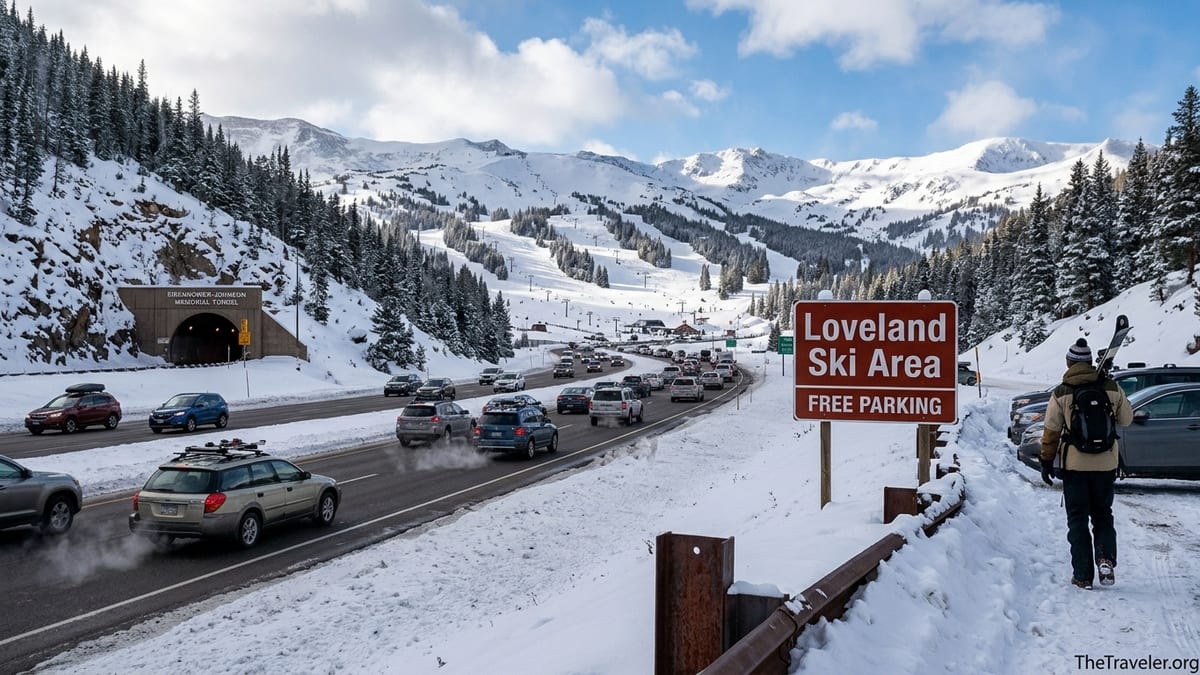
Loveland Ski Area sits beside the Eisenhower Tunnel about 53 miles west of Denver on Interstate 70, with typical winter drive times in clear conditions of about 1 hour to 1 hour 20 minutes from central Denver. It is often one of the first in Colorado to open and among the last to close, which helps if you are targeting cheaper early or late season dates. A major perk for budget travelers is that Loveland widely advertises free parking right at the base, so you avoid the garage and shuttle charges that add up quickly at big resorts.
Loveland’s single-day lift tickets use a variable pricing model and tend to be cheaper when bought online in advance. While exact figures shift, recent adult day tickets have often landed in the roughly 100 to 130 dollar range on busier midwinter days, with lower prices midweek or early and late season. The mountain also regularly offers a “Lift + Lunch” or package-style promo and is known for local-friendly passes and four-pack products that drive the per-day cost significantly lower for repeat visitors.
Transportation is another value angle. Loveland partners with a bus operator to offer a round-trip bus from Denver bundled with an adult lift ticket for a single combined price, recently advertised around the mid-100-dollar range for the 2026–27 season. That can be cost-effective for solo travelers who do not want to rent a car, especially once you factor in winter driving stress and the Colorado traction law that requires appropriate tires or chains on I-70 between roughly September and May during certain conditions. For those learning to ski, Loveland generally runs lesson and rental packages that can be cheaper than the big resorts, though availability and exact pricing vary by date.
Echo Mountain: Night Skiing and Short Drives on a Tight Budget
Echo Mountain markets itself as the closest ski area to Denver, sitting near Idaho Springs with a typical winter drive of about 50 minutes to 1 hour from downtown in good conditions. The road in can be snowy or icy during storms, but when it is clear you spend less time and fuel on the highway than any other mountain on this list. For affordable half-day or after-work laps, its evening hours can be a major budget advantage because you avoid peak-hour I-70 traffic and pay for a shorter session.
Echo’s pricing structure is straightforward but dynamic. A full-day lift ticket, valid from open until close including night skiing, is sold directly through the resort at fluctuating online rates; recent advance-purchase examples place many adult days in the ballpark of 70 to 110 dollars, with the lowest prices on off-peak weekdays. Night-only tickets are often substantially cheaper, and recent online pricing examples have placed adult night tickets notably below the full-day rate and youth tickets as low as around 30 dollars when purchased in advance. Parking at Echo is typically free, and the compact base minimizes the time you spend walking or riding shuttles.
There is no regular public bus service from Denver to Echo, so you will need a car or a rideshare, which can be cost-effective if split among friends. Rental packages are available on-site, although currently they are generally valid for daytime use only and not for the night session. Echo participates in value-oriented programs such as the Indy Pass and Colorado Ski Country GEMS products, which can make multiple visits much cheaper if your dates align. For those learning on a budget, Echo often promotes learn-to-ski and ride offerings tailored to first-timers, and the smaller terrain footprint can feel less intimidating and easier on the wallet.
Eldora: Bus-Accessible Local Mountain near Boulder
Eldora sits above Nederland, west of Boulder, and is popular with Front Range locals who want to skip long I-70 drives. From central Denver, typical winter driving in reasonable conditions runs about 1 hour 30 minutes to 1 hour 45 minutes via US 36 to Boulder and then up Boulder Canyon. Traffic or weather can extend that significantly, but compared with the Eisenhower Tunnel corridor, you avoid some of the worst weekend bottlenecks. Parking at Eldora requires attention: in recent seasons the resort has managed demand with reservation systems and, on peak days, paid or tiered parking, so budget travelers should factor this into total trip cost.
One of Eldora’s biggest budget advantages is the Regional Transportation District (RTD) “NB” bus route from Boulder to Nederland, operating regular service on weekdays and weekends as of fall 2026. With a local or regional Day Pass priced in the single digits for adults, it is possible to travel from Denver to Boulder on rail or bus, then transfer to the NB route for a very manageable fare. Once in Nederland, a short connecting shuttle or carpool can reach the mountain. For solo skiers or anyone without a vehicle, this can be significantly cheaper than renting a car for a full day.
Eldora uses dynamic pricing for alpine lift tickets, with adult day passes varying by date and when you buy. While exact 2026–27 prices move around, many midweek adult days have recently fallen roughly in the 100 to 140 dollar range when purchased early online, with weekends and holidays trending higher. The resort also sells season passes and multi-day products that can be excellent value for those planning several visits. Learn-to-ski packages, especially midweek and early season, often bundle lift, lesson and rentals at a relative discount, so first-timers should check current offers rather than buying items separately.
Arapahoe Basin: Higher Ticket, Strong Value for Frequent Visitors
Arapahoe Basin, often called A-Basin, sits a little beyond Loveland on I-70 near the base of Loveland Pass. Typical winter driving times from Denver are around 1 hour 30 minutes to 1 hour 45 minutes in clear conditions, but a combination of tunnel traffic and resort congestion can stretch that on busy Saturdays and powder days. Parking at A-Basin includes both free and paid options, with premium or close-in lots sometimes carrying a charge while more distant lots remain free, so ultra-budget skiers will usually accept a longer walk in order to avoid fees.
In recent seasons, A-Basin has shifted deliberately away from big multi-resort passes toward its own season and multi-day products. Single-day lift tickets purchased last minute at the window tend to be among the higher on this list, but three, four or five-day “anytime” passes and local season passes can bring the per-day cost down considerably when used fully. For example, promotional material for the 2026–27 season emphasizes that these multi-day products “save big over lift ticket prices” while including flexible, no-blackout access.
For budget-conscious skiers, this makes A-Basin more compelling as a repeat destination than a one-off window purchase. Those staying in Summit County could combine a car-based trip from Denver with a night or two in town, using an A-Basin multi-day product to maximize value across a long weekend. While not the cheapest single-day option, A-Basin’s terrain, views and long season can justify a slightly higher ticket when you factor in the quality of experience, particularly if you enjoy steeper terrain and a strong local atmosphere compared with mega-resorts.
Ski Cooper and Monarch Mountain: Cheaper but Longer Drives
Ski Cooper, near Leadville, and Monarch Mountain, on Monarch Pass west of Salida, both sit at the outer edge of what many travelers consider a reasonable day trip from Denver. In typical winter conditions, each is roughly 2.5 to 3 hours of driving one way, and that can increase with snow or slow traffic on mountain passes. That said, their reputations for affordable tickets, free parking and low-key vibes make them appealing for budget-minded skiers willing to log the extra miles.
Ski Cooper promotes itself as one of Colorado’s best values, keeping lift ticket pricing simple and often avoiding aggressive holiday surcharges. Public information for the 2026–27 season emphasizes that the online and window price for day tickets is the same, which can be a relief if you prefer last-minute decisions. While exact numbers vary by age and date, adult lift tickets at Cooper are commonly positioned noticeably lower than the big I-70 resorts, and the area backs that up with free parking and generally modest rental and lesson pricing.
Monarch Mountain similarly leans into an old-school, affordable identity. The mountain confirms that parking is free and does not require reservations, which removes a cost that has become increasingly common elsewhere. Publicly listed information highlights that there are no public shuttles to Monarch; the resort encourages carpooling, and during the core season it operates employee and local commuter transportation rather than an open ski bus network. Recent third-party data for 2025–26 places adult day lift tickets significantly below the highest-priced Colorado resorts, and direct resort material shows four-pack products and reload discounts that can bring the per-day cost down for those who plan ahead.
Both areas are best suited to budget skiers planning a winter weekend rather than a single-day out-and-back. Lodging in Leadville, Salida or nearby communities can be more affordable than major resort towns, and food, rentals and incidentals are often lower as well. By staying two or three nights and skiing multiple days, you spread the long drive and fuel cost over more time on snow.
Comparing Total Day-Trip Costs to Big Resorts
To understand why these smaller and mid-sized areas often win on value, it helps to compare a realistic day-trip budget from Denver against a larger I-70 destination such as Breckenridge or Keystone. At the big resorts, adult single-day lift tickets bought close to the visit date can easily exceed 200 dollars in midwinter. Add to that potential paid parking, higher on-mountain food prices, and sometimes more expensive rentals or lessons, and a solo weekend-day visit can push well beyond 350 to 400 dollars before lodging.
By contrast, a weekday at a closer value mountain might include an online adult ticket in the 80 to 130 dollar range at places like Echo, Loveland or Eldora, or a similar or slightly lower figure at Ski Cooper or Monarch. Parking is often free, especially at Loveland, Echo, Ski Cooper and Monarch, and food prices in smaller lodges or nearby towns are generally more modest. Rentals and learn-to programs are also often cheaper at these less famous hills, although frequent skiers will save most by buying used gear or seasonal rentals in Denver.
Terrain and amenities are where big resorts fight back. Breckenridge or Keystone may offer far more lifts, modern gondolas, large beginner zones and expansive intermediate terrain. They also provide extensive dining, shopping and non-ski activities that can matter to families or mixed-ability groups. That means there are times when paying more truly buys you additional value in the form of comfort and variety. The key is being honest about what your group actually needs. For confident intermediates who just want to rack up laps, the smaller areas can offer as much effective skiing time for far less money.
Sample Budgets: Solo Skier and Family of Four
To illustrate how this plays out, consider a midweek day trip from Denver in January 2027, using approximate current-season ranges. For a solo adult heading to a value destination like Loveland or Echo, assume an advance-purchase adult lift ticket of around 100 dollars, fuel cost of about 25 dollars for a round trip in a reasonably efficient car, free parking, and 40 dollars for rentals if needed. Pack simple food from home and budget 15 dollars for a coffee and snack at the lodge. That puts the day around 180 dollars with rentals or roughly 140 dollars if you already own gear. Substituting a bundled bus plus lift ticket deal to Loveland could shift the fuel and parking portion into a single transit line item in the mid-100s total.
Now compare that with a family of four, two adults and two school-age children, spending a weekday at Ski Cooper or Monarch. Use a representative adult ticket around the low- to mid-100-dollar range and youth tickets somewhat lower; that can reasonably place lift totals near 350 to 400 dollars for the family, though actual numbers may be lower on promotional days. Add 30 to 40 dollars in fuel, free parking, and perhaps 80 to 100 dollars for rentals if two family members need full gear while others own equipment. Pack sandwiches, snacks and drinks to avoid most lodge dining, but plan on 40 to 60 dollars for a couple of treats or hot chocolates. The entire day then lands near 500 dollars, give or take, for four people.
At a large I-70 resort on a similar weekday, the same family might face lift totals exceeding 650 to 700 dollars at window rates, plus potential parking costs, higher food prices and equivalent fuel and rental spending. The gap between roughly 500 and 850 dollars or more per day is why many budget-focused families gravitate to smaller mountains. All of these figures remain estimates and depend on actual ticket calendars, gas prices, car efficiency and how aggressively you self-cater, but they give a realistic sense of the relative differences.
Denver-Specific Strategies: Traffic, Traction Law and Timing
Winter driving in Colorado always introduces risk and variability, so any low-cost plan must also be a safe one. The Colorado Department of Transportation reiterates that from early September through late May, traction requirements apply on key corridors such as I-70 when conditions warrant. Updated regulations emphasize tire condition and type, meaning that even all-wheel-drive vehicles must carry adequate tread depth or traction devices when the Passenger Vehicle Traction Law or Chain Law is active. For budget travelers, that may mean spending a bit upfront on proper winter tires, which not only keeps you compliant but also reduces the chance of expensive mishaps or tow fees.
Timing your departure and return is just as important as what mountain you pick. Leaving Denver before 6 a.m. on weekends, or around 7 a.m. on weekdays, often beats the worst of morning ski traffic, though specific congestion patterns vary by storm cycle and holidays. Coming home, many locals either leave before 2 p.m. or wait until after 6 p.m. to avoid long backups on I-70, especially on Sundays. Choosing closer areas such as Echo or Eldora can help you thread narrower traffic windows for half-day or night sessions.
Weather flexibility is another underrated money saver. Aim early-season and late-season visits at smaller hills when ticket prices are often reduced and crowds are thinner. In deep midwinter, keep an eye on storm tracks: if a major system is hammering the central I-70 corridor, it might be safer and more enjoyable to pivot to Eldora, Ski Cooper or Monarch, or to delay your day by 24 hours. Always build a margin into your return time if you are catching a flight out of Denver or need to be back for work the next morning.
Food, Gear and When Paying More Makes Sense
On-mountain dining is one of the most controllable costs. Even at cheaper mountains, cafeteria lunches and snacks add up quickly, especially for families. Denver-based skiers can cut costs dramatically by packing sandwiches, trail mix, fruit and thermoses of coffee or cocoa, then supplementing with a single purchased item on the hill. Smaller resorts are often more relaxed about tailgate lunches or quick breaks at the car, which is easier when lots are free and close to the base area.
Gear choices also have an outsized budget impact. For anyone planning more than three or four days on snow in a season, shopping local ski swaps, used-gear stores or early-season sales in Denver typically beats repeated daily rentals. Families with growing children can look into seasonal rental programs that spread the cost over months rather than single expensive days. Helmets, goggles and proper gloves are worth prioritizing for safety and comfort, even if you cut corners elsewhere.
There are still times when paying more for a larger resort is the right decision. If you are entertaining out-of-town guests who want a full-service mountain village experience, prefer extensive beginner zones with multiple magic carpets, or need plenty of high-speed lifts and terrain variety for a mixed group, then Breckenridge, Keystone or similar destinations may justify their premiums. The key is to reserve those splurge days for when you will fully use what you are buying. For routine day trips and skill-building laps, the smaller and mid-sized mountains near Denver deliver much of the same joy for a fraction of the cost.
Choosing the Best Budget Mountain for Your Trip
For ultra-cheap day trips, Echo Mountain and Loveland stand out for Denver-based travelers. Echo offers the shortest drive, free parking and relatively low night-ski pricing, which makes it ideal for after-work outings or quick weekday sessions. Loveland combines free parking and value-friendly passes with a high-elevation, long-season experience that feels close to the big resorts without the same level of cost or crowding.
For slightly pricier but still value-oriented weekend terrain, Arapahoe Basin, Ski Cooper and Monarch Mountain shine. A-Basin rewards committed skiers who buy multi-day or season products and want steeper, more challenging runs, while Ski Cooper and Monarch deliver traditional, family-friendly skiing at lower daily price points in exchange for longer drives. Eldora fills a special niche for those leaning on public transport, thanks to RTD’s Boulder to Nederland service and relatively easy access from the Denver metro area without a car.
Ultimately, the right choice depends on your priorities. If your main goal is to maximize vertical for the lowest possible cost, prioritize free parking, short drives and midweek or night-ski visits at Echo or Loveland. If you want relaxing, low-key weekends with cheaper lodging and food, look toward Ski Cooper and Monarch. And if you occasionally crave big-resort amenities and variety, plan one or two carefully chosen days at the larger I-70 destinations, but let Denver’s value mountains carry the bulk of your season. With smart timing, solid traction, and a packed lunch, world-class Colorado snow can fit far more comfortably into a real-world budget.