


Since the EU’s Entry/Exit System (EES) went live in October 2025 and progressively rolled out through 2026, travelling by ferry between the UK and France has felt very different for many British passport holders. Long familiar passport stamps are being replaced by digital records and biometric checks, and new procedures are now in place at ports like Dover, Calais and Dunkirk. This guide explains in clear, practical terms what UK-based travellers can expect on the main ferry routes, how the EES works in practice, and how to prepare so your journey runs as smoothly as possible.
Get the latest updates straight to your inbox!
What the EU Entry/Exit System Is – and How It Affects UK Travellers
The EU Entry/Exit System is a large-scale digital border system used at the external borders of the Schengen area. For short-stay visitors who are not EU, EEA or Swiss citizens, including most UK passport holders after Brexit, it replaces manual passport stamping with an electronic record each time they enter or leave the Schengen zone. The system automatically counts stays against the familiar rule that allows up to 90 days of visit in any rolling period of 180 days.
When you cross an external Schengen border in person, a border guard uses the EES to check your identity, record your entry or exit, and verify whether you still have days available under the 90/180 rule. In most cases this removes the need for visible passport stamps. The system is focused on short-stay visits for tourism, business trips or family visits. It is separate from visas and from residence rights, although the same traveller might be in other EU databases if they hold a long-stay permit or visa.
It is important to distinguish the EES from ETIAS. ETIAS will be a pre-travel authorisation system that certain non-EU travellers will have to obtain online before they are allowed to board transport to the Schengen area. As of late 2026, ETIAS is not yet operational and no applications are being accepted. The EU has said it will announce a specific start date several months before launch, so travellers should check official information shortly before they sail.
The EES applies now on UK–France ferry routes and is part of routine French border checks. If you are used to simply showing your passport at Dover or Calais, the main change you will notice is the extra time needed at your first EES registration, when biometric data is taken and entered into the system.
What Data EES Collects and How Long It Lasts
At your first EES registration, border guards collect basic identity details from your passport, a facial image, and four fingerprints. The EU describes this as core biometric and travel information: your full name, date of birth, passport number and expiry date, together with a digital photograph and scans of four fingers, normally taken on an electronic scanner at the border. The system then creates an individual file that will be used for future border crossings.
Each time you enter or leave the Schengen area, the EES records the date, time and place of crossing and links that record to your file. Over time this creates a history of your short-stay trips, which border guards can use to confirm that you have not exceeded the authorised stay and to spot any previous overstays. For most straightforward visitors, the data is used mainly to automate the 90/180 calculation and speed up repeat entries.
Official information from the EU and several national border agencies indicates that a traveller’s EES file remains valid for roughly three years of inactivity, after which a fresh registration and biometric capture may be required. Data retention rules in the EES regulation state that entry and exit records are kept for three years for travellers who respect their permitted stay, and for longer periods if someone has overstayed. Because there are detailed and occasionally updated derogations and special cases, readers should always confirm the latest retention and re-enrolment rules on official EU or national border websites before travelling.
Children are treated slightly differently for biometrics. Under the EES rules, fingerprints are not taken from children under 12, although there is no lower age limit for facial images. In practice this means that a younger child will have a photograph taken but will not be asked to place their fingers on a scanner, while teenagers and adults will give both face and fingerprints.
Where EES Happens on UK–France Ferry Routes
The UK and France operate “juxtaposed controls” at several cross-Channel ports. This means that border checks for entry into one country are carried out on the other country’s soil before boarding. For EES purposes, that arrangement is crucial, because it determines where French officials capture biometrics and create or update EES records for travellers heading to or from France.
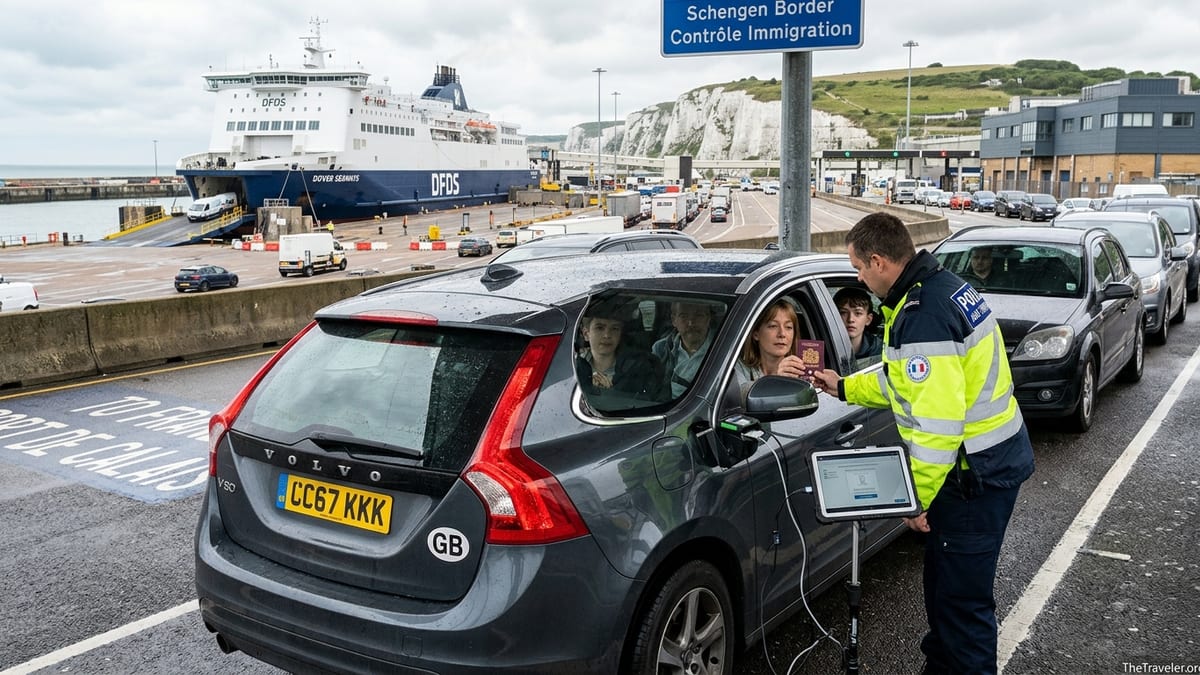
On Dover to Calais and Dover to Dunkirk ferries, French border police carry out Schengen entry checks in Dover itself before you board a France-bound ship. When you arrive in Calais or Dunkirk, you normally drive or walk straight off the ferry without further immigration checks. For UK-bound journeys on the same routes, the French exit check and EES recording take place in Calais or Dunkirk before you embark for Dover, while UK immigration controls are often done on French soil as well.
On routes such as Newhaven to Dieppe or Portsmouth to Caen, the pattern is similar, but the details vary by port. At some smaller ports, French checks for France-bound travellers are handled in the UK terminal building with relatively simple flows, while UK-bound checks occur in the French port area at the usual outbound car, coach and foot passenger facilities. Because the layout of each port is different and operators have been adapting to EES in phases, travellers should look at the latest guidance issued by the ferry company and port for their specific route.
Implementation has not been uniform. At Dover, for example, the new dedicated EES facility for coaches and foot passengers in the Western Docks opened in October 2025, while processing for car passengers at the Eastern Docks has been introduced progressively. In the early months of 2026, French border police focused on creating electronic records and sometimes took biometrics in a more manual way at existing booths while long-term solutions for car flows were still being optimised. Arrangements continue to evolve and may differ at busier holiday periods, so it is essential to check up-to-date local instructions.
Step-by-Step: UK to France by Ferry Under EES
For foot passengers travelling from the UK to France on routes such as Dover to Calais, the basic sequence is: check in with your ferry operator, pass through security screening if required, and then proceed to the French border area where EES checks are carried out. At Dover, foot and coach passengers are now directed first to a dedicated facility in the Western Docks, where they disembark from coaches or arrive on foot and use biometric kiosks supervised by French border police. You can expect to have your passport scanned, your face photographed and, if this is your first EES registration, four fingerprints taken.
After completing the kiosk steps, you will normally see a French border guard who verifies your details on screen, may ask a few routine questions about your trip and confirms your entry in the system. Once cleared, you return to the general departure area or re-board your coach and then proceed to board the ferry in the usual way. For repeat travellers whose biometrics are already on file and whose stay record is straightforward, the process may be quicker, although you can still be called to a counter for additional checks.
Car passengers at Dover generally follow the familiar route through the Eastern Docks. After check-in, vehicles are assigned to lanes and directed towards French border booths. During the progressive roll-out of EES in 2026, French officers at these booths have sometimes created or updated EES files using their own equipment rather than dedicated kiosks, and biometrics for car occupants have been taken in a phased manner. Some facilities are designed so that passengers may briefly step out in a controlled area to use kiosks, while in other cases officers use tablets to capture data through the car window. Because these arrangements have been subject to temporary workarounds and technical constraints, travellers in cars should assume that first-time EES registration may add noticeable time at the French booth and should check current instructions from the port and their operator.
Coach passengers from the UK to France are among those most affected by EES. At Dover, coaches are required to call first at the Western Docks facility, where all passengers disembark and pass through a hall equipped with multiple kiosks and staffed French border counters. Here, each passenger completes their EES steps and has their passport checked before returning to the coach. Only once the coach has cleared EES and French border control does it head over to the Eastern Docks terminal to join the boarding process. Coach operators have been issued detailed route maps and timing advice, and they in turn often ask passengers to arrive earlier at the original departure point to absorb the extra processing time before the ferry.
Step-by-Step: France to UK and Exit EES Checks
On France to UK journeys, EES applies when you leave the Schengen area. For foot passengers in ports like Calais or Dieppe, the usual process is to check in with your ferry company, then proceed through the French departure controls. French border police record your exit from Schengen in the EES, usually at staffed counters without a separate biometric kiosk stage if your biometrics are already on file. If this is your first time leaving since EES started and your entry was recorded manually or under a temporary exception, you may be asked to provide your biometrics as part of regularising your record.
After French exit checks, UK border controls typically take place in the same French port area before boarding, under the juxtaposed controls arrangement. From a passenger perspective, the main difference from pre-EES days is that the French part of the process can take longer if a large number of travellers still need full biometric registration, particularly at peak holiday times.
Car passengers driving from Calais or Dunkirk to the UK usually pass French exit booths before UK checks. While EES technically requires biometric verification when leaving as well as entering, French authorities have some flexibility during the progressive start period that began in October 2025. Early in the roll-out, they focused primarily on recording exits using passport scans and matching these to existing records. Where biometric kiosks for car passengers are in full operation, occupants may again be asked to step out briefly in a controlled area to confirm their identity at a kiosk if necessary, though many routine exits for previously registered travellers are processed at the booth without additional steps.
Coach passengers leaving France for the UK are guided through dedicated coach processing areas in ports such as Calais and Dunkirk. In many cases, passengers disembark and pass through a combined EES and border control hall before re-joining the coach, similar to the procedure at Dover but arranged for exit checks. Because group flows are more complex, coach operators are strongly advised to build in additional time when planning schedules. Passengers should follow the instructions given by staff on the ground and be prepared for queues, especially during school holidays and summer weekends.
Who EES Applies To – And Who Is Exempt
The EES covers most non-EU, non-EEA and non-Swiss nationals entering the Schengen area for a short stay of up to 90 days in any 180-day period. This includes UK passport holders who do not have EU or Schengen residence status, as well as visitors from countries like the United States, Canada, Australia and many others. Whether you are visa-exempt or hold a short-stay Schengen visa, you are generally registered in the EES when you cross the external border in person.
EU, EEA and Swiss citizens are not registered in the EES when travelling on their own valid national passports or identity cards. Their right of free movement is handled under separate rules. Similarly, third-country nationals who hold certain long-stay visas or residence permits issued by a Schengen country may not be processed as short-stay visitors at the external border and therefore may not have their usual border crossings recorded in EES in the same way.
There are important edge cases. Family members of EU citizens who are themselves third-country nationals, and dual nationals who hold both an EU and a non-EU passport, may fall under different provisions depending on which document they use and whether they hold residence cards. Some travellers with local border traffic permits or specific professional statuses can also have special arrangements. Because these categories can be complex and are sometimes updated, anyone who is not a straightforward visitor on a single nationality passport should consult current guidance from the relevant border authorities or consulate well before travel.
For the typical British holidaymaker taking a short break in France, however, the rule of thumb is simple: if you do not travel on an EU, EEA or Swiss passport and you are visiting for 90 days or less within any rolling 180 days, you will go through EES at the French border on your ferry route.
Documents, Preparation and the 90/180 Rule
For ferry travel from the UK to the Schengen area, your primary document is a valid passport. The Schengen rules generally require that your passport is less than ten years old on the date you enter and has at least three months of validity remaining after the date you plan to leave the Schengen zone. In practice, travellers are strongly advised to travel with significantly more than the bare minimum validity to avoid disputes at check-in or at the border, and to ensure they can cope with any unplanned extensions to their trip.
While EES digitises entry and exit records, it does not remove the underlying requirement to be a genuine visitor. French border police can still ask for evidence that you meet the conditions for entry, especially on your first EES registration or if your travel pattern appears close to the 90/180 limit. You may be asked to explain your itinerary, show proof of accommodation such as hotel bookings or an invitation from a host, and demonstrate that you have sufficient funds for your stay. Having printed or easily accessible digital confirmations on your phone can help keep the process smooth.
To show that you will respect the 90/180 rule, keep a simple record of your trips to the Schengen area, especially during the early years of EES when not all ports may yet be fully automated for all passenger types. You can, for example, note down the dates you enter and leave France and other Schengen countries or keep boarding passes and booking confirmations. While border guards now have an electronic history to consult, being able to explain your travel pattern clearly can quickly resolve any questions.
Above all, allow extra time. Ports like Dover and Calais have repeatedly warned that biometric registration and data checks can increase processing times, particularly during busy holiday periods or when technology issues arise. Some ports and operators advise arriving at least two hours before scheduled departure for foot passengers and cars, and coach groups are often told to build additional buffers into their schedules. Exact waiting times vary hugely with the day, time and operational conditions, so treat any estimates as guidance rather than guarantees.
Looking Ahead: How EES Will Work With ETIAS
In the coming years, many British and other non-EU travellers will need both a valid passport and an approved ETIAS authorisation to travel to the Schengen area, in addition to being registered in EES at the border. ETIAS is planned as a pre-travel security and risk assessment system, similar in concept to the United States ESTA, but managed at EU level. Travellers will apply online, receive a decision electronically and need to hold a valid authorisation before boarding a ferry or other transport bound for the Schengen zone.
As of November 2026, however, ETIAS is not yet in operation. The official EU ETIAS information states that no applications are currently being collected and that a formal start date will be announced publicly several months in advance. This means that, for now, ferry operators and border guards do not check for ETIAS approvals and rely instead on traditional checks and the new EES when handling UK–France traffic.
Once ETIAS goes live, ferry passengers can expect a two-stage compliance picture: first, they will need to have a valid ETIAS authorisation linked to the passport they intend to use for travel, which may be checked at booking or at check-in; second, they will still go through EES registration and verification at the French border on departure and return. The two systems are designed to complement each other, with ETIAS providing advance screening and EES providing accurate records of actual border crossings.
Because both systems are still subject to refinement and have already seen delays, anyone planning cross-Channel travel in future seasons should check official EU and national information shortly before their journey. Relying on older assumptions about dates, fees or exemptions is risky in such a fast-evolving policy area.
Key Questions for Ferry Passengers
Many UK-based travellers have practical concerns about the EES process on ferries. Refusal of entry is one of the most serious. If French border police at Dover or in a French port decide that you do not meet the conditions for entry – for instance, because you cannot explain your plans, lack necessary documents or have clearly exceeded the 90/180 rule – they can refuse you entry. This decision is recorded in the EES, and you will normally be required to return to the UK on the next available sailing. Such refusals can make future trips more complicated, so it is vital to present your situation clearly and honestly at the first attempt.
Parents often ask about children. Under the EES, facial images are collected from children of all ages, but fingerprints are only required from those aged 12 and above. In practice, younger children will be guided to look into a camera at a kiosk or desk but will not be asked to use fingerprint scanners. Families should be prepared to help younger children follow instructions and may wish to talk them through what will happen in advance to reduce anxiety.
Another common concern is data protection. The EES regulation and related EU documents set detailed rules on how long data is kept, who can access it and for what purposes. For most short-stay visitors, entry and exit records are kept for three years from the date of exit or any refusal of entry. If a traveller overstays, their data can be retained for longer, up to five years in certain cases. Data is stored in a central EU system managed by the agency responsible for large-scale IT systems, and national border and immigration authorities have controlled access for specified purposes such as border checks and law enforcement. Travellers who have questions or wish to exercise data rights can consult privacy notices from the relevant national authority.
Some travellers who liked collecting passport stamps wonder whether they can still ask for one. In general, the move to EES means that manual stamping is no longer the standard for third-country short-stay visitors, and border guards are encouraged to rely on the electronic record. In practice, some officers may still stamp passports during the transitional period or in specific situations, but you should not depend on receiving a stamp to evidence your travel history. The electronic EES record is what matters for calculating days stayed.
Passengers with disabilities or reduced mobility should inform their ferry operator and, where possible, the port in advance of their needs. EES processing at kiosks can involve standing, reaching scanners and following on-screen prompts, which may be difficult for some travellers. Ports and border agencies have been working on assisted-service lanes and staff-supported procedures so that passengers who cannot easily use kiosks can complete their registration with the help of an officer at a desk. If you think you might need such assistance, arrive early, bring any documentation of your condition that might help explain your needs, and speak to staff as soon as you enter the terminal area.
Conclusion: What UK–France Ferry Travellers Need to Remember
The EU Entry/Exit System has transformed how short-stay visits from the UK to France and the wider Schengen area are recorded. For most ferry passengers, the key changes are the introduction of biometric registration, the shift from passport stamps to digital records and the increased time required at the border, especially on the first trip since EES became operational in October 2025. Understanding where checks happen, particularly under the juxtaposed controls system at Dover and in French ports, can help you plan your route and timing more effectively.
Before you travel, make sure your passport meets Schengen validity rules, gather simple evidence of accommodation, plans and funds, and calculate your days carefully under the 90 days in 180 rule. Expect to have your face photographed and, if aged 12 or over, your fingerprints taken at a kiosk or by a border guard, and allow enough time at busy ports such as Dover, Calais and Dunkirk for possible queues and technical hiccups.
Looking ahead, ETIAS will eventually add a pre-travel authorisation requirement on top of EES, meaning that some travellers will need to complete both an online application in advance and biometric registration at the border. Because launch dates, port procedures and temporary workarounds continue to evolve, the single most important step is to check official EU, UK government, port and ferry operator guidance in the days before your trip. Doing so will help ensure that your Channel crossing is as smooth and predictable as possible in this new era of digital border controls.