


Landing at Chiang Mai International Airport and getting your phone connected quickly can make the rest of your trip far smoother. Airport SIM counters, eSIM apps and city phone shops all compete for your first few minutes on the ground. This guide walks you through exactly what to expect at Chiang Mai International Airport in 2026, how the AIS, True and dtac-style options work after the True–dtac merger, what you will roughly pay, and how to decide whether to buy at the airport or wait until you reach town.
Get the latest updates straight to your inbox!
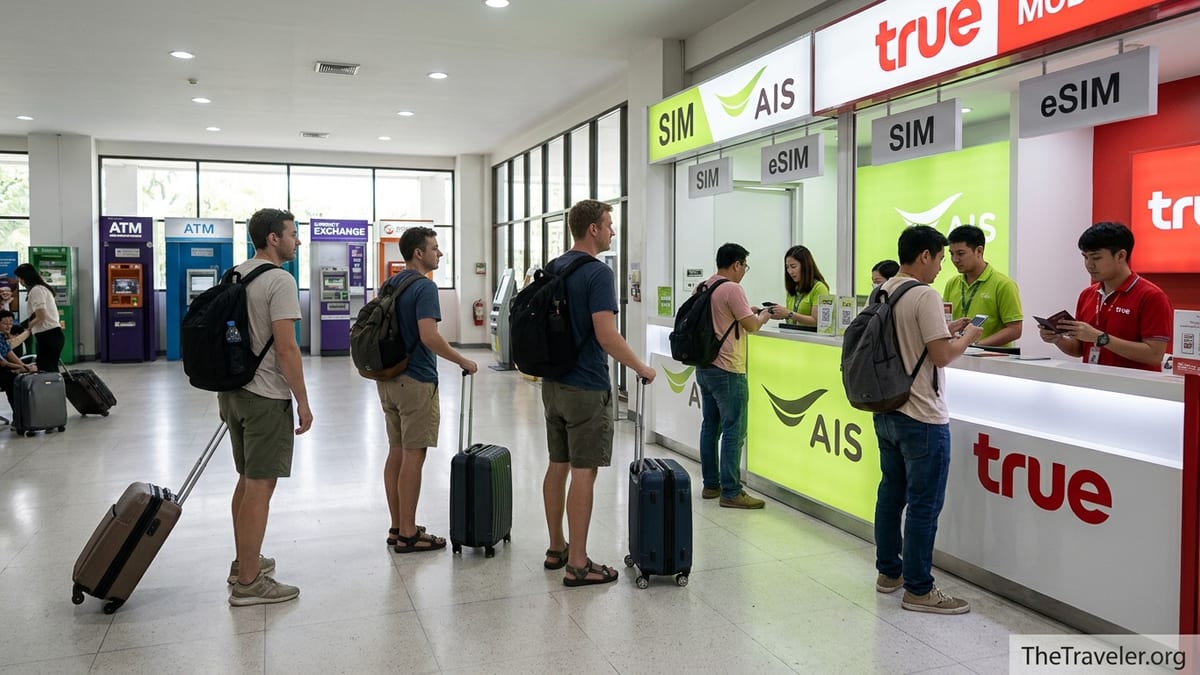
What to Expect on Arrival at Chiang Mai International Airport
Chiang Mai International Airport (airport code CNX) is compact, with both domestic and international flights handled in a single terminal building. Arrivals and check-in are on the ground floor, while departures and gates are upstairs. After your flight lands you will clear immigration, collect your bags and pass customs before you reach the public arrivals hall, where you will find ATMs, currency exchange desks and mobile operator counters clustered in a relatively small space.
As of mid 2026, travelers report that all three major Thai networks are represented here: AIS, True and dtac-branded offerings are sold at staffed counters on the arrivals level, typically open from morning until late evening. Some signage now reflects the True–dtac merger, so you may see True-dtac branding or separate AIS and True counters side by side. The layout can shift slightly over time, but in practice you will not need to hunt for them; once you walk out into the public area after customs, you will see bright green (AIS) and red (True / True-dtac) booths facing the flow of arriving passengers.
The atmosphere around these counters is distinctly “first stop after landing.” Staff often stand in front of the booths and call out offers like “Tourist SIM, unlimited internet” as passengers walk through. English is widely spoken, and staff are used to processing tired travelers quickly. If you already have an eSIM working, you can simply walk past. If you still rely on a physical SIM or want a Thai phone number right away, this is the most convenient point to get set up.
It is worth noting that Chiang Mai Airport does not have an airside transit zone in the same way as larger hubs, and there are no mobile counters between the gate and immigration. All the tourist SIM services are landside in the arrivals hall, so you do need to fully exit the formalities before you can buy.
Where Exactly to Find SIM Counters at CNX
For international arrivals, once you pass customs you will emerge into a single-level arrivals area. Here you will see a row of service counters along the walls: car rental desks, tour counters, money changers, and clustered among them the mobile operators. The AIS counter is usually easy to identify by its bright green color scheme and “AIS Traveller” or “AIS 5G” signage. True, which now incorporates dtac, typically uses red branding with “True 5G” or “True-dtac” marks. Some seasons also see third-party travel-agency desks reselling SIMs, but the main network counters are the safest and simplest choice.
Domestic arrivals feed into the same general hall, though depending on where your flight parks you might exit slightly further down the corridor. Even so, the terminal layout is small enough that walking a minute or two in either direction along the concourse will bring you to the mobile kiosks. If you are unsure, any airport staff member will be able to point you to “AIS” or “True” counters.
Operating hours can vary slightly with flight schedules, but most travelers arriving between roughly 8:00 and 22:00 find at least one or two counters open. Very early morning or past-midnight arrivals might encounter shuttered booths, in which case you can fall back on eSIM options or buy a physical SIM later in the city at a 7‑Eleven or mall phone shop. For peace of mind, assume the airport counters are a “day and evening” service rather than 24 hours.
Because the arrivals hall is compact, you can also take a moment to compare offers. You are not committing to anything just by stepping closer to look at the rate boards. If one counter looks busy, you can easily walk ten meters to the next one and check whether their package suits your trip better.
Tourist SIM Card Options: AIS, True and dtac-Style Plans
At Chiang Mai Airport, you are effectively choosing between AIS and the merged True-dtac when you buy a tourist SIM. Both networks offer dedicated “tourist SIM” products that bundle a physical SIM card with a fixed number of days of data and voice service. The branding may vary, but the idea is similar: you pay a flat price in Thai baht for a short-term, mostly data-focused package that is simple to understand even if you do not speak Thai.
Typical airport tourist SIMs in 2026 are in the range of roughly 300 to 450 baht for about 8 to 15 days of “unlimited” data, usually with a high-speed data cap after which speeds are throttled. For example, you might see an AIS package offering around 8 or 10 days of data at a high-speed allowance before slowing, plus some local call minutes and a small credit for international calls. True’s bundled tourist SIMs tend to be similar, sometimes adding small extras like social media data bonuses or short free periods for certain apps.
These airport bundles are rarely the absolute cheapest way to get mobile data in Thailand, but they are designed to be friction-free. You pay one flat amount, the staff set everything up for you, and you walk away with a working Thai number in less than ten minutes. For a one-week holiday built around Chiang Mai’s Old City, Nimman neighborhood and day trips to popular spots like Doi Suthep or elephant sanctuaries, that convenience is often worth paying a little more than you would in town.
If you plan to stay in Thailand for a month or mix Chiang Mai with more remote northern provinces, it can be worth thinking about a standard prepaid SIM rather than a tourist-branded one. Network shops in the city sell regular prepaid SIMs that you can then top up with monthly data packages through the provider’s app, often at lower rates than the simple airport tourist bundles. However, this approach takes more time and usually requires visiting a proper AIS or True shop, not just a small kiosk.
eSIM Alternatives: Before You Fly and on Arrival
eSIM options have improved rapidly, and by 2026 they are a realistic alternative to a physical SIM for most travelers heading to Chiang Mai. There are two broad categories. First, there are eSIMs sold directly by Thai operators such as AIS and True, which function much like their physical tourist SIMs but are delivered digitally. Second, there are international travel eSIM brands that resell access to Thai networks, often riding on AIS or True infrastructure but managed entirely through their own apps.
If your phone supports eSIM, one simple strategy is to purchase a Thailand eSIM online from a travel eSIM app before you leave home. These services typically let you choose a data-only plan for a fixed number of days or gigabytes. Prices change frequently, but as a rough guide many travelers in 2025 and 2026 report paying the equivalent of around 10 to 20 US dollars for a week or two of usable data. Once installed, these eSIMs normally activate automatically when you land in Thailand and your phone detects a local network, which means you step off the plane with working data before you even reach immigration.
Thai operators also sell their own eSIM tourist packages through their websites and sometimes at airport counters. AIS, for example, promotes tourist eSIM options that include a Thai number along with data, and True-dtac has tourist eSIM bundles that mirror physical SIM offers. In practice, some visitors find the local operator websites a bit fiddly to navigate in English, so the international travel eSIM apps remain popular. The key questions to check are which network the eSIM uses in Thailand and whether you need a local phone number for calls or ride-hailing account verification.
At the airport itself, some AIS and True counters can convert a physical SIM purchase into an eSIM profile if your phone is compatible, effectively scanning a QR code instead of inserting plastic. Staff may still describe the product as a “tourist SIM” at the counter, even if it is technically an eSIM. If you know you want an eSIM, it is worth mentioning this clearly at the start of the conversation so they can offer the correct option.
Registration, Passport Requirements and Setup Process
Thai regulations require SIM cards to be registered to an identity, which means you cannot buy an anonymous SIM at Chiang Mai Airport. Expect staff at all official counters to ask for your passport when you purchase a tourist SIM or eSIM linked to a Thai number. They will typically scan or photograph the photo page and enter your details into their registration system before activating the line.
The registration process is usually quick, often taking just a few minutes. A typical interaction at the AIS counter might look like this: you choose a package from the laminated rate sheet, hand over your passport and phone, and the staff member inserts the SIM, adjusts your phone settings if needed, and completes the registration on a tablet. Once that is done, they will show you that data is working by opening a website or mapping app on your device. For an eSIM, the main difference is that they display or print a QR code for you to scan, then help you enable the new plan in your phone’s settings.
You should assume that any SIM which includes voice and text service with a Thai number will require passport registration. Some purely data-only international eSIMs sold outside Thailand might not require your passport, as they are technically roaming profiles rather than local Thai lines. However, if you want the benefits of a Thai number, such as easier use of local banking apps, food delivery or certain ride-hailing services that rely on SMS verification, you will be going through the ID registration process at some point.
Once the SIM or eSIM is registered and working, it is a good idea to ask staff to show you how to check your remaining data or validity. Many tourists leave the counter without this information and later struggle with Thai-language USSD codes. Staff can usually demonstrate the provider’s English app on your phone or highlight a simple balance-checking code, which will save you guesswork later in your trip.
How Much You Will Likely Pay and How It Compares to the City
Prices for tourist SIM and eSIM packages at Chiang Mai Airport are intentionally kept simple and are usually higher than what a local resident would pay for the same amount of data. In mid 2026, sources tracking Thai telecom pricing commonly describe airport tourist SIMs in the 300 to 450 baht range for about 8 to 15 days of “unlimited” data with a reasonable high-speed cap, sometimes including small call and SMS allowances. Ultra-cheap short-term packages do exist, but they are more often sold in city shops or convenience stores rather than at airport tourist counters.
For comparison, travelers who skip the airport and instead buy a standard prepaid SIM at a mall-based AIS or True shop in Chiang Mai’s Central Festival or Maya shopping centers often report paying the equivalent of 200 to 300 baht for a month of data, sometimes with unlimited data at a capped speed or a generous data bundle that can be renewed through the operator’s app. A 7‑Eleven convenience store SIM, combined with a self-activated package, can also come in lower than airport tourist offerings, although staff there might not always be able to walk you through the whole setup in English.
The trade-off is clear in practice. A couple staying in Chiang Mai for just one week might walk out of the airport with two tourist SIMs at roughly 350 baht each and be fully connected in minutes. Another couple staying a month might instead use their hotel Wi‑Fi for the first night, then visit a mall the next day and sign up for regular prepaid plans, spending perhaps 500 to 600 baht total for the month for both phones but investing more time and effort. Neither approach is inherently right or wrong; it depends on your budget, schedule and comfort with arranging mobile service in a foreign language.
With eSIMs, the pricing comparison is similarly nuanced. Many travel eSIM apps sell data-only packages for Thailand that, once converted to baht, can land in a similar ballpark to airport tourist SIMs for a short stay. You might pay slightly more for the convenience of setting everything up before flying, or slightly less if you find a promotion. Where you can often save more significantly is on longer stays using local prepaid plans purchased in the city rather than short-term tourist-branded eSIMs or SIM cards.
Should You Buy at the Airport or Wait for Chiang Mai City?
Whether it is “worth it” to buy a SIM at Chiang Mai Airport is one of the most common questions among first-time visitors. The answer depends mainly on three factors: how long you are staying, how price sensitive you are, and how comfortable you feel navigating Thai mobile services in the city. The airport counters specialize in speed and simplicity, not rock-bottom pricing, and for many short trips that balance makes sense.
If you are in Chiang Mai for less than two weeks and you value immediate connectivity, buying at the airport is usually the most straightforward choice. For a 7-day trip built around walking the Old City temples, exploring Nimmanhaemin’s cafés and taking a day tour into the mountains, the difference of a few hundred baht compared with city options is small in the context of your total travel budget. You get instant access to maps for your ride into town, can message your accommodation on arrival, and do not have to carve out time in your first day to find a mall shop.
If you are staying for a month or more, or you are traveling as a family with several devices, the math shifts. In that situation, it can make sense to use your home carrier’s roaming, airport Wi‑Fi or a pre-purchased travel eSIM for the first day, then visit an AIS or True store in one of Chiang Mai’s major malls to set up regular prepaid plans at local rates. For example, a group of four digital nomads sharing a house in the Nimman area for six weeks might save a notable amount over time by avoiding repeated short-term tourist SIM packages and instead using monthly data plans configured in-store.
Another consideration is how much you need a Thai phone number. If all you really care about is data and you already use messaging apps for communication, an international data-only eSIM bought before departure may remove the need to interact with airport counters at all. You can then revisit the question of a local SIM later only if you discover that specific services, such as certain banking apps or local delivery platforms, demand a Thai number linked to your account.
The Takeaway
Chiang Mai International Airport makes it easy to get connected as soon as you land, with clearly visible AIS and True-dtac counters in the arrivals hall selling ready-to-use tourist SIMs and, increasingly, eSIM options. What you pay at these counters is higher than the most economical plans available in the city, but in exchange you gain an English-speaking setup experience and leave the airport with working data in under ten minutes.
For a typical one or two week visit focused on Chiang Mai and nearby day trips, buying a tourist SIM or eSIM at the airport is a practical, low-stress choice. You can budget in the region of a few hundred baht per person for around 8 to 15 days of usable data and light calling, hand over your passport for registration, and let staff handle the configuration. Short-term visitors often find that this convenience is worth more than the moderate savings they might achieve by waiting.
Longer-stay travelers, frequent visitors and those watching every baht can instead lean on eSIM apps or temporary Wi‑Fi for the first hours and then arrange regular prepaid plans in Chiang Mai’s malls or larger phone shops, where monthly data packages run cheaper for sustained use. In all cases, understanding the basic landscape of AIS versus True, airport tourist bundles versus city prepaid options, and SIM versus eSIM will help you choose the setup that best matches your style of travel.
Whichever route you choose, the good news is that mobile coverage in Chiang Mai and across Thailand is generally strong, with widespread 4G and growing 5G service. Once you have your SIM or eSIM in place, staying connected for navigation, translation and trip planning during your time in northern Thailand should be straightforward.
FAQ
Q1. Are there AIS, True and dtac SIM counters at Chiang Mai Airport?
Yes. As of 2026, AIS and True (which now incorporates dtac’s services) both operate tourist SIM counters in the arrivals hall at Chiang Mai International Airport, and you will see their branded kiosks shortly after you exit customs.
Q2. Do I need my passport to buy a SIM at Chiang Mai Airport?
Yes. Thai regulations require SIM registration with ID, so you will be asked to show your passport when buying a tourist SIM or Thai-number eSIM at the airport counters.
Q3. How much does a tourist SIM at Chiang Mai Airport usually cost?
Prices change over time, but many airport tourist SIM packages in 2026 fall roughly in the 300 to 450 baht range for about 8 to 15 days of data with some call allowances.
Q4. Is it cheaper to buy a SIM in Chiang Mai city instead of at the airport?
Often yes. Regular prepaid plans bought in AIS or True shops in malls like Central Festival or Maya can be cheaper over longer stays, but they require more time and setup effort than airport tourist SIMs.
Q5. Can I get an eSIM instead of a physical SIM at Chiang Mai Airport?
In many cases, yes. Some AIS and True counters can issue tourist eSIMs or convert a package to an eSIM profile for compatible phones, and international travel eSIMs bought before departure will also activate once you land.
Q6. Which network is better in Chiang Mai, AIS or True-dtac?
Both AIS and True-dtac generally provide strong 4G and expanding 5G coverage in Chiang Mai and other major Thai cities. The difference for most short-term tourists is small, so it is reasonable to choose based on the package that best fits your trip.
Q7. What if my flight arrives very late at night?
If you arrive in the middle of the night, you may find some airport counters closed. In that case you can rely on airport Wi‑Fi and, if possible, a pre-purchased travel eSIM, then buy a physical SIM the next day in town at a phone shop or 7‑Eleven.
Q8. Will a Thailand eSIM give me a local phone number?
It depends on the product. eSIMs sold directly by AIS or True-dtac as tourist packages typically include a Thai number, while some international travel eSIMs are data-only and do not provide a local number.
Q9. Can I keep my home SIM active and use a Thai eSIM at the same time?
Most modern dual-SIM phones allow you to keep your home SIM for calls and texts while using a Thai eSIM for data. Just remember to disable roaming on your home line if you want to avoid unexpected charges.
Q10. Is it necessary to buy at the airport if I already have a travel eSIM?
No. If your travel eSIM provides enough data and you do not need a Thai phone number, you can skip the airport counters entirely and rely on your eSIM throughout your stay in Chiang Mai.