


Chiang Mai International Airport may be compact by global standards, but its split between domestic and international sections, multiple exits, and tightly packed transport counters can still confuse first time visitors. This guide walks you through the terminal layout floor by floor, so you know exactly where to walk for arrivals, departures, baggage claim, taxis, Grab pick ups, songthaews, and car rental desks.
Get the latest updates straight to your inbox!
How Chiang Mai Airport Is Laid Out
Chiang Mai International Airport (airport code CNX) has one main terminal building that functions as both a domestic and an international terminal. The building is divided into two main sections rather than two completely separate terminals. If you are standing outside facing the terminal, the domestic side sits to the right (north side) and the international side to the left (south side). Both sides are directly connected inside, so you can walk between them in a few minutes without going outdoors.
The airport has two public levels for passengers. The ground floor is where you will find arrivals for both domestic and international flights, along with baggage claim, customs for international arrivals, car rental counters and most ground transport exits. The first floor above is used for departures, with check in desks, security screening and all boarding gates located on this upper level. Gates serving domestic flights are grouped closer to the domestic side of the building, while the international gates sit nearer the international end, but once you are airside it feels like one continuous departures hall.
Because the airport is small and relatively low rise, distances are short. Walking from the far end of the international arrivals area to the far end of domestic arrivals typically takes less than five minutes at a normal pace. This compact footprint is convenient, but it also means different services are packed closely together. Travelers often walk straight past taxi counters or car hire desks without noticing them, especially when the arrivals hall is busy at peak evening times.
There is no rail link connected directly to the terminal and there is no large multilevel transport hub like you might find in Bangkok. Instead, everything radiates from the ground floor curb in front of the terminal. Taxis, prebooked cars, minivans, hotel shuttles and private vehicles all share this relatively short roadway, which can be crowded in the late afternoon and evening when flights from Bangkok, Singapore and Kuala Lumpur arrive close together.
Domestic Arrivals: From Gate to Curb
On domestic flights you will arrive at the ground floor on the domestic side of the building. After you step off the aircraft, you usually walk along a short corridor or use a jet bridge before descending to the arrivals corridor. Signage is simple, with “Baggage Claim” and “Exit” signs in both Thai and English. You do not pass through immigration or customs formalities here, so the entire post flight process can be very quick. Many travelers report walking off a Bangkok flight and stepping outside the terminal with their bag in under 15 minutes when the carousel is moving quickly.
Domestic baggage claim is just inside the domestic arrivals hall, with a small number of carousels serving several airlines. Overhead screens display flight numbers from Bangkok, Phuket, Krabi and other Thai cities. If you are arriving from Bangkok on Thai Airways, Thai Smile or Bangkok Airways, your bags typically appear on one of the carousels closest to the domestic exit doors. If you arrive on a low cost carrier such as AirAsia, Thai Vietjet or Nok Air, your carousel may be slightly further along the same hall, but still only a short walk away.
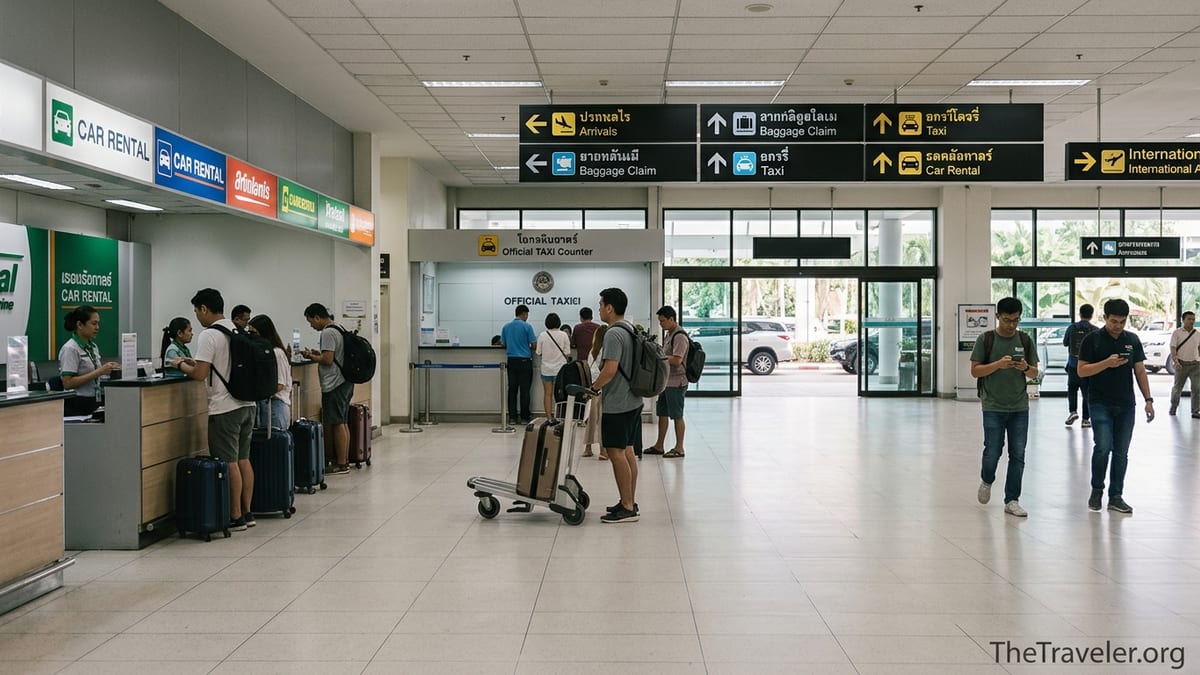
Once you have collected your luggage, you emerge into the domestic arrivals public area. This is where many ground services are concentrated. Near exit doors on this side, you will usually find the airport taxi meter counter, often signposted in English and sometimes with a bright colored sign above the desk. Here you tell staff your destination, pay a fixed fare in Thai baht, and receive a slip directing you to a particular parking bay outside. For example, a couple heading to a guesthouse inside the Old City moat can typically expect a flat taxi fare in the region of 150 baht, while travelers going to the trendy Nimman area usually pay slightly more, around 200 baht.
Just beyond the taxi counter are several car rental desks representing major brands such as Budget, Hertz, Avis and local Thai companies. These desks generally cluster near exit doors 1 and 2 on the domestic arrivals side. Staff will confirm your booking, check your driving license and deposit, and then direct you either outside to a nearby parking area or to a small lot a short walk from the terminal. Because the domestic arrivals hall is relatively compact, it is easy to walk past these desks without meaning to, especially if you are focused on getting outside. Keep an eye out for the familiar brand logos as soon as you step into the public area.
International Arrivals: Immigration, Baggage and Customs
International flights arrive into the ground floor of the international side of the building. After disembarking, you follow signs for “Immigration” and join queues based on your passport type and visa status. Queues move reasonably quickly at off peak times but can lengthen in the late evening when flights from regional hubs arrive close together. Travelers connecting from Bangkok sometimes underestimate this step and schedule tight onward connections from Chiang Mai to domestic bus terminals; allowing at least one hour from landing to reaching the curb is sensible for international arrivals.
After passport control you pass through security checks and into the international baggage claim area, which has its own carousels and overhead displays. This space feels smaller and more crowded than the domestic equivalent, particularly when several narrow body aircraft arrive at once. You collect your luggage, and if required, proceed through customs. There is usually a green channel for passengers with nothing to declare and a red channel if you are carrying goods above duty free allowances.
Once you clear customs, automatic doors open into the international arrivals hall. Compared with larger Asian airports, retail and food options are limited here, mostly small kiosks, currency exchange booths and mobile SIM card counters. Many travelers use this first hallway to purchase a local data SIM or an eSIM activation from a Thai provider and draw cash from an ATM, as using cash simplifies payment for taxis and small purchases in town.
A common point of confusion is the location of ground transport desks. In the immediate international arrivals space you may not see the main airport taxi counter or some car rental desks. To reach them, you often need to walk left along the hall and continue toward the domestic arrivals section. This connection is indoor and straightforward, but first timers sometimes wait near the doors on the international side hoping for a taxi kiosk that is actually a short walk away. If you find yourself in a crowd of greeters and hotel representatives but do not see a clearly branded taxi counter, follow signs for “Domestic Arrivals” or “Car Rental” along the interior corridor until you reach the shared ground transport area.
Departures: Check In, Security and Gates
All departures, whether domestic or international, use the first floor of the terminal. Escalators, elevators and staircases from both domestic and international ground floor areas lead up to this level. Once on the first floor, the terminal’s central hall is lined with airline check in counters. Domestic airlines such as Thai Airways, Bangkok Airways and low cost carriers like AirAsia and Thai Vietjet typically occupy banks of counters closer to the domestic side of the hall, while international airlines and regional carriers check in nearer the international side, but the layout can change based on demand and airline schedules.
Self service kiosks are limited, so most passengers still check in at staffed counters or arrive already checked in online and only need to drop bags. It is worth knowing that the check in hall can feel crowded in the morning bank of departures to Bangkok and again mid afternoon. Arriving about two hours before a domestic flight and at least two and a half to three hours before an international flight gives comfortable margins for check in, security and any unexpected queues.
After check in you pass through security screening at checkpoints located roughly in the middle of the departures hall. Domestic and international security areas are adjacent but enter separate airside zones. Once through security, domestic passengers find themselves in a compact departures lounge with a few cafés, convenience kiosks and seating areas facing the aircraft stands. Gates serving popular domestic routes such as Bangkok, Phuket and Krabi are numbered and grouped near the domestic side. Announcements are made in both Thai and English, but they can be hard to hear at busy times, so keep an eye on the departure screens above each gate.
International passengers enter a separate airside zone after security and passport control, with its own cluster of gates, duty free shop and small food options. Again, the space is relatively small compared to major hubs, and walking from one end to the other rarely takes more than ten minutes. Because gates can change close to departure, especially during busy seasonal periods, it is wise to recheck the screens shortly before boarding time rather than relying on the initial gate printed on your boarding pass.
Ground Transport Exits: Taxis, Grab, Songthaews and More
Almost all ground transport at Chiang Mai Airport operates from the curbside outside the ground floor arrivals area. After domestic or international arrival, once you are in the public hall, look for the main exit doors leading to the taxi rank. These are usually marked with “Exit” signs and sometimes show icons of taxis or public transport. The most important area for many travelers is the official airport taxi counter, typically located inside near the domestic arrivals hall. Here you pay a fixed fee for destinations in central Chiang Mai, receive a paper slip, and walk out through a nearby exit to meet your driver at a numbered bay.
Typical sample fares as of mid 2026 for official airport taxis are in the range of 150 baht for most destinations inside the Old City moat, around 200 baht for hotels in Nimmanhaemin area, and upwards of 250 baht for riverside or outlying neighborhoods. Prices can vary slightly depending on vehicle type and time of day, but the airport counter system is designed to be transparent and reduce haggling at the curb. This makes it a popular option for first time visitors or those arriving after long flights who just want a straightforward ride to their hotel.
App based ride hailing services such as Grab also operate at Chiang Mai Airport. If you use Grab, you generally book your ride once you have collected your bags, then follow in app instructions to a designated pick up area along the same curb used by other vehicles. In practice, many drivers wait in the short term parking lanes just beyond the main exits. Fares quoted in the app for a standard car to the Old City are often slightly lower than the official taxi counter rate at off peak hours, though when demand is high or during rainstorms the difference may shrink or even reverse.
Budget travelers and those with light luggage sometimes choose red songthaews, the shared pickup trucks with bench seating that function as informal buses in Chiang Mai. These do not typically queue directly at the terminal doors under the control of airport authorities. Instead, you often need to walk a little way out toward the main road in front of the airport to flag one down. A typical ride from that road to the Old City might cost around 30 to 40 baht per person, agreed with the driver before you hop in. This option works best during the day and early evening when songthaews are frequent. Arriving late at night, especially after 22:00, you are more likely to rely on official taxis or Grab instead.
Car Rental Counters and Pick Up Areas
Chiang Mai Airport has a cluster of car rental counters inside the arrivals hall on the ground floor, primarily on the domestic side. International brands such as Budget, Hertz, Avis, Enterprise and Europcar share the space with established Thai rental companies. Their desks are typically positioned along the wall near exit doors 1 and 2, close to the domestic baggage claim area. For travelers arriving on international flights, this means exiting customs and then walking left through the connecting hall toward the domestic section to reach the full lineup of car hire desks.
If you have prebooked a vehicle, you can often go directly to the relevant brand’s counter and present your confirmation number, passport and driving license. Staff then complete any remaining paperwork and either escort you outside to the car park or give you clear directions to the pick up area. In many cases, cars are parked in a lot just across the roadway from the arrivals hall, reachable via a short walk of a few minutes. Some companies may drive the car closer to an exit for you, especially if you have large luggage or are traveling with children.
The domestic arrivals hall is also where walk up rentals are commonly arranged. For example, a traveler who lands from Bangkok, decides on the spot to drive up to Pai or Chiang Rai, and has not reserved in advance can approach several counters in a row to compare prices and vehicle availability. In the high season from November to February, popular vehicle categories such as compact SUVs can sell out on certain days, so prebooking is still recommended if you have specific plans.
A point that often catches people off guard is the flow after returning a rental car. Most companies ask you to bring the vehicle back to the same lot where you collected it, where staff inspect it and close the contract. From there you walk back across the short roadway to the terminal. If you are catching an international flight, remember that you will still need to go upstairs for check in and then through exit immigration, so leave sufficient time not only for the car drop but also for the departure formalities.
Common Confusion Points and How to Avoid Them
Because Chiang Mai Airport is small, travelers sometimes assume it will be completely intuitive and find themselves momentarily lost at a few key junctions. One regular source of confusion is the connection between international arrivals and the main ground transport and car rental area. After exiting customs, many people stop just inside the doors, expecting to see a taxi counter directly opposite. Instead, what they often find is a cluster of people holding hotel signs and a few small kiosks. The actual airport taxi desk and the majority of car rental counters are further along, closer to the domestic arrivals section. If you are not being met by a hotel driver, it is almost always worth walking along the indoor corridor until you see clearly marked taxi and car hire signs.
Another common issue arises with exit doors. The ground floor has several exits along both the domestic and international sides, all opening onto the same general roadway. It is easy to step outside through the first door you see, then realize the taxi rank or your prebooked driver’s meeting point is actually further along the curb. To avoid double backing in the heat, check which exit is closest to your chosen transport before heading outside. Staff at the taxi counter or car rental desk will usually point you toward the correct door and even note the bay number for your vehicle.
Ride hailing can also create small layout puzzles. The Grab app may direct you to a particular pick up point label that does not match any obvious signage on the curb. In practice, drivers often send you a message indicating a nearby landmark: for example, “in front of domestic arrivals, near exit 2” or “opposite the taxi counter doors.” When in doubt, share a description such as “we are standing outside domestic arrivals next to the airport taxi sign” to help the driver spot you. Because the curb is short, a little patience usually resolves any confusion within a few minutes.
Finally, passengers transferring from international arrivals to immediate domestic departures within Chiang Mai sometimes misjudge the layout. There is no special sterile transfer corridor between international and domestic flights. You always exit to the public arrivals level, then go upstairs to the departures level, check in again, and clear security. If you schedule a tight connection that relies on walking directly from one gate to another, you may find yourself rushed. A safer plan is to allow a comfortable buffer, particularly at busy travel periods such as Christmas, Chinese New Year and Songkran in April, when queues for immigration and check in can both lengthen.
The Takeaway
Chiang Mai International Airport combines the scale of a regional airport with the passenger flows of a major tourist hub. The single terminal building keeps walking times short, but the split between domestic and international areas, along with several parallel exits and clustered service counters, can catch first timers by surprise. Understanding that arrivals for both domestic and international flights feed into the same ground floor, and that almost all ground transport and car rental services are accessed from this level, simplifies your mental map before you even land.
For arrivals, the key is to move calmly from gate to baggage claim to the shared transport area, looking beyond the first doors you see. For departures, arriving early enough to navigate check in, security and any last minute gate changes will keep the experience low stress. Whether you choose a fixed fare airport taxi, a Grab ride, a budget friendly songthaew from the nearby main road or a self drive rental car, the terminal layout supports straightforward exits once you know where to look.
With these details in mind, Chiang Mai’s airport should feel less like a maze and more like the simple gateway it is to the mountains, night markets and cafés of Northern Thailand. A little advance familiarity with its compact terminal map will help you step off the plane and into the city with confidence.
FAQ
Q1. Are the domestic and international terminals at Chiang Mai Airport in separate buildings? No. They are two sections of the same terminal building, with domestic on the right and international on the left when facing the airport, and you can walk between them indoors in a few minutes.
Q2. How long does it usually take to get from an arriving domestic flight to the taxi rank? In light traffic, most passengers can walk from the gate, collect checked bags and reach the airport taxi counter in about 15 to 25 minutes, though delays in baggage delivery can occasionally extend this.
Q3. Where do I find the official airport taxi counter in the terminal? The main airport taxi counter is inside the ground floor arrivals area near the domestic side of the hall. Look for the clearly marked taxi desk near the exits before you step outside.
Q4. Can I use Grab for pick up and drop off at Chiang Mai Airport? Yes. Grab operates at Chiang Mai Airport, with pick ups usually arranged along the same curb as other vehicles. Use the app instructions and driver messages to confirm the exact meeting point.
Q5. Is there a bus or train directly from Chiang Mai Airport into the city? There is no dedicated train from the airport into town. Airport bus services and public buses change over time, so most visitors rely on taxis, Grab, hotel transfers, or red songthaews from the nearby main road.
Q6. Where are the car rental counters located inside the airport? Car rental counters for major international and local brands are clustered in the domestic arrivals hall on the ground floor, close to exits on that side. International arrivals can reach them by walking along the indoor corridor from customs toward the domestic section.
Q7. How early should I arrive for a domestic departure at Chiang Mai Airport? Arriving about two hours before a domestic flight is usually sufficient, giving you time for check in, possible queues and security screening on the first floor departures level.
Q8. Is it easy to walk between international arrivals and domestic departures? Yes. After clearing immigration, baggage claim and customs, you enter the public arrivals hall. From there you go upstairs via escalator or elevator to the departures floor to check in for your domestic flight.
Q9. Can I catch a red songthaew directly at the arrivals curb? Red songthaews do not typically line up at the main terminal doors under airport control. Most travelers who want a songthaew walk out toward the main road in front of the airport and flag one down there, especially during daytime.
Q10. Are there plenty of signs in English inside Chiang Mai Airport? Yes. Directional signs for arrivals, departures, baggage claim, taxis, restrooms and other essential services are posted in both Thai and English, which makes navigating the compact terminal straightforward once you know where key areas are located.