


Landing at Chiang Mai International Airport can feel pleasantly small-scale compared with Bangkok, but confusion often starts the moment you step out of arrivals and face a maze of taxi counters, ride-hailing pickup points and drivers calling for your attention. This guide walks you through exactly how to get from the airport to your hotel in the Old City, Nimman or beyond, what fares to expect, and how to avoid overpaying, whether you arrive at midday or after midnight.
Get the latest updates straight to your inbox!
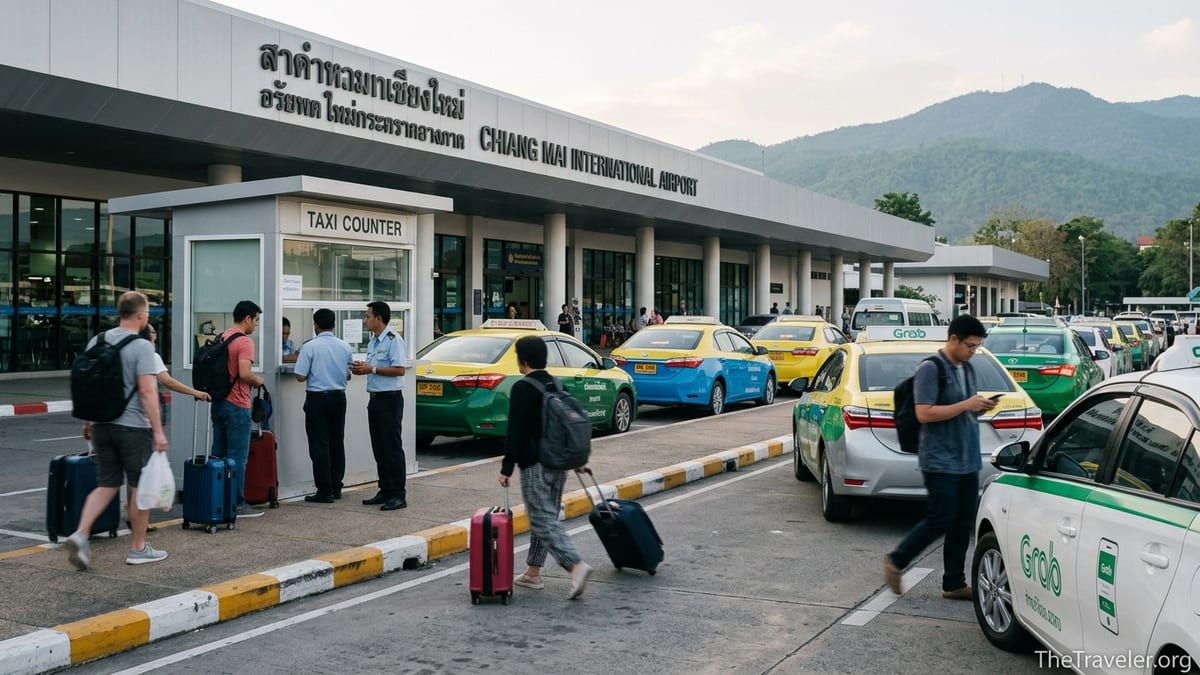
How Chiang Mai International Airport Is Laid Out for Taxis
Chiang Mai International Airport sits just southwest of the Old City, roughly 3 to 4 kilometers from most central hotels. In light traffic, that is a 10 to 15 minute ride; in rush hour, it can double. Both the domestic and international terminals are in one compact building, so regardless of where you land, you will exit into the same ground transportation area. Metered taxis, airport flat-fare services and ride-hailing pickups are all clustered near the ground floor exits.
After clearing immigration and customs, you walk straight into the public arrivals hall. Here you will see an official airport taxi counter, car rental desks and, depending on the time of day, a few independent drivers calling out “taxi, taxi.” Outside the sliding doors, just beyond the domestic arrivals side, is the designated pickup point for ride-hailing services such as Grab, which operates with official approval at Chiang Mai airport and has marked pickup and drop-off points on airport grounds.
The small size of the airport is a benefit because walking between the official taxi counter, the metered taxi stand and the Grab pickup zone typically takes only a few minutes. That also makes it easy to quickly compare your options or change plans if one queue looks long. For example, if the line at the taxi counter is backed up after a bank of evening flights from Bangkok, you can often step outside, check prices on Grab and decide in real time which option makes more sense.
Despite the relatively simple layout, first-time visitors are often unsure which counter is the official one or whether the metered taxis outside are legitimate. In practice, services operating from the clearly signed airport taxi counter and the “Taxi Meter” stand just outside are regulated and have set conditions. Issues with overcharging tend to come from informal touts who approach you directly before you reach a counter or exit.
Airport Taxi Counters and Typical Flat Fares
The most straightforward option on arrival is the official airport taxi counter in the public arrivals area. Staff ask for your hotel name, assign a driver and print a ticket with a flat fare based on broad zones such as the Old City or Nimman. While exact rates can change with fuel prices and policy, many travelers in 2025 have reported paying in the region of 150 to 200 baht for a standard car from the airport to hotels inside the Old City moat or just north around Chang Phuak Gate. Larger SUVs, often used by families or groups with big suitcases, usually cost more, around 250 baht per vehicle for central areas.
To give a concrete example, a couple arriving on an evening flight from Bangkok and heading to a guesthouse near Tha Phae Gate might be quoted around 160 to 180 baht at the airport taxi counter for a standard sedan. A family of four with two large suitcases staying near Wat Phra Singh inside the Old City might be steered toward an SUV at approximately 250 baht. These fares are per car, not per person, and are designed to be mildly higher than what you might pay a metered taxi outside the airport, in exchange for simplicity and clear pricing.
When you pay at the counter, you usually settle the full fare there and receive a slip to hand to the driver waiting outside. Sometimes you pay a small portion at the counter and the remainder directly to the driver on arrival, but this will be clearly marked on the ticket. The benefit of this arrangement is that it reduces the risk of last-minute price changes or “misunderstandings” when you reach your hotel, since the fare is agreed in advance and printed on paper.
For hotels slightly farther out, such as along the riverside near Wat Ket or up toward the Central Festival mall, expect the printed flat fare to rise in steps. A ride to a riverside hotel east of the Old City might sit closer to 220 to 260 baht for a sedan, again depending on how the taxi company divides its zones. If you are heading much farther, such as to the outer ring road or popular out-of-town resorts, the counter will sometimes quote a custom flat fare rather than a simple zone price. In these cases, it can be worth quickly checking the price on Grab before committing.
Metered Taxis and the 50 Baht Airport Surcharge
Alongside the flat-fare airport taxis, Chiang Mai also has metered taxis that can pick up at the airport. Official information notes that metered taxis add a 50 baht airport surcharge on top of the meter fare, which is a standard practice across several Thai airports. In practice, a metered ride from the airport to the Old City might show around 100 to 140 baht on the meter in light traffic, which becomes 150 to 190 baht once the fixed surcharge is added at the end of the trip.
There is usually a signed “Taxi Meter” stand outside the terminal, often near the tourist police booth, where staff allocate metered taxis in turn. When you join this line, you do not negotiate a flat fare. Instead, you should confirm with the driver that they will use the meter and that the only extra is the 50 baht airport fee. If the driver tries to insist on a high flat fare instead of using the meter for a simple city trip, you can politely decline and return to the stand to request a different taxi.
As a real-world example, a solo traveler arriving mid-afternoon and going to a hostel near Chiang Mai Gate might find that the metered fare reads roughly 110 baht when pulling up outside the hostel. The driver then adds the 50 baht surcharge, and the final total comes to 160 baht. If you had taken a flat-fare airport taxi, you might have paid a similar 160 to 180 baht upfront, so the savings are modest, but the meter allows you to see how the fare is built up.
Outside the airport, within the city, metered taxis are less common than ride-hailing cars or red songthaew trucks, but at the airport itself, they are a viable and regulated option. If you are concerned about transparency, taking a metered taxi from the stand, watching the meter tick up and knowing that only a fixed, posted 50 baht fee is added can offer peace of mind. Just remember that, as in many cities, a minority of drivers may still try to negotiate side deals, so insisting on the meter is important.
Ride-Hailing Apps, Luggage and the Grab Pickup Point
Ride-hailing plays a key role at Chiang Mai International Airport. Grab, in particular, has an official arrangement with airport authorities that allows its cars to pick up and drop off passengers at designated points. The airport’s own information notes specific pickup and drop-off zones for Grab, and frequent travelers report a clearly marked Grab pickup area just beyond the domestic arrivals doors on the ground floor. When you order a car in the app, it will direct you to one of these signed spots.
Pricing via apps like Grab, Bolt or InDrive can fluctuate with demand, time of day and driver availability. At quiet times, you might see a GrabCar quoted around 120 to 160 baht from the airport to the Old City, roughly on par with or slightly below the official flat-fare taxis. At peak times, such as weekend evenings in high season, surge pricing can push the fare to 200 baht or more for the same route. For Nimman, which is just northwest of the airport, fares can sometimes be a little lower simply because the distance is shorter, but the difference is often small.
Luggage capacity is an important practical detail. A standard GrabCar or similar sedan can comfortably fit two full-size suitcases plus carry-on bags in the trunk and rear seat. If you are traveling with three or four large suitcases or oversized sports equipment, you may need to request a larger vehicle category, such as GrabSUV or an equivalent. Those larger cars usually carry a higher base fare. For example, a group of three friends with four big backpacks and two checked suitcases heading from the airport to a Nimman hotel might see a GrabSUV quote around 220 to 260 baht in the app, making it comparable in price to the airport’s official SUV taxis.
It is also worth noting that some travelers prefer to pre-book their airport ride using Grab’s advance booking feature, especially for late-night arrivals or early-morning departures. However, because advance bookings still rely on a driver accepting the job shortly before pickup, they are not a guaranteed car reservation in the same way as a private transfer service. If you are landing at a busy time and see long lines at the taxi counter, checking your apps while you walk toward the exit can help you decide whether to book a ride-hail or simply join the queue for an airport taxi.
Old City vs Nimman: Hotel Zone Tips and Example Fares
Most visitors to Chiang Mai stay either in or around the Old City or in the Nimmanhaemin (Nimman) area. The Old City is the square, moat-surrounded historical core, home to temples like Wat Chedi Luang and countless guesthouses. Nimman, just northwest of the airport, is a modern neighborhood of cafes, boutique hotels and co-working spaces. Because both areas are relatively close to the runway, taxi trips from the airport rarely exceed 20 minutes in normal traffic.
For the Old City, a typical flat-fare airport taxi ride for two people with moderate luggage is often in the 150 to 200 baht range, depending on the specific taxi company and current policies. A metered taxi with the 50 baht surcharge usually lands in a similar zone, perhaps 150 to 190 baht in light traffic. If you open a ride-hailing app at the curb, you might see quotes from about 120 baht up to 200 baht, reflecting time-of-day and demand-based pricing. From a tourist’s perspective, it is helpful to think of 150 to 200 baht as a broadly normal one-way cost to most Old City hotels from the airport.
Nimman is even closer, and in a car, you often reach Maya Lifestyle Shopping Center or the main Nimman strip in under 10 minutes when the roads are clear. Flat-fare taxis might still charge a similar 150 to 180 baht simply because of their zone structure, while ride-hailing fares can sometimes dip slightly below. For instance, a solo traveler arriving at 10 a.m. and heading straight to a Nimman guesthouse might pay about 130 to 150 baht via GrabCar, while an airport flat-fare taxi may quote 150 baht. With two people sharing, the difference per person is minimal.
Where costs start to rise noticeably is when you move well beyond these central zones. A taxi from the airport to a resort along the outer ring road or to venues on the way toward Doi Suthep can cost significantly more, often 300 baht or higher, particularly if the driver expects to return empty. In these cases, checking both the airport counter and ride-hailing apps before committing can save you from surprises. Still, compared with private hotel transfers that can easily exceed 600 to 800 baht, official airport taxis remain one of the better-value options.
Late Arrivals, Early Departures and 24-Hour Service
Chiang Mai International Airport and its ground transport services now operate around the clock, particularly during the busy cool season when late-night and early-morning flights are common. Ride-hailing services like Grab have announced 24-hour coverage at Chiang Mai airport, with pickup points designed for overnight arrivals. In reality, however, the experience at 02:00 can feel different from mid-afternoon, and it is wise to plan accordingly.
For very late arrivals, say after midnight, the official airport taxi counter may still be open, especially when a large scheduled flight arrives, but staffing can be minimal. You might find only one or two taxis waiting, which can lead to longer waits if multiple flights land close together. In such scenarios, many travelers report success using ride-hailing apps for a quicker pickup, as some drivers specialize in night work and watch for incoming airport requests.
Early-morning departures from the city to the airport, for flights leaving between 05:00 and 07:00, can pose the opposite challenge: you are leaving from your hotel into mostly quiet streets. While you can ask your hotel to arrange a pickup the night before, reports suggest that pre-booked taxis occasionally fail to show very early in the morning. To reduce risk, it is sensible to schedule a car via a ride-hailing app a little earlier than strictly necessary and, if possible, confirm a backup option, such as your hotel having the number of a reliable local driver who serves the neighborhood.
Overall, though, travelers rarely find themselves completely stranded. Because the airport is close to populated areas, even an unscheduled request around 04:00 often finds a driver within 10 to 20 minutes. The key is to give yourself extra buffer time, particularly during high season when queues and occasional confusion can add unexpected minutes before you are actually on the road.
How to Avoid Overpaying or Being Scammed
Chiang Mai is generally friendlier and lower-stress than some larger Southeast Asian hubs, but it is still possible to overpay if you are tired from a long flight and accept the first offer you hear. The simplest way to protect yourself is to use either the official airport taxi counter, the clearly signed metered taxi stand or a recognized ride-hailing app. Avoid making deals with unmarked drivers who approach you inside the terminal and quote an all-inclusive price without any reference to posted rates or meters.
Before you travel, it helps to have a mental price range for your route. For a central Old City or Nimman hotel, anything in the ballpark of 150 to 220 baht per car from the airport is within a normal range for 2025, depending on the size of vehicle and time of day. If someone inside the terminal offers 400 or 500 baht for a simple city-center drop in a standard sedan, you can confidently decline. Having your hotel address written down or saved in Thai on your phone also reduces confusion that can lead to claims of “wrong area, longer distance” and last-minute fare increases.
With ride-hailing apps, overpaying is less about scams and more about accepting high dynamic prices at busy times. If you open an app and see a quote of 300 baht for a short airport-to-city ride, it is worth checking how long the line looks at the airport taxi counter or meter stand before you tap “Confirm.” Conversely, if you spot an exceptionally low price on an app, remember that there may be a wait while a driver navigates airport traffic to reach the pickup point, so factor time into your decision as well as cost.
Another common-sense precaution is to confirm the payment method and total before you set off. If paying cash, agree on the approximate total including the 50 baht airport surcharge for metered taxis or any tolls if you are heading onto expressways outside the immediate city. For app rides, confirm that the correct destination is entered and that your payment card, if used, is the one you expect. Taking a quick photo of the taxi’s license plate or noting it down is standard advice and gives you a reference if you later realize that something was left in the car.
The Takeaway
Getting from Chiang Mai International Airport to your hotel should be a short, relatively inexpensive journey whether you are staying in the Old City, Nimman or along the river. Official airport taxi counters and metered taxi stands offer regulated fares, while ride-hailing apps provide transparent, real-time pricing and the flexibility to match vehicle size to your luggage. For most central destinations, setting your expectations around 150 to 220 baht per car helps you immediately recognize normal quotes and politely walk away from anything excessive.
If you arrive late at night or depart very early, allow extra time and consider using both a pre-arranged option and a live backup via app. Focus on clearly signed counters and stands, confirm whether you are paying a flat fare or a metered fare plus the 50 baht surcharge, and keep your hotel address handy in both English and Thai. With those simple steps, Chiang Mai’s small, straightforward airport becomes an easy gateway rather than a stress point at the start of your northern Thailand journey.
FAQ
Q1. How much should I expect to pay for a taxi from Chiang Mai airport to the Old City?
For most hotels inside or just around the Old City moat, a typical fare in 2025 is roughly 150 to 200 baht per car, whether you use the airport taxi counter, a metered taxi with the 50 baht airport surcharge or a ride-hailing app without surge pricing.
Q2. Is there an official taxi counter at Chiang Mai International Airport?
Yes. After you exit into the public arrivals hall, you will find an official airport taxi counter where staff ask for your hotel, quote a flat fare based on zones and assign a driver with a printed ticket.
Q3. Do taxis from the airport use the meter or flat fares?
It depends on the service. The airport taxi counter uses flat fares by zone, while taxis from the signed “Taxi Meter” stand outside are supposed to use the meter plus a fixed airport surcharge. You can choose whichever you prefer.
Q4. Can I use Grab or other ride-hailing apps at Chiang Mai airport?
Yes. Grab operates with official pickup and drop-off points at the airport, and other apps like Bolt or InDrive also serve the area. The app will guide you to a designated pickup zone just outside the terminal.
Q5. Is it cheaper to go to Nimman than to the Old City from the airport?
Nimman is slightly closer to the airport, so metered fares can be a little lower, but airport flat-fare taxis often price both zones similarly. Expect broadly similar costs, usually between about 130 and 200 baht depending on vehicle and time.
Q6. Are taxis and ride-hailing services available late at night?
Yes. Both the airport transport services and ride-hailing apps operate 24 hours, though options may be thinner in the very early hours. It is still wise to allow extra time if you land after midnight or leave before dawn.
Q7. How many people and how much luggage can fit in a standard taxi?
A standard sedan taxi or GrabCar can usually take up to four passengers, but with large suitcases it is more comfortable for two or three. Two full-size suitcases plus smaller bags typically fit in the trunk, while oversize items may require a larger SUV-type vehicle.
Q8. Do I need to tip taxi drivers in Chiang Mai?
Tipping is not strictly required, but it is common to round up the fare. For example, if the total is 160 baht, many travelers hand over 180 or 200 baht, especially if the driver helps with heavy luggage or waits while you sort out your accommodation.
Q9. What is the best way to avoid being overcharged at the airport?
Stick to the official airport taxi counter, the clearly signed metered taxi stand or recognized ride-hailing apps. Have a rough idea of normal fares for your route and politely decline offers that are significantly higher, especially from unmarked drivers who approach you directly.
Q10. Is there public transport from Chiang Mai airport into the city?
Chiang Mai has a growing city bus system with routes starting and ending at the airport, but services may not be convenient for travelers with luggage or those arriving late at night. For most visitors, taxis, ride-hailing cars and hotel transfers remain the most practical choices.