


More news on this day
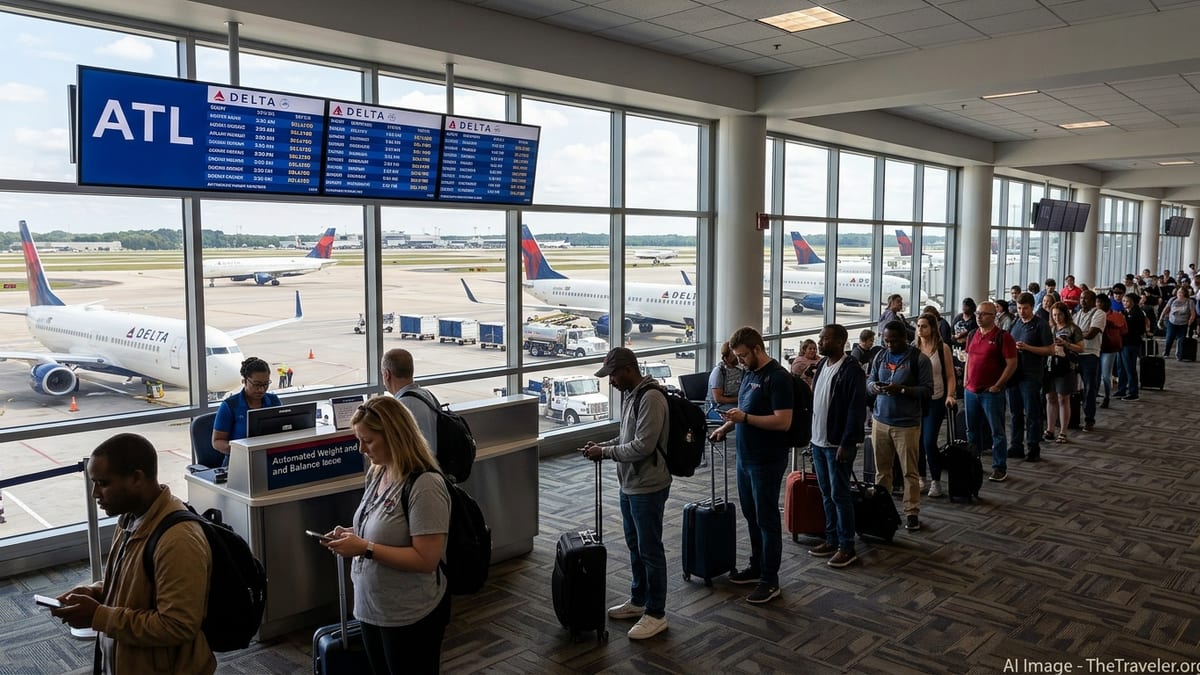
Delta Air Lines says it has restored an automated weight-and-balance system that failed on November 22, triggering a ground delay program at Hartsfield-Jackson Atlanta International Airport and causing widespread disruptions across its network just as Thanksgiving travel peaked.
Get the latest news straight to your inbox!
What happened to Delta’s system in Atlanta
Delta’s disruption began on Sunday, November 22, when an automated system used to calculate aircraft weight and balance for departing flights malfunctioned at its largest hub, Hartsfield-Jackson Atlanta International Airport. The tool supports performance calculations that determine how passengers, baggage and cargo are distributed and how much fuel is required so each aircraft remains within safe operating limits. Without reliable automated data, dispatchers and crews were forced to slow or halt departures while alternative procedures were put in place.
In response to the outage, Delta requested operational restrictions at Atlanta early Sunday. The Federal Aviation Administration implemented a ground delay program affecting Delta departures at Hartsfield-Jackson, with some flights held on the ground while the airline worked to verify performance numbers manually. The FAA lifted those restrictions late Sunday morning once Delta began restoring its systems, but delays and cancellations continued to ripple through the day as aircraft and crews fell out of position.
Delta stated that the problem was confined to its own automation and not related to a broader air traffic control or cybersecurity event. The airline also emphasized that core flight-safety functions remained in place and that flights did not depart without verified weight and balance information, which contributed to longer turnaround times even after the immediate system fault was corrected.
Scale of delays in Atlanta and nationwide
Although the technical fault originated with Delta’s weight-and-balance automation supporting Atlanta departures, the impact quickly spread across the carrier’s network. Flight tracking data on Sunday evening indicated that approximately 58 percent of Delta-operated flights were delayed, affecting roughly 2,000 services worldwide. A smaller share of flights were cancelled outright as the carrier sought to reset schedules and reposition aircraft and crews for the week ahead.
At Hartsfield-Jackson, where Delta operates the majority of daily flights, hundreds of departures and arrivals were delayed on Sunday. The knock-on effects extended to other Delta hubs and focus cities as aircraft scheduled to connect through Atlanta arrived late to their next destinations. Travelers reported delays of several hours on flights that neither originated nor terminated in Atlanta, underscoring how disruptions at a major hub can cascade through an interconnected schedule.
The operational impact continued into Monday, November 23. While Delta’s automation was back online, schedule data showed that the airline was still working through residual delays and a modest number of cancellations, particularly on early-morning departures. Some flights were operating with new departure times or equipment changes as part of the recovery plan. By Monday afternoon, Delta and airport officials in Atlanta were describing operations as stabilized and trending back toward normal, though some passengers were still experiencing extended travel days because of missed connections from the previous day’s disruption.
Delta’s response and what passengers experienced
Delta said its technicians moved quickly on Sunday to identify and correct the failure in the weight-and-balance automation and to introduce backup procedures while the system was offline. As automated calculations became unreliable, dispatchers resorted to manual or alternative methods to determine performance figures for each departure. That process increased the time required between boarding and pushback, since aircraft could not leave the gate until valid numbers were confirmed.
On the passenger side, the disruption translated into a mix of long waits at gates, changing departure times and, in some cases, day-long or overnight journeys. Some travelers reported boarding their flights only to remain at the gate for extended periods while crews awaited updated weight-and-balance data. Others encountered rolling delay notifications as Delta adjusted departure times to reflect congested departure queues and aircraft availability. A smaller group saw itineraries rebooked or partially cancelled as the airline consolidated lightly booked flights or prioritized certain routes during the recovery.
Customer communication varied by route and airport. Many passengers received repeated updates via Delta’s app and text alerts, while others reported less consistent information, particularly when schedules were changing rapidly. At some airports, local announcements referenced ongoing system issues in Atlanta, explaining that checked baggage acceptance could be limited or that gate agents were awaiting clearance before beginning boarding. For travelers with tight connections through Atlanta on Sunday, the rolling nature of the delays meant that even short hold-ups could cascade into missed onward flights.
How the outage fits into a volatile travel week
The Delta disruption arrived at the start of one of the busiest travel periods of the year in the United States. Airlines and airports had already been managing the aftermath of a federal air traffic ground stop earlier in the month that disrupted flights nationwide, as well as a separate technology issue at United Airlines the previous week. Against that backdrop, the failure of a critical Delta automation tool further strained staffing plans and airport capacity heading into Thanksgiving.
Hartsfield-Jackson Atlanta International Airport, as Delta’s primary hub and the world’s busiest airport by passenger numbers, was particularly sensitive to timing. Airport officials expected more than four million travelers to move through Atlanta between November 19 and December 1. Any large-scale disruption to Delta’s operations during this window risked filling concourses and gate areas quickly as delayed passengers overlapped with on-time waves of departing travelers.
The outage also highlighted how modern airline operations depend on a layered set of digital tools, many of which are invisible to passengers until something goes wrong. Weight-and-balance automation, crew scheduling systems, airport departure management platforms and third-party reservation tools each play distinct roles in moving flights on and off the ground. In this case, the failure of one specific system did not halt air traffic control services or ground every carrier, but it was sufficient to slow much of Delta’s operation and trigger a formal ground delay program at its largest hub.
What travelers should do now and in the days ahead
With Delta’s weight-and-balance automation restored and Atlanta’s ground restrictions lifted, the airline’s schedule is expected to continue normalizing through Tuesday, November 24. However, some residual delays remain possible as aircraft and crews return to their usual rotations. Travelers booked on Delta over the next couple of days should pay close attention to their flight status, particularly if their itinerary involves a connection in Atlanta or another busy hub.
Delta has not announced a broad travel waiver specific to this incident that would allow fee-free changes over an extended period, but standard U.S. Department of Transportation rules still apply. Passengers whose flights were cancelled by the airline and who chose not to travel are entitled to a refund for the unused portions of their ticket, regardless of the cause of the cancellation. Those who were significantly delayed may also be able to request accommodation or rebooking assistance, depending on the circumstances and the policies that applied at the time of travel.
For travelers preparing to fly in the next few days, the most practical steps are to reconfirm itineraries through Delta’s app or website before leaving for the airport, monitor gate information screens closely once at the terminal, and allow extra time for connections where possible. Given the broader holiday demand and the recent series of air travel technology issues affecting multiple organizations, itineraries that build in longer layovers and some schedule flexibility are likely to be more resilient if further operational hiccups occur as the Thanksgiving travel period continues.