


More news on this day
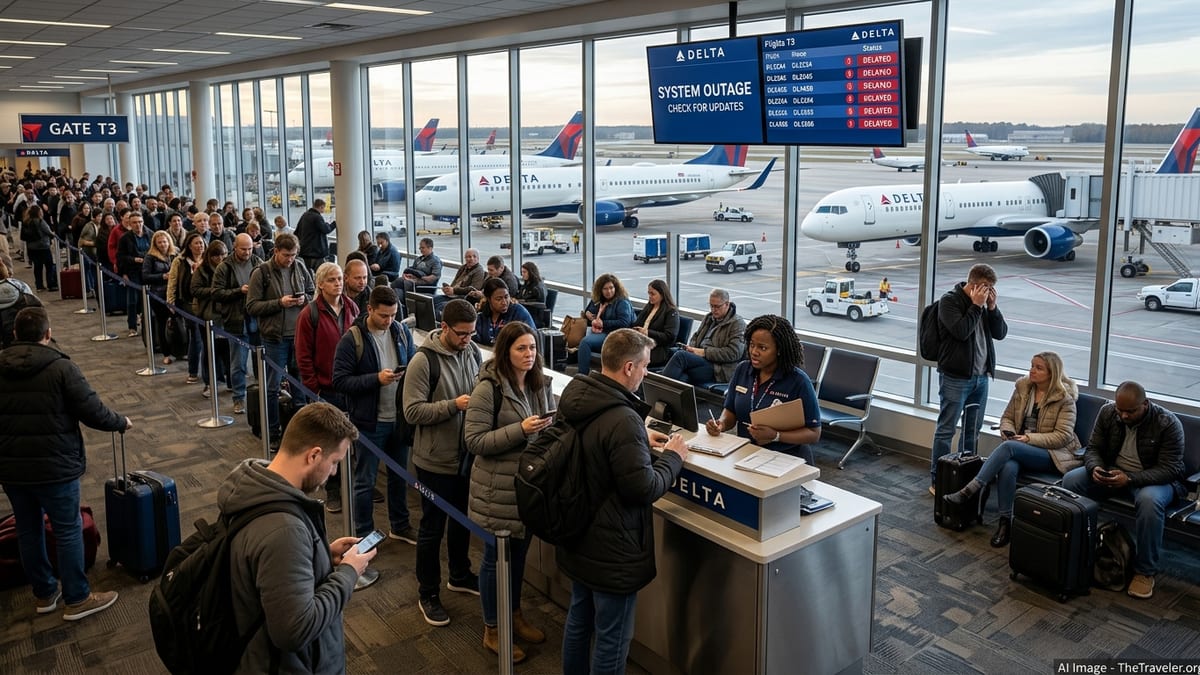
Delta Air Lines suffered a widespread technology outage on Sunday, November 22, disrupting more than 1,600 flights across the United States just as Thanksgiving travel ramped up and only nine days after a separate nationwide ground stop by the Federal Aviation Administration (FAA) over unrelated telecommunications problems.
Get the latest news straight to your inbox!
What happened to Delta’s systems on November 22
Delta confirmed on Sunday that an automated system used to calculate aircraft weight and balance before departure malfunctioned, forcing the airline to slow or halt departures across its network while crews reverted to manual procedures. The carrier said the system was restored later in the day, but residual disruption persisted into Monday as aircraft and crews fell out of position.
Public flight-tracking data and airline statements indicate that more than 1,600 Delta flights were delayed on November 22, accounting for a significant share of all U.S. flight disruptions that day. Some tallies place the total closer to 2,000 delayed Delta services once evening operations are included, although counts vary slightly by data provider and cut-off time.
The affected tool automates a critical safety step that determines whether an aircraft’s total weight and its distribution across the airframe fall within certified limits, taking into account passengers, baggage, cargo and fuel. While airlines can and do perform these calculations manually when needed, doing so for a large network on a busy travel day slows the operation considerably, which is what many Delta customers experienced on Sunday.
Impact across Delta’s network and at Atlanta
Delta’s hub at Hartsfield-Jackson Atlanta International Airport, the world’s busiest airport by passenger volume and the centerpiece of the airline’s network, experienced some of the highest levels of disruption. The FAA briefly instituted a ground stop for certain Delta flights bound for Atlanta while the carrier worked to assess the problem, before replacing it with a ground delay program that allowed flights to depart but at extended intervals.
Passengers at multiple U.S. airports reported delays ranging from about 30 minutes to several hours. In some cases, aircraft were boarded and then held at the gate while flight crews awaited manually generated weight-and-balance numbers from Delta dispatchers. In others, boarding was paused while local teams confirmed that manual processes were in place. Airports including New York LaGuardia, Orlando, Boston, Baltimore/Washington and Boise all saw Delta departures held as staff worked around the outage.
Although the technology issue did not directly affect aircraft already in flight, knock-on effects built through the day as aircraft and crews arrived late into their next rotations. Travel data providers and airline advisories indicated that the bulk of the delays were concentrated on Sunday, but a smaller number of cancellations and late departures carried into Monday, November 23, as Delta reset its schedule.
How the outage compares with the FAA’s November 13 ground stop
The Delta incident came just nine days after the FAA ordered a rare nationwide ground stop on Friday, November 13, following instability in the agency’s telecommunications network that supports communications and radar feeds for air traffic control. According to FAA and U.S. Department of Transportation updates, the ground stop lasted around four hours and 45 minutes while engineers worked to stabilize the system, during which departures of many U.S. domestic and inbound international flights were paused.
Federal briefings following the FAA event stated that approximately 12,462 flights were canceled that day, including about 9,082 cancellations among major U.S. carriers, although officials stressed that not all of those cancellations were solely due to the ground stop itself. Early technical findings pointed to recently installed network routers in Amarillo, Texas, and El Dorado, Arkansas, which overwhelmed legacy systems at multiple air route traffic control centers and related facilities. The FAA has said the November 13 disruption was not the result of a cyberattack.
While both events led to major disruption for travelers within a span of less than two weeks, the causes and responsible systems were distinct. The FAA ground stop arose from telecommunications instability affecting air traffic control infrastructure that serves all airlines, whereas Delta’s November 22 problems were confined to the carrier’s own weight-and-balance automation system. FAA statements have emphasized that Sunday’s Delta outage did not originate in air traffic control systems, underscoring that the two disruptions were operationally separate even as they affected some of the same passengers.
Holiday travel pressures and what passengers are seeing on the ground
The timing of both the FAA ground stop and the Delta outage has heightened concern among Thanksgiving travelers already facing crowded airports and seasonal weather risks. Forecasts compiled by federal transportation officials and private analysts suggest Thanksgiving-week air traffic will be at or near a 16-year high this year, with more than 400,000 flights scheduled across U.S. carriers between November 23 and December 1 and tens of millions of passengers expected to travel at least 50 miles from home by air, road or rail.
At individual airports, that demand translates into heavy daily passenger flows. Memphis International Airport, for example, expects about 97,000 passengers to pass through its security checkpoints between November 19 and November 30, with November 20 and November 29 projected as peak days and more than 10,000 passengers anticipated each of those dates. Similar patterns are playing out at major hubs including Atlanta, Dallas/Fort Worth, Denver, Chicago O’Hare and New York area airports, where airport operators are warning that parking facilities may periodically reach capacity.
For travelers, the combination of near-peak traffic volumes, recent technology failures and the potential for adverse weather has translated into longer lines and more complex rebooking scenarios when delays occur. Some passengers affected by the November 13 FAA ground stop chose to shift their trips to later weekends, only to encounter Delta’s November 22 outage. Social media posts and interviews from multiple airports describe a mix of frustration with repeated system failures and empathy for front-line staff who must manage crowded gate areas and anxious customers while relying on manual workarounds and rapidly changing operating plans.
Reliance on automation, redundancy questions and what travelers should do now
The two November disruptions have renewed scrutiny of how heavily modern aviation operations depend on large, interconnected technology systems and how resilient those systems are when parts of the network fail. In Delta’s case, the automated weight-and-balance tool is designed to streamline a mandatory safety process that can still be completed by hand, albeit more slowly. In the FAA’s case, the focus has been on the robustness of decades-old telecommunications and radar infrastructure as newer equipment is integrated into existing networks.
Members of Congress and transportation oversight bodies have already requested detailed briefings on the November 13 nationwide ground stop, pressing the FAA for timelines to harden critical systems, improve redundancy and clarify how new hardware is tested before being deployed into live operations. Industry analysts and safety specialists are likewise examining whether airlines and regulators have sufficient independent backup systems to maintain at least limited operations when a primary system fails, and how quickly contingency plans can be activated without compromising safety margins.
For travelers, however, the immediate concern is practical: how to navigate the busy Thanksgiving period given the recent disruptions. Airports and airlines are advising passengers with flights this week to arrive at least two hours before scheduled domestic departures and three hours before international departures, allow additional time for parking and ground transport, and monitor flight status directly through airline apps, websites or text alerts. Given the potential for rolling knock-on effects from the November 22 Delta outage, passengers booked on the airline over the next few days are being encouraged to check their reservations frequently, confirm terminal and gate assignments and consider carrying essential items in hand luggage in case of delayed or misrouted checked bags.
Although Delta has reported that its weight-and-balance automation system is back online, some crews have indicated that individual flights may still experience localized delays as dispatchers clear backlogs and manual workarounds are phased out. The FAA’s telecommunications network, meanwhile, has been restored to normal operation, but formal investigations into the root causes and any necessary system upgrades are ongoing. Until those reviews are complete and any recommended changes implemented, travelers during the remainder of the holiday season should be prepared for occasional irregular operations and build extra flexibility into their plans, particularly on peak days and through the busiest hubs.