


More news on this day
Millions of Americans heading to airports for Thanksgiving between November 24 and November 30 face an unusually fragile air travel week, with a recent nationwide ground stop, airline tech outages and coastal storm systems all increasing the risk of delays and cancellations even as federal officials predict the busiest holiday skies in more than a decade.
Get the latest news straight to your inbox!
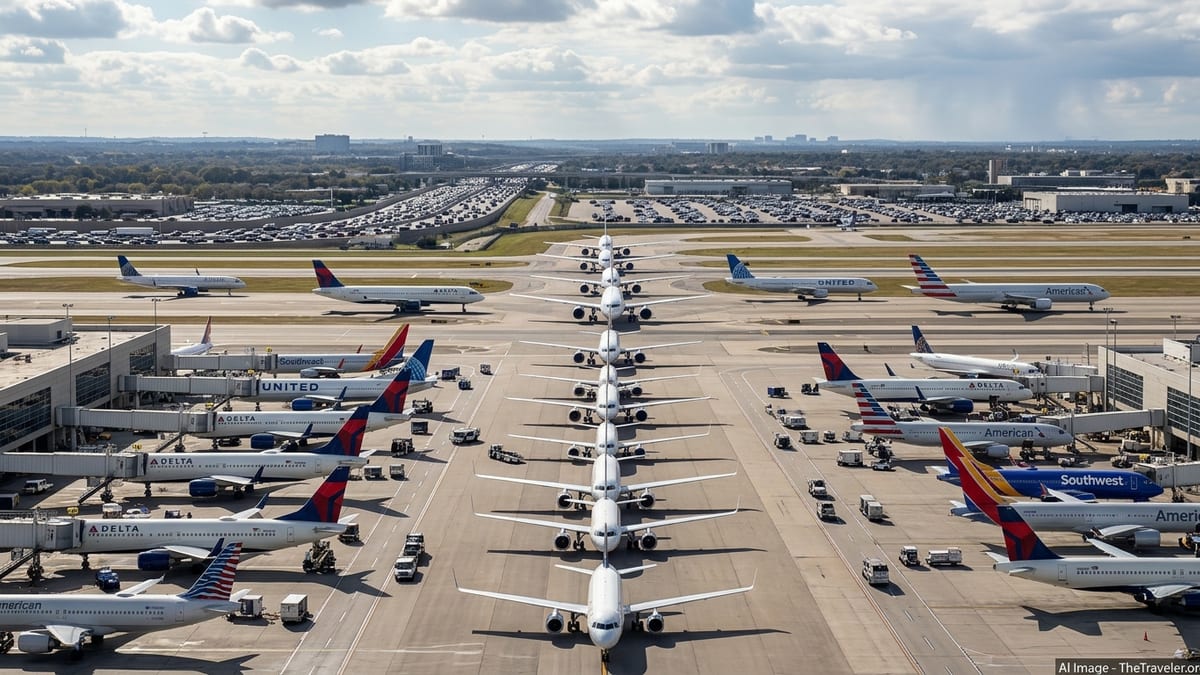
Record Thanksgiving Flight Volumes Meet a Strained System
The Federal Aviation Administration has forecast 417,775 flights across the United States between November 23 and December 1, 2026, the highest Thanksgiving-period flight volume in 16 years. The agency expects Tuesday, November 24, to be the single busiest day, with more than 52,000 scheduled flights. Transportation officials say they have added staffing and new airspace management tools to try to keep delays and cancellations in check during the peak period.
At the same time, road and air demand is only slightly below last year’s near-record levels. AAA projects that 81.5 million Americans will travel at least 50 miles from home for Thanksgiving between Tuesday, November 24, and Monday, November 30. Of these, about 5.96 million are expected to fly on domestic routes, a small decline compared with 2025 but still more than 7 percent of all holiday travelers. Early-morning departures on November 24 and November 25 are expected to be among the most crowded flights of the week.
Official Department of Transportation data show that in a typical late-year period roughly one in four U.S. flights arrives at least 15 minutes behind schedule, with late-arriving aircraft and airline operational issues accounting for far more delay minutes than weather alone. That means the system enters the 2026 Thanksgiving rush with relatively tight margins, and even short-lived disruptions can ripple for days when aircraft and crews are already fully utilized.
Recent Ground Stop and Airline Outages Set a Volatile Backdrop
Travelers entering the holiday week are still dealing with the consequences of several recent operational shocks. On Friday, November 20, a problem with air traffic control communications and radar feeds prompted the FAA to order a nationwide ground stop that lasted more than four hours. The halt, imposed as a safety precaution, led to thousands of cancelled and heavily delayed flights on one of the last major getaway Fridays before Thanksgiving.
Although the ground stop was lifted the same day and flight volumes have since recovered, cancellations and missed connections from that episode pushed some travelers onto already busy flights in the days that followed. Airlines have been rebooking passengers and adding limited extra capacity where possible, but schedules in popular leisure markets are dense enough that some customers have had to accept alternative routings or travel a day earlier or later than planned.
Separately, major carriers have reported their own technology issues in the run-up to Thanksgiving. Delta Air Lines experienced a computer outage on Sunday, November 22, that briefly halted flights into its main hub at Hartsfield–Jackson Atlanta International Airport. The FAA issued a temporary ground stop for Atlanta-bound flights while the problem was addressed, and while operations resumed later that day, data from flight-tracking services show that Delta saw more than two thousand delays on November 22 alone. United Airlines and Delta also reported earlier system glitches within the same week, which contributed to hundreds of additional delays as airlines reset their operations.
Weather Systems Threaten Disruptions on Both Coasts
Meteorologists are warning that multiple storm systems could complicate Thanksgiving week flying, particularly around key coastal hubs. Forecasts as of November 24 point to recurring rain and wind along the Pacific Coast and in the Southeast through the holiday, along with at least one storm system that could bring snow to higher elevations and pockets of wintry weather inland. Another weather maker is expected to move up or along the East Coast late in the weekend, potentially affecting return flights on Sunday, November 29, and Monday, November 30.
On the West Coast, an unusual sequence of very high tides is expected to coincide with passing storms. Forecasters say so-called king tides along parts of the Pacific Coast could reach or exceed records set about four decades ago. In low-lying coastal communities, these tides may cause saltwater flooding of roads and rail lines near airports, particularly around the San Francisco Bay Area. Local officials have warned that high water levels could slow ground transportation to and from airports, even if flights themselves are able to operate on schedule.
In the Southeast, forecasters highlight the risk of heavy rain, gusty winds and the possibility of severe thunderstorms, especially across Florida on Wednesday, November 25. Short-lived but intense storms around major hubs like Miami and Orlando can prompt air traffic control to reduce arrival and departure rates, leading to airborne holding patterns, ground delay programs and, in some cases, diversions to nearby airports. While national forecasts stress that exact impacts will depend on how each system evolves, they agree that travelers using coastal airports should build additional buffer time into their plans.
Demand Softens Slightly, but Delay Risk Remains Elevated
Despite the record number of scheduled flights, overall Thanksgiving travel is expected to edge down compared with last year. AAA’s national forecast shows a 0.1 percent decline in total travelers versus 2025, ending a three-year run of record Thanksgiving volumes. Air travel is projected to dip about 0.2 percent, and AAA branches in several states, including Wisconsin and Virginia, report modest reductions in the number of residents planning to fly.
The slight easing in demand is attributed in part to higher prices. Travel organizations and booking sites report that average domestic airfares for the holiday period are higher than they were in 2025, reflecting increased fuel costs and strong demand on peak dates. Some travelers have opted to drive instead or to shift trips to early December, but for those who need to fly on the core dates surrounding Thursday, November 26, aircraft load factors remain high and seats in popular time bands are limited.
Historical federal statistics suggest that even with a small drop in passenger numbers, late November remains one of the most delay-prone periods of the year. In the final two months of 2025, nearly a quarter of U.S. flights arrived at least 15 minutes late, and airlines cancelled a higher share of flights than during many off-peak months. Analysts emphasize that while weather is a visible cause, operational issues such as aircraft being out of position and tight crew schedules often play an equal or larger role, particularly when recovering from earlier disruptions like this year’s nationwide ground stop.
What Thanksgiving Week Flyers Should Check Next
Transport officials and travel organizations are urging passengers to treat schedules during the 2026 Thanksgiving period as subject to change, particularly through Monday, November 30. The Department of Transportation and the FAA advise passengers to monitor their airline’s app or website closely on the day of departure, as these are usually updated before airport display boards when schedules shift. Airlines are also using push notifications and text messages more aggressively this year to flag gate changes, rolling delays and rebooking options after cancellations.
Given the potential for storms and lingering operational knock-on effects, travelers booked on tight connections at large hubs may want to review same-day alternatives in advance and understand their airline’s reaccommodation and refund rules. Under current regulations, U.S. carriers must provide refunds when a flight is cancelled and the passenger chooses not to travel, but they are not required to compensate for weather-related delays. Some airlines have issued limited travel waivers around specific weather forecasts or the earlier ground stop, typically allowing customers to move their trip by a few days without change fees when seats are available.
Those yet to depart should build in extra time for every stage of their journey. The Transportation Security Administration continues to recommend that passengers arrive at least two hours before domestic flights and three hours before international departures, and suggests allowing additional time at the busiest airports or during early morning departure waves. With further updates on both weather systems and airline operations expected daily through the end of November, travelers can reduce the impact of this year’s disruptions by checking conditions repeatedly rather than relying on a single forecast or schedule snapshot made days in advance.