


More news on this day
Arriving flights into Las Vegas’ Harry Reid International Airport faced federally ordered delays of up to 90 minutes on Monday night, 23 November 2026, after the U.S. Federal Aviation Administration (FAA) introduced a temporary ground delay program citing air traffic control staffing constraints during one of the year’s busiest travel weeks.
Get the latest news straight to your inbox!
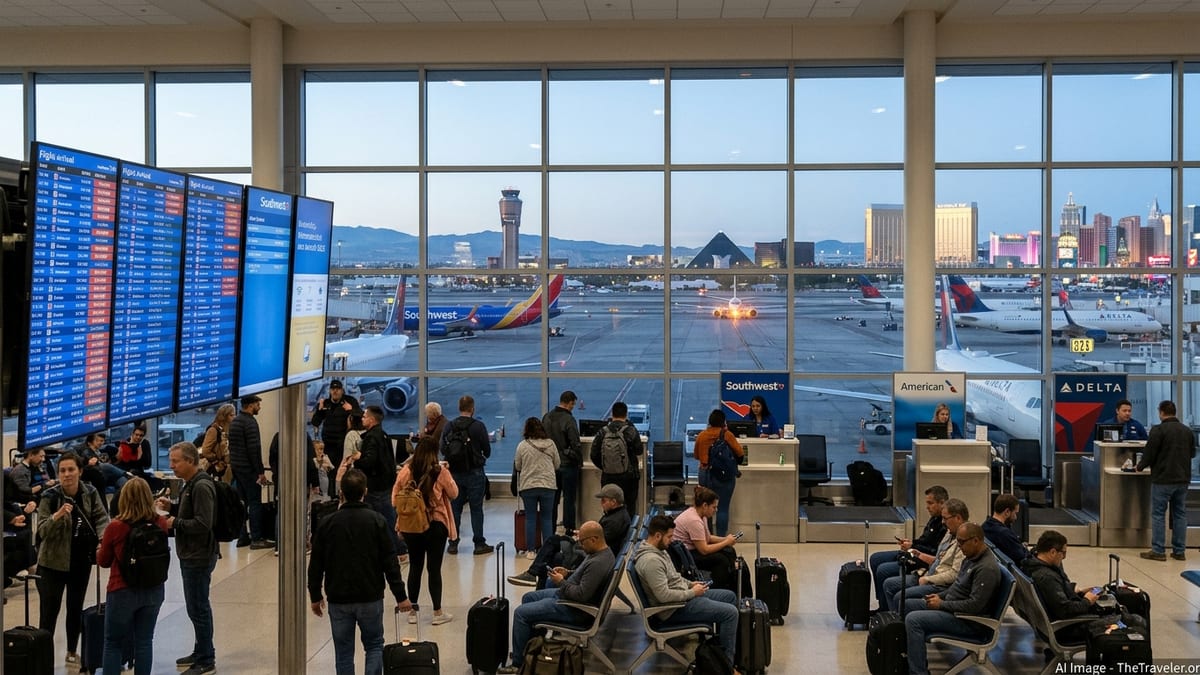
FAA Caps Las Vegas Arrivals For Monday Night Peak
According to an FAA traffic management advisory issued early on Monday evening, a ground delay program was put in place for selected flights arriving at Harry Reid International Airport, with the agency explicitly identifying air traffic control staffing as the reason for the restriction. The program applied to eligible flights departing from airports in the contiguous United States that fell within the FAA’s distance-based parameters for such controls.
The advisory scheduled the ground delay program to cover arrivals into Las Vegas from 9:00 p.m. to 11:59 p.m. Pacific Time on 23 November. Within that window, the agency set an arrival rate of 32 aircraft per hour, below what the airport can typically accept in normal conditions. To achieve that reduced flow, departure slots for affected aircraft were metered at their origin airports so that flights would reach Las Vegas more evenly spaced.
The FAA advisory indicated that flights subject to the program were being assigned an average delay of about 34 minutes, with some itineraries receiving holds of up to 90 minutes. These figures refer to traffic management delays assigned through the FAA system to specific flights rather than the average delay experienced by all passengers using the airport on Monday.
Staffing, Not Weather, Cited As Cause Of Las Vegas Restrictions
The FAA’s national airport status tools and the text of the Las Vegas advisory both linked the restrictions to staffing limitations in the air traffic control system rather than to local weather disruption. Routine weather observations for Harry Reid International on Monday evening showed generally good visibility and light winds, and there were no concurrent FAA weather-related ground stops listed for the airport during the same period.
A ground delay program of the type used in Las Vegas does not close an airport to traffic. Instead, it is a traffic management measure that regulates the rate of arrivals by assigning controlled departure times at origin airports. Airlines must hold affected departures until their allocated slot, which in turn spaces out inbound flows so that they align with the temporarily reduced handling capacity of controllers managing the destination airport’s airspace.
Because only certain flights fall within the program parameters, not all passengers flying to or through Las Vegas on Monday night were directly affected by the FAA measure. However, late-arriving aircraft can have a knock-on effect on subsequent departures if operating crews or aircraft are scheduled to operate later segments from Harry Reid International, particularly on tightly timed evening turns.
Las Vegas Delays Follow Separate O’Hare Staffing Ground Stop
The staffing-related Las Vegas arrival restrictions were introduced several hours after the FAA ordered a brief ground stop for some flights bound for Chicago O’Hare International Airport earlier on Monday. Publicly available FAA status data and multiple airline and local news updates indicate that the O’Hare ground stop began late on Monday morning, local time, and was lifted around midday.
In the Chicago case, the FAA cited staffing constraints at Chicago’s Terminal Radar Approach Control facility, which manages approach and departure traffic for O’Hare, as the reason for halting selected inbound flights at their departure points. Summaries of the event compiled from FAA information indicate that the stop was in place for around 90 minutes, with assigned average delays close to 50 minutes and some flights experiencing holds approaching 80 minutes before being released.
The FAA has not stated that the Chicago and Las Vegas measures were operationally linked beyond both being attributed to staffing issues. The two events took place in different facilities and airspace sectors and were managed through different types of programs: a ground stop for O’Hare and a ground delay program for Harry Reid International. Taken together, however, they underline how resource constraints at individual air traffic control units can temporarily reduce the amount of traffic that can be safely handled, even in generally good flying weather.
Busy Week For Las Vegas After F1 Grand Prix And Ahead Of Thanksgiving
The Monday night arrival controls at Harry Reid International came at the end of a particularly demanding period for Las Vegas air traffic. The city hosted the Formula 1 Las Vegas Grand Prix from 19 to 21 November, an event that drew large numbers of international and domestic visitors and boosted demand for flights, hotel rooms and ground transportation across the metropolitan area.
In advance of that race weekend, the FAA had already implemented special airspace and traffic management procedures around Las Vegas to cope with increased numbers of charter flights, private jets and additional scheduled services. Those measures, which covered Harry Reid International and several surrounding general aviation facilities, were primarily designed to accommodate additional aircraft movements directly associated with the Grand Prix and were scheduled to finish after race-related traffic subsided.
Monday’s staffing-related ground delay program was separate from the F1 arrangements and came just as the U.S. Thanksgiving travel period was beginning in earnest. Federal forecasts released this week indicate that overall U.S. air traffic during the nine-day Thanksgiving window from 23 November to 1 December is expected to reach its highest level in more than a decade, meaning that even short-lived constraints at major airports can quickly ripple through airline networks.
Impact On Airlines And What Travelers Should Check
Harry Reid International Airport is a significant base or focus city for several domestic carriers, including Southwest Airlines as its largest operator, alongside American Airlines, Delta Air Lines, United Airlines, Spirit Airlines and Frontier Airlines. Because many of these airlines operate high-frequency daily schedules into Las Vegas, especially in the evening period when leisure travelers arrive for short stays, even a moderate reduction in the hourly arrival rate can have a visible effect on same-day operations.
Real-time flight data on Monday evening showed selected arrivals into Las Vegas operating with extended airborne holding or delayed departures from origin airports compared with their published schedules, consistent with the FAA’s metering program. While some flights outside the defined program window continued largely on time, passengers booked on later connections or on aircraft due to operate multiple segments in one night were at greater risk of knock-on disruption.
The FAA scheduled the Las Vegas ground delay program to end before midnight Pacific Time on 23 November, and subsequent FAA status updates on Tuesday showed Harry Reid International operating without special staffing-related arrival programs. As of the morning of 24 November, neither Las Vegas nor Chicago O’Hare was under a staffing-related ground stop or ground delay program, though both airports continued to report routine weather and volume-related delays typical of the Thanksgiving period.
What Happens Next For Thanksgiving Week Flyers
With the Las Vegas program and the O’Hare ground stop both lifted and no continuing staffing-related FAA programs in force at either airport on Tuesday morning, airlines have moved to absorb residual delays and reposition aircraft ahead of the busiest outbound travel days. Federal forecasts for the holiday period anticipate hundreds of thousands of flights nationwide through the first weekend of December, leaving little slack in schedules if further localized issues arise.
Travelers heading to or connecting through Harry Reid International over the coming days are advised to follow airline communications closely and to check both their departure and arrival airport status on the day of travel. Same-day schedule changes can occur quickly when the FAA introduces new traffic management measures, and airlines often update departure times, gate assignments and rebooking options first through mobile apps and direct messages rather than airport display screens.
Passengers travelling to the Las Vegas Strip should also allow extra time for ground transport. Although the F1 Las Vegas Grand Prix has concluded, parts of the street circuit infrastructure and associated traffic diversions can remain in place while barriers and temporary facilities are removed, affecting the flow of taxis, ride-hailing services and shuttle buses between the airport and resort corridor. With Thanksgiving approaching, higher-than-usual passenger volumes and continued construction or removal work around the Strip may add to journey times even after flight operations at the airport return to normal patterns.