


More news on this day
With U.S. government data showing roughly one in four flights arriving late during recent holiday seasons, many travelers will spend unexpected hours in airport terminals this year. Health organizations and fitness coaches say using that time for light movement instead of sitting and scrolling can meaningfully reduce stiffness, stress and some long‑haul health risks before you board.
Get the latest news straight to your inbox!
Delays Are Common, But Sitting Still Is Optional
Federal data compiled for the U.S. Department of Transportation’s Air Travel Consumer Report shows that delays remain a routine part of flying, particularly around peak holiday periods. Separate analyses of November and December 2025 performance found that nearly one quarter of U.S. flights arrived at least 15 minutes late, illustrating how quickly weather, congestion and technical glitches can ripple through the system during busy weeks. For travelers, that translates into long stretches in gate areas and crowded concourses with little certainty about when a flight will actually depart.
Public-health guidance has increasingly focused on what travelers do with those hours. The Centers for Disease Control and Prevention and the American Society of Hematology both note that long periods of sitting, especially in cramped conditions, can contribute to leg swelling and raise the risk of deep vein thrombosis, a blood clot that usually forms in the legs. They recommend regular movement, calf exercises and brief walks during long journeys to help maintain circulation, whether the trip is by air, road or rail.
For most healthy people, the absolute risk of a serious travel-related blood clot is still low, and medical bodies emphasize that long-distance trips are safe for the vast majority of passengers. But the same organizations say that simple habits like stretching in the terminal, flexing ankles while seated and taking short walks can reduce discomfort and may help lower risk further, particularly on flights longer than four hours or for travelers with additional risk factors such as recent surgery, pregnancy or a history of clots.
How Light Exercise Helps Before You Board
Trainers who work with frequent flyers point to three main benefits of moving during a delay: improved circulation, reduced stiffness and calmer mood. Even five to ten minutes of low-intensity activity, such as walking the length of the concourse or doing a short series of bodyweight movements, is enough to increase heart rate slightly and encourage blood flow back from the lower legs to the rest of the body. That can counteract some of the pooling that occurs when you spend prolonged periods in a seat, both at the gate and later on the aircraft.
Joint stiffness is another concern on heavy travel days. Prolonged sitting can leave the hip flexors, hamstrings and lower back feeling tight before you even buckle in. Physical-activity guidelines from organizations like the World Health Organization and U.S. health agencies highlight regular movement breaks as one way to reduce musculoskeletal discomfort. Stretching major muscle groups at the airport can help you board feeling looser and may make it easier to find a comfortable position in a cramped row once airborne.
Mental health is a third reason to swap doomscrolling for movement. Research on light-intensity exercise shows that short bouts of activity can improve mood and reduce anxiety for many people. Trainers who work with anxious flyers often incorporate simple walking or breath-linked stretching into pre-flight routines, arguing that focusing on physical sensation and breathing can interrupt rumination about delays, missed connections or turbulence. In a chaotic terminal environment, even a brief, structured routine can restore a sense of control.
Five Terminal-Friendly Moves You Can Do In Regular Clothes
Most airports now offer at least some open space near unused gates or along quieter corridors where travelers can move without blocking foot traffic. Fitness coaches recommend choosing exercises that require no special equipment, respect nearby passengers’ personal space and can be done in ordinary travel clothing. The following five movements meet those criteria and align with general guidance from health organizations to prioritize circulation, mobility and light strength work.
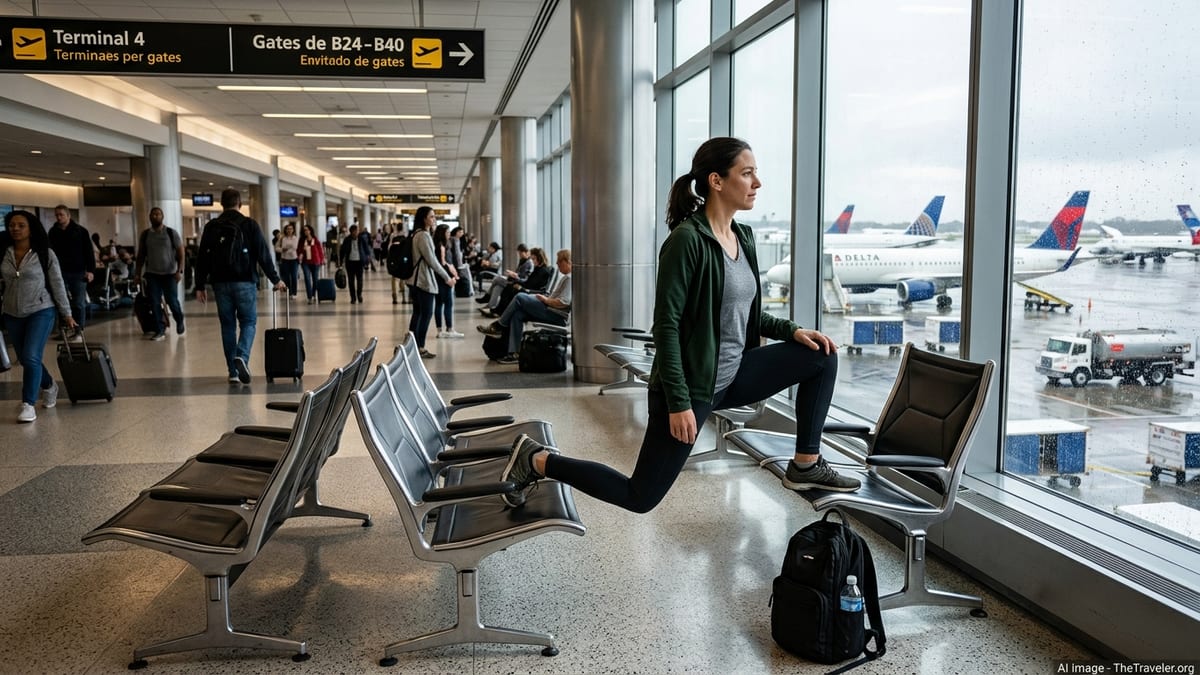
An elevated runner’s lunge targets the hip flexors and front of the thigh, areas that tighten quickly on long travel days. To perform it using a standard terminal chair, stand about one long step in front of the seat with your back to it, place the toes of one foot lightly on the chair and bend the front knee until you feel a stretch along the front of the rear hip. Keeping the torso upright and the front knee stacked roughly over the ankle, hold for 30 to 60 seconds while breathing steadily, then switch sides. This stretch requires only the footprint of your chair space and can be done facing away from the boarding area to maintain privacy.
A seated glute stretch can be performed without standing up at all, which makes it useful at a crowded gate. Sit tall toward the front of the chair, cross your right ankle over your left knee and flex the right foot. Gently hinge forward from the hips until you feel a stretch along the outside of the right hip and glute, then hold for 30 to 60 seconds before switching legs. Trainers say this movement can relieve some of the pressure that builds in the hips and lower back after hours of sitting in the car, on airport shuttles and later on the plane.
Bodyweight squats add a light strength component and get large muscle groups working without requiring much space. From a standing position with feet about shoulder-width apart, sit your hips back and bend your knees as if you were going to sit in the chair behind you, then stand back up. Performing 10 to 15 repetitions at a controlled pace can raise your heart rate slightly and wake up the quadriceps and glutes. Some coaches suggest starting with a few squats that use the chair for support, then progressing to a wider “sumo” stance with toes turned slightly out to reach the inner thighs, provided your knees feel comfortable.
Hand luggage can substitute for gym equipment if used carefully. Holding a small carry-on, duffel or backpack close to the body, travelers can perform basic biceps curls or standing rows in front of an empty window or corner section of the concourse. Trainers recommend choosing a weight you can lift for 8 to 12 repetitions without straining and keeping movements smooth rather than jerky to avoid disturbing those nearby. For safety and courtesy, it is important to ensure bags are fully zipped and to avoid swinging them into walkways.
Finally, brisk walking remains one of the most accessible exercises in any terminal. Public-health agencies routinely highlight walking as a simple way to meet daily activity recommendations, and many airport terminals offer long, uninterrupted stretches of corridor. Setting a relaxed but purposeful pace for 10 to 20 minutes can accumulate thousands of steps without special preparation. Some travelers choose to walk laps between landmarks, such as from one end of the concourse to the other, to make use of the time between delay updates.
Medical Guidance On Movement, Circulation And Long Flights
Health authorities consistently advise travelers not to remain completely still for the entire duration of a long journey. The CDC’s travel health resources note that sitting without moving for many hours can cause blood to pool in the legs, particularly on trips longer than about four hours. They recommend standing up to walk occasionally when it is safe to do so, flexing and extending the ankles while seated and avoiding tight, restrictive clothing around the waist or legs. These measures, while simple, are intended to support normal venous return from the lower limbs.
The CDC’s Yellow Book for clinicians, along with reviews in medical journals, emphasizes that the airplane environment itself is less important than immobility and certain personal risk factors. For travelers with a previous history of deep vein thrombosis, recent major surgery, active cancer or known clotting disorders, clinicians may suggest additional strategies such as medical compression stockings or, in some cases, preventive medication. For otherwise healthy passengers, guidance usually focuses on regular movement, hydration and avoiding smoking and excessive alcohol before and during long flights.
Aviation-focused safety materials echo the same message in more practical terms. Educational brochures distributed by aviation regulators and pilot-safety programs advise passengers to increase leg-muscle activity during long periods of sitting by walking around the cabin when possible and performing ankle circles and heel raises in the seat. Some documents also point out that aisle seats make it easier to stand and move without disturbing others, which can be a consideration on itineraries that involve multiple long segments.
Experts also stress nuance about risk. Studies suggest that the likelihood of a serious clot remains low for most travelers, and some research indicates the risk rises most markedly on very long flights, such as those over 10 to 12 hours. Nevertheless, medical organizations note that shorter trips can still be uncomfortable if you remain in a fixed position. For that reason, combining in-flight leg movements with pre-boarding stretches and a brief walk through the terminal offers a layered approach that targets both comfort and risk reduction without requiring specialized equipment or facilities.
Practical Tips For Building An “Airport Movement Routine”
For many travelers, the biggest barrier to airport exercise is not a lack of space but uncertainty about etiquette and logistics. Trainers suggest starting with a simple, repeatable sequence that fits within a standard boarding area: a few minutes of walking, two seated stretches and one short set of squats. Choosing a relatively quiet gate or an unused corner of the terminal reduces self-consciousness and ensures you are not blocking passengers rushing to board.
Time management is another concern during irregular operations. Airlines may update departure times in short increments, and boarding can sometimes begin earlier than expected after a long delay. To avoid missing key announcements, travelers can break movement into five- to ten-minute segments between status checks, staying within sight and earshot of the departure screens. Noise from the public-address system also means it is sensible to exercise without headphones or to keep the volume low enough to hear gate calls clearly.
Comfort and hygiene are worth considering as well. Light layers that are easy to remove, such as a zip-up jacket, allow you to warm up without overheating. Carrying a small pack of hand wipes or sanitizer lets you clean your hands after touching armrests or railings and before eating. Trainers discourage floor-based movements in busy terminals, both to respect cleanliness and to avoid occupying excessive space during peak times; standing and seated variations usually offer sufficient benefit for most travelers.
Finally, some coaches encourage pairing movement with a short mental reset. That can be as simple as taking a few slow breaths at the start and end of your routine or silently noting one or two aspects of the trip you are looking forward to. While such practices are not a substitute for medical or therapeutic care, they can help shift attention away from schedule frustrations and toward elements of the journey you can control.
What Travelers Should Check Before Their Next Holiday Flight
With holiday air traffic in the United States projected to approach or exceed pre-pandemic levels again, transportation agencies are promising operational improvements, yet delays remain likely at least some of the time. Before heading to the airport, travelers can review their itinerary to identify the longest segments and tightest connections, then plan when they will have realistic opportunities to move. Checking terminal maps in advance can highlight longer corridors, moving walkways and less busy seating areas that lend themselves to short walks and stretches.
Those with medical conditions that might affect circulation or mobility should consult healthcare providers before travel, particularly if they have a history of blood clots or recent major surgery. Clinicians can advise whether additional measures such as compression stockings or prescription medication are appropriate. Once at the airport, travelers can also pay attention to their own comfort levels: signs such as increasing leg swelling, pain or severe shortness of breath during or after a flight warrant prompt medical evaluation rather than self-treatment.
As busy holiday weeks begin, the underlying message from both trainers and health authorities is that passengers are not powerless during disruptions. Even when departure times slide and gate areas grow crowded, short bouts of movement, stretching and walking can make long days in transit more manageable. Building a simple airport routine in advance means that if your next flight joins the many that run behind schedule, you will already know how to use that unexpected time in a way that supports your body and mind.