


More news on this day
Brussels Airport suspended all passenger flights on Monday 23 November 2026 after Belgium’s national strike extended to air traffic control, forcing airlines to cancel hundreds of departures and arrivals during the main operating day.
Get the latest news straight to your inbox!
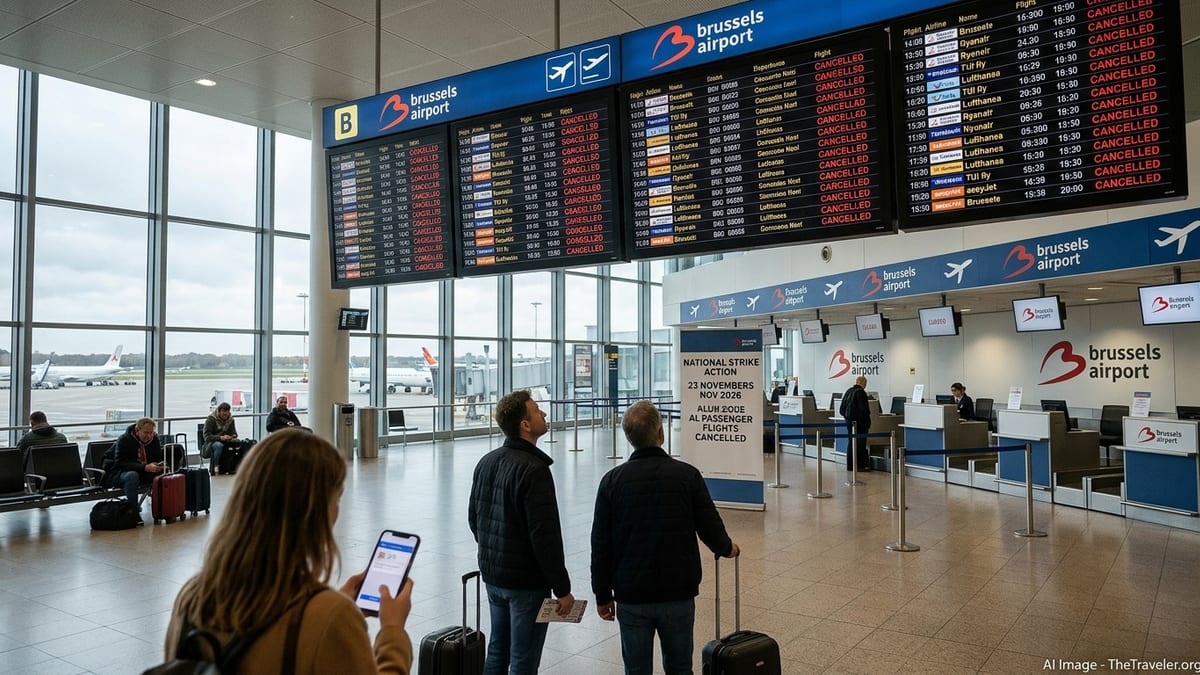
What happened at Brussels Airport on 23 November
Brussels Airport confirmed ahead of the national strike that it would cancel all passenger flights on Monday 23 November 2026 after receiving notice that some air traffic controllers at skeyes, Belgium’s air navigation service provider, would participate in the industrial action. With normal air traffic operations no longer guaranteed, the airport told airlines to scrap their passenger flight programme during the core day, and carriers subsequently removed their Brussels schedules for that date.
Airport and aviation industry reports indicate that the cancellations affected both departing and arriving passenger services throughout the day, with the main interruption running from the early morning peak through the evening. Operational summaries published after the strike point to more than 400 passenger flight movements being removed from the schedule at Brussels Airport alone, representing essentially the entire planned passenger programme for 23 November.
The disruption was not limited to Brussels Airport. Charleroi Airport, Belgium’s second-largest passenger gateway, also reported significant cancellations linked to the same national strike, although the exact level of service at Charleroi varied by airline and time of day. Elsewhere in Belgium, public transport and other services were heavily reduced or halted as unions staged a coordinated day of action against federal government austerity measures.
Why the national strike grounded flights
The national strike on 23 November was called by major Belgian trade unions in protest at the federal government’s budget plans and wider cost-cutting agenda. While the action formally targeted economic and social policy, its impact quickly extended into transport because several categories of workers, including air traffic controllers, airport staff and public transport employees, joined the walkout. Once skeyes staff participation was confirmed, the capacity of Belgian airspace to handle normal passenger traffic was sharply reduced.
Brussels Airport stated in advance that, without reliable staffing levels at air traffic control, it could not ensure safe and orderly management of passenger flights. The airport therefore asked airlines to proactively cancel their Brussels services for 23 November rather than attempt to operate a limited schedule that might require last-minute diversions or airborne holding. This approach aligned with previous Belgian strike days when airspace restrictions and staffing shortages prompted large-scale preventative cancellations at major airports.
Because air traffic control is a critical national function that affects all airlines equally, the cancellations were spread across the home carrier Brussels Airlines, leisure operator TUI fly Belgium, low cost carriers such as Ryanair and a long list of European and intercontinental network airlines. Cargo operations were also affected where flights required the same air traffic control and ground handling resources as passenger services, although detailed data on cargo movements has been less widely reported than the passenger impact.
How airlines and passengers were affected
According to post-strike tallies by aviation outlets and network monitoring services, the decision to suspend passenger operations at Brussels Airport translated into hundreds of individual flight cancellations. One review counted just over 400 cancelled passenger flights at Brussels on 23 November, with additional disruption at Charleroi. For comparison, this placed the day among the most heavily disrupted in recent Belgian aviation history, similar in scale to previous national strike days that forced airspace closures or near-complete shutdowns of traffic.
Airlines began adjusting their schedules several days before the strike, but the final wave of cancellations was confirmed over the weekend of 21–22 November after Brussels Airport’s formal announcement. Carriers updated their booking systems and notified customers through email, text message and mobile apps, although some travelers reported that the airport’s public flight board continued to show flights as scheduled until airlines had fully processed the changes. This lag is consistent with the airport’s own explanation that a flight only appears as cancelled on its board once the operating airline has officially recorded the cancellation.
For affected passengers, options varied by airline and ticket type. In most cases, carriers offered free rebooking to later dates or alternative routings via nearby hubs on the first available service, subject to seat availability. Some airlines also provided refunds for customers who chose not to travel once their flights were cancelled. As is typical in Europe for industrial action outside an airline’s direct control, most carriers treated the strike as an extraordinary circumstance in terms of cash compensation, while still being responsible for re-routing or reimbursing customers in line with applicable regulations.
Impact on wider Belgian transport and connections
The one-day national strike had wider consequences for domestic and international connectivity beyond the immediate flight cancellations. Belgian media and international broadcasters reported that large parts of the country’s public transport network were severely disrupted on 23 November, with rail, bus, tram and metro services operating at reduced frequencies or suspended entirely in some regions. This combination of airport disruption and limited ground transport made it more difficult for travelers to reach alternative departure points or continue journeys by land.
Rail links between Brussels Airport and the city centre were affected by the wider rail strike, although a small number of skeleton services and long-distance trains continued to run. International services such as Thalys and Eurostar adjusted their timetables around the strike, but passengers were advised to check specific trains rather than assume normal operations. For travelers whose flights were rebooked via neighboring countries, the reduced Belgian rail and coach offering sometimes complicated same-day connections.
Hotel occupancy in Brussels and surrounding towns saw a short-term bump as stranded travelers accepted airline offers of accommodation or made their own last-minute bookings when same-day re-routing proved impossible. However, the strike was confined to a single day, and airports and rail operators aimed to resume their regular schedules on Tuesday 24 November. Some knock-on delays and aircraft re-positioning continued into the following day as airlines worked through the backlog created by the large number of cancellations.
What travelers should do for current and future bookings
The national strike on 23 November 2026 has concluded, and Brussels Airport and Charleroi Airport have resumed normal operations. For travelers whose flights on that specific date were cancelled, the main task is to work with their airline or travel agent on rebooking or refunds according to the conditions already communicated. Because the strike was a single-day event, most airlines are focusing on accommodating displaced passengers within the surrounding days rather than applying longer-term schedule changes.
Looking ahead, union representatives in Belgium have not announced a new date for another nationwide strike directly linked to the same dispute, but they have left open the possibility of further action if talks with the government do not progress. Eurocontrol and other network coordination bodies typically publish operational bulletins when national strikes are formally notified, and Belgian airports issue passenger-facing updates when disruption is likely. Travelers with flights to or from Belgium in the coming months should monitor these channels and their airline’s direct notifications rather than relying on historical strike patterns.
For any upcoming trip involving Brussels or Charleroi, passengers are advised to verify their flight status on the day of travel using their airline’s app or website and to allow extra time for airport procedures if industrial action in related sectors, such as security screening or public transport, is announced. If a new strike is confirmed for a future date, airlines will normally outline specific options for free changes or cancellations once they adjust their schedules. Keeping contact details up to date in existing bookings and checking reservations a few days before departure remains the most practical way for travelers to stay informed when labor disputes threaten to disrupt Belgian air travel.