


More news on this day
Recent technology glitches and weather disruptions have again highlighted how Delta Air Lines manages flight delays, drawing attention to the airline’s internal playbook for keeping people and aircraft moving when schedules begin to unravel.
Get the latest news straight to your inbox!
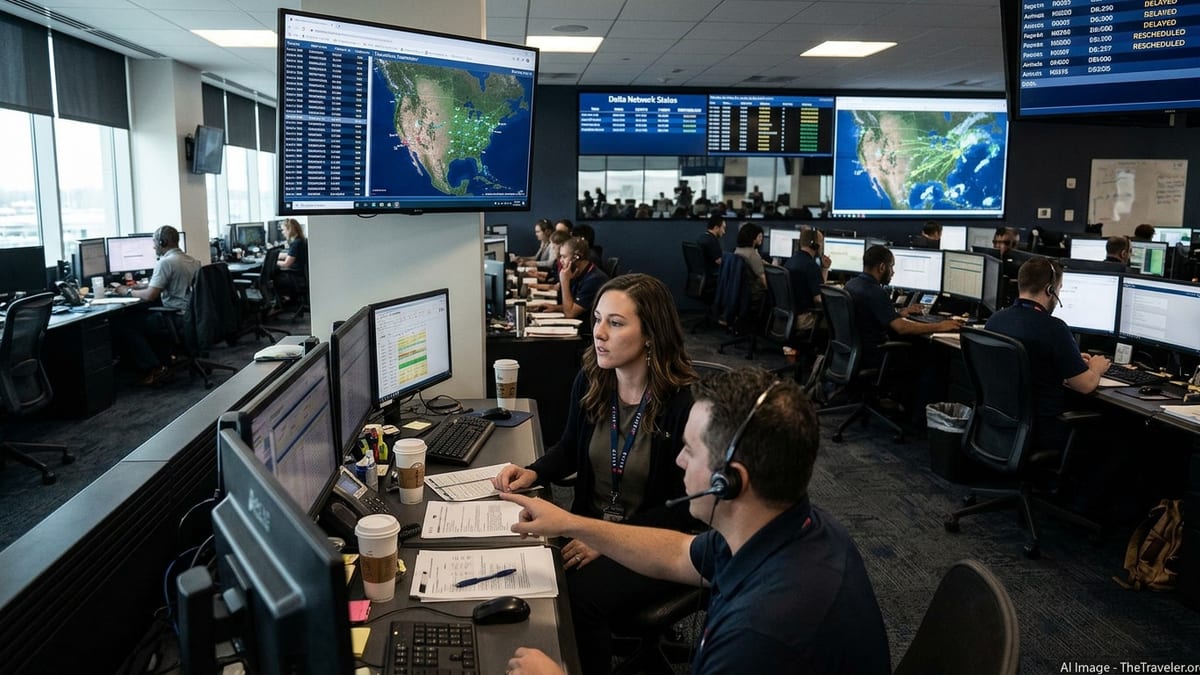
Inside Delta’s Operations Center When Flights Start To Slip
When delays begin to build, the first moves happen far from the gate, inside Delta’s operation and customer centers. These control rooms are responsible for balancing aircraft, crews and airport capacity across the network. During November 2026, for example, an outage in the automated system used to calculate aircraft weight and balance forced Delta to slow departures while teams temporarily switched to manual processes. The airline said the system was later restored and operations stabilized, illustrating how an internal technical issue can quickly translate into widespread delays even when weather is not severe.
In disruption scenarios, Delta’s operations teams examine whether delays are likely to remain isolated or cascade. They can decide to hold flights briefly to accommodate connecting passengers, re-sequence departures so that long-haul flights leave first, or cancel select services in order to preserve the broader schedule. These decisions are constrained by federal crew duty rules, gate availability, airport curfews and maintenance requirements, all of which can turn what appears to be a short delay into a much longer knock-on effect for later departures.
Coordination with the Federal Aviation Administration is also central. When air traffic flow programs, ground stops or reroutes are issued because of congestion or storms, Delta must integrate those restrictions into its own recovery plan. The result is that a delay attributed to “air traffic control” on a flight-status screen often reflects a mix of FAA capacity limitations and internal choices by the airline about which departures to prioritize and how long to wait for inbound aircraft and connecting passengers.
Delta’s Formal Rules: Contract of Carriage, Customer Plan and Tarmac Policy
For travelers, the most concrete guide to what Delta will and will not do during delays is set out in three public documents: the Contract of Carriage, the Customer Service Plan and the Contingency Plan for Lengthy Tarmac Delays. The Contract of Carriage, updated in mid 2026 for U.S. itineraries, spells out Delta’s legal obligations when flights are canceled or significantly delayed. In general, if a delay or cancellation is within the airline’s control, it commits to rebooking passengers on the next available Delta flight at no additional fare. If travel is no longer desired, the contract provides for refunds in certain circumstances, especially when a flight is canceled or significantly changed and the customer chooses not to travel.
Delta’s Customer Service Plan is more operational in tone. It describes how the airline will provide information and basic care during disruptions, including regular updates on gate displays, through airport announcements and via digital channels. Importantly for passengers facing extended waits at the airport, the plan commits to offering a meal or meal vouchers if a cancellation or delay within Delta’s control results in a wait of three hours or more beyond the scheduled departure time. Hotel accommodations may also be provided when overnight stays are required and the cause is within Delta’s control, although the plan notes that this commitment is subject to local availability.
Separate from schedule changes at the gate, Delta’s Contingency Plan for Lengthy Tarmac Delays covers situations in which passengers are on board the aircraft but cannot take off or return to the gate. In line with U.S. Department of Transportation rules, Delta’s plan states that for domestic flights the airline will not allow an aircraft to remain on the tarmac for more than three hours without offering passengers an opportunity to deplane, subject to safety, security or air traffic control restrictions. The plan also requires Delta to provide adequate food and potable water no later than two hours after the start of the tarmac delay, along with operable lavatories, appropriate medical attention when needed and reasonable cabin temperature. These assurances apply both at origin and at diverted airports, and the DOT treats failures to comply as unfair and deceptive practices under federal law.
Irregular Operations, Rebooking Priorities and When Compensation Applies
Internally, Delta refers to major disruptions as “irregular operations,” often shortened to IROP. The airline maintains detailed IROP policies for its own staff and travel agency partners that describe which flights can be changed without additional charges, how far in advance rebooking can occur, and when partners are allowed to move customers onto other routes. During an IROP event, Delta typically authorizes agents to waive change fees and fare differences for specific date and city pairs covered by a travel waiver, enabling passengers to move their trips forward or backward by a limited window or reroute through alternative hubs when seats are available.
Rebooking priority in these circumstances depends on several factors, including original cabin, frequent flier status and the time at which travel was disrupted. However, the Contract of Carriage confirms that when a flight is canceled or extensively delayed, Delta’s first remedy is to transport the passenger on its own services as soon as practical, even if that requires using a higher cabin of service while managing upgrades and seat allocations according to its normal priority rules. If a passenger decides not to travel because of a qualifying schedule change or cancellation, the contract allows for refunds instead of rebooking, subject to conditions such as whether travel has already begun and whether certain special fares are involved.
Cash compensation for delays is more limited on U.S. domestic itineraries than many travelers might expect. There is no general federal requirement for airlines to pay cash for delayed flights that operate within or between U.S. cities, and Delta’s U.S. Contract of Carriage does not create a broad right to such payments. Compensation is more structured on flights departing from the European Union, the United Kingdom and certain other jurisdictions. In those cases, Delta directs customers to a dedicated process for claims under local passenger rights rules, such as EU Regulation 261/2004, which may provide fixed-sum compensation for long delays, cancellations or denied boarding when the cause is not an extraordinary circumstance. Whether a traveler qualifies depends on the exact routing, length of delay on arrival and cause of the disruption.
How Information and Care Flow to Passengers During a Delay
Delta’s public commitments place a strong emphasis on timely communication. The Customer Service Plan states that the airline will provide full and prompt information about known delays, cancellations and diversions within 30 minutes of becoming aware of a change in flight status. In practice this information is pushed through multiple channels, including airport departure boards, gate announcements, text and app notifications and updates on Delta’s website. When delays evolve gradually, travelers may see departure times revised in increments as operations and dispatch teams refine their estimates based on incoming aircraft, crew duty limits, weather and air traffic control instructions.
On the ground, Delta station staff are responsible for translating high-level operational decisions into specific options for passengers. When a disruption is within the airline’s control and the wait crosses the three-hour threshold, the Customer Service Plan calls for meal vouchers to be issued at the airport, typically via electronic codes that can be used with designated food vendors. When overnight delays occur for reasons within Delta’s control, staff may arrange hotel rooms and ground transportation, prioritizing travelers whose journeys cannot be completed the same day. In periods of widespread disruption, capacity at nearby hotels can become constrained, and the airline’s ability to secure rooms for all affected passengers may be limited by local supply.
For passengers already on board during an extended taxi or holding period, cabin crews implement the tarmac delay plan. That includes monitoring the two-hour point at which food and water must be offered and coordinating with pilots and ground staff about opportunities to return to a gate if the delay approaches the three-hour limit on domestic flights. U.S. regulators have previously penalized carriers, including Delta, when they failed to provide required opportunities to deplane during past tarmac events, and the Department of Transportation has reinforced that updated plans must be submitted and followed. This regulatory pressure has led airlines to pay closer attention to how long aircraft remain on the ground with passengers aboard during irregular operations.
What Travelers Can Do Before and During Disruptions
For passengers, understanding how Delta’s system works can help in making decisions when delays occur. Before travel, monitoring forecasts for key hubs such as Atlanta, New York and Minneapolis and checking for travel waivers on Delta’s website can indicate whether the airline is already anticipating schedule disruptions. When a waiver is in place for a particular region and date range, customers may be able to move their flights at no extra charge before delays actually begin, which can be easier than seeking options after operations are already constrained.
Once a delay is underway, digital tools are often the fastest route to alternative arrangements. Delta’s app and website typically display rebooking options that reflect the same inventory agents can access, allowing customers to switch flights or adjust connections without waiting in line at the airport. For longer or more complex itineraries, contacting Delta Reservations can open additional possibilities, including re-routing through different hubs or moving to the following day when same-day seats are no longer available. When disruption appears to be within Delta’s control and the wait at the airport is extending, travelers can ask gate staff whether meal vouchers or hotel assistance are available under the Customer Service Plan.
Travelers on flights departing the European Union, the United Kingdom or other jurisdictions with specific air passenger rights regimes should also be aware that separate local rules may apply. In those cases, keeping records of delay durations, cause explanations and any written notices provided by Delta can be helpful if a later claim is submitted under EU Regulation 261/2004 or similar frameworks. Within the United States, where compensation is more limited, the most practical steps are often to stay informed through multiple channels, use self-service tools quickly to secure remaining seats on alternative flights, and understand that the level of care offered at the airport will depend on whether the disruption is considered within or outside the airline’s control.