


More news on this day
Delta Air Lines is working to recover its operation at Hartsfield-Jackson Atlanta International Airport after a technology outage affecting automated weight-and-balance calculations triggered more than 1,000 flight delays across its network on Sunday, November 22, 2026, with residual disruptions for Atlanta travelers continuing into Monday.
Get the latest news straight to your inbox!
What happened to Delta’s systems in Atlanta
The disruption began early on Sunday, November 22, 2026, when Delta reported problems with an automated system used to calculate aircraft weight and balance before departure. The airline said the issue affected one of its weight-and-balance systems and forced crews to shift to manual workarounds while technicians worked to restore automation. According to statements provided to multiple outlets, safety procedures remained in place, but the extra time required for manual calculations significantly slowed departures.
Because Atlanta is Delta’s largest hub and handles a high proportion of the carrier’s connecting traffic, the malfunction at a single system quickly had network-wide effects. Data from flight-tracking services indicated that more than 1,300 Delta flights across the United States were delayed on Sunday, with the heaviest concentration at Hartsfield-Jackson Atlanta International Airport. The Federal Aviation Administration briefly implemented a ground delay program for Atlanta-bound Delta flights on Sunday morning to manage congestion while the airline addressed the outage.
By mid- to late afternoon on Sunday, Delta said the automated system had been restored and normal departure processes could resume. However, the volume of aircraft and crews already out of position meant that schedules could not recover immediately, particularly in Atlanta, where Delta and its partners account for roughly four out of every five passenger flights.
Impact on flights at Hartsfield-Jackson Atlanta International Airport
Atlanta felt the brunt of the outage because of its role as Delta’s primary hub. At various points on Sunday, departures from Hartsfield-Jackson slowed to a crawl as the carrier prioritized safety checks and manual weight-and-balance work. The FAA confirmed that a temporary ground delay program was used for flights heading into Atlanta, meaning some aircraft were held at their origin airports to prevent gridlock on arrival.
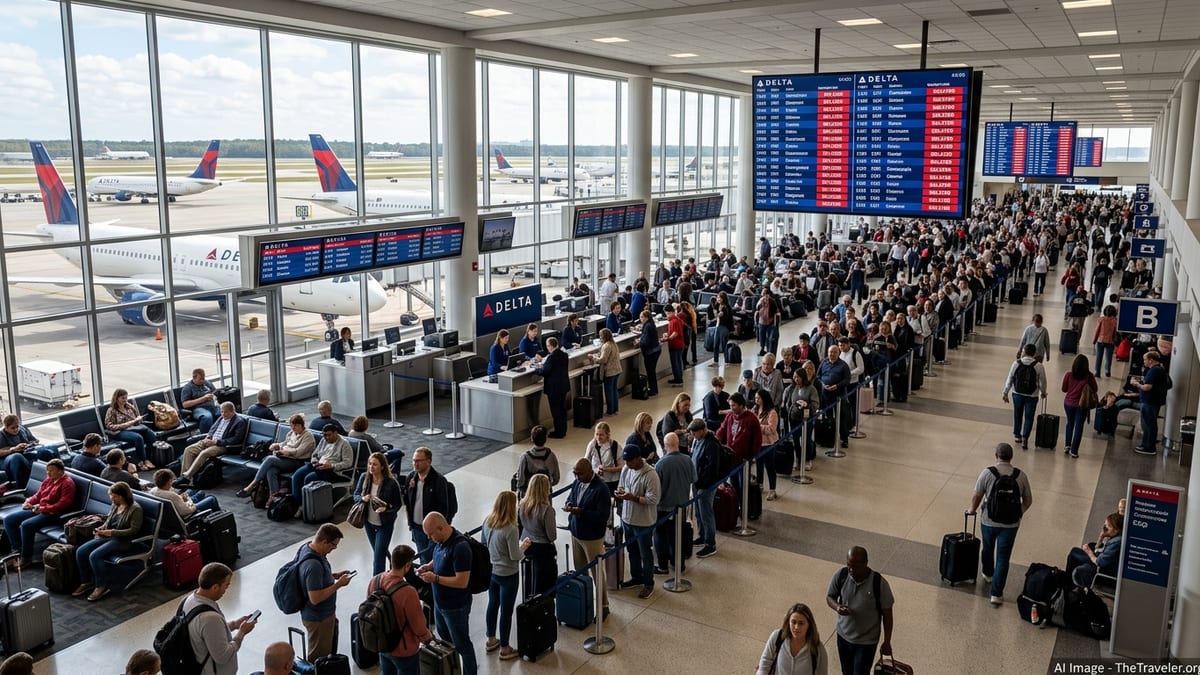
The disruption did not end when the technology was brought back online. On Monday morning, November 23, flight status data showed dozens of Delta-operated departures and arrivals at Atlanta still delayed or canceled as the airline worked through the backlog. One set of figures from flight-tracking provider FlightAware indicated more than 40 cancellations and over 100 delays for Delta flights at Atlanta alone by mid-morning Monday. Local media and airport images showed crowded concourses and passengers camped out near gates as they waited for rebooked flights or delayed departures.
The ripple effects extended beyond Atlanta because the hub connects passengers across the U.S. and internationally. Aircraft and crews delayed in Atlanta on Sunday arrived late into other cities, which in turn caused further delays for subsequent legs of those aircraft. Travelers departing from smaller Delta stations reported shorter delays on Monday than those connecting through Atlanta, but many still encountered late departures or missed connections attributable to the previous day’s outage.
How this outage fits into a wider pattern of aviation tech problems
The latest Delta outage came less than two weeks after a separate nationwide ground stop linked to the Federal Aviation Administration’s communications systems and within days of a technology disruption at United Airlines that interfered with crew communications and weight data for departing flights. While the causes of these incidents were distinct, they have collectively highlighted the aviation sector’s reliance on complex, aging technology at both the airline and air traffic control levels.
In the case of Delta’s Atlanta disruption, the airline has so far described the issue as involving an automated weight-and-balance system but has not publicly detailed the root cause of the malfunction. Early indications point to a localized airline system failure rather than a cyberattack or a direct consequence of the earlier FAA outage. Federal officials and industry groups have nonetheless used the string of recent incidents to renew calls for accelerated investment in both airline IT resilience and the FAA’s infrastructure.
For passengers, the distinction between an airline-specific system issue and a government-run air traffic control problem can be hard to discern in real time. In Sunday’s event, the FAA’s involvement was primarily operational, through tools such as ground delay programs requested or coordinated with Delta to manage congestion into Atlanta while the carrier resolved its internal issue. Once Delta restored its automation, airspace management constraints eased, but the operational consequences for travelers persisted until aircraft and crews could be repositioned.
Timing with the Thanksgiving travel surge
The timing of the disruption heightened its impact. The outage unfolded at the start of the Thanksgiving travel period, historically one of the busiest times of the year for U.S. airlines and particularly for Atlanta, which is the world’s busiest airport by passenger numbers. Industry forecasts ahead of the holiday projected that 2026 Thanksgiving air travel would reach or exceed pre-pandemic records, leaving little slack in the system for recovering from a large operational shock.
As of Monday, November 23, Delta said operations were stabilizing following Sunday’s difficulties, but multiple sources advised that residual delays could continue into Tuesday, November 24, as schedules normalized. Travel advisories recommended that passengers flying with Delta, especially through Atlanta, allow extra time at the airport and monitor their flight status regularly, given that even small schedule adjustments could affect tight connections.
Weather was a secondary but relevant factor. Delta indicated that the majority of its Sunday delays and cancellations were directly tied to the technology issue, but some additional disruptions were attributed to inclement weather in parts of the network. With additional storm systems forecast in parts of the country later in Thanksgiving week, airlines and the FAA are seeking to restore normal operations as quickly as possible to reduce the risk that any new weather problems will interact with unresolved scheduling imbalances from the weekend outage.
What affected travelers should do next
For travelers with upcoming Delta flights, the most immediate step is to verify current flight status directly with the airline before leaving for the airport, especially if their itinerary includes Atlanta or uses the airport as a connection point. While the malfunctioning weight-and-balance system has been restored, knock-on effects such as aircraft and crew repositioning can still lead to schedule changes, short-notice gate swaps or aircraft substitutions over the next day or so.
Passengers already impacted by delays or cancellations stemming from the outage should review Delta’s rebooking and waiver options for this specific event. Although policies can vary depending on fare type and route, airlines often provide more flexible rebooking rules during major operational disruptions, particularly around key holiday travel periods. Customers who missed connections or arrived late may also wish to keep documentation of delays and any additional costs in case they qualify for future vouchers or reimbursement under the airline’s customer service commitments or, for international itineraries, applicable regulations.
Looking ahead to the remainder of the Thanksgiving period, travelers across all U.S. airlines may benefit from building extra buffer time into their plans, especially where tight layovers or last-flight-of-the-day segments are involved. While Delta’s latest technology issue is now formally resolved, its impact illustrates how quickly a localized systems problem at a major hub such as Atlanta can escalate into a broader operational challenge during peak demand, and how recovery can take longer than the underlying outage itself.