


More news on this day
Thanksgiving air travel in 2026 is colliding with fresh disruption and hard numbers on past performance, as a new analysis of federal data identifies JetBlue as the carrier with the highest share of delayed Thanksgiving-week flights in recent years while a separate technology outage at Delta has already snarled thousands of journeys ahead of this year’s holiday.
Get the latest news straight to your inbox!
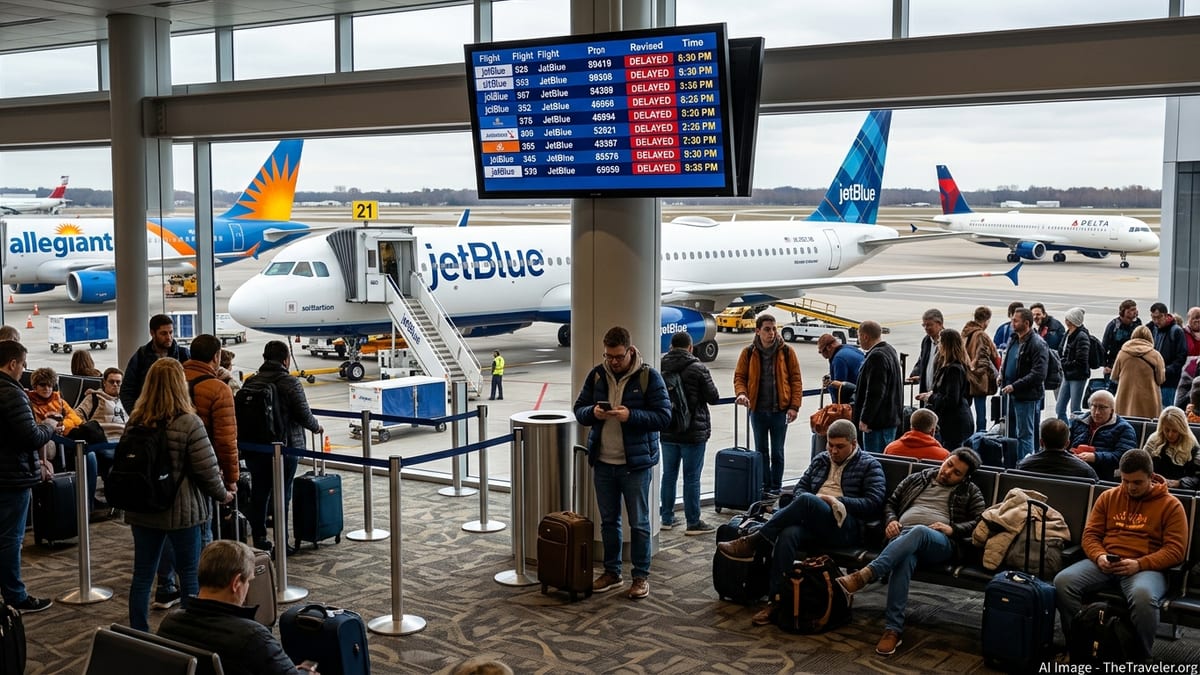
Study of 2021–2025 Thanksgiving flights puts JetBlue at top of delay table
The new Thanksgiving delay rankings come from coupon site CouponFollow, which analyzed U.S. Bureau of Transportation Statistics on-time performance data for large domestic airlines during the nine-day Thanksgiving travel period from 2021 through 2025. According to the study, JetBlue had the highest proportion of late departures over those holiday weeks, with 28.2 percent of its flights arriving at least 15 minutes behind schedule. Allegiant followed at 27.4 percent and Frontier at 26.5 percent over the same Thanksgiving windows.
By contrast, Delta recorded the lowest rate of Thanksgiving delays among the airlines included in the CouponFollow analysis, with just under 14 percent of its holiday-period flights arriving late during those four years. The figures reflect performance for the pre-Thanksgiving Saturday through the Sunday after the holiday, a period that federal and private forecasters consistently identify as one of the busiest and most delay-prone stretches of the U.S. aviation calendar.
The study’s authors caution that historical performance does not guarantee similar results in a given year, particularly during peak travel periods that are highly sensitive to weather and operational shocks. However, the figures offer travelers a data-backed comparison when weighing tight connections or planning itineraries that must align with fixed events such as Thanksgiving dinners or cruise departures.
Delta system failure triggers thousands of delays ahead of the holiday
The historical edge that Delta enjoyed in the CouponFollow rankings has already been tested in 2026. On Sunday 22 November, just three days before Thanksgiving, Delta suffered a major outage affecting the automated system it uses to calculate aircraft weight and balance before takeoff. The malfunction forced delays and cancellations across the carrier’s network, with particular disruption at its largest hub, Hartsfield-Jackson Atlanta International Airport.
Flight-tracking service FlightAware reported that roughly 2,000 Delta flights were delayed on 22 November, equal to more than half of the airline’s schedule that day, and that more than 60 percent of Delta’s operations experienced some form of delay at the peak of the disruption. Subsequent tallies indicated hundreds of additional delays and nearly 100 cancellations on Monday morning as the airline worked through aircraft and crew dislocations caused by the outage, even after the core system was restored.
Delta has said its systems were brought back online on Sunday afternoon and that it aimed to have all delayed flights in the air by the end of that day, but has acknowledged ongoing knock-on effects into the early part of Thanksgiving week. There is currently no indication from the airline or federal officials that the issue was cybersecurity-related, and regulators have emphasized that the fault did not affect on-board safety systems. However, the incident follows a separate Federal Aviation Administration ground stop earlier in November, underscoring how dependent the U.S. air travel system remains on aging digital infrastructure.
Thanksgiving 2026 volumes near record levels despite recent glitches
The Delta disruption and earlier FAA ground stop come as overall Thanksgiving travel in 2026 is expected to be near recent highs. AAA forecasts that about 81.5 million people in the United States will travel 50 miles or more from home between Tuesday 24 November and Monday 30 November, only slightly below last year’s record estimate. Of those travelers, roughly 6 million are expected to fly on domestic routes, representing just over 7 percent of all Thanksgiving trips.
Federal Aviation Administration projections obtained by industry outlets indicate that airlines plan to operate more than 417,000 flights over the broader nine-day Thanksgiving period from 23 November through 1 December. That is about 2 percent more flights than during the same period in 2025 and around 7 percent more than in 2019, before the pandemic. Major hubs including Atlanta and Dallas–Fort Worth are forecast to be among the busiest airports by seat capacity, with each expected to handle more than 2 million departing seats around the holiday.
Travel demand is returning despite higher prices. Data from travel booking platforms compiled in late October suggest that average domestic round-trip fares for Thanksgiving are roughly one-third higher than a year earlier, while some international routes are up by as much as 30 percent. Analysts attribute most of the increase to elevated fuel costs and strong demand rather than to the specific disruptions seen in November, which are more likely to affect individual travel days than overall pricing for the period.
Weather and congestion outlook: where delays are most likely
Weather forecasts from the National Weather Service’s Weather Prediction Center for the week of Thanksgiving point to unsettled conditions on both U.S. coasts, with a series of systems expected to bring rain to portions of the East and West and pockets of snow inland, particularly at higher elevations. Forecasters currently expect comparatively dry conditions across much of the central United States, which could ease some pressure on hubs in that region but does not eliminate the risk of local storms or low ceilings that can curtail airport capacity.
Congestion projections from traffic analytics firm Inrix and AAA indicate that the heaviest road traffic will fall on Tuesday 24 November and Wednesday 25 November, as well as Sunday 29 November and Monday 30 November as travelers return home. Those days also tend to see elevated airport congestion and longer security lines, according to Transportation Security Administration screening data from prior Thanksgiving periods. By contrast, flying on Thanksgiving Day itself typically yields lighter crowds and, historically, fewer delays, although individual storms or operational issues can still cause significant local disruption in any given year.
For New York City, where the Macy’s Thanksgiving Day Parade will mark its 100th procession, forecasters are monitoring wind speeds that could affect the famous character balloons, though detailed hour-by-hour conditions will only be confirmed closer to the morning of Thursday 26 November. The National Weather Service issues specific wind and weather guidance to city officials and parade organizers, who can lower or ground balloons if sustained winds or gusts exceed safety thresholds. Travelers heading to or from New York around the parade should be prepared for additional street closures, crowding on public transport and potential weather-related adjustments to airport operations in the wider region.
What the data and disruptions mean for Thanksgiving travelers
Although the CouponFollow analysis highlights notable differences in historical Thanksgiving delay rates by airline, the events of November 2026 illustrate how quickly the picture can change when a single carrier experiences a major technical problem. Travelers booked on Delta over the days following the 22 November outage, for example, may still encounter residual delays even though the airline’s average Thanksgiving performance between 2021 and 2025 was strong. Conversely, carriers with weaker historical statistics could have relatively smooth operations in a particular year if weather and systems cooperate.
For passengers yet to travel this week, the most immediate step is to monitor flight status directly with the airline and through airport information channels, particularly if flying on the peak days of Tuesday, Wednesday or Sunday. Same-day rebooking options, waivers or schedule changes are usually published first through airline apps and websites when operational issues arise. Travelers making tight connections or linking flights to time-sensitive ground transportation may wish to consider earlier departures or more generous layovers, since the combination of heavy volumes, weather and recent system glitches leaves less margin for error than at quieter times of year.
Looking beyond Thanksgiving 2026, the combination of rising demand, higher fares, a series of technology-related disruptions and aging national air traffic control infrastructure is prompting renewed scrutiny of how resilient the U.S. travel system is during peak periods. Federal officials have pointed to new forecasting tools and contingency planning teams designed to manage congestion and limit delays, while industry groups are calling for accelerated investment in both government and airline technology. For individual travelers, however, the practical implications this week remain straightforward: check status often, build in extra time where possible and be aware that even airlines with strong long-term holiday records are not immune to sudden disruptions.