


More news on this day
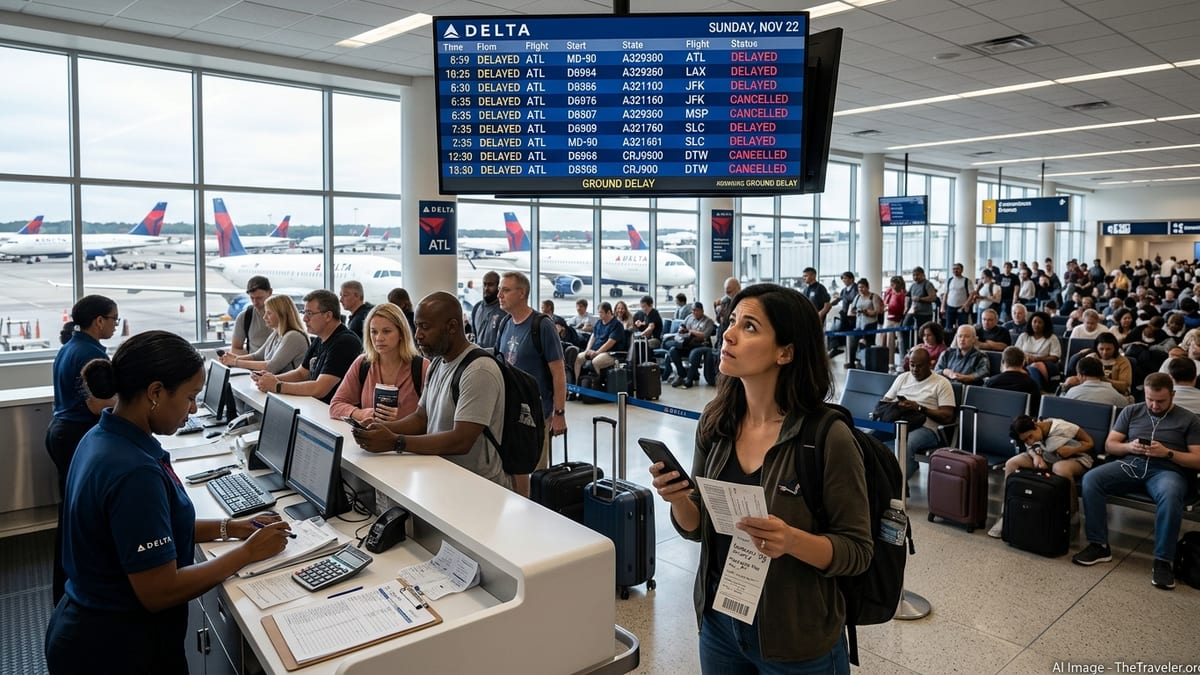
Delta Air Lines’ automation failure on Sunday, November 22, has spilled into the first major day of the 2026 Thanksgiving travel rush, with flight‑tracking services reporting more than 1,300 delays and nearly 200 cancellations affecting U.S. flights by late Monday morning as airlines worked to reposition aircraft and crews ahead of one of the busiest holiday periods in years.
Get the latest news straight to your inbox!
What happened to Delta’s automation system?
On Sunday, November 22, Delta confirmed an issue with the automated system it uses to calculate weight and balance for departing flights, a critical safety step that determines how passengers, baggage, cargo and fuel are distributed on each aircraft. The airline said the problem affected its Automated Load Instruction System, known internally as ALIS, which generates digital load sheets used by crews and ground staff before departure.
As the outage unfolded, Delta told passengers and media that teams were using manual workarounds to dispatch flights while technicians worked to restore automation. Federal Aviation Administration advisories and local airport statements show that the carrier requested a ground stop for Delta and its regional affiliates into Hartsfield-Jackson Atlanta International Airport on Sunday morning, which the FAA later downgraded to a ground delay program that metered arrivals into the already congested hub.
Public data collated by flight-tracking platforms indicate that more than 1,400 Delta flights were delayed worldwide on Sunday, with several hundred cancellations, as aircraft waited for manual calculations and crews went out of position. While Delta said the automation issue was resolved later on Sunday and that core operations were stable again by Monday, the disruption created a backlog that continued to affect travelers at the start of Thanksgiving week.
Scale and geography of the knock-on delays
By late morning on Monday, November 23, aggregated flight-status data showed at least 1,300 flights within, into or out of the United States running late and just under 200 canceled, across all airlines. Although not every delay could be traced directly to Delta’s outage, aviation data providers and airport reports linked a significant share of Monday’s U.S. disruption to residual effects from Sunday’s ground stop and ground delay program into Atlanta.
The impact was most visible at airports where Delta has a major presence. Hartsfield-Jackson Atlanta International, the carrier’s largest hub, continued to see late-arriving aircraft and tight turnaround times at the gate as Delta worked through Sunday’s backlog. Knock-on delays were also reported at Detroit, Minneapolis–St. Paul, Salt Lake City, Los Angeles International, and New York’s LaGuardia and John F. Kennedy airports, where passengers encountered rolling schedule changes and extended waits for connecting flights as aircraft and crews were repositioned.
Because the outage affected a core operational system used for every departure, the ripple effects were not confined to Delta’s own network. Congestion at shared airports and in shared airspace fed into delays for other airlines operating in and out of the same hubs. FAA traffic management logs for Monday attribute most of the lingering disruption to recovery operations from earlier outages, localized weather and routine flow-control measures, rather than to a new nationwide technical failure.
Interaction with a heavily loaded Thanksgiving schedule
The timing of Delta’s automation failure has amplified its impact for travelers. Federal Aviation Administration forecasts released ahead of the holidays project that U.S. skies between November 23 and December 1 will be busier than at any point in the past 16 years, with more than 410,000 flights expected in that nine-day window. Separate industry analyses indicate that scheduled flights for Thanksgiving 2026 are up slightly compared with last year, even as average domestic round-trip fares have risen compared with 2025.
At major hubs including Atlanta, Dallas–Fort Worth, Denver, Chicago O’Hare and Los Angeles, airlines have increased seat capacity to meet demand, and airports have prepared for passenger volumes at or near record levels. Carriers have also added extra frequencies on key trunk routes and shifted to larger aircraft on some services. While that additional capacity increases choice, it leaves relatively little slack in the system: when a fully booked flight is canceled or significantly delayed during such a busy week, rebooking passengers is challenging because there are few empty seats on later departures.
That dynamic has been evident in the wake of Sunday’s outage. Travel agents and travelers reported multi-hour waits to secure alternative itineraries after missed connections, particularly for those attempting to depart or transit through Atlanta on Sunday evening or Monday morning. In some cases, passengers were rebooked onto flights later in the week or routed through secondary hubs, and a smaller number required overnight accommodation near the airport while they waited for available seats.
How this outage fits into a month of aviation tech problems
Delta’s weight-and-balance system failure is the latest in a string of technology-related incidents affecting U.S. aviation in November 2026. Earlier in the month, a malfunction in the FAA’s communications network prompted what officials described as the longest nationwide ground stop for U.S. flights in roughly a quarter-century, temporarily halting departures around the country while engineers worked to restore data links between controllers and aircraft.
Within days of that government systems issue, United Airlines reported its own technology outage that briefly stopped the carrier from dispatching flights while a system used for operational planning and weight calculations was restored. Those events had largely been resolved before the weekend of November 21–22, but they highlighted how quickly glitches in complex aviation networks can cascade, as airlines and air traffic control rely on tightly calibrated schedules and digital tools to keep flights moving safely.
In this context, the FAA and airlines have repeatedly stressed that halting or slowing departures when systems behave unpredictably is a safety-first decision, even when it leads to long delays. For Delta, switching from automated to manual weight-and-balance calculations is a standard contingency that dispatchers and load controllers train for, but industry experts note that such procedures are inherently slower and can reduce throughput significantly at high-traffic hubs like Atlanta.
What airlines are offering affected passengers
Delta has acknowledged that Sunday’s disruption originated within its own automation systems and said it is working directly with affected travelers on rebooking and providing assistance in cases of substantial delay. In public statements, the airline has pointed to meal vouchers, hotel stays and ground transportation support at certain locations where passengers were stranded overnight, although it has not published a detailed tally of how many customers qualify for each form of support.
Under U.S. regulations, airlines are required to provide a refund if a flight is canceled and a passenger chooses not to travel. Beyond that, compensation policies for delays and missed connections are set by each carrier. Many large U.S. airlines, including Delta, distinguish between disruptions within their control, such as certain technical issues, and those caused by weather or air traffic restrictions; in practice, this distinction influences whether accommodation and meal vouchers are routinely offered or handled case by case.
Other U.S. carriers were less directly affected by Delta’s outage but still contended with crowded terminals and airspace. Most have continued to advise passengers traveling this week to check flight status frequently via airline apps, text alerts and airport information screens, and to build extra time into itineraries. For travelers using separate tickets on different airlines, customer service reminders emphasize that each carrier is responsible only for the flights it operates, which can complicate assistance when a delay on one airline causes a missed connection on another.
Practical steps for travelers still facing disruption this week
For passengers whose flights were delayed or canceled on Sunday or Monday, securing a workable alternative itinerary remains the immediate priority. Travel advisers generally recommend starting with an airline’s mobile app or website, where automated tools may present self-service rebooking options more quickly than airport counters or phone centers can handle requests, especially during large-scale disruptions when call queues can last for hours.
Booking directly with the operating carrier, rather than through a third-party platform, can make this process easier, because the airline retains greater flexibility to move passengers between its own flights or those of partners when interline agreements permit. If a trip was purchased via an online travel agency, travelers may find that both the airline and the intermediary need to be involved in significant changes, which can add time during already stressful periods.
Once new travel plans are confirmed, it is worth reviewing whether any part of the original ticket or paid extras can be refunded or credited. Depending on the fare rules, accepting a rebooking onto a lower-priced itinerary or a different cabin can leave unused value that is applied as a voucher for future travel. Those conditions are specific to each airline and fare class and are not always explained in detail at the airport, so checking the confirmation email or the booking details after the trip can help travelers avoid leaving money on the table.
What to watch for through the remainder of Thanksgiving week
As of Tuesday, November 24, airlines and federal aviation officials report that Delta’s weight-and-balance automation system has been restored and that there are no separate nationwide air traffic control outages in effect. However, the combination of a recent airline-specific technical failure, earlier infrastructure issues at the FAA, high passenger volumes and unsettled late-November weather means that travelers should still plan for the possibility of localized delays and occasional cancellations through the end of the holiday period.
Passengers yet to begin their Thanksgiving journeys may be able to reduce risk by choosing morning departures where possible, building longer connection times into itineraries and, for those transiting ultra-busy hubs like Atlanta or Dallas–Fort Worth, checking whether scheduled layovers meet or exceed the minimum connection times that airlines recommend under current operating conditions. If a planned connection appears particularly tight, contacting the airline before travel to explore an earlier inbound flight can provide additional buffer.
Given how quickly conditions can change, the most reliable information for day-of-travel decisions will continue to come from official airline channels, airport status boards and FAA traffic management notices. Before leaving for the airport, travelers should confirm departure times, terminals and gate assignments, and be prepared for changes even after check-in. With several of the busiest days of the Thanksgiving travel window still ahead, building flexibility into plans, packing essential medications and valuables in carry-on bags, and monitoring updates closely remain the most practical ways to navigate the lingering effects of Delta’s outage and any additional bottlenecks that may emerge later in the week.