


More news on this day
Hundreds of flights across the United States were delayed and dozens canceled in recent days as airlines and passengers continued to feel the ripple effects of a nationwide Federal Aviation Administration ground stop earlier this month, compounded by localized storms and a series of airline technology outages heading into the busy Thanksgiving travel period.
Get the latest news straight to your inbox!
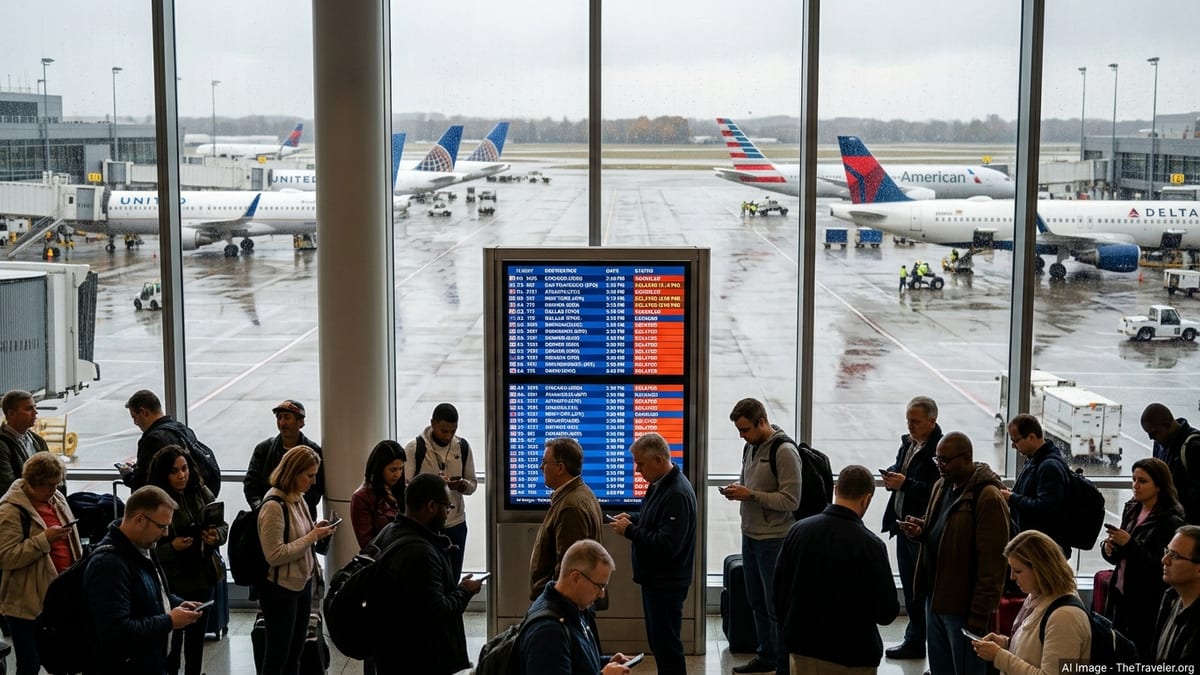
Latest disruption: hundreds of delays and dozens of cancellations
On Friday 20 November 2026, more than 925 flights within, into or out of the United States were delayed and at least 70 were canceled, according to figures compiled from FlightAware data and reported by multiple outlets. Those numbers represent a snapshot for that day rather than an ongoing condition, but they underline how fragile operations remain less than two weeks after the FAA ordered the first nationwide ground stop in decades on 13 November.
As of the morning of Tuesday 24 November, FlightAware’s live statistics showed well under 200 delays and a smaller number of cancellations, indicating that the system has largely stabilized for now. The FAA’s own daily Air Traffic Report for 24 November flagged only potential weather-related slowdowns at San Francisco and Seattle and did not list any broad traffic management programs beyond routine flow measures. Independent trackers that monitor the FAA’s National Airspace System feed also reported no active ground stops, ground delay programs or airport closures in the United States at the time of publication.
The contrast between a relatively quiet current picture and the spike in delays and cancellations on 20 November highlights how quickly travel conditions can change during a high-volume period when airlines are still working through earlier disruptions. For travelers, it means statistics from even a few days earlier can paint a more severe picture than what they will actually encounter at the airport, while still serving as a reminder that plans may be vulnerable to renewed interruptions.
Background: nationwide ground stop and a week of outages
The recent wave of disruptions is closely linked to a nationwide FAA ground stop that began on Friday 13 November 2026 and lasted roughly four hours and forty-five minutes. According to an update from the U.S. Department of Transportation and a subsequent FAA question-and-answer document, the halt in departures stemmed from telecommunications problems that affected communications and radar feeds used by air traffic controllers. Out of caution, the FAA instructed all airports to hold departures until the issue could be stabilized, while flights already in the air were handled with existing backup procedures.
Although the ground stop itself was lifted later that evening, its effects spilled into the following days. A nonpartisan Congressional Research Service brief estimated that about 6,700 flights were canceled on Saturday 14 November, with more than 2,300 additional cancellations on Sunday 15 November as airlines worked to reposition aircraft and crews. Carriers also had to rebook or refund large numbers of passengers and adjust schedules that had been meticulously planned for the Thanksgiving surge.
The nationwide halt came during what analysts have described as the worst week for major technology outages in over a decade, with failures affecting Microsoft cloud services, United Airlines, the National Security Agency and a large U.S. bank among others. In aviation, United had already reported a system failure affecting its own operations earlier in the week. These events have intensified scrutiny of both airline IT resilience and the FAA’s broader air traffic control modernization program, but specific long-term policy responses are still in the discussion phase and have not yet translated into confirmed operational changes for travelers.
Additional pressure from airline glitches and localized weather
Beyond the FAA’s system issue, individual airlines have added their own complications. On Sunday 22 November, Delta Air Lines experienced a problem with the automated system that calculates an aircraft’s weight before departure. The airline and aviation officials confirmed that the glitch forced a temporary ground stop for Delta departures, most notably at its Atlanta hub. Flight tracking data indicated that more than 1,000 Delta flights were delayed that day, with a smaller share canceled as the carrier worked through the backlog and reset schedules.
United Airlines also reported an outage affecting its technology systems in the same general period, resulting in substantial delays and a limited number of cancellations while it restored normal operations. Details of that incident are still emerging through company statements and regulatory disclosures, but the timing meant that some passengers booked on United experienced disruption on top of the wider instability in the national aviation system. These airline-specific events are separate from the FAA’s own ground stop, although for travelers caught up in them the cause may matter less than the practical impact on their itineraries.
Concurrent weather conditions in parts of the country have further strained recovery efforts. Earlier in November, storms intensified by El Niño brought heavy rain and flooding to South Florida and triggered strong winds and downpours in Northern California. At San Francisco International Airport, this led to temporary halts to some operations and multi-hour delays on certain flights as air traffic controllers reduced arrival and departure rates for safety. Ferry services around the Bay Area were disrupted and roads in surrounding counties were flooded, complicating surface access to the airport and adding to the overall travel challenge for passengers.
How current performance compares and where delays cluster
While the recent delays and cancellations have been disruptive, federal statistics from earlier in the year indicate that the overall reliability of U.S. airline operations in 2026 is not dramatically worse than in many pre-pandemic years. The Department of Transportation’s Air Travel Consumer Report covering January through September 2026 shows cancellation rates ranging from under 1 percent for some carriers to a little over 3 percent for larger networks when measured across all operations. Those figures capture normal schedule performance rather than extreme events like the November ground stop, which fall into separate irregular operations categories.
Historical analyses of holiday-season performance reveal that delays tend to cluster on specific days rather than being evenly spread. One recent review of Department of Transportation data for 2023 through 2025 found that the Sunday after Thanksgiving was consistently the worst day for delays, with nearly one in three flights arriving at least 15 minutes late, compared with less than one in ten on Thanksgiving Day itself. Late-arriving aircraft accounted for a significant share of delay minutes, followed by airline-related causes such as maintenance and staffing, and then weather. These patterns suggest that system strain builds across the holiday period and peaks as travelers return home, rather than being driven solely by outbound demand.
At the airport level, performance can vary widely. For example, an Axios review of November and December 2025 operations at Austin–Bergstrom International Airport found that around a quarter of both departures and arrivals were delayed by at least 15 minutes, higher than the national average for that season. Other hubs, such as Chicago O’Hare, experience congestion driven by their role as major connecting points. On Monday 23 November 2026, the FAA briefly implemented an arrival ground stop for O’Hare due to a staffing issue at a regional air traffic control facility, pausing some inbound flights before shifting to a longer-term traffic management solution. That episode was localized and had been lifted by early evening, but it illustrates how staffing variations can affect specific cities even when national systems are functioning normally.
What travelers should watch in the coming days
Looking ahead to the rest of the Thanksgiving period, official forecasts point to high volumes but no nationwide shutdowns. The Transportation Security Administration has said it expects to screen roughly 17.6 million passengers between 24 November and early December, while FAA planning documents obtained by media outlets project more than 400,000 flights over the nine-day holiday window from 23 November to 1 December. Weather models at the time of writing suggest that the greatest risk of holiday-related delays will occur on Thanksgiving Day itself in certain regions, with lingering effects possible into Friday morning where storms interact with already tight schedules.
Travelers should be aware that despite the normalization of FAA systems, residual effects from earlier disruptions can still surface unpredictably. Airlines are operating with aircraft and crew allocations that were reshuffled during and after the November 13 ground stop and the subsequent Delta and United outages. In practice, this means that a minor local issue, such as a brief ground stop at a busy hub or a thunderstorm along a key corridor, may lead to larger knock-on delays than it might in a less stressed system. Conversely, today’s relatively low counts of delays and cancellations show that recovery is possible when weather cooperates and technology remains stable.
For individual passengers, the most actionable step remains close monitoring of flight status through airline apps and official airport channels on the day of travel. Given the recent history, it is reasonable to build extra time into connections, favor earlier departures where possible to preserve rebooking options later in the day, and keep contingency plans in mind for overnight stays if flights are heavily disrupted. Travelers should also pay attention to updated guidance on rebooking and compensation policies published by their carriers in response to this month’s irregular operations, as these determine what assistance is available when widespread delays reappear.