


More news on this day
As U.S. travelers brace for another busy holiday season complicated by technology glitches and storms, Delta Air Lines is highlighting the largely unseen systems and policies it uses to manage flight delays, from its Atlanta operations control center to updated commitments on meals, hotels and refunds when trips are disrupted.
Get the latest news straight to your inbox!
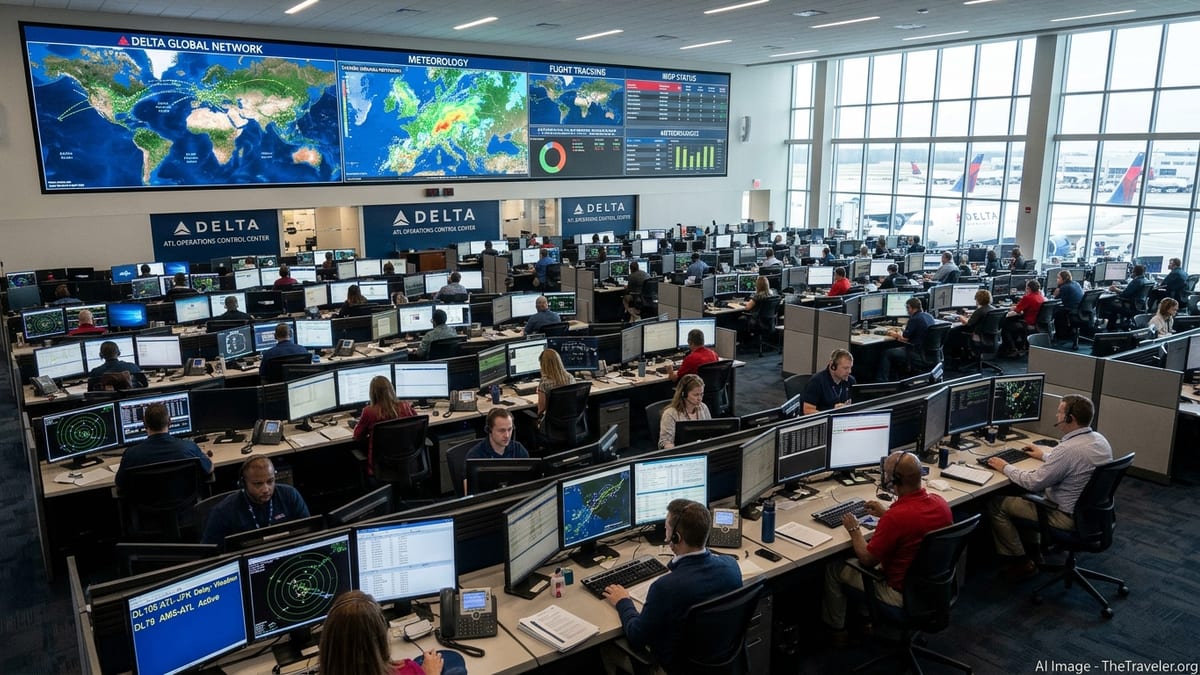
Inside Delta’s Operations Control Center in Atlanta
Every Delta flight that leaves a gate or sits at one during a delay is monitored from the airline’s operations control center at its Atlanta headquarters. Delta describes this facility as the “heartbeat” of the airline, where hundreds of specialists oversee the global network, track aircraft and crews, and respond in real time to weather, air traffic and technical issues that can lead to delays or cancellations. The room functions like a mission-control environment, with large wall displays, rows of workstations and representatives from key departments seated together to speed decisions.
Teams in the operations control center are organized around specific functions, including flight dispatch, crew tracking, maintenance coordination, customer rebooking and meteorology. Delta has its own in-house weather group, which analyzes storm systems and turbulence forecasts and advises dispatchers on routing, departure holds and diversions. That meteorological input is especially important during peak travel periods when storms threaten major hubs, because early decisions on ground stops or schedule trims can reduce the risk of last-minute cancellations and lengthy tarmac delays.
The control center’s job is to balance three priorities: safety, regulatory compliance and keeping the network moving as efficiently as possible. When conditions deteriorate at a hub such as Atlanta, Minneapolis or New York, decisions made in the control room ripple to dozens of other airports. Controllers decide whether to delay individual departures, swap aircraft, reassign crews who are nearing federal duty limits or consolidate lightly booked flights, and they coordinate with airport teams responsible for updating passengers, handling baggage and arranging amenities when delays stretch on.
How Delta Responds When Delays Disrupt the Schedule
When irregular operations occur, Delta describes a structured internal response, often referred to as its irregular operations, or IROP, process. For routine disruptions where no broad travel waiver is issued, the operations control center works flight by flight with local airport staff to adjust departure times, rebook customers and manage crew schedules. For more severe events, such as the automation system outage that delayed a large share of Delta’s schedule ahead of Thanksgiving 2026, the airline may trigger a wider IROP plan and coordinate schedule recovery over many hours.
The first decisions typically involve whether flights can operate safely under current conditions and within crew duty-time rules. If an aircraft cannot depart within a certain time window or a crew will exceed legal limits, controllers may cancel that specific flight and look at available options to re-accommodate passengers on later services. Because aircraft and crew assignments are tightly interlinked throughout the day, a delay on one segment can affect multiple later flights using the same plane or crew pairing, and the control center uses proprietary software to model those impacts before finalizing changes.
When a disruption is within Delta’s control, such as many mechanical issues or certain technology problems, the airline states that it will work to rebook travelers on the next available Delta flight at no additional fare. In some cases, particularly when same-day options on Delta are limited, airport agents may also look at partner airlines, subject to availability and internal guidelines. For larger events, Delta may issue a travel waiver that allows affected customers to change their trips without change fees and, in some cases, fare differences, as long as they travel within specified dates and routes.
What Delta Formally Promises Passengers During Delays
Delta’s customer service plan and contract of carriage set out what the airline commits to provide when flights are significantly changed or delayed. For U.S. itineraries, Delta’s contract specifies that if a flight is canceled, if departure is moved up by three hours or more, or if arrival is delayed by three hours or more in a way that significantly changes the trip, customers may cancel the remaining ticket and receive a refund of the unused portion, including certain ancillary fees, back to the original form of payment. Separate rules apply to some international journeys, where Delta’s international tariff defines significant changes using a longer time threshold.
For controllable delays and cancellations, Delta has also made specific amenity commitments that are summarized on the U.S. Department of Transportation’s Airline Cancellation and Delay Dashboard. In those circumstances, the airline publicly commits to providing complimentary meal vouchers when a passenger waits at least three hours beyond the scheduled departure time, and to offering complimentary hotel accommodations, when available, plus ground transportation between the airport and hotel if a traveler is stranded overnight away from home or their destination. If contract hotels are full, Delta’s written policies state that it will issue a travel voucher approximately equal to the contracted hotel rate rather than leaving passengers without support.
Delta’s own delayed or canceled flight guidance further explains that for residents of the United States and Canada whose flights are canceled or significantly delayed by three hours or more for reasons within the airline’s control, the carrier will consider reimbursement requests for reasonable meal and hotel expenses, as well as reasonable transportation to and from the hotel, when travelers are inconvenienced overnight. To make a claim, passengers must submit receipts through Delta’s reimbursement form after the trip. These commitments apply on top of any rights travelers have under local or foreign regulations, such as European Union rules governing delays and cancellations on qualifying flights.
Communication, Tarmac Rules and the Role of Regulators
Regulators set minimum standards for how U.S. airlines must communicate during delays and manage extended tarmac waits, and Delta incorporates those requirements into its internal procedures. Under federal rules, carriers must designate employees responsible for monitoring delays and cancellations and must notify customers within 30 minutes of becoming aware of a significant change such as a cancellation, diversion or delay of 30 minutes or more. Delta’s customer service plan commits to providing timely updates through gate agents, airport displays, its website and mobile app as new information becomes available.
Federal regulations also govern how long an aircraft may remain on the tarmac with passengers on board before the airline must allow them to deplane, with limited safety and security exceptions. Delta’s published commitments indicate that, during such events, the airline will provide essential needs including food and water at appropriate times, functioning restrooms and necessary medical attention, and will keep customers informed about the status of the delay. The operations control center coordinates closely with airport teams in these situations to decide whether to return to the gate, continue to wait in a departure queue, or cancel and deboard.
The U.S. Department of Transportation does not require airlines to pay cash compensation for delays and cancellations that are the airline’s fault, but it does enforce adherence to what carriers promise in their customer service plans. To make those promises more transparent, the department hosts the Airline Cancellation and Delay Dashboard, which compares, airline by airline, whether they guarantee services such as rebooking, meals, hotels and ground transportation when a problem is within the airline’s control. Delta appears on that dashboard with green check marks for several categories, indicating firm commitments that regulators can hold the airline to if it falls short.
What Travelers Should Do When a Delta Flight Is Delayed
When a delay or cancellation occurs, travelers have a better chance of minimizing disruption if they understand both what Delta is promising and what remains at its discretion. If a schedule change meets the airline’s definition of significant for the itinerary in question, passengers may request a refund rather than accept rebooking or vouchers, even when the cause is weather or other factors outside Delta’s control. For controllable disruptions, travelers can expect efforts to rebook them on Delta flights, meal vouchers when the wait extends beyond three hours, and hotel and local transportation support if they are stuck overnight away from home.
Practical steps at the airport include monitoring the Delta app or departure boards for official schedule updates, speaking with gate agents as soon as it becomes clear a misconnection is likely, and asking what specific amenities are available in that situation. If an event is affecting a wide swath of the airline’s schedule, travelers should also check whether Delta has issued a travel waiver that might allow them to move their trip to another date or airport combination without additional cost. When expenses are incurred out of pocket during a controllable disruption, saving itemized receipts is essential for any later reimbursement request.
Rules and commitments can change, so before traveling, passengers may wish to review the latest version of Delta’s contract of carriage, customer service plan and delay guidance, along with the U.S. Department of Transportation’s dashboard entry for Delta. These documents outline, in concrete terms, what the airline currently promises to do when operations do not go as planned and what options travelers have if a flight is significantly delayed, canceled or otherwise altered. Knowing those boundaries helps passengers interpret what is happening behind the scenes in Delta’s operations control center when their own flight is suddenly no longer on time.