


Landing at Denver International Airport is the starting line for most Colorado ski trips, whether you are heading to Breckenridge, Vail, Keystone, Winter Park or even Aspen. The real question is how you should cover the final 80 to 200 miles into the Rockies, especially in winter conditions. From shared shuttles and private SUVs to rental cars and even ski trains, the choice you make can shape your first and last day on the mountain as much as the snow report.
Get the latest updates straight to your inbox!
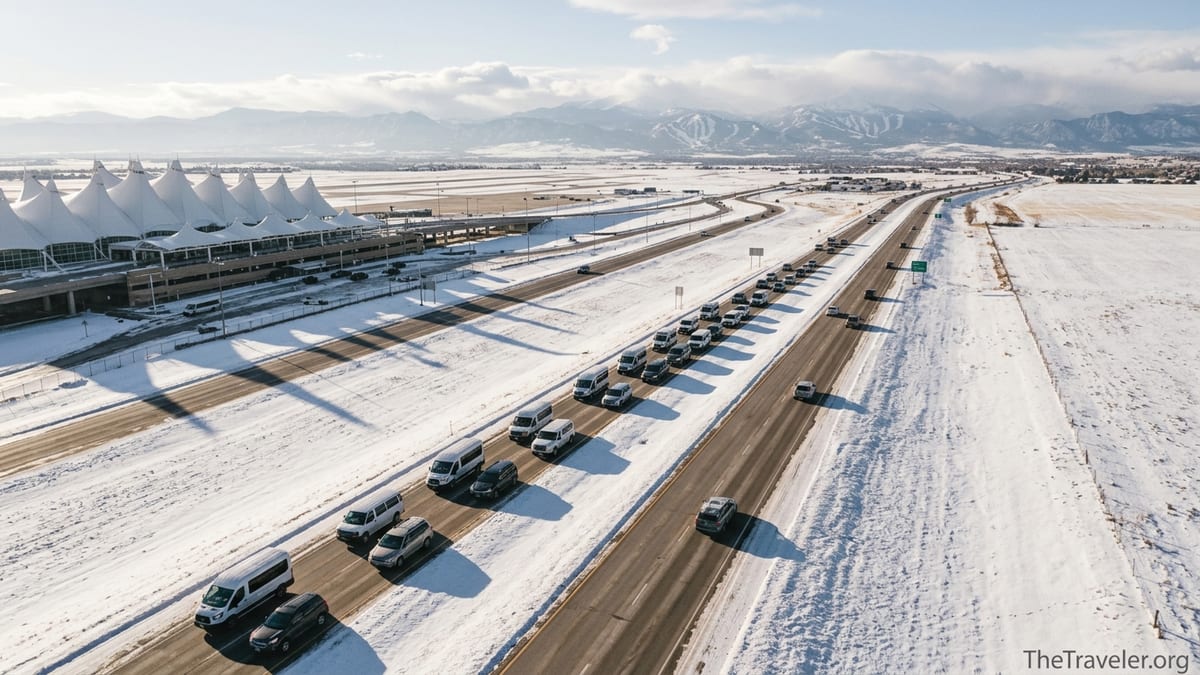
Understanding Distances, Drive Times and Winter Reality
From Denver International Airport, Colorado’s major ski resorts line up along and beyond Interstate 70 like a mountain conveyor belt. In good weather and light traffic, Breckenridge is typically about two and a half hours by road, Vail around two and a quarter, Keystone just over two, and Winter Park right at the two-hour mark. Aspen is the outlier, usually four hours or more by car, involving either Interstate 70 to Glenwood Springs and then a scenic river canyon, or a southern route over Independence Pass when it is open in late spring and summer.
Those “blue sky” drive times can double on busy Saturdays or during a snowstorm. On a peak winter weekend, a Denver to Breckenridge run that looks like 100 miles and 2.5 hours on a map can stretch to four hours or longer if traffic stacks up on the approach to Eisenhower Tunnel or Vail Pass. Holiday periods around Christmas, New Year and Presidents’ Day are particularly prone to stop-and-go traffic westbound in the mornings and eastbound on Sunday afternoons.
Winter weather adds another layer. Between September 1 and May 31, Colorado’s traction laws can be active on the I-70 mountain corridor between roughly Morrison and Dotsero. When the passenger vehicle traction law is in effect, your car must meet specific standards such as all-wheel or four-wheel drive with adequate winter-rated tires, or accepted traction devices for two-wheel-drive vehicles. State officials regularly remind drivers that fines for blocking I-70 because of inadequate equipment can be several hundred dollars, and more if you cause a closure in a travel lane.
All of this makes the “how to get there” decision more than a simple price comparison. Visitors who are used to dry highways and short urban commutes can find mountain winter driving surprisingly stressful. For many travelers, especially those arriving from sea level, it is worth paying more for a service that lets a Colorado-based driver handle chain laws, icy curves and heavy weekend traffic while you hydrate and adjust to altitude.
Shared Mountain Shuttles: The Workhorse Option from Denver
For most visitors heading to Breckenridge, Vail, Keystone or the larger cluster of Summit County resorts, shared shuttle vans and buses are the most common alternative to renting a car. Denver International Airport designates “mountain carrier” operators that run scheduled services from the terminals to major ski areas. These companies typically use 10 to 15 passenger vans or mini-coaches equipped with winter tires or chains and drivers who spend the entire season running the same routes.
Pricing varies by date and resort, but as a rough guide a one-way shared shuttle seat from Denver International to Breckenridge or Vail often sits somewhere in the range that many visitors describe as mid-tier: usually more than a typical city airport shuttle but less than a private SUV. Families sometimes find the math works well if they travel light and can fit four people into one booking. Some operators also offer modest discounts for round trips or for children under a certain age. Rates to Keystone and Winter Park are usually similar, with Aspen commanding a noticeable premium because of the distance.
In practical terms, shared shuttles are best for travelers who value simplicity over flexibility. A typical experience looks like this: you land at Denver, collect bags, follow signs to the shuttle pickup area, check in at a counter or via app, and then board the next departure for your resort. Many services drop passengers at central transit hubs, large hotels or condo complexes along the main corridors in Breckenridge or Vail. If your rental is on a side street or in a private home, you may need a short local bus ride or resort shuttle to complete the trip.
The trade-off is time. Shared shuttles usually wait for a cluster of flights to arrive and then stop at several drop-off points in each town. If your condo is the last one on the list, your two and a half hour highway leg can turn into a four-hour door-to-door journey. That is still often faster and less tiring than renting a car during an active snowstorm, but it is worth factoring in if you are flying in late and hoping to pick up rental skis before the shops close.
Private SUVs and Vans: Best for Groups and Gear-Heavy Trips
Private transfers bridge the gap between the efficiency of shared shuttles and the freedom of a rental car. Using full-size SUVs, luxury crossovers or high-roof vans, these operators quote flat rates from Denver International to specific resorts such as Breckenridge, Vail, Keystone, Winter Park or Aspen. Instead of paying per seat, you pay per vehicle, which can be cost-effective for families or groups of four to seven people traveling with multiple ski bags and grocery boxes.
On a typical winter weekend, a private SUV transfer from Denver to Breckenridge or Vail often prices in a band that many visitors describe as comparable to a night in a mid-range hotel room in those resorts. Prices climb for larger vehicles or premium brands, and for longer routes such as Denver to Aspen. For a group of six friends on a four-day ski trip, the per-person cost can end up similar to or only slightly above a shared shuttle, with the big advantage that the driver meets you on your schedule and takes you directly to your lodging.
Private services shine for late-night arrivals, families with young children, or visitors planning to stock up at a supermarket on the way to the mountains. Some companies allow a short scheduled stop in a town like Frisco or Silverthorne for groceries or gear rentals, which can eliminate the need for a car later. Vehicles typically have roof boxes or interior racks for skis and snowboards, and drivers are accustomed to navigating steep driveways or icy side streets that can leave unfamiliar visitors anxious.
The main downsides are cost and the need to book well ahead during peak periods. Popular weekends in January and February often sell out far in advance for morning arrival slots. If you are traveling during a February school vacation week or around major holidays, treat your ground transfer booking with the same urgency as your flights and lodging. Also remember that while private SUVs offer comfort, they are not immune to I-70 travel delays. Allow generous time for the return leg to Denver, especially if you are catching a midday or early afternoon flight on a Sunday.
Renting a Car: Freedom, Parking and When Not to Drive
Renting a car at Denver International remains attractive, especially for visitors who plan to ski multiple mountains, explore non-ski attractions, or stay in areas with limited in-town transit. The appeal is obvious: you can stop in Idaho Springs for breakfast, detour to Loveland Ski Area for a half day on arrival, or drive between Breckenridge and Keystone on your own schedule. For Aspen trips, a rental car allows side excursions to nearby resorts in the Roaring Fork Valley.
Winter, however, changes the equation. Colorado’s traction rules and chain laws mean that not every vehicle on the airport rental lot is legal to drive into the mountains on a snowy day. Agencies do offer all-wheel or four-wheel drive SUVs, but inventory is limited in peak season and premiums can be substantial compared with economy sedans. Many renters discover that a mid-size SUV with proper winter-rated tires can cost as much per day as a budget hotel room in Denver during prime ski weeks.
Before you commit, consider your route and your comfort level. Driving from Denver to Keystone or Breckenridge involves climbing over or through the Continental Divide, often in active snowfall and with heavy truck traffic. The Vail approach includes the notoriously slick Vail Pass, which can close for avalanche control or spinouts. Winter Park requires crossing Berthoud Pass, a two-lane mountain road with tight curves, no median and frequent snowpack. Aspen via Glenwood Canyon introduces narrow sections flanked by canyon walls, where winter storms can trigger brief closures.
There are also practical concerns at your destination. Breckenridge, Vail and Aspen all enforce strict parking rules, with paid lots near lifts and limited free parking on the town fringes. Overnight parking on residential streets can be restricted because of snowplows. If you are staying in a central hotel in Breckenridge or Vail that sits directly on a ski shuttle line, you may find your car sits unused for most of the week while you pay both rental charges and resort parking fees. In such cases, a shuttle or private transfer may be more economical and less stressful.
Colorado Traction Laws, Safety and Legal Responsibilities
Whether you drive your own car, rent at Denver International, or use a private transfer that provides its own vehicle, it pays to understand the basics of Colorado’s winter driving rules. The Colorado Department of Transportation can activate the passenger vehicle traction law on I-70 and other highways when conditions warrant. When active, drivers are required to have adequate snow traction: typically this means all-wheel or four-wheel drive with sufficient tread depth on winter-rated tires, or two-wheel drive equipped with approved chains or alternative traction devices carried in the vehicle and installed when chain law is declared.
The penalties for ignoring these requirements are real. State guidance notes that drivers who do not comply when chain or traction laws are active risk fines that can exceed several hundred dollars, especially if their vehicle becomes stuck and blocks a travel lane. Law enforcement agencies along the I-70 corridor periodically conduct enforcement operations, focusing on both commercial trucks and passenger vehicles that attempt to climb steep grades with worn tires or no traction devices.
For visitors, one of the most important changes in recent years is the expectation that rental car companies must inform renters of winter traction requirements. That does not, however, guarantee that the car handed to you at Denver International comes equipped for the mountains. Many standard rental sedans carry all-season tires that may not be marked with the mountain snowflake symbol. If you plan to drive I-70 between September and May, ask explicitly at the rental counter about winter readiness and whether the vehicle meets Colorado traction requirements when laws are active.
From a safety perspective, even legal equipment is not a substitute for experience. Local agencies and safety campaigns stress that winter driving in the Rockies demands slower speeds, longer following distances and smooth steering and braking inputs. Visitors coming from low-altitude climates can also experience fatigue and mild altitude symptoms on day one. If you feel uncertain about handling a snowy mountain pass at night after a long flight, a shuttle or private transfer is more than just a convenience. It may be the safest decision for you and everyone else on the road.
Resort-by-Resort: Breckenridge, Vail, Keystone, Winter Park and Aspen
Each major resort reachable from Denver International has its own transportation personality. Breckenridge, for example, is part of Summit County, a cluster that also includes Keystone and Copper Mountain. Shared shuttles from the airport run frequently to this corridor, and the county maintains a free bus network that links Breckenridge with Frisco, Keystone and Silverthorne. Many visitors choose a shuttle into town and then rely on buses and resort shuttles to move between lifts, grocery stores and restaurants without ever needing a private car.
Vail and its neighboring resort Beaver Creek sit farther west along I-70 and tend to draw a mix of shuttle users and rental car drivers. Vail’s central village is largely pedestrian, with structured parking at the edge of the village and bus routes serving outlying condos. Travelers who book lodging right in Vail Village or Lionshead often discover that they hardly drive once they arrive. For them, a shuttle or private SUV transfer can feel more logical than renting a car that will spend the week parked in a garage.
Keystone is slightly different. Many of its accommodations sit in purpose-built base villages or along a single main access road. While shared shuttles do serve Keystone, some visitors prefer a rental car there to allow easy grocery runs or side trips to nearby resorts like Arapahoe Basin. However, because Keystone is just off I-70 and within Summit County’s transit web, it also works well for travelers who shuttle in and then ride local buses or hotel shuttles through the week.
Winter Park and Aspen each add their own twist. Winter Park is one of the few Colorado resorts served by a seasonal ski train from Denver, which departs from Denver Union Station and arrives at a platform adjacent to the slopes. Travelers could theoretically take an airport train from Denver International to downtown, then connect to the ski train, avoiding I-70 completely. Aspen, by contrast, requires a longer road transfer from Denver, whether by shuttle, private SUV or rental car. Many visitors to Aspen choose to fly into its own regional airport when winter schedules permit, then use taxis, hotel shuttles or short private transfers in the Roaring Fork Valley, keeping Denver as more of a backup entry point.
When You Should Not Drive Yourself
There are times in Colorado’s ski season when the most experienced locals think twice about getting on I-70, and visitors should too. If a strong winter storm is forecast to coincide with your arrival or departure day, expect chain laws, slow speeds, and possible temporary closures on key passes. Trying to thread a small rental sedan with basic all-season tires through that environment, especially at night, is not just stressful but potentially unsafe and non-compliant with traction rules.
You should also reconsider driving if your itinerary leaves no margin. If your return flight to Denver departs at 10 a.m. on a Sunday in February, and you are staying in Breckenridge, you have almost no way to both sleep reasonable hours and guarantee an on-time arrival at the airport if you self-drive. Westbound Sunday afternoon traffic toward Denver can be extremely heavy, but even early mornings can be disrupted by overnight storms. Professional shuttle and private drivers track conditions continuously and know alternate routes or timing tricks that casual visitors lack.
Other red flags include unfamiliarity with snow, jet lag, and group dynamics. If no one in your party has driven on compacted snow or black ice, if you are arriving from overseas after more than 10 hours of flying, or if your trip group includes small children who will be riding without winter coats during the drive, a shuttle can remove one layer of complexity. You can focus on adjusting to altitude, drinking water, and planning your first ski day instead of scanning every roadside sign for chain requirements.
Finally, do not underestimate how quickly conditions can change. A drive that looked simple at noon can turn difficult by dusk if temperatures drop and shaded curves glaze over. Online forecasts and road cameras are useful tools, but they do not replace the judgment of a professional mountain driver who makes the same trip every day. If you are hesitating between a marginal rental car and a fully equipped shuttle when snow is in the forecast, err on the side of letting someone else take the wheel.
The Takeaway
Getting from Denver International Airport to Colorado’s marquee ski resorts involves more than just picking a price on a booking site. Distances, winter weather, traction laws and resort-specific transit options all have real consequences for your trip. Shared shuttles remain the most straightforward choice for popular destinations like Breckenridge, Vail, Keystone and Winter Park, while private SUVs and vans are ideal for groups and late arrivals who want a direct door-to-door experience.
Rental cars still make sense for experienced winter drivers who want maximum flexibility, especially outside the peak snow months or for itineraries that combine several valleys. Yet Colorado’s evolving traction rules, limited all-wheel-drive rental fleets and resort parking costs mean that self-driving is no longer the automatic default it once was. For many travelers, especially those new to mountain winters, paying for a seat in a vehicle driven by someone who navigates I-70 for a living is an investment in safety and peace of mind.
As you plan your trip, line up your ground transfer with the same care you devote to choosing a ski pass or slopeside condo. Check seasonal shuttle schedules, confirm whether your lodging charges for parking, and build in generous time buffers on travel days. With the logistics dialed in, the journey from Denver to Breckenridge, Vail, Keystone, Winter Park or Aspen becomes part of the adventure instead of an obstacle between you and the snow.
FAQ
Q1. How far is Breckenridge from Denver International Airport?
Breckenridge is roughly 100 miles from Denver International Airport. In good weather it often takes about two and a half hours by road, but winter traffic and storms can extend that to three or four hours.
Q2. Is it safe to rent a regular sedan to drive to Vail in winter?
It can be safe only if the car meets Colorado’s traction requirements and you are comfortable with winter mountain driving. Many rental sedans have basic all-season tires that may not be ideal for Vail Pass in snow. All-wheel or four-wheel drive with proper winter-rated tires is strongly recommended.
Q3. Are shared shuttles from Denver cheaper than private SUVs?
Yes, shared shuttles usually cost less per person because you pay by the seat. Private SUVs and vans charge a flat rate per vehicle and work out best for families or groups who can fill most of the seats.
Q4. Do I need a car if I stay in central Breckenridge or Vail?
If you are staying near the main lifts or in the pedestrian villages, you generally do not need a car. Both Breckenridge and Vail have robust bus and shuttle systems, and many visitors find that a car would sit parked most of the week.
Q5. What happens if I ignore Colorado’s traction or chain laws?
If traction or chain laws are active and your vehicle does not comply, you risk being fined and, if you get stuck and block a lane, facing higher penalties. You may also be held responsible for delays or accidents caused by your lack of equipment.
Q6. How early should I leave Vail for a flight out of Denver in winter?
From Vail, many locals plan at least four hours between departure from the resort and their flight time on winter weekends, sometimes more during holidays or active storms. This allows for slow traffic on Vail Pass and I-70, plus time for rental car return or shuttle drop-off and airport security.
Q7. Is there a train from Denver to any ski resort?
Yes, there is a seasonal ski train known as the Winter Park Express that runs between Denver’s downtown station and Winter Park Resort on select winter days. Travelers arriving at Denver International can connect via the airport train to downtown and then board the ski train, avoiding highway driving.
Q8. What is the best option for a family with small children?
For families with young kids and lots of gear, a private SUV or van transfer is often the most comfortable choice. The driver meets you on your schedule, helps with luggage, and takes you directly to your lodging so you do not juggle car seats and ski bags through multiple shuttle stops.
Q9. Should I fly into Aspen’s regional airport instead of Denver?
If your entire trip is focused on Aspen and nearby mountains, flying directly into Aspen’s regional airport can save several hours of driving, especially in winter. Many travelers still use Denver as a backup when Aspen’s flight schedules or weather do not align with their plans.
Q10. When is it reasonable to drive myself from Denver to the ski resorts?
Driving yourself can be reasonable if you have winter driving experience, your vehicle meets traction requirements, the forecast is stable, and you have ample time for the trip. Early or late season days with dry roads and light traffic are often the most comfortable for first-time drivers on Colorado’s mountain highways.