


More news on this day
Mumbai commuters on the Central Railway corridor faced significant delays during busy morning hours on Tuesday after operations at Diva’s LC-29 level crossing repeatedly favoured road traffic, holding up multiple suburban and long-distance trains and bunching services across the network.
Get the latest news straight to your inbox!
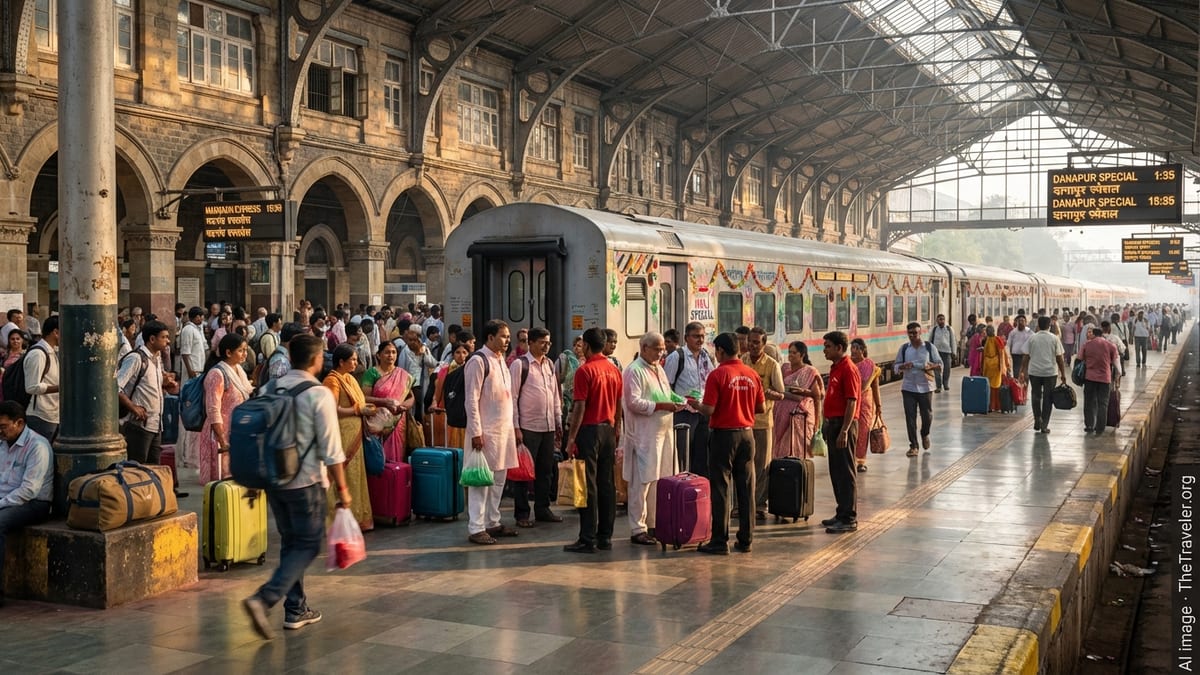
Peak-Hour Local Services Slowed By Diva Gate Operations
Reports from Mumbai’s Central Railway network indicate that suburban services were hit on Tuesday morning when Diva level crossing gate LC-29 was opened multiple times in quick succession for dense road traffic. The repeated road movement led to more than half an hour of cumulative detention for trains passing through the busy Diva section, according to detailed coverage of the incident.
The effect was immediately visible on the core Central line, where Mumbai’s “local” trains operate at some of the heaviest passenger densities in the world. Trains heading towards key commuter hubs such as Thane, Dombivli and Chhatrapati Shivaji Maharaj Terminus (CSMT) experienced cascading delays as services queued on either side of the crossing, reducing the corridor’s already tight operational margins.
Published accounts describe services being held near Diva and neighbouring stations, creating gaps in the usual three to five minute headway that characterises peak-hour schedules. With outstation and suburban trains sharing tracks along this stretch, priority decisions at a single level crossing translated into wider timetable disruption.
Local media coverage also highlights that delays were not confined to a single route. Long-distance services running on the same alignment, including trains linking the Mumbai metropolitan region with the broader Konkan and interior Maharashtra, experienced extended run times as they were slotted around detained suburban rakes.
Cascading Impact Across Central Railway’s Busy Corridor
The Diva incident comes against the backdrop of a suburban system that is already operating close to saturation. Parliamentary data and network statistics show that Central Railway runs more than 1,800 suburban services daily, including an expanding fleet of AC locals, across multiple corridors radiating from CSMT. The line through Diva also intersects with the Vasai Road–Roha route, turning the junction into a critical node for both commuter and freight movements.
When blockages occur at such nodes, even short interruptions can ripple quickly. Recent disruptions linked to engine failures and technical faults near other choke points like Badlapur have shown how morning peak-hour incidents often lead to bunching, where several trains arrive together after extended gaps. Coverage of earlier episodes indicates that commuters then encounter overcrowded platforms and coaches, as passengers from cancelled or delayed services converge on the next available train.
Travel-time tools and live running-status trackers for Central Railway services on Tuesday reflected the knock-on effect of the Diva crossing disruption, with several trains through the section showing behind-schedule arrivals. Observers point out that this pattern is consistent with the broader trend of frequent minor delays on the Central line, where shared tracks with express services, technical snags and road-rail conflicts at level crossings compound pressure on punctuality.
Online commuter forums and recent reports have frequently described Central Railway’s suburban services as more vulnerable to such disruption compared with the Western line, citing a higher volume of long-distance trains, more level crossings and complex junctions such as Kalyan and Diva as contributing factors.
Road-Rail Conflict Highlights Ongoing Level Crossing Challenge
The Diva episode underscores a longstanding structural issue for Mumbai’s rail operations: at-grade level crossings that serve dense urban road corridors while simultaneously carrying some of the country’s busiest rail traffic. Publicly available network information notes that the Diva junction lies on an alignment where multiple lines intersect, and where road demand has grown in tandem with suburban expansion into the Thane district.
Coverage of Tuesday’s disruption explains that LC-29 was opened repeatedly to clear backed-up vehicular traffic, which in turn extended the time during which trains were forced to wait. For a system scheduled at near-metro frequencies in the peak, even a few extra minutes at a gate can throw off carefully sequenced movements, leaving trains stacked on approach and departure routes.
Past analyses of Mumbai’s suburban safety and punctuality record have highlighted level crossings as a dual concern: they create potential conflict points between trains and vehicles and also contribute to operational delays when gates must be kept closed for extended periods to allow tightly spaced trains to pass. Efforts over the past decade have focused on replacing many urban crossings with road overbridges and underpasses, yet locations like Diva, where land and alignment constraints are significant, remain difficult to reconfigure.
Transport commentators observing the network argue that as suburban services and long-distance trains continue to be added, the time window during which gates can be opened for road users without disrupting rail timetables is shrinking. The Diva disruption is being cited in regional coverage as another example of how these competing demands can collide during peak usage.
Commuter Experience and Reliability Concerns on Central Line
For commuters, Tuesday’s incident translated into packed platforms, longer waits and extended journeys at the very time many office-goers and students rely most on predictable service. Accounts from recent months already point to a perception that delays of 10 to 20 minutes have become more common on Central Railway, particularly beyond the core morning window when schedules are more heavily interwoven with long-distance operations.
Travel reportage and social media posts have regularly contrasted this experience with that on Mumbai’s Western line, where even shorter delays often attract attention. On the Central line, riders describe building in personal “buffers” to account for potential snags, including level crossing issues at Diva and congestion at junctions such as Kalyan and Thane.
The current disruption also intersects with a broader modernization drive. Central Railway has progressively added AC local services and upgraded signalling and rolling stock in recent years, aiming to improve both safety and passenger comfort. However, as recent technical faults and crowding episodes have shown, new technology alone cannot fully offset capacity constraints at ground-level conflict points like level crossings.
Urban planners and transport analysts quoted in prior studies of Mumbai’s rail system have repeatedly stressed that tackling punctuality and safety risks will require coordinated investments in grade-separated crossings, additional tracks, and better separation of long-distance and local flows in and around nodes such as Diva. Until such projects are fully implemented, incidents similar to Tuesday’s Diva crossing disruption are likely to remain a recurrent feature of the city’s commuting landscape.
Pressure Mounts For Infrastructure Upgrades Around Diva
The Diva level crossing disruption arrives at a time when multiple rail infrastructure projects are underway across the Mumbai Metropolitan Region. Recent official documents and media reports outline plans for additional tracks, signalling enhancements and corridor upgrades intended to ease pressure on the Central line and its junctions.
Regional rail observers note that Diva’s strategic position, connecting the main Central Railway corridor with the Vasai Road–Roha route, makes it a candidate for priority interventions. Suggestions raised in public discussions include accelerated construction of road overbridges or underpasses to replace remaining level crossings, as well as operational measures to better coordinate road and rail flows during predefined peak windows.
In parallel, some long-distance trains serving Mumbai have recently been short-terminated or temporarily diverted to alternative terminals such as Dadar and Thane to accommodate blocks and works at CSMT. While these adjustments are primarily linked to platform expansion and power-block schedules, they reflect an ongoing effort to redistribute traffic loads across the suburban network and may indirectly influence how choke points like Diva are managed.
Travel and transport analysts following Mumbai’s rail developments indicate that the recurring strain visible in episodes like Tuesday’s Diva disruption is reshaping expectations of punctuality among the city’s millions of daily riders. For now, commuters on the Central Railway are once again adapting their routines to a system where even a single level crossing can, for a crucial half-hour each morning, hold up the city’s most essential journeys.
Times of India coverage of Diva LC-29 disruption
Indian Express report on Central Railway suburban and long-distance impact
Konkan Railway circular on short-termination of trains at Dadar and Thane
Free Press Journal explainer on frequent Central Railway delays