


More news on this day
Air travel across the Gulf is facing renewed uncertainty after the United Arab Emirates reported intercepting an Iranian drone over its territorial waters, shortly after the United States and Iran exchanged fire for the first time in a month, raising fresh concerns for flights transiting Dubai and the wider Middle East.
Get the latest news straight to your inbox!
UAE drone interception highlights shifting risk around key air corridors
Publicly available information from the UAE indicates that air defenses shot down an Iranian drone over Emirati waters on Monday, in an incident linked to the latest round of US Iran hostilities around the Strait of Hormuz. The interception occurred against the backdrop of a six month war that has repeatedly disrupted shipping and aviation in one of the world’s most vital energy and air transit corridors.
Reports from international media describe the intercepted drone as part of a broader pattern of Iranian activity in and near the Strait, where Iranian forces have been accused of targeting vessels and positioning missile and rocket launchers close to busy sea lanes. US Central Command has previously said its forces struck launchers that it assessed were preparing to deploy rockets or mines into these waters, underscoring how quickly localized military engagements can unfold near civilian flight paths.
While the interception took place over water rather than over land or near commercial airports, the incident reinforces long running concerns among airlines and regulators over the possibility of miscalculation in congested airspace. Even when military assets remain well separated from civil routes, the presence of drones, missiles and air defense systems can trigger additional flight planning restrictions, diversions or delays as operators seek to limit exposure.
Regional aviation analysts note that Gulf carriers and air navigation authorities generally maintain conservative buffers between known military activity and scheduled air traffic. However, each new incident prompts fresh reviews of routing, altitude profiles and crew guidance, especially for flights climbing out of or descending into Dubai, Abu Dhabi and Sharjah, which sit close to the eastern approaches to the Strait of Hormuz.
US and Iran trade strikes after month long lull in fighting
The drone interception followed a weekend exchange of fire between the United States and Iran, described in multiple reports as the first significant military contact between the two sides in roughly a month. US forces targeted Iranian missile and rocket launch sites on Larak Island in the Strait of Hormuz, saying those positions were linked to attempts to threaten commercial shipping in the narrow waterway.
In response, Iran announced that it had launched missiles at American military facilities in Jordan. According to published coverage, Jordanian defenses intercepted incoming projectiles without reported mass casualties, though the attacks underscored the widening geographic scope of the confrontation. Subsequent statements from Washington and Tehran signaled both a willingness to retaliate and a public interest in avoiding uncontrolled escalation.
Financial and energy markets reacted quickly, with benchmark crude prices rising as traders reassessed the risk of disruption to oil exports moving through the Strait. For aviation, the immediate impact is more focused on route stability, insurance considerations and crew risk assessments rather than fuel costs alone. Airlines overflying the region depend on predictable access to air corridors that can be rerouted or constrained whenever military tensions spike.
Analysts tracking the conflict suggest that this latest cycle of strikes fits into a broader pattern where periods of relative calm are punctuated by short, sharp exchanges of fire. For airlines and hub airports such as Dubai International, the challenge lies less in a single incident and more in managing the cumulative operational impact of an unpredictable security environment that has now persisted for months.
Dubai and Gulf hubs juggle disruption, capacity and safety margins
Dubai International Airport, one of the world’s busiest long haul hubs, has already reported a marked slowdown in passenger numbers earlier this year as the Iran war and associated airspace restrictions altered travel patterns. Airport operators cited the February and March shutdowns and reroutings across parts of the Gulf as a key factor weighing on second quarter traffic, with some passengers and airlines opting to avoid the region entirely during periods of intense fighting.
More recent reporting from regional outlets indicates that UAE airports remain operational, but with rolling adjustments to schedules as airlines respond to updated security briefings and airspace notices. Carriers including Emirates, Etihad, flydubai and Air Arabia are understood to be monitoring conflict zone advisories and conflict zone information bulletins issued by European and other regulators, which currently highlight elevated risks in Gulf airspace due to the US Iran conflict.
Industry coverage suggests that, despite the latest escalation, most Gulf based airlines have so far managed to maintain core networks by adjusting routings and altitudes to skirt sensitive areas. Reports emphasize that attacks have primarily targeted military rather than civilian aviation assets, limiting direct interference with commercial flight paths. Nevertheless, even modest changes in routing can lengthen flight times, increase fuel burn and compress turnaround schedules at already busy hubs.
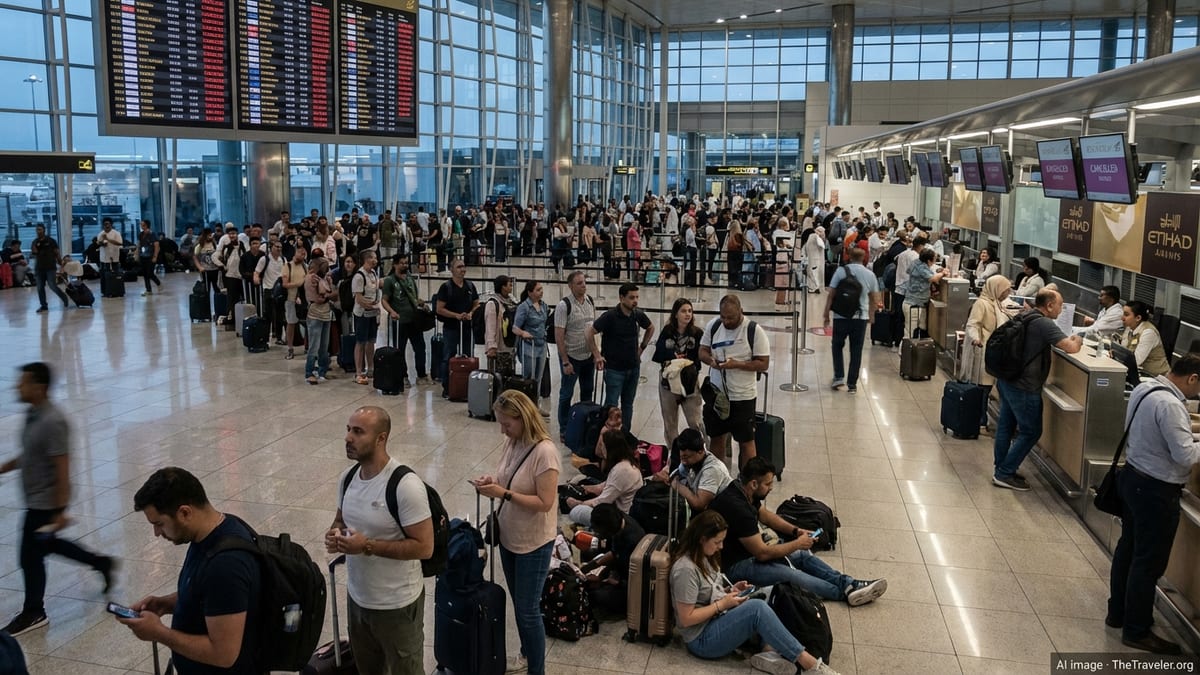
For Dubai in particular, the timing of the drone incident and exchanges of fire coincides with the end of the summer holidays, when inbound and outbound volumes typically rise. Airport advisories urge passengers to arrive well ahead of departure and to check the latest status of flights, reflecting the reality that short notice changes to regional airspace arrangements can ripple quickly through tightly timed connection banks.
Global airlines reassess Middle East exposure and routing choices
International carriers outside the Gulf are also recalibrating their approach to the Middle East. Travel industry reporting on September schedules shows several non regional airlines extending or expanding suspensions of services to Dubai and other Gulf destinations, citing continuing geopolitical uncertainty and restricted airspace capacity. Examples include European and North American carriers that had previously trimmed flights during earlier peaks in the conflict and are now delaying any return to normal frequencies.
Other airlines have opted to keep serving the region, but with modified routings that avoid certain portions of Iraqi, Iranian or Gulf airspace flagged in conflict zone bulletins. This can push some Europe to Asia traffic further north or south of traditional great circle routes, increasing block times but reducing perceived overflight risk for crews and passengers.
Behind the scenes, aviation insurers and corporate travel managers are updating their own risk models. Higher perceived security threats along particular corridors can translate into increased insurance premiums for airlines and more restrictive travel policies for multinational companies, which may instruct staff to avoid itineraries that transit specific hubs or conflict adjacent airspace. Such decisions compound the impact on Gulf airports, even when local operations remain technically safe and open.
At the same time, some Gulf based carriers frame the situation as a test of their resilience, pointing to investments in diversified fleets, flexible crew scheduling and real time route planning tools that allow rapid shifts in response to new notices to air missions and security assessments. However, as the war around the Strait of Hormuz stretches on, the cumulative drag on demand and network efficiency is becoming harder for the sector to ignore.
What travelers using Dubai and the wider region should do now
For passengers, the practical implications of the latest US Iran flare up and the intercepted Iranian drone are most visible in potential timetable changes rather than in-flight safety concerns. Public guidance from UAE focused outlets encourages residents and visitors to monitor the live status of their specific flight on airline websites or apps before leaving for the airport, and to keep contact details updated so they can receive last minute notifications.
Travel advisories stress that travelers should allow additional time at airports, particularly in Dubai, Abu Dhabi and Sharjah, where enhanced security checks and adjusted boarding procedures may contribute to longer processing times. Those connecting through the region on long haul itineraries are advised to pay close attention to minimum connection times and to consider building in more generous buffers between flights where possible.
Specialists in corporate and risk aware travel recommend maintaining flexibility in trip planning while the conflict persists. This can include booking changeable tickets, confirming that travel insurance covers disruption linked to regional hostilities, and being prepared to reroute via alternative hubs in Europe, Asia or Africa if airlines shift capacity away from Gulf stopovers at short notice.
Despite the heightened tensions and the symbolic weight of an intercepted drone near UAE waters, current open source reporting does not indicate a systematic targeting of civilian airliners by any party to the conflict. The main challenge for travelers remains navigating a volatile operational environment, where decisions made in distant military and political circles can have swift, practical consequences at check in counters and departure gates in Dubai and across the Middle East.
Associated Press: UAE intercepts Iranian drone as US Iran exchange fire
The National: Middle East flights status amid US Iran tensions
Gulf News: UAE flight update and Europe conflict zone warnings
CBS News: Live updates on US Iran strikes around Strait of Hormuz