


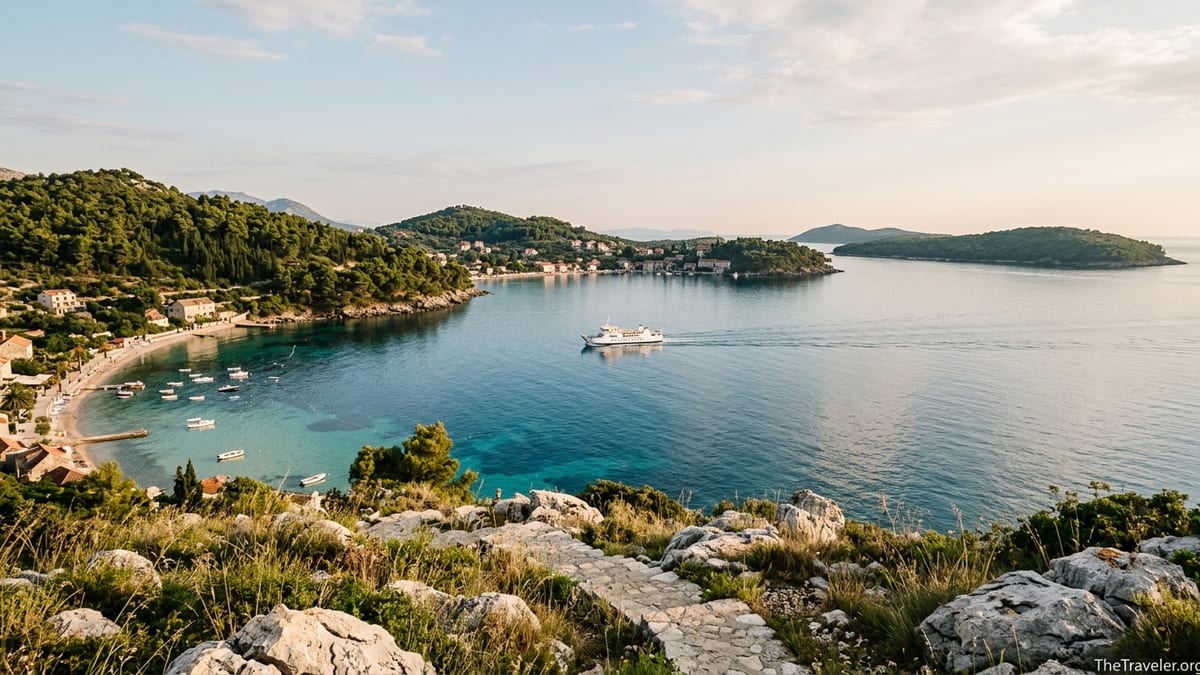
Just off the coast of Dubrovnik, the Elafiti Islands of Koločep, Lopud and Šipan promise pine-scented footpaths, clear Adriatic coves and stone villages that feel far removed from cruise ship crowds. They sit on the same local ferry route, yet each island has a very different character. Choosing the right one can shape your entire stay, whether you are after a lazy beach day, coastal hikes between olive groves, or long dinners in quiet harbors.
Get the latest updates straight to your inbox!
Getting Oriented: How the Three Elafiti Islands Differ
Koločep, Lopud and Šipan lie in a neat line northwest of Dubrovnik, about 20 to 60 minutes by local ferry from Gruž port. They share some essentials: all three are largely car-free at village level, all have small year-round communities, and all are popular as day trips in summer. But once you step off the ferry, the experience on each island feels distinct.
Koločep, locally known as Kalamota, is the closest and smallest of the three main Elafiti islands. It has two sleepy villages, Donje Čelo and Gornje Čelo, connected by forest trails and a simple road, with no regular car traffic. Travelers come here mostly for quiet coves, short coastal walks and a low-key lunch by the sea, then sail back to Dubrovnik the same evening.
Lopud, in the middle, is the classic holiday choice. It has one main village with a long promenade lined with cafés and restaurants, plus Šunj Beach, one of the few truly sandy bays in the Dubrovnik region. The island is completely car-free, so everything moves at walking pace. Ferries from Dubrovnik are frequent in season, and the island has enough infrastructure for a relaxed overnight stay without feeling overbuilt.
Šipan, the furthest and largest, feels more rural and traditional. Two small harbor villages, Suđurađ and Šipanska Luka, bookend a fertile valley planted with vines and olive trees. The island has a scattering of historic summer villas from the days of the Republic of Ragusa, a handful of good restaurants, and plenty of space to escape other visitors. Of the three, Šipan is best if you want a longer, quieter stay rather than a quick day trip.
Beaches and Swimming: Where to Find the Best Sea Access
If your priority is a classic beach day with soft sand and shallow water, Lopud is the clear winner. Šunj Beach, set in a horseshoe-shaped bay on the south side of the island, is one of the rare sandy beaches near Dubrovnik. The sea stays shallow for a long way out, which makes it ideal for children and less confident swimmers. In season you can rent sun loungers and umbrellas, and there are a couple of casual beach bars where main dishes typically run in the region of 10 to 20 euros, plus basic facilities like showers and toilets.
Lopud village itself fronts a long, pebbly beach where you can slip into the water directly off the promenade. Here, the atmosphere is gentler and less busy than Šunj in peak months. Many travelers split their time, spending a few hours at Šunj and then returning to the village for an evening swim and dinner. For those who prefer quieter spots, paths also lead to smaller rocky coves on the island’s north side, where you might share the water with just a handful of people even in July.
On Koločep, beaches are smaller and feel more intimate. Donje Čelo Bay has a compact sandy-and-pebble beach right by the pier, popular with families because of its shallow entrance and easy access to a mini-market and seafront restaurants. Walk ten to fifteen minutes along the shore or through the pine woods and you will find rocky platforms and tiny coves where you can lay out a towel and swim straight from the rocks. Sea kayakers often base here exactly because you can quickly reach secluded spots on the outer side of the island.
Šipan does not have a single headline-grabbing beach like Šunj, yet it offers plenty of atmospheric places to swim. Both Suđurađ and Šipanska Luka have pebble or stone waterfronts where locals wander down for evening dips. A short walk out of either village brings you to flat rocks and small coves backed by pine and carob trees. The water here is typically very clear, and often you will be swimming alongside fishing boats rather than day-trip catamarans. It is a better choice for those who like to combine swimming with walking and photography rather than spending an entire day on a single sunbed.
Walking, Hiking and Exploring the Interior
All three islands are small enough to explore on foot, but each offers a different kind of walking. Lopud is the most straightforward. A paved path and then a shady forest track connect the main village with Šunj Beach in roughly 20 to 25 minutes at a relaxed pace. From the village you can also walk up to Sutvrač Fortress on the hill above, a popular half-day hike that rewards you with views across the whole Elafiti archipelago and back to Dubrovnik’s walls on a clear day.
Koločep is ideal if you enjoy short, unhurried walks between coves. From Donje Čelo you can follow marked footpaths through pine forest and low karst to Gornje Čelo on the opposite side of the island in about 30 to 40 minutes. Along the way you pass abandoned stone houses, small chapels and occasional viewpoints over the open sea. The island’s size means you can comfortably loop between both villages and several swimming spots in a single day, stopping for lunch at a seafront konoba before continuing along the coastal path.
Šipan offers the most rewarding inland walk of the three. The route between Suđurađ and Šipanska Luka takes about 45 minutes to an hour on a gently undulating lane lined with olive groves, fig trees and low stone walls. Many travelers describe it as one of the prettiest easy walks in southern Dalmatia. Along the way you pass the remains of Renaissance summer houses and the occasional tiny church. Because the valley opens toward the sea at both ends, you can start in one village, walk to the other for a late lunch or an ice cream on the quay, and then return by local bus or on foot in the cooler evening.
Whichever island you choose, pack proper walking shoes or sturdy sandals. Trails can be rocky and uneven, and summer temperatures easily climb into the high twenties or low thirties Celsius by midday. Start longer walks in the early morning, carry plenty of water, and allow time to pause in the shade. In practice, many visitors combine a couple of hours of walking with long breaks for swimming, turning the whole island into one big outdoors playground.
Villages, Atmosphere and Crowds Through the Seasons
For a lively but still relaxed island village atmosphere, Lopud sits in the middle ground. Its main bay is lined with small hotels, guesthouses and family-run restaurants, but the absence of cars helps keep the pace human. In July and August, expect plenty of day trippers arriving on mid-morning ferries and on organized island-hopping tours. By late afternoon, most groups leave, and the village settles into a more local rhythm of children cycling along the waterfront and people lingering at café tables until late.
Koločep feels quieter and less social, especially in the evenings. There are a few restaurants and bars close to the Donje Čelo pier, but fewer options than on Lopud, and nothing in the way of late-night nightlife. Many visitors comment that it feels like stepping into someone’s small seaside neighborhood: modest houses, a church on the hill, locals chatting on benches. During the day, the main beach and pier swell with people arriving on the morning ferry, but paths just beyond the bay empty out quickly.
Šipan, even at the peak of summer, rarely feels crowded. Suđurađ is a compact port village with stone houses cradling a small harbor, while Šipanska Luka, at the far end, is a more open bay backed by hills. You will find a couple of accommodation options, including a small waterfront hotel in Šipanska Luka and several private apartments spread around both villages. Evenings here are low-key: a few bars, waterside restaurants, the sound of fishing boats coming and going. For many travelers, that is exactly the appeal.
Crowd levels across all three islands drop sharply outside high season. In May, June, September and early October, ferries are less packed, restaurant terraces have more empty tables, and you are more likely to share a beach with local families than with tour groups. Winter and early spring bring a more resident-focused atmosphere, with limited restaurant openings and fewer ferries, so these months suit repeat visitors or those happy with a very quiet stay.
Eating and Drinking: What to Expect on Each Island
The Elafiti Islands share a similar food base: grilled fish caught nearby, simple seafood risottos, pasta with shellfish, and plenty of olive oil produced on the surrounding hills. Prices on all three islands generally sit a little above what you might pay in inland Croatia but below Dubrovnik Old Town levels. As of recent seasons, a main course of grilled fish, calamari or meat will often cost somewhere in the range of 15 to 25 euros, with house wine by the carafe representing the best value.
On Lopud, the highest concentration of restaurants lines the promenade in the main village. Many have outdoor terraces just a few steps from the water, making it easy to combine a quick swim with a lingering meal. Several focus on seafood, while others serve pizza, pasta and simpler grill dishes that suit families. Near Šunj Beach, a couple of casual beach bars and restaurants offer salads, burgers, grilled fish and drinks, handy if you want to stay on the sand all day rather than walking back to the village for lunch.
Koločep has fewer options, which is part of its charm. In Donje Čelo, seafront konobas dish up fried small fish, octopus salad, grilled vegetables and local wines, often with just a handful of tables under the pines. Because supply depends on local catches and deliveries from the mainland, it is worth glancing at daily specials written on blackboards rather than only relying on the printed menu. If you are staying late, check opening days and hours in advance, as some places operate only in high summer or close early in the shoulder season.
Šipan has quietly earned a reputation among food-focused travelers. Both Suđurađ and Šipanska Luka have konobas that emphasize seasonal ingredients from the island’s fields and sea, including home-produced olive oil and wine. You might start an evening at a harbor-front restaurant in Šipanska Luka with marinated anchovies and local cheese, then move on to slow-cooked lamb or grilled sea bass. The experience feels closer to eating in a small Dalmatian village than in a polished resort, which is precisely what many people come here for.
History, Culture and Sense of Place
These islands may be small, but their history is surprisingly rich. All three formed part of the maritime Republic of Ragusa, the medieval state centered on Dubrovnik that traded across the Adriatic and beyond. Wealthy Dubrovnik families built summer villas here to escape the city heat, pray in hilltop churches and oversee olive groves and vineyards. Today, traces of that era linger in crumbling stone mansions, defensive towers and tiny chapels tucked into the landscape.
On Lopud, you can wander by the remains of old monasteries and noble houses just a few minutes’ walk from the harbor. The island once supported a sizeable merchant fleet, and for a time was wealthier than Dubrovnik itself. While much of that built heritage is now faded, the feel of a compact, self-contained community remains strong, especially if you step back from the main promenade into quieter lanes where laundry hangs between stone facades.
Koločep has several small churches dating from the early medieval period, some adorned with simple fresco fragments. Walking trails often pass by these chapels, sometimes standing alone in clearings surrounded by pines and maquis. Because the island is so small, it is easy to combine a swim, a visit to a historic church and a coffee in one of the villages in just a few hours.
Šipan showcases its past most clearly in the valley between Suđurađ and Šipanska Luka, where ruins of summer residences, old olive mills and small defensive towers dot the countryside. In Suđurađ, a Renaissance-era fortified house looms over the tiny harbor, hinting at a time when pirates and rival powers prowled the Adriatic. Exploring these sites does not require formal tickets or guided tours; you simply encounter them as part of daily life, which adds to the islands’ understated sense of place.
Practicalities and the Best Order to Visit
The three islands sit on the same local ferry line that runs between Dubrovnik’s Gruž port and Šipan. Travel times vary with the schedule and intermediate stops, but you can typically expect around 20 to 30 minutes from Dubrovnik to Koločep, 45 minutes or so to Lopud, and roughly an hour to Šipan. In high season there are several sailings a day, while in the shoulder months the timetable is more limited, so always check current schedules locally before setting off and allow for changes in case of bad weather.
For many travelers, the most satisfying order is to move from closest and simplest to furthest and quietest. A common pattern is to start with a day trip to Koločep to get a feel for the Elafiti pace of life without committing to an overnight stay. Next, spend one or several nights on Lopud, using the sandy beach at Šunj and the car-free promenade as your base for easy holiday days. Finally, continue to Šipan for one or more nights if you want to unwind in a rural setting, waking to church bells and roosters rather than city noise.
If you are short on time and staying in Dubrovnik, Lopud is usually the best single-island choice. It balances easy ferry access, a good range of restaurants, a mix of sandy and pebbly swimming spots, and enough walking to fill a day without rushing. Organized three-island boat excursions from Dubrovnik also exist, but they tend to allow only brief stops on each island, often just long enough for a quick swim and a set lunch. Independent travelers who prefer to explore at their own speed often find the scheduled ferry more rewarding, as it gives them several hours or longer on a chosen island.
Accommodation availability can shape your decision too. Koločep and Šipan have a smaller selection of rooms and apartments than Lopud, and some places open only from late spring to early autumn. Booking ahead is essential in July and August, especially for Šipan, where waterfront rooms are limited and can sell out months in advance. In May, June, September and early October, you are more likely to find last-minute options and enjoy milder weather with fewer crowds.
The Takeaway
If you picture a classic beach holiday with children paddling in shallow water and an easy stroll back to buzzing cafés, Lopud is likely your island. Šunj Beach, the car-free village, and the number of dining options make it the most versatile choice for first-time visitors and short stays from Dubrovnik.
If your idea of a perfect day is a quiet swim, a simple seafood lunch and a gentle walk through pine forest without seeing too many people, Koločep fits the brief. It is small, green and peaceful, close enough to Dubrovnik for a half day yet different enough to feel like a genuine escape from city heat and cruise ship crowds.
For travelers who value space, longer walks and unhurried evenings in traditional harbors, Šipan stands out. The combination of rural valley, historic villas and low-key but rewarding restaurants makes it ideal for a slow-paced stay of several nights, perhaps at the end of a busy itinerary through Croatia’s cities.
In practice, many visitors blend the strengths of all three. A thoughtful route might see you day-tripping to Koločep, spending two or three nights on Lopud, then unwinding for a final couple of nights on Šipan before heading back to Dubrovnik. However you structure it, the Elafiti Islands reward those who slow down, walk between coves, linger over seafood dinners and let the rhythm of the Adriatic set the pace.
FAQ
Q1. Can I visit Koločep, Lopud and Šipan all in one day?
It is possible on an organized three-island boat tour, but you will only get short stops on each. Independent travelers who use the public ferry usually find it more rewarding to focus on one island per day so there is time for walks, swims and a relaxed meal.
Q2. Which Elafiti Island is best for families with young children?
Lopud is generally the most family-friendly choice. Šunj Beach has soft sand and shallow water, and the entire island is car-free, so children can move around more freely between the beach and the village promenade.
Q3. Is it worth staying overnight, or is a day trip enough?
A day trip gives you a good taste of island life, but staying at least one night lets you experience quieter evenings after day trippers leave. Many travelers stay several nights on Lopud or Šipan to enjoy empty early-morning beaches and long dinners by the water.
Q4. How busy do the islands get in peak season?
In July and August, mid-morning ferries and the main beaches, especially Šunj on Lopud, can be quite busy. Koločep and Šipan usually feel calmer than Dubrovnik itself, but planning walks and swims for early morning or late afternoon helps avoid the hottest and most crowded hours.
Q5. Do I need to book ferry tickets in advance?
For the local car ferry that serves Koločep, Lopud and Šipan, many passengers simply buy tickets at the Jadrolinija office in Dubrovnik’s Gruž port on the day. In high season, it is wise to arrive early for popular morning sailings, and to check the latest timetable locally as schedules can change.
Q6. Are there cash machines and shops on the islands?
Lopud and Šipan each have at least one ATM and small grocery shops where you can buy basics like water, snacks and sunscreen. Koločep has more limited services, so bring enough cash and essentials with you, especially if you are staying into the evening or overnight.
Q7. Can I bring or rent a car on the Elafiti Islands?
Lopud and Koločep are effectively car-free, and you cannot bring a vehicle on regular passenger ferries. Šipan does have a small road network and a few local vehicles, but most visitors get around on foot, by bicycle or with occasional local transfers arranged by accommodation providers.
Q8. What is the best time of year to visit the Elafiti Islands?
May, June, September and early October are ideal for many travelers, with warm but not extreme temperatures, swimmable sea and fewer crowds. July and August offer the liveliest atmosphere and the most frequent ferries but also higher prices and busier beaches.
Q9. Are the islands suitable for travelers who do not like hiking?
Yes. On Lopud, the main village and beachfront are flat and easy to navigate, and you can reach good swimming spots without steep climbs. Koločep and Šipan have some gentle inclines and uneven paths, but you can still enjoy harbor areas, short walks and waterfront cafés without tackling longer hikes.
Q10. How much should I budget for a meal on the islands?
Prices vary by restaurant and dish, but a main course of grilled fish, calamari or meat typically costs in the region of 15 to 25 euros. Beach bars and pizzerias can be a bit cheaper, while more elaborate seafood platters or multi-course meals will cost more. Ordering house wine by the carafe is usually better value than bottled labels.