


More news on this day
Operations at Manila’s Ninoy Aquino International Airport (NAIA) are slowly returning to normal after an emergency landing by a Philippine Airlines flight to Daraga, Albay forced the closure of the airport’s main runway for several hours on Sunday, November 29, disrupting domestic and international travel at the start of a long weekend.
Get the latest news straight to your inbox!
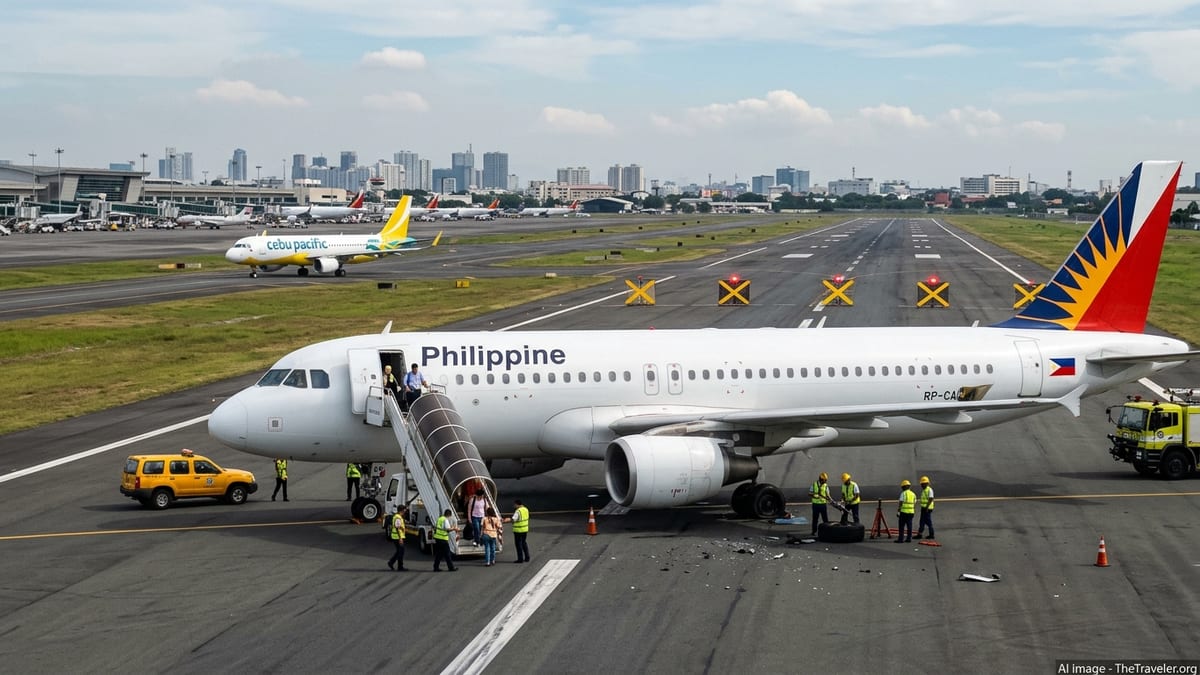
What happened to PAL flight PR2923
According to statements from Philippine Airlines and the Civil Aviation Authority of the Philippines, flight PR2923, an Airbus A320 service from Manila to Bicol International Airport in Daraga, Albay, departed on the morning of November 29 but was forced to return to Manila after the crew reported a hydraulic system issue while the aircraft was en route. The flight was operating on a regularly scheduled domestic route linking the capital with the Bicol region’s main gateway airport.
The aircraft landed back at NAIA at around 11:45 a.m. local time. Multiple reports from aviation authorities and airport officials confirm that several tires burst on touchdown, disabling the aircraft on NAIA’s primary Runway 06/24. All passengers and crew disembarked safely via mobile stairs, and no injuries have been reported.
Philippine Airlines has said it is cooperating with airport authorities and regulators as they review the incident and carry out standard safety checks on the aircraft and runway surface. The carrier emphasized that the return to Manila was precautionary in nature following the hydraulic alert and that the safety of passengers and crew remained its primary concern.
Runway closure, diversions and delays across the network
The tire bursts left the aircraft immobilized on the main runway, triggering NAIA’s emergency protocols. Airport operator New NAIA Infra Corp temporarily closed Runway 06/24, halting most jet operations while maintenance crews worked to secure, inspect and eventually tow the Airbus off the pavement. A combination of airport and airline maintenance teams began replacing the damaged tires shortly after midday so the aircraft could be moved.
During the closure, authorities relied on NAIA’s secondary Runway 13/31 for limited operations. Data and official bulletins from NAIA and the Civil Aviation Authority indicate that only narrowbody and lighter aircraft were able to use the secondary runway during part of the disruption, restricting capacity for long-haul and widebody flights that normally require the main strip. This led to a build-up of arriving traffic in holding patterns over Manila and forced several inbound flights to divert.
Confirmed diversions included Philippine Airlines and Cebu Pacific services inbound from Taipei, a Philippine Airlines flight from Dubai and a domestic widebody service from General Santos City, which were rerouted to Clark International Airport north of Manila. Some reports also indicate additional diversions and reroutings to Cebu for certain services, as operators sought available alternates with sufficient runway length and ground handling capability. These diversions added several hours of travel time for affected passengers, who then had to be re-accommodated to Manila on later flights or ground transport.
Timeline of closure and gradual restoration of operations
Based on consistent accounts from NAIA’s operator, aviation authorities and multiple local news outlets, the emergency landing and tire bursts occurred at around 11:45 a.m. on November 29. Shortly afterward, NAIA declared the main runway unavailable, issued formal notices to airmen and activated its crisis management procedures, including coordination between air traffic control, airport operations, ground handling and emergency services.
By approximately 12:50 p.m., maintenance staff had begun work to change the damaged tires and prepare the aircraft for towing. This phase required careful inspection of both the landing gear and the asphalt surface, as tire bursts can leave debris across the runway and may cause localized damage that must be checked before reopening to traffic. During this period, arrivals and departures were either funneled to the secondary runway or held at origin airports to prevent further congestion around Manila.
New NAIA Infra Corp later confirmed that the main runway was fully reopened at 5:48 p.m., roughly six hours after the emergency landing. At that point, the disabled aircraft had been removed from Runway 06/24 and the pavement cleared of debris. While the reopening allowed airlines to start recovering their schedules, NAIA and carriers warned that knock-on delays would persist well into the evening as aircraft and crews repositioned and diverted passengers were moved back toward Manila.
Impact on passengers and domestic Philippine travel
The incident coincides with the Bonifacio Day long weekend in the Philippines, a period that typically sees heavier-than-usual domestic travel as Manila-based residents take short breaks to regional destinations. The timing of the disruption on a Sunday midday meant that flights into and out of NAIA were already busy, increasing the risk of extended queues at check in, security and boarding gates once the runway reopened.
Philippine Airlines has said it is arranging onward transportation for passengers from PR2923 to reach Bicol International Airport, as well as for travelers on flights that were diverted to Clark. The carrier is working to rebook affected customers on the next available services where possible, though same-day options may be limited to and from certain regional points given aircraft rotations and curfews at provincial airports.
For travelers already at NAIA on November 29, the temporary reliance on the secondary runway resulted in staggered boarding, gate changes and longer waits on the tarmac. Some domestic services departed out of sequence or with consolidated loads to make best use of available slots once the main runway came back online. International passengers connecting through Manila, particularly those arriving on widebody flights redirected to Clark, are having to adjust to revised itineraries and, in some cases, overnight stays arranged by airlines.
What travelers should know and what comes next
With the main runway now back in service, NAIA and airlines are working through a backlog of delayed flights into the late evening of November 29 and potentially into November 30. Travelers with departures or arrivals around Manila during this window are being advised to allow extra time at the airport, monitor airline communications closely and check their flight status before leaving for NAIA, Clark or other affected airports.
Philippine Airlines has encouraged passengers booked on today’s Manila to Daraga services, as well as on connecting domestic and international itineraries involving NAIA, to use its digital channels and customer service hotlines for the most up-to-date information on rebooking, recovery flights and any accommodation or transport arrangements offered. Other airlines operating at NAIA have issued similar advisories, reminding customers that even flights not directly involved in the runway closure may see schedule changes as aircraft are repositioned.
Regulators, including the Civil Aviation Authority of the Philippines, are expected to review the incident in detail as part of standard post-event procedures. This typically involves examining technical data from the aircraft, maintenance records and crew reports to confirm the nature of the hydraulic issue and assess the sequence of events that led to the multiple tire bursts on landing. While no findings have yet been released, there is currently no indication of a wider safety concern affecting other aircraft types or routes. For now, the main implications for travelers are short term: residual delays, possible reroutings and busier-than-normal conditions at Manila and Clark as the Philippine air transport system absorbs the disruption and returns to regular operations.