


Durmitor National Park is Montenegro’s high-mountain showpiece: a limestone massif of sharp peaks, dark pine forests, glassy glacial lakes and the yawning Tara River Canyon. Basing yourself in the small town of Žabljak, you can walk around iconic Black Lake before lunch, drive to a Tara Canyon viewpoint in the afternoon, then finish the day with sunset over serrated summits from a roadside pass. This guide focuses on exactly that kind of trip, giving you concrete, on-the-ground advice about hiking, rafting, viewpoints, driving conditions, weather, car rental and how to fold Durmitor into a wider Montenegro itinerary that also includes the coast.
Get the latest updates straight to your inbox!
Žabljak: Your Base in Durmitor
Žabljak is the main gateway to Durmitor National Park and one of the highest towns in the Balkans at roughly 1,450 meters above sea level. In practice, that means cool nights even in summer, crisp air and an alpine feel that contrasts sharply with the humidity of the Adriatic coast. The town itself is compact: you can walk from the central square to the Black Lake trailhead in about 25 to 30 minutes, or drive there in 5 minutes and park in the official lot by the entrance gate.
Accommodation in Žabljak ranges from simple rooms in private houses to small hotels and chalet-style apartments. In high season from late June to early September, it is common to see apartments around the center advertised from roughly 40 to 70 euros per night for a couple, while more polished lodges with saunas or half-board can easily run 90 to 140 euros. Many visitors choose family-run guesthouses a short walk from the center so they can stroll to restaurants in the evening without needing to drive dark rural roads after a long hike.
Services are better than the town’s size suggests. You will find a couple of mid-sized supermarkets on the main road suitable for stocking up on hiking snacks and picnic lunches, several outdoor stores selling gas canisters and basic gear, and ATMs from major Montenegrin banks. Restaurants lean heavily on grilled meats, stews and dairy; dishes like kačamak (cornmeal, potatoes and cheese) or cicvara (rich cornmeal and cheese) are local staples and make hearty post-hike meals. Vegetarian options exist, but menus are meat-heavy, so plant-based travelers may want to self-cater from supermarkets and bakeries.
For park logistics, almost everything starts in or just outside Žabljak. The park entry kiosk for Black Lake, shuttle departures for some rafting trips, taxis to trailheads and local tour agencies are all clustered around town. Even if you stay in a rural cabin 5 to 10 kilometers away, expect to pass through Žabljak daily for supplies, cash and information, especially if weather forces last-minute changes to your plans.
Black Lake: Durmitor’s Signature Walk
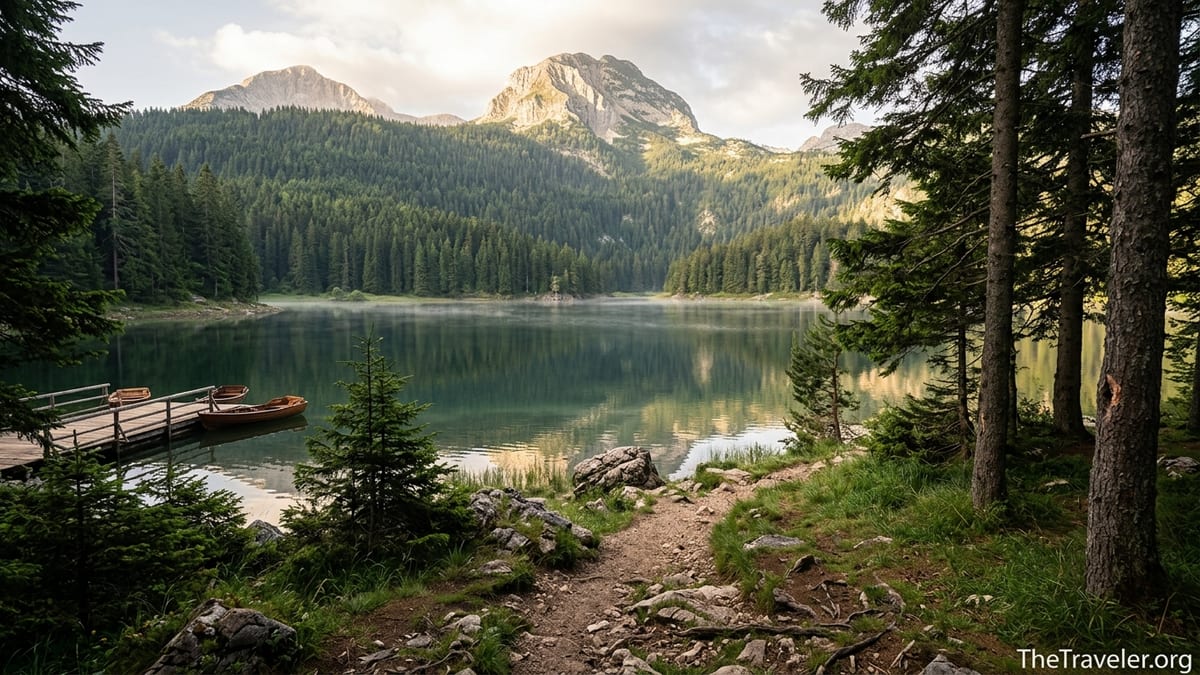
Black Lake (Crno Jezero) is Durmitor’s most famous sight and the easiest way to stretch your legs on arrival day. The lake lies less than 2 kilometers from Žabljak’s center; many travelers simply follow the signed footpath from town through the woods. At the park entrance you pay a modest per-person fee that helps fund trail maintenance. Once through the gate, a wide forest track leads you in a few minutes to the lakeshore, where the twin basins of the lake are framed by dense spruce and the peaks of Međed and Savin Kuk.
The classic activity here is the loop walk around the lake, roughly 3.5 kilometers on a mostly flat, well-trodden dirt path. Most people complete it in 60 to 90 minutes with photo stops. It is suitable for children and casual walkers in normal conditions, though sections can be muddy after rain and occasional tree roots require attention. Many hikers use this loop as a gentle acclimatization walk on their first afternoon in Durmitor, especially if they have just driven up from sea level at Kotor or Budva.
On busy summer weekends, you will see rowboats for rent on the near shore and a few simple cafes or kiosks selling coffee, beer and basic food like grilled dishes and pancakes. Prices are higher than in town but still moderate by Western European standards, so many visitors plan a lakeside drink stop rather than bringing everything with them. If you walk clockwise, you soon lose the crowds: the far side of the lake feels quieter and offers some of the best photo angles back across the water to the peaks.
From Black Lake, a web of marked trails continues deeper into the park toward smaller glacial lakes and higher passes. Signs near the shore indicate routes such as the ascent to Bobotov Kuk or longer traverses. You do not need a guide for the basic lake loop in good conditions, but if you plan to turn it into a longer day hike into higher terrain, it is worth checking current trail conditions in Žabljak first and considering a local guide if snow, fog or storms are in the forecast.
Tara Canyon and Đurđevića Tara Bridge
The Tara River Canyon, up to around 1,300 meters deep, cuts along the northern edge of Durmitor and is often described as the deepest gorge in Europe. For many visitors, their first up-close encounter is at Đurđevića Tara Bridge, about 25 kilometers and 30 to 40 minutes’ drive from Žabljak on a paved but winding road. The bridge, completed in the mid-20th century, offers sweeping views up and down the canyon and has become a classic photo stop as well as a hub for adventure activities.
At the bridge you can park on either side and walk the span on a pedestrian walkway. Several small cafes and souvenir stands line the road; a coffee or juice here typically costs a little more than in Žabljak but remains fairly reasonable. For a more adrenaline-fueled view, several companies operate ziplines across the canyon with launch platforms right beside the bridge. Prices commonly sit around 20 to 25 euros per person for a single ride, with steeper or longer lines priced slightly higher; you usually pay on the spot without advance booking, though peak August weekends can see queues forming late morning.
Beyond the bridge, viewpoints along the canyon rim offer a more tranquil experience. Popular spots such as the Čurevac viewpoint involve short drives down signed side roads followed by simple walks of 15 to 30 minutes from improvised parking areas. The final sections of these access roads can be on gravel and a bit rutted; in dry weather a standard rental car driven slowly is usually fine, but after heavy rain or in early spring conditions can deteriorate. If you do not feel comfortable with rougher surfaces, book a local driver or join a small-group excursion from Žabljak that combines the bridge with one or two viewpoints.
Time-wise, many travelers allocate half a day for Tara Canyon if just visiting the bridge and one viewpoint, or a full day when adding rafting or an extended scenic drive. A realistic example would be leaving Žabljak after breakfast, stopping at the bridge for photos and a coffee, taking a mid-morning zipline ride, then driving on to a rafting base or another viewing area before looping back to town for dinner.
Rafting the Tara River
Rafting on the Tara River is one of Montenegro’s signature outdoor experiences and is easily combined with a stay in Žabljak. Numerous licensed operators run trips that vary from gentle family-friendly floats on calmer stretches to full white-water runs through the deepest parts of the canyon near the Bosnian border. The classic one-day route is between Brštanovica and Šćepan Polje, a roughly 18-kilometer section with a series of rapids graded around Class III and IV in peak spring and early summer flows.
Typical packages advertised in recent seasons for a one-day rafting trip with a Žabljak-based agency might cost around 60 to 80 euros per person. That generally includes transport from Žabljak to the rafting base, all equipment, a professional guide and at least one substantial meal, often a hearty late lunch featuring local dishes. Half-day or shorter options, sometimes focused on families or people short on time, can be slightly cheaper. It is a good idea to ask specifically what is included when you book: whether wetsuits are provided, whether photos are part of the price or sold separately, and what kind of meal to expect if you have dietary restrictions.
Seasonality matters. From May into June, snowmelt from the high Durmitor peaks swells the Tara and produces the most powerful rapids; this is when experienced rafters often target their trips. By July and August the water level usually drops, the river becomes more forgiving and air temperatures climb, making it better suited to first-time rafters or families with older children who are comfortable in moving water. Operators will generally not take very young children on the full white-water sections; if traveling with kids, look for shorter or calmer stretches marketed explicitly as family-friendly.
Safety standards on the Tara are improving, but as in any adventure destination, they vary between companies. When comparing offers, look beyond price and ask about guide training, maximum group size per raft and whether there is a safety kayaker on busier stretches. Reputable operators will run briefings at the put-in, fit helmets and buoyancy aids carefully and cancel or modify trips in the event of thunderstorms or dangerously high flows. If you do not have your own transport, picking a company that includes transfers from and back to Žabljak will simplify logistics, especially for the sections near Šćepan Polje, which lie over an hour’s drive from town.
Key Hikes and Viewpoints in Durmitor
Beyond Black Lake, Durmitor offers a dense network of hiking trails, from easy valley walks to serious summit ascents. The best-known peak is Bobotov Kuk at about 2,523 meters, reachable on several marked routes that typically take 6 to 9 hours round-trip, depending on your starting point and conditions. One popular option is to start from the Sedlo Pass on the P14 road, which allows you to begin at roughly 1,900 meters and cut some of the ascent. This route involves steep, rocky terrain and short exposed sections where the path narrows, so it is not recommended in wet weather, persistent snow or for hikers uncomfortable with heights.
For something less committing, there are scenic half-day walks to ridges and balconies above Žabljak. Shorter hikes from the town’s outskirts lead to viewpoints over the plateau and surrounding peaks in 2 to 3 hours round-trip, offering far-reaching vistas without serious exposure. Families often combine a relaxed morning at Black Lake with a modest afternoon hike up to one of these balconies, returning in time for an early dinner in town. Ask your guesthouse host or a local guide office for suggestions suited to your fitness level and the current conditions: trails that are straightforward in late August can be slippery with residual snow in May.
The Durmitor Ring road itself functions as a rolling viewpoint, with numerous informal pullouts from which you can step out for five-minute photo stops or short exploratory walks. Classic road viewpoints include the area around Sedlo Pass, where layered ridges run off toward the horizon, and the slopes beneath peaks such as Prutaš, whose striped rock faces photograph beautifully in the late afternoon. Always park fully off the narrow carriageway and be cautious of oncoming traffic; some bends are blind, and locals familiar with the road may drive faster than visitors expect.
If you are new to mountain hiking, a guided day can help you learn the lay of the land. Local guides based in Žabljak offer private or small-group hikes tailored to ability, which might mean a mellow lakes circuit one day and a more challenging ridge traverse the next. Aside from route choice and navigation, they bring up-to-date knowledge of where snowfields linger into summer, which sections become slippery after storms and what to do if sudden mountain fog rolls in, which is not uncommon on Durmitor’s higher plateaus.
Road Access, Car Rental and the Durmitor Ring
Reaching Žabljak is straightforward by road and is easiest with your own vehicle. From Podgorica, the drive via Nikšić and Šavnik typically takes around 2.5 to 3 hours under normal traffic and weather conditions, climbing steadily into the highlands on a mostly good paved road with bends and occasional narrow sections. From the Bay of Kotor, routes via Nikšić or via the canyon roads through Šavnik and Plužine both take roughly 3 to 4 hours, depending on summer traffic and photo stops. Buses do exist between Podgorica, Nikšić, the coast and Žabljak, but services are limited and connections can be slow, so self-drive is the more flexible option for most visitors.
Car rental is widely available in coastal cities like Kotor, Budva and Tivat, as well as in Podgorica. Prices vary by season, but in recent years compact cars in July and August often start around 35 to 50 euros per day from local agencies, with major-brand desks sometimes higher. Local agencies are often more relaxed about crossing into neighboring countries and may offer better value on older but adequate vehicles. When comparing offers, look closely at mileage limits, insurance coverage and the policy on unpaved roads, which can be relevant if you plan to explore less-maintained side tracks around Durmitor.
The Durmitor Ring, sometimes labeled Panoramic Road 2, is a roughly 70 to 80 kilometer loop that begins and ends in Žabljak, circling the massif through high pastures, karst plateaus and deep valley views. The loop is fully paved but very narrow in places, with steep drops and few guardrails. Expect oncoming livestock as well as cars. It is typically recommended to drive the Ring in good weather from late May to October; snow and ice can close or severely complicate sections such as the Sedlo Pass outside this window. Many travelers plan a full day for the Ring, leaving Žabljak after breakfast and returning by late afternoon with stops for photos, short walks and a simple lunch in a village café.
Within the park, the main access to Black Lake from Žabljak is on a short spur road with a small parking fee at the end. In high season, the lot fills by late morning, so arriving around opening time or in late afternoon helps avoid queues and allows a quieter circuit of the lake. For the Tara Canyon and Đurđevića Tara Bridge, the road from Žabljak is paved but twisty, with some narrow shoulder sections. Drivers used to central European or North American highways sometimes find the lack of shoulders unnerving at first; take your time, use low gears on descents and pull into lay-bys to let faster local traffic pass.
Weather, Seasons and What to Pack
Durmitor’s weather is genuinely mountain in character, far cooler and more variable than Montenegro’s coast. Long-term climate data from the Žabljak area show mean summer temperatures in the mid-teens Celsius, with daytime highs often in the high teens to low 20s and nights dropping into single digits. Winters are cold and snowy, with frequent sub-zero temperatures and deep snowpack, particularly on the plateau and higher slopes. For travelers coming from Kotor or Budva in July, it is common to experience a 10 to 15 degree temperature drop when arriving in Žabljak the same day.
The main hiking season runs roughly from late May to October, but conditions vary by year. In late May and even into June, higher routes such as Bobotov Kuk often retain snowfields, and some passes may be icy early in the morning. July and August bring the most stable weather and warmest temperatures, but also the largest crowds and the greatest thunderstorm risk on hot afternoons. September is a favorite month among many hikers, with cooler, often clear days, changing foliage and quieter trails, though nights become noticeably cold.
Whatever month you visit, plan for rapid changes. A common pattern in summer is a bright, sunny morning, clouds building after lunch and short but intense showers or thunderstorms in the late afternoon. At higher elevations, fog can roll in quickly and drastically reduce visibility. Check the forecast daily in Žabljak, but still carry waterproof layers, an insulating mid-layer and a hat and gloves for longer hikes above the tree line. Even in August, a wind-exposed ridge at over 2,000 meters can feel wintry if a storm blows through.
Packing-wise, think in terms of flexible layers. Many visitors find that a light base layer, a fleece or light synthetic jacket and a waterproof shell cover most conditions from June to September. Sturdy hiking shoes or light boots with good traction are recommended for rocky trails; sneakers can cope with the Black Lake circuit in dry weather but may be slippery on muddy or rooty sections. Sunscreen and sunglasses are important, as UV exposure is heightened at altitude, and a refillable water bottle saves you from relying on cafes and kiosks on busy days.
Combining Durmitor with Montenegro’s Coast
One of Montenegro’s biggest strengths as a destination is how easily you can combine alpine scenery with the Adriatic in a relatively short trip. A common pattern is to spend two or three nights in Kotor or another coastal town first, then drive up to Žabljak for three or four nights in Durmitor, before either returning to the coast or continuing toward Bosnia and Herzegovina or Serbia. The drive from Kotor to Žabljak can be done in around three and a half hours without long stops, but many travelers break it up with a coffee in Nikšić or a photo stop at a reservoir or canyon viewpoint.
For example, a one-week itinerary might look like this: arrive in Tivat or Podgorica and transfer to Kotor for two nights of old-town exploration and bay views, then pick up a rental car and drive via Nikšić to Žabljak for three nights. Day one in Durmitor could be Black Lake and a short viewpoint hike, day two rafting on the Tara plus a stop at Đurđevića Tara Bridge, and day three driving the Durmitor Ring with plenty of photo stops. From there, you could either drive back to the coast for your final night near Budva or head to Podgorica for a flight out, returning the car at the airport.
Another option is to visit Durmitor after exploring central or northern Montenegro, such as Biogradska Gora National Park or the Lim valley, then drop down to the Bay of Kotor at the end of your trip for a more relaxed finale. Travelers who prefer cooler temperatures sometimes reverse the usual pattern and start in the mountains, then finish with two quieter nights on the coast once they have already done their main hiking. Either way, allow for the weather difference: a morning of 30 degrees Celsius in Budva can give way to 15 degrees and showers by the time you crest the highland roads near Šavnik on the way to Žabljak.
Public transport between the coast and Durmitor is improving but still not ideal for tight itineraries. While there are bus links between Kotor, Podgorica, Nikšić and Žabljak, schedules may require changes and the total travel time can easily stretch to five or six hours with waits. For most visitors who want to combine the coast, Durmitor and possibly a rafting trip or the full Durmitor Ring, a rental car remains the most efficient solution and gives you the freedom to respond to mountain weather. Just be prepared for challenging driving at times and consider sharing the driving between confident drivers in your group.
FAQ
Q1. How many days do I need in Durmitor National Park?
Most travelers find that three full days in Žabljak works well: one for Black Lake and a shorter hike, one for Tara Canyon and possibly rafting, and one for the Durmitor Ring or a longer summit hike. With only one or two days, focus on Black Lake, the bridge on the Tara and a few viewpoints.
Q2. Do I need a car to visit Durmitor, or can I rely on buses and tours?
It is possible to reach Žabljak by bus from Podgorica or the coast, and to join local tours once there, but having a rental car makes exploring far easier. A car allows you to drive the Durmitor Ring, reach trailheads early and visit Tara Canyon viewpoints on your own schedule.
Q3. When is the best time of year to hike in Durmitor?
The main hiking season runs from late May to October. July and August usually bring the most stable weather and snow-free higher trails, while June and September are cooler and often quieter but may still have snow patches or colder nights.
Q4. Is Black Lake suitable for families with young children?
Yes, the Black Lake loop is one of the park’s most family-friendly walks. The path is about 3.5 kilometers, mostly flat and well-trodden. You should still use sturdy shoes, keep an eye on children near the water and be prepared for mud after rain.
Q5. How difficult is rafting on the Tara River, and is it safe for beginners?
Difficulty depends on the time of year and section of river. In May and June, water levels are higher and rapids stronger, which suits adventurous beginners and experienced rafters. By July and August, the river is usually calmer and more forgiving. Choose a reputable operator, wear provided safety gear and be honest about your comfort level in moving water.
Q6. What should I pack for a summer visit to Durmitor?
Even in summer, bring layers. A typical packing list includes a light base layer, warm mid-layer, waterproof jacket, sturdy hiking shoes, sun protection, a refillable water bottle and a small daypack. Nights in Žabljak can be cool, so a light hat or fleece is useful.
Q7. Can I drive the Durmitor Ring in a regular rental car?
Yes, the Durmitor Ring is fully paved and most people complete it in a standard compact rental. However, the road is narrow, winding and exposed in places, with few guardrails. Drive slowly, use pullouts to let others pass and avoid the loop in poor visibility or when snow or ice is present.
Q8. Are there vegetarian or vegan options in Žabljak?
Traditional cuisine in Žabljak is meat- and dairy-heavy, but most restaurants offer at least a few vegetarian dishes like grilled vegetables, salads, pasta or cheese-based specialties. Vegan travelers may find options limited and often rely on supermarket supplies and self-catering for part of their stay.
Q9. Do I need a guide for hiking in Durmitor?
You do not need a guide for simple routes like the Black Lake loop in good weather, provided you are comfortable in basic mountain terrain. For longer or more technical hikes such as Bobotov Kuk, especially early or late in the season when snow and ice are possible, hiring a local guide is strongly recommended.
Q10. How easy is it to combine Durmitor with a stay on Montenegro’s coast?
It is very feasible to combine the two. The drive between Kotor or Budva and Žabljak typically takes 3 to 4 hours. Many itineraries include two or three nights on the coast and three or four nights in Durmitor, connected by a scenic self-drive with a rental car.