


Walk the short curve of the Malecón de la Playa Húcares in Naguabo and you immediately understand why this tiny fishing village looms so large in Puerto Rico’s food imagination. Boats nose into the pier, fish boxes slide straight from skiff to kitchen, and along a compact strip of thirty–plus restaurants and kiosks, the smell of hot oil and garlic announces exactly what this place is about: seafood, and especially the pastelillo de chapín that locals insist was born right here.
Get the latest updates straight to your inbox!
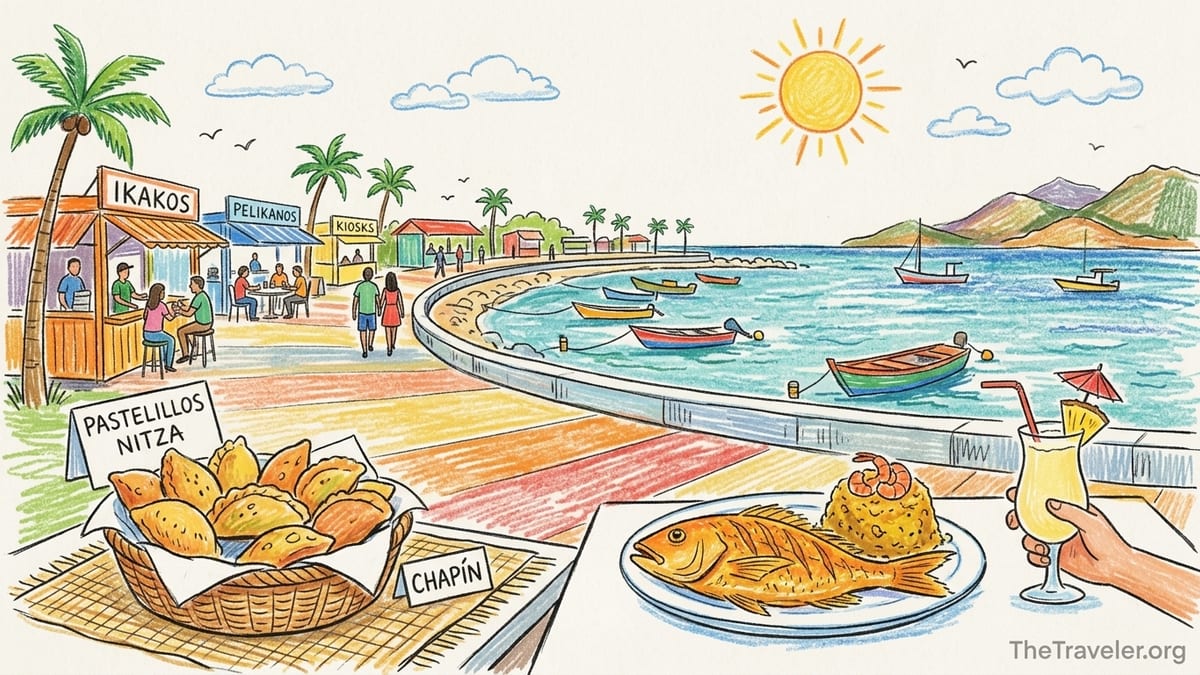
Understanding the Food Identity of Playa Húcares
The Malecón de la Playa Húcares is not just another seaside strip with a few fried fish joints. Discover Puerto Rico currently lists 33 places to eat along this boardwalk, a significant concentration for a town of Naguabo’s size. The local economy and identity pivot around the sea: fishermen head out early in small boats for lobster, conch, and reef fish like chillo, and that same catch is cleaned just a few steps from where visitors sit down to eat it later in the day.
What sets Naguabo apart is the clarity of its signature dish. Tourism officials and local residents alike point to pastelillos de chapín, turnovers filled with coffer fish, as a defining specialty. These are not generic frozen empanadillas; several long-running businesses here describe chapín pastelillos as their pride, and the town even celebrates the fish with an annual Festival del Chapín. The result is a place where visitors are not guessing what to order. They are here for very specific things from the sea, prepared in very specific ways.
That clarity makes the Malecón one of the easiest food stops to navigate on Puerto Rico’s east coast. You are not balancing ten different culinary traditions or chasing elusive “chef-driven” dishes. Instead, you are choosing between simple, overlapping menus that focus on fried fish, stewed seafood, mofongo, rice with jueyes, and a long lineup of fritters. The challenge is not figuring out the specialty, but finding which counters and dining rooms treat that specialty with the most care.
To get a realistic sense of what is actually worth ordering, this report focuses only on dishes tried in person at a cross-section of spots: a full-service seafood restaurant popular with both locals and visitors, a classic pastelillo kiosk, a pescadería that also cooks, and a newer restaurant pushing the boardwalk into slightly more polished territory. Prices and wait times reflect recent on-the-ground visits as of late 2026, but are always subject to change, especially with fresh seafood.
When to Go: Beating the Weekend Crowds
Official tourism materials note that weekends on the Naguabo Malecón can be crowded with local families, day-trippers, and groups driving over from San Juan or the resorts in Humacao. That picture matches what you see on the ground. Saturday afternoons from about 1 p.m. through sunset bring packed sidewalks, double-parked cars, and waits of 45 minutes or more for a full meal at the most popular sit-down restaurants.
If your priority is tasting as much as possible rather than joining the party, a weekday visit is far more practical. Tuesday through Thursday, arriving between 11:30 a.m. and 2 p.m. hits a sweet spot. By late morning many restaurants have already bought or received the day’s catch, the fryers are hot, but the big lunch rush has not fully materialized. Waits for a table at the main seafood spots are closer to 10 to 20 minutes, and you can usually order at kiosks and get fritters in under 10.
For sunset views with less chaos, early evening on a non-holiday Monday can be surprisingly calm, though some smaller kiosks take that day off. In shoulder hours, around 3 to 5 p.m., you can sometimes move along the strip grazing: a pastelillo at one place, a shared mofongo at another, and a drink with a view at a third. Parking is also more manageable then, with open curbside spots along the road instead of the dense tangle of cars that builds up late on weekend afternoons.
On the other hand, if you want the Malecón at full volume, plan for a Saturday or Sunday visit and book your appetite around the crowds. Show up by noon to secure parking within comfortable walking distance. Expect wait times of 30 to 60 minutes at the most famous dining rooms and plan to order fritters or drinks from smaller kiosks while you wait. The upside is an energy level that turns a simple lunch into an event, with music, families circling the promenade, and fish coming off boats as you eat.
Ikakos Bar & Restaurant: Fried Fish, Mofongo, and the View
Ikakos Bar & Restaurant sits near the heart of the Malecón and is one of the names you hear most often when people talk about eating in Naguabo. It benefits from a direct view of the bay and a slightly elevated terrace that catches the breeze. On a midweek lunchtime visit, a table for two required about a 15-minute wait. On a return Saturday, the quoted wait rose to 45 minutes, which matched the crowd spilling into the sidewalk.
Here the ordering strategy is simple: lean into whole fried fish and mofongo with seafood. A mid-size fried chillo for two, priced around 32 to 36 dollars depending on weight, arrives butterflied and crisp, with skin blistered but not burnt and flesh that pulls away from the bone in moist flakes. Portions are generous enough to share, especially once you add a side of tostones and a basic salad. Freshness is the key test at places like this, and the fish at Ikakos passes easily, with clean aroma and flavor rather than muddiness.
The other standout is a mofongo stuffed with shrimp in garlic sauce, in the mid-teens price-wise. The mound of mashed green plantain leans toward the rustic side, with some bigger chunks, and the garlic and butter from the shrimp stew seep into the plantain so that the last bites are the best. It is hearty but not heavy, and works well as a shared second dish after the whole fish. Service at Ikakos is brisk but friendly, with servers juggling large trays and keeping water and beers coming even when the dining room is full.
Ikakos feels slightly more polished than a simple beachfront kiosk but still very local in clientele, especially at weekday lunch, when workers from nearby towns and fishermen themselves sit down for the menu del día. On weekends, the ratio tilts toward visiting Puerto Ricans and stateside tourists, but the core of the menu remains straightforward. If you are only choosing one full-service seafood meal on the Malecón and want reliability, good views, and a clear sense of place, this is one of the better bets.
Pastelillos Nitza and Other Fritter Specialists: Chasing the Chapín
To understand why pastelillos de chapín have become synonymous with Naguabo, you have to step away from the big dining rooms and walk up to the pastelillo specialists that have served this stretch of waterfront for decades. Pastelillos Nitza is a prime example, a small operation on the Malecón that has been making fritters here for more than thirty years. The setup is modest: a service counter, a few shaded spots to lean and eat, and a steady queue of customers ordering by the piece.
At Nitza, the pastelillos are made to order or at least fried in small batches. A chapín pastelillo typically costs under 4 dollars and arrives hot, slightly blistered, and surprisingly light given that it just came out of deep oil. The filling is finely flaked fish seasoned with sofrito, a bit of acidity, and enough salt to stand up to the dough. Compared with generic frozen empanadillas found at highway kiosks, the difference in texture and flavor is obvious: you taste fish, not only dough and oil.
Beyond chapín, Nitza and similar kiosks usually offer pastelillos stuffed with shrimp, conch, crab, beef, and chicken, plus arepas and sometimes piononos. During a recent weekday visit, a mixed order of four pastelillos and two arepas, enough for two hungry people, came to just under 20 dollars and was ready in about 10 minutes. There is limited formal seating, but the real dining room is the seawall across the street, where you can sit and watch pelicans dive while the pastelillos cool enough to bite.
These fritter stands feel primarily aimed at locals and returning Puerto Rican visitors who know exactly what they are looking for. English is understood but Spanish dominates both the banter with staff and the conversations among customers. For travelers, this is where the food identity of Naguabo comes into focus in a way that glossy restaurant menus cannot match. If you come to the Malecón and do not eat at least one chapín pastelillo from a place like Nitza or Vinny’s pastelillo factory, you are missing the point of this waterfront completely.
Pescaderías and Vinny’s Pastelillos: Freshness at the Source
Another way to experience Naguabo’s seafood culture is to buy or eat directly from the pescaderías that operate along or just off the Malecón. Vinny’s, known formally as Pescadería y Fábrica de Pastelillos Vinny, illustrates how blurred the line is here between fish market and kitchen. They sell fresh catch to cook at home and also turn that same fish into pastelillos and other simple plates, keeping the chain from ocean to fryer exceptionally short.
Ordering here feels more like dealing with a neighborhood fishmonger than a restaurant. You step up to a counter lined with coolers and handwritten signs that list chapín, carrucho, camarones, jueyes, and more. Prices for raw fish are by the pound and track closely with what fishermen are getting in the region, while ready-to-eat pastelillos are priced similarly to the kiosks, in the 3 to 4 dollar range. Portion sizes are straightforward: each pastelillo is a single turnover, each arepa about the size of a hand.
A mixed order of chapín and crab pastelillos during a midday visit took roughly 12 minutes to arrive, slightly longer than at dedicated kiosks because staff were splitting time between retail and fryers. The payoff was notable freshness. The chapín here tasted a bit richer and more marine than some other versions along the Malecón, and the crab filling in particular offered sweet, distinct flavor rather than the generic, overly seasoned mush that sometimes passes for crab in touristy areas.
As a place, Vinny’s feels entirely oriented toward locals first. Most customers are there to buy fish to take home, and many treat the cooked pastelillos as a snack while they shop rather than the main event. Seating is minimal, views are less dramatic than from the waterfront terraces, and service is functional rather than orchestrated. For visitors who care about where their food comes from and want to taste chapín as close to the source as possible, however, this is a compelling stop, especially when combined with a later sit-down meal nearby.
Pelikanos and the New Wave: When Things Do Not Quite Land
In recent years, newer restaurants have opened along the Malecón with an eye toward more polished decor, broader bar programs, and menus that mix classic Naguabo seafood with burgers, pastas, and trend-conscious dishes. Pelikanos Bar & Restaurant, which began operating in 2021, is representative of this newer wave. It occupies a bright, modern space on the waterfront, with an inviting bar and a deck looking straight out at the water and the hills beyond.
On a late afternoon weekday visit, service started promisingly, with a table on the terrace offered immediately and drinks arriving within about 10 minutes. The house piña colada, around 9 to 11 dollars, was balanced and cold, and the atmosphere felt relaxed, with a soundtrack leaning more toward contemporary Latin pop than the salsa and merengue blasting from some of the older spots. Unfortunately, the food that followed did not quite match the promise of the setting.
A lobster mofongo, one of the pricier items on the menu at just under 40 dollars, arrived after a wait of about 35 minutes. The portion was visually generous, with half a lobster presented on top of the plantain mound, but the meat was slightly overcooked, bordering on rubbery, and underseasoned. The mofongo itself was on the dry side, with not enough garlic sauce or broth worked in to tie the dish together. Given the price and the reputation of Naguabo for lobster landed just down the road, the plate felt more like a photo opportunity than a deeply satisfying meal.
Other dishes, such as fried calamari and basic fish bites ordered for the table, were competently executed but indistinguishable from similar plates at mid-range bars all over the island. Pelikanos clearly aims to serve both tourists and younger locals looking for a place to drink and socialize as much as to eat, and it succeeds in that respect. As a food destination, however, it did not deliver the kind of standout seafood that would justify choosing it over the older stalwarts for a main meal. On a return visit, this would be a place to stop for a drink and a sunset view rather than for the most important plate of the day.
What Was Actually Worth Ordering
Across multiple meals and snacks around the Malecón, a pattern emerged. The best bites were the simplest ones that leaned hardest into Naguabo’s core strengths: freshly caught fish and the long-refined craft of frying. Whole fried chillo at Ikakos was a clear highlight, delivering moist, clean-flavored flesh with enough crisp skin to satisfy the craving that draws many people to the Malecón in the first place. Split between two people, paired with tostones and a basic salad, it made for a meal that felt both special and appropriately tied to this particular stretch of coast.
Pastelillos de chapín from dedicated fritter stands like Pastelillos Nitza and from fish markets such as Vinny’s delivered on the town’s reputation. What stood out was not size or excess but balance. The pastelillos were large enough to feel indulgent but not so massive that one became a burden. The fillings were seasoned assertively enough to stand up to the fried dough without overwhelming the flavor of the fish. When eaten hot, with a view of the same bay where that fish was likely caught, they felt like the purest expression of Playa Húcares as a food destination.
Mofongo with seafood, particularly shrimp in garlic sauce at Ikakos and similar spots, landed solidly in the “worth ordering” column as long as you approached it as a shared dish. Alone, it can be heavy. Split between two or three people, it becomes a satisfying complement to fried fish and fritters, a way to taste another of Puerto Rico’s signature preparations without losing focus on what Naguabo does best.
By contrast, more elaborate or expensive plates that tried to dress up the core ingredients, especially lobster at trendier venues, frequently disappointed. Overcooking, timid seasoning, and a sense that the dish was built for social media rather than flavor all played a role. In a town where you can eat exceptionally well by sticking to the basics, those misfires stood out more sharply. The lesson was straightforward: in Naguabo, the closer a plate stays to the pier, the better it tends to be.
The Takeaway
Eating at the Malecón de la Playa Húcares is ultimately about aligning your expectations with what this waterfront does uniquely well. This is not a long list of avant-garde tasting menus or pan-Caribbean fusion experiments. It is a concentrated stretch of family-owned restaurants, fritter kiosks, and fish markets that have built a clear, almost singular identity around fresh seafood and the pastelillo de chapín in particular.
For travelers, that clarity is a gift. You do not need to overthink your order. Plan your visit for a weekday lunchtime or early afternoon if you want shorter waits and easier parking, or embrace the crowds on a weekend if you are after atmosphere as much as food. Either way, anchor your meal around three pillars: a whole fried fish at a trusted sit-down restaurant like Ikakos, a selection of chapín pastelillos from specialists such as Pastelillos Nitza or Vinny’s, and one shared mofongo with seafood to round things out.
Accept that not every highly photographed plate, especially high-priced lobster at newer, style-forward spots, will live up to its looks. Where the Malecón shines most is in dishes that have been made the same way for decades, by cooks who know the fish, the oil, and the rhythms of this small bay. If you keep your focus there, your chances of a memorable meal are high.
On a return visit, starting order is easy to imagine. Arrive late morning on a weekday, claim a pastelillo de chapín and an arepa from a long-standing kiosk, walk the seawall while you eat, then sit down at Ikakos for a shared fried chillo and a mofongo with shrimp in garlic sauce, watching the boats rock just offshore. That combination captures what is genuinely worth traveling to Naguabo for: a short stretch of boardwalk where the link between sea, kitchen, and plate is unusually direct and delicious.
FAQ
Q1. What time of day is best for eating at the Naguabo Malecón?
Late morning to early afternoon on weekdays, roughly 11:30 a.m. to 2 p.m., offers fresh seafood with shorter waits and easier parking than busy weekends.
Q2. Which dishes are truly essential to try in Playa Húcares?
The essentials are a pastelillo de chapín from a specialist kiosk or pescadería, a whole fried fish such as chillo at a sit-down restaurant, and a shared seafood mofongo.
Q3. Where can I find the best pastelillos de chapín?
Long-running fritter stands like Pastelillos Nitza and fish markets such as Vinny’s, which also fry their own pastelillos, are strong options for fresh, well-seasoned chapín.
Q4. Are the restaurants on the Malecón more for locals or tourists?
There is a mix. Traditional fritter kiosks and pescaderías lean local, while larger waterfront restaurants and newer bars attract a blend of Puerto Rican visitors and tourists.
Q5. How much should I expect to spend on a full seafood meal?
A shared whole fried fish with sides and a seafood mofongo for two at a popular restaurant typically lands in the 50 to 70 dollar range before drinks and tip.
Q6. Is parking difficult along the Malecón de Naguabo?
On weekends and holidays parking can be challenging, with cars lining the road and filling nearby spaces. On weekdays, especially earlier in the day, curbside spots are easier to find.
Q7. Do I need reservations at places like Ikakos or other popular spots?
Many restaurants operate on a walk-in basis. Reservations are not common but arriving early helps avoid the longest waits at peak times.
Q8. Are there good options for people who do not eat seafood?
Most menus include alternatives such as chicken, pork, or burgers, but the strongest dishes and reasons to visit Naguabo center firmly on seafood and fritters.
Q9. Can I buy fresh fish to cook at my lodging?
Yes. Pescaderías along or near the Malecón, including Vinny’s, sell fresh local fish and shellfish by the pound for customers who want to cook at home or in rentals.
Q10. If I only have time for one stop, where should I go?
If time is short, many visitors will get the clearest taste of Naguabo by grabbing a chapín pastelillo and a cold drink at a long-standing kiosk facing the bay, then walking the waterfront.