


Few countries rival Egypt for sheer density of ancient sites. From the pyramid fields of Memphis and its Necropolis between Giza and Dahshur to Ancient Thebes in Luxor, the Nubian monuments from Abu Simbel to Philae, Historic Cairo, Abu Mena, the Saint Catherine Area and the fossil rich valley of Wadi Al Hitan, multiple Egyptian landscapes are recognised on the UNESCO World Heritage List. For first and second time visitors, the challenge is rarely whether to go, but how to prioritise, how long to stay, and how to move efficiently between regions without turning the trip into a blur of transfers.
Get the latest updates straight to your inbox!
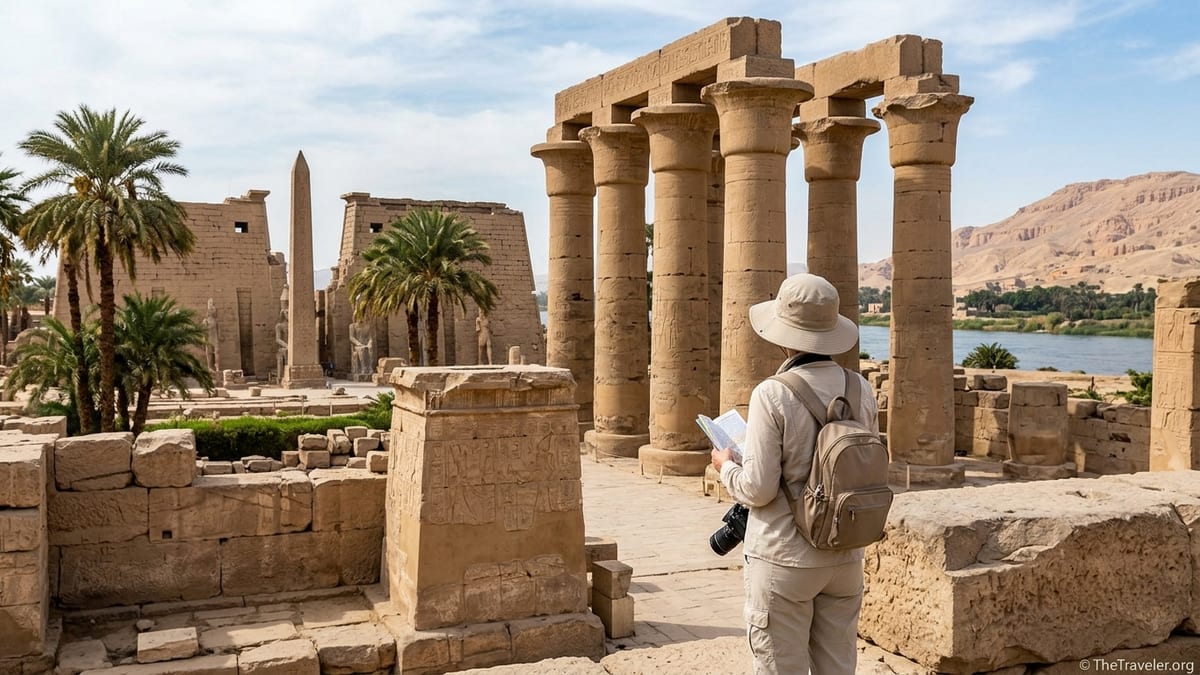
How This Guide Helps You Plan an Archaeology Focused Itinerary
This guide is designed as a practical starting point for travellers who want to build their Egyptian itinerary around temples, tombs and ruins. It focuses on the classic Cairo–Luxor–Aswan axis, with extensions to Alexandria, Sinai and the Western Desert where these are realistic to visit on short and medium length trips. For each region you will find a concise description of the main archaeological sites, the kind of visitor they suit, and the typical time needed on the ground.
It also summarises current patterns in domestic transport. As of late 2026, Cairo remains the main international gateway, with frequent domestic flights south to Luxor and Aswan operated by EgyptAir and other Egyptian carriers, and additional options by overnight train along the Nile Valley. Published schedules show dozens of weekly direct flights on the Cairo–Luxor and Cairo–Aswan routes, but frequencies and timings vary seasonally and are sometimes adjusted at short notice, so travellers should always reconfirm closer to departure through airlines or reliable aggregators.
Ticketing and site regulations change regularly. The Egyptian Ministry of Tourism and Antiquities publishes official opening hours and foreign visitor prices for major monuments, and a national e ticketing platform sells timed entries for key sites such as the Giza Plateau and major Luxor temples. In practice, discrepancies sometimes appear between different official pages and local ticket offices, and occasional special openings or closures occur around public holidays. Treat all quoted examples as indicative only and always verify hours, inclusions and prices shortly before travel.
Seasonality, accessibility and safety all matter when you are spending long hours among stone monuments in intense sun. This guide flags when heat is particularly punishing, when ground is uneven or involves steep stairways, and where common scams cluster around major visitor entrances. Conditions are not universally unsafe, but travellers should plan with realistic expectations rather than assuming every site visit will feel effortless.
Greater Cairo: Giza Plateau, Saqqara, Dahshur and Historic Cairo
The logical starting point for most archaeology themed trips is Greater Cairo, which encompasses much of the World Heritage property known as Memphis and its Necropolis, the pyramid fields stretching roughly 30 kilometres along the desert edge from Giza to Dahshur. At Giza, the celebrated pyramid complex of Khufu, Khafre and Menkaure and the Great Sphinx form the northern anchor of this landscape. The plateau entry ticket gives access to the wider site, with separate tickets for going inside specific pyramids or select tombs, a structure confirmed in current Ministry guidance. As of late 2026, official sources indicate daily opening from morning to late afternoon, but published first entry times differ slightly between platforms, so visitors should check the latest hours and arrive well before last entry.
Giza suits almost every type of visitor, from casual sightseers to dedicated enthusiasts, but the experience can feel crowded and commercial at the main viewpoints. Most travellers should allow at least a half day for the plateau, and history oriented visitors who want to photograph the pyramids from multiple angles, enter at least one pyramid and visit the on site boat museum or nearby new Grand Egyptian Museum complex can easily spend a full day. The site slots naturally into a short Cairo stay of two or three nights or as the first day of a longer Egypt journey.
South of Giza, Saqqara offers a more atmospheric introduction to Old Kingdom funerary architecture. This vast necropolis contains the Step Pyramid of Djoser and a patchwork of tombs and mastabas, many with fine reliefs and hieroglyphic inscriptions. Continuing further south, Dahshur preserves the Bent Pyramid and Red Pyramid in a quieter desert setting. Together, Saqqara and Dahshur appeal strongly to travellers who want to go beyond a single pyramid postcard and understand how royal tomb design evolved, while still remaining manageable for engaged casual visitors. From central Cairo, each can be visited as a half day or combined full day trip by private driver or organised tour, though traffic and security routing mean travel times fluctuate.
Historic Cairo itself is a separate World Heritage site that repays at least a full day on foot. Here, the focus shifts from pharaonic to Islamic and Coptic heritage, with medieval mosques, madrasas, city gates and churches layered around the old core of Fustat and the Citadel. While not an ancient temple zone in the pharaonic sense, it offers essential context on how Cairo rose after Memphis declined. It suits culturally curious travellers of all levels and is best explored with a local guide who can help navigate busy streets and highlight architectural details. For many itineraries, two to three days based in Cairo allows time for one full day at Giza, one day between Saqqara and Dahshur, and one day in Historic Cairo, with the Egyptian Museum or the new Grand Egyptian Museum woven into evenings or partial days.
Nile Valley: Luxor’s East and West Banks, Abydos and Dendera
Luxor, built on the site of ancient Thebes, is the heart of many archaeological itineraries and a core World Heritage property. The east bank is dominated by Karnak and Luxor Temple, once linked by a processional avenue of sphinxes. Karnak is a vast temple complex devoted primarily to Amun, with pylons, obelisks and the famous Great Hypostyle Hall. Current official ticket lists show a base foreign visitor tariff for Karnak and note separate tickets for subsidiary areas such as the Mut Temple, with extended opening hours into early evening on some days, although these details can shift with tourism demand. Most visitors will want at least two to three hours on site, while enthusiasts can spend half a day or more exploring outlying shrines.
Luxor Temple, more compact and centrally located, comes into its own at sunset and after dark when columns and statues are illuminated. It suits casual visitors who may be overwhelmed by Karnak as well as travellers who want atmospheric evening photography. Many tours combine both major east bank temples in a single half day, but travellers particularly interested in architecture and reliefs should consider devoting separate sessions to each, perhaps with a midday rest to avoid heat.
Across the Nile on the west bank lies the necropolis of the New Kingdom rulers known as the Valley of the Kings, part of the Ancient Thebes World Heritage area. The official Ministry description notes that pharaohs of the Eighteenth to Twentieth Dynasties were buried in this rugged ravine in elaborately decorated rock cut tombs. Standard tickets typically cover entry to a limited number of tombs on a rotating schedule, with surcharges for particularly famous tombs, and official tables currently list opening from early morning to late afternoon. Conditions inside tombs involve gradients, steps and sometimes stuffy air, so the site best suits reasonably mobile visitors prepared for heat and humidity. Allocate at least half a day and more if you plan to see multiple premium tombs or combine with the nearby Valley of the Queens or workers’ village at Deir el Medina.
Also on the west bank, the terraced mortuary temple of Hatshepsut at Deir el Bahri and the Ramesseum and Medinet Habu temple complexes give additional insight into royal ideology and daily religious practice. These sites appeal strongly to archaeology enthusiasts but remain accessible to interested generalists, especially when visited with a guide. Many standard itineraries devote two full days in Luxor to cover Karnak and Luxor Temple on one day and a combination of west bank tombs and temples on the other, with extra time for museums or hot air ballooning. Travellers with a deeper interest in temple art can extend north to Dendera, with its Ptolemaic temple of Hathor, and Abydos, centre of the Osiris cult. These are usually approached as long day trips by road from Luxor or as stops on Nile cruise itineraries, and are best suited to second time visitors or specialists due to the travel commitment.
Aswan and Nubia: Philae, Abu Simbel and Other Monuments
Further south, Aswan forms the gateway to Egypt’s Nubian monuments. The UNESCO listed serial property from Abu Simbel to Philae includes ten component sites, among them the relocated temples of Ramses II at Abu Simbel and the island sanctuary of Isis at Philae, as well as smaller temples and quarries around Aswan. The Temples of Philae, moved to higher ground to save them from rising Nile waters, are one of the most evocative temple complexes in Egypt. They can be reached by a short boat ride from a dock south of Aswan and are generally visited in a two to three hour excursion that suits most visitors, including those on tight cruise schedules.
Abu Simbel, carved into a cliff near the modern Sudanese border and later relocated block by block, is often a highlight for those who make the journey. It is accessible from Aswan by early morning road convoys or by domestic flights that may run daily or several times weekly depending on season and demand. Transport typically requires a very early start and at least eight to ten hours door to door when travelling by road, including around two hours on site, so this excursion suits travellers willing to sacrifice some comfort for an iconic experience and is often recommended for keen photographers, ancient history enthusiasts and repeat visitors. Day tour operators commonly package transport and guiding, but travellers should confirm current convoy rules and flight schedules, which have changed over time.
Within Aswan itself, additional archaeological interest lies in the unfinished obelisk quarry, Nubian Museum and island temples and tomb remains on Elephantine. These are compact sites that can fill a relaxed day of exploration. For many travellers, two nights in Aswan provides enough time to see Philae and key Aswan sites, while three nights allows inclusion of Abu Simbel without excessive rush. Aswan also functions as the southern terminus for Nile cruises, which sail north to Luxor over three or four nights, stopping at intermediary temples such as Kom Ombo and Edfu that feature distinctive double temples and well preserved reliefs attractive to committed archaeology fans.
Domestic connectivity between Cairo, Luxor and Aswan is currently robust in terms of published frequencies, with dozens of weekly flights and day and night trains along the Nile corridor. However, travellers’ reports and specialist planning resources note that departure times and even some services can shift, particularly in shoulder seasons or around public holidays. Anyone planning tight connections to onward flights or cruises should therefore leave generous buffers and confirm schedules not just at the time of booking but again shortly before departure.
Alexandria and the Mediterranean Coast: Graeco Roman Heritage
While not usually the first priority for travellers focused on pharaonic sites, Alexandria offers an important layer of Graeco Roman archaeology and later heritage. The city itself is not yet inscribed as a separate World Heritage property in the way Memphis or Ancient Thebes are, but it has long been central to Egypt’s multicultural story. For archaeology minded visitors, the main urban sites include the Roman amphitheatre and residential quarter at Kom el Dikka, the underground corridors of the Kom el Shoqafa catacombs and scattered remnants of ancient walls and pillars.
These sites are compact and relatively easy to reach within the city, making Alexandria a good fit for travellers who want to mix a Mediterranean coastal atmosphere with half a day to a day of light archaeological sightseeing. The sites involve stairs and subterranean passages that may not suit visitors with mobility limitations or claustrophobia, but they are far less extensive than the temple fields of Upper Egypt. They appeal to second time visitors to Egypt who have already explored the Nile Valley, as well as to history enthusiasts interested in the Hellenistic and Roman periods.
Practical access is straightforward. Fast road links and rail services connect Alexandria to Cairo, with travel times typically around three hours or less depending on mode and traffic. Many travellers visit Alexandria as a long day trip from Cairo, leaving early in the morning and returning in the evening, while others build in one or two overnight stays. Archaeology focused itineraries might choose a single overnight to allow for quieter early visits to Kom el Dikka and the catacombs before returning to Cairo for onward flights south.
Sinai and the Desert: Saint Catherine Area and Wadi Al Hitan
Egypt’s World Heritage sites extend beyond the Nile corridor to the Sinai Peninsula and Western Desert. The Saint Catherine Area in southern Sinai is centred on the monastery traditionally associated with the biblical Mount Sinai. While the site is more significant for religious and natural heritage than for pharaonic archaeology, its long monastic history and manuscript collection attract cultural travellers. Reaching Saint Catherine requires a substantial road journey from Sharm el Sheikh or Cairo, with security checkpoints and potential weather constraints in winter. Overnight stays are standard, and the climb to the summit route involves steep, uneven paths better suited to reasonably fit visitors.
In the Western Desert, Wadi Al Hitan, or Whale Valley, is a World Heritage site known for exceptionally preserved fossil remains documenting the evolution of whales from land mammals to sea going animals. It sits within the Fayoum region, reachable from Cairo by road, often as part of organised day or overnight trips that also visit nearby desert lakes and oases. Although it is not an archaeological site in the traditional sense of temples and tombs, it offers deep time context and appeals to travellers with a broad interest in earth history and palaeontology. Infrastructure on site is more limited than at major Nile monuments, so visitors should be prepared for simple services and bring robust sun protection.
Other lesser visited desert sites, such as remote oases with smaller temples and Roman remains, are usually only realistic for longer itineraries or repeat visitors comfortable with basic conditions and long drives. In all cases, travellers should consult up to date local advice about security, road conditions and conservation rules, as access and permitted routes can be adjusted in response to environmental or safety considerations. For most first and second time visitors, Saint Catherine and Wadi Al Hitan are optional add ons rather than core elements of an archaeology themed itinerary.
Tickets, Opening Hours, Seasonality and On Site Practicalities
Across Egypt’s major archaeological areas, tickets often follow a layered structure. Large sites such as the Giza Plateau, Karnak or the Valley of the Kings generally require a base area ticket, with additional tickets for special interiors or separate complexes, such as entering the Great Pyramid, visiting specific tombs or accessing subsidiary temples. Official pricing tables issued by the Ministry of Tourism and Antiquities have been updated in recent years to reflect new rates for foreign visitors and students, but figures vary by site and have been revised several times since 2024. Travellers should therefore consult the latest official price lists or ticketing portal rather than relying on older guidebooks or hearsay.
Opening hours are another area where caution is advisable. Even within official sources, there can be minor discrepancies between different pages regarding first entry times, and seasonal adjustments occur for Ramadan, peak summer heat and special events. As of late 2026, many major sites list core visiting hours from early morning to late afternoon, roughly around sunrise to before sunset, with extended evening openings at selected temples or museums. A good rule of thumb is to plan key visits for early morning, both to avoid heat and to build margin in case actual last entry is earlier than expected.
Egypt’s climate strongly shapes the visitor experience. From roughly April to October, daytime temperatures in Upper Egypt often climb well above 30 degrees Celsius, and sun exposure on stone surfaces can be intense. In these months, travellers may want to structure days around very early starts, long midday breaks and late afternoon returns to sites. The cooler months from November to March are more comfortable for extended site visits but coincide with higher visitor numbers at headline sites such as Giza and Luxor, particularly around year end holidays. Public holidays and religious festivals can influence both opening hours and crowding, so it is wise to ask hotels or local operators about expected patterns during your specific dates.
Accessibility varies widely between sites. Many major temples have at least some level ground and ramps near main entrances, but inner courts, colonnades and tomb corridors frequently involve uneven stone, sand, low passages and stairways. Underground tombs in the Valleys of the Kings and Queens often require descending sloping paths or steps with limited handrails, before returning the same way uphill. Visitors with mobility or respiratory issues may wish to focus on open air temple complexes such as Karnak, Luxor Temple or Philae, where it is possible to experience much of the architecture without tackling the most confined spaces.
On site safety considerations are generally straightforward but worth taking seriously. Heat exhaustion and dehydration are more common risks than crime at most monuments, so travellers should carry water where permitted, wear sun hats and light clothing and pace themselves, especially during midday hours. Around some entrances, particularly at Giza and parts of Luxor, visitors may encounter insistent touts offering camel rides, unofficial guiding or souvenirs at inflated prices. Declining politely but firmly, using official ticket offices and considering pre arranged licensed guides can reduce stress. Overall security at archaeological sites is usually handled by visible police and tourism officers, but conditions can evolve, so travellers should always check current advisories from reputable sources before departure.
Transport Hubs, Typical Routes and How Long to Allow
For most archaeology focused itineraries, Cairo, Luxor and Aswan serve as the main hubs. Cairo handles the bulk of international arrivals and offers the most choices for day trips to Giza, Saqqara, Dahshur, Historic Cairo and, for longer stays, the Fayoum and Wadi Al Hitan. Luxor anchors exploration of Ancient Thebes, while Aswan provides access to Nubian monuments and the southern Nile temples. Between these points, travellers choose among domestic flights, rail services, private drivers and Nile cruises.
Recent flight schedule snapshots indicate that there are many direct flights each week on the Cairo–Luxor and Cairo–Aswan routes, operated by EgyptAir and other Egyptian carriers, with journey times of around one hour. Frequencies and departure times fluctuate with season and demand and are known to change, so travellers should verify options close to the time of booking and again before flying. Overnight sleeper trains between Cairo and Luxor or Aswan remain a popular choice for those who prefer to avoid domestic flights or want to combine transport with a travel experience, but these should also be booked and reconfirmed through reliable channels because coaches, timings and service levels can vary.
Private drivers or small group tours are common for day trips from Cairo to Saqqara, Dahshur and the Fayoum, and from Luxor to neighbouring sites such as Dendera and Abydos. Nile cruises typically link Aswan and Luxor over three or four nights, stopping at Kom Ombo and Edfu and functioning as both transport and accommodation. Road journeys beyond the main Nile corridor, such as to Saint Catherine or remote oases, are significantly longer and may be subject to convoy rules or route changes, making them more suitable for experienced travellers with flexible schedules.
In terms of time allocation, most first time visitors who are primarily interested in archaeological highlights find that about a week to ten days allows a well balanced introduction. A compact trip might include three nights in Cairo for Giza, Saqqara or Dahshur and Historic Cairo, three nights in Luxor for east and west bank sites, and two nights in Aswan focusing on Philae and Aswan itself. Second time visitors or those with two weeks or more can layer in Abu Simbel, a Nile cruise, side trips to Dendera and Abydos, and an overnight in Alexandria or the Fayoum. Whatever the combination, travellers should build in buffer time for unexpected schedule changes and site fatigue rather than attempting to string together multiple dawn to dusk site visits every day.
Comparing Egypt’s Major Archaeological Regions
The following comparative overview frames key archaeological regions in terms of their main highlights, UNESCO status, typical visitor time and access difficulty. Classifications such as “easy” or “moderate” access are indicative only and can shift with infrastructure changes, security rules and personal fitness levels.
Region / Key Sites: Greater Cairo (Giza, Saqqara, Dahshur, Historic Cairo). Main Highlight: Old Kingdom pyramids and necropolises, plus medieval Islamic and Coptic monuments. UNESCO Status: Memphis and its Necropolis, Historic Cairo. Typical Time Needed: Three full days to sample main pyramid fields and historic districts. Difficulty of Access: Generally easy by road within Greater Cairo, but subject to heavy traffic, crowding and desert heat.
Region / Key Sites: Luxor and Nile Valley (Karnak, Luxor Temple, Valley of the Kings and Queens, Hatshepsut’s temple, Dendera, Abydos). Main Highlight: New Kingdom royal burials and monumental temple complexes. UNESCO Status: Ancient Thebes with its Necropolis. Typical Time Needed: Two to four full days in Luxor, with an extra day each for Dendera and Abydos extensions. Difficulty of Access: Moderately easy, with domestic flights and trains; on site involves significant walking, stairs and underground passages.
Region / Key Sites: Aswan and Nubia (Philae, Abu Simbel, Kom Ombo, Edfu). Main Highlight: Temples relocated due to the Aswan High Dam, Nubian and Ptolemaic sanctuaries. UNESCO Status: Nubian Monuments from Abu Simbel to Philae. Typical Time Needed: Two to three days in Aswan plus one long day or overnight for Abu Simbel. Difficulty of Access: Flights and trains link Aswan to Cairo and Luxor; Abu Simbel involves long road journeys or limited flights, so access is moderate to demanding.
Region / Key Sites: Alexandria and Mediterranean Coast (Kom el Dikka, catacombs, scattered classical remains). Main Highlight: Graeco Roman urban archaeology and coastal setting. UNESCO Status: Not a separate listed property, but tied to Egypt’s broader heritage. Typical Time Needed: One long day or one to two nights. Difficulty of Access: Easy rail or road links from Cairo; urban exploration with some stairs and confined spaces.
Region / Key Sites: Sinai and Desert (Saint Catherine Area, Wadi Al Hitan). Main Highlight: Monastic and biblical heritage, and fossil rich desert valley. UNESCO Status: Saint Catherine Area and Wadi Al Hitan. Typical Time Needed: One to two nights for Saint Catherine, a long day or overnight for Wadi Al Hitan. Difficulty of Access: Road journeys are long and subject to checkpoints and environmental conditions, with hiking or rough ground on site, so access is moderate to challenging.
Putting It Together: Sample Time Frames and Final Checks
For travellers planning a short break focused mainly on iconic archaeological sites, a five to six day Cairo and Luxor combination works well. Two or three nights in Cairo allow time for the Giza Plateau and at least one additional pyramid area such as Saqqara, plus a partial day in Historic Cairo. A short domestic flight or overnight train then connects to Luxor, where two to three nights offer scope for Karnak and Luxor Temple on the east bank and a full day among west bank tombs and temples.
Those with around ten days can add Aswan into the mix. A representative route might be three nights in Cairo, three or four in Luxor and two or three in Aswan, optionally including Abu Simbel as a long day trip. Travellers with a strong interest in ancient religion and art could further incorporate a three or four night Nile cruise between Aswan and Luxor, using the vessel as both transport and a base for guided visits to riverside temples. With two weeks or more, additional layers such as Alexandria, Dendera, Abydos, Wadi Al Hitan or Saint Catherine become realistic, particularly for second time visitors who want to explore more specialised sites.
Whatever the duration, it is essential to recognise that detailed operational information is fluid. Ticket structures at key sites, opening hours, security protocols and transport schedules have all seen adjustments in recent years. Before finalising a day by day plan or publishing any detailed guide, travellers and travel writers should cross check current data directly with the Egyptian Ministry of Tourism and Antiquities, the national ticketing portal, airlines, rail operators and reputable local partners. Noting the date on which such information was last verified helps future readers interpret it appropriately.
With realistic expectations, thoughtful pacing and up to date information, Egypt’s archaeological landscapes reward both first encounters and repeat explorations. Whether you are standing between the pyramids of Giza, tracing painted scenes in a royal tomb in Luxor or watching the sun rise behind the colossal statues of Abu Simbel, the country’s World Heritage sites provide an extraordinary framework for understanding the deep past and its ongoing resonance in the present.