


More news on this day
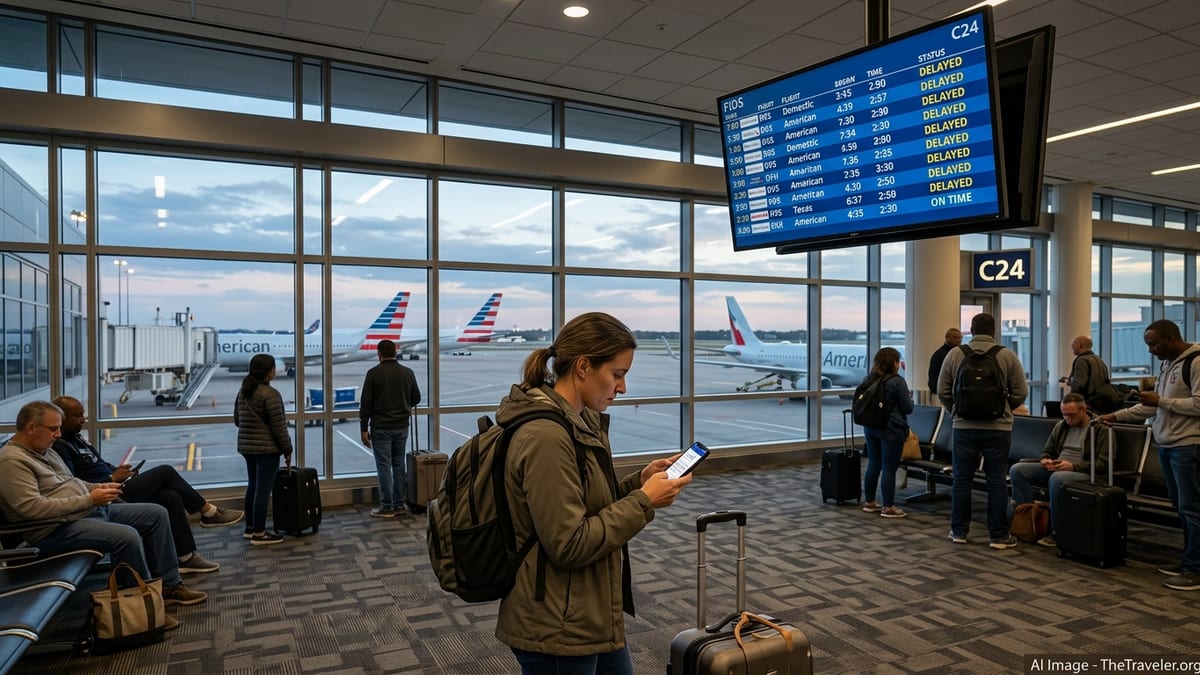
As U.S. airlines brace for what the Federal Aviation Administration projects will be the busiest Thanksgiving skies in 16 years, federal data, strengthened refund rules and a growing ecosystem of flight-tracking apps are changing how travelers can prepare for, respond to and in some cases avoid serious flight delays in late 2026 and into 2027.
Get the latest news straight to your inbox!
Delays Remain Common, Especially Around The Holidays
Government data confirms that delays remain a built-in feature of U.S. air travel rather than an exception. Bureau of Transportation Statistics figures for reporting carriers show that in the 12 months to August 2026, roughly three-quarters of domestic flights arrived on time, with about 23 percent arriving at least 15 minutes late and a small additional share cancelled or diverted. That means close to one in four scheduled flights either ran late or never operated as planned over that period, even before factoring in the busiest holiday weeks.
The picture was slightly worse during the 2025 year-end holidays. An analysis of more than one million BTS flight records for November and December 2025 found that nearly a quarter of U.S. flights arrived 15 or more minutes behind schedule during those two months, underscoring how congestion and winter weather can amplify routine operational strains when demand peaks. Early indications from this November’s data suggest that the nationwide air traffic control network outage on 13 November and subsequent airline technology glitches have already injected additional disruption into the 2026 holiday season.
Behind the topline numbers, BTS delay-cause statistics show that most lost minutes are attributed to late arriving aircraft and carrier-related issues such as maintenance, crew scheduling and aircraft changes, with a smaller but highly disruptive share assigned to extreme weather. In the most recent 12 months of data, airlines reported that late-arriving aircraft alone accounted for close to 40 percent of delay minutes, with air carrier factors contributing roughly one third and weather a single-digit percentage in typical months. Those proportions can swing sharply when large storms or infrastructure failures hit major hubs, as this November’s ground stop and a separate Delta automation outage in Atlanta have shown.
Why Departure Time Still Matters For On-Time Odds
For individual travelers, when you fly can be almost as important as which airline you choose. Multiple analyses of BTS data and route-level breakdowns show that early morning departures consistently post the highest on-time arrival rates across many U.S. routes. A route comparison service based on BTS data, for example, reports materially better punctuality for flights leaving in the first few hours of the day than for the same city pairs in mid-afternoon and evening, even when operated by the same carrier.
The operational logic is straightforward. The first wave of departures each morning generally uses aircraft and crews that overnighted at the airport, so they are not waiting on an inbound leg that might itself be delayed. Early in the day, airspace and runways are less saturated, crew duty-time limits are easier to manage, and there is more slack to absorb minor issues without tripping into long delays. As the schedule rolls forward, knock-on disruptions accumulate: one late inbound can unsettle several outbound flights, and ground congestion at large hubs can add minutes at each step of taxi and departure.
Data from some hubs also highlight a smaller reliability “sweet spot” late at night. Once the day’s busiest traffic banks have passed, late-evening and overnight flights often face less congestion in the terminal area and more stable air traffic control programs. Airlines also tend to schedule longer block times for overnight services, which can make it easier to arrive within the 15‑minute on-time definition even when moderate headwinds or ground holds occur. The trade-off is comfort and convenience, particularly for families and travelers with early-morning commitments at their destination, but for those whose priority is reducing the risk of missed connections or morning meetings, red-eyes and last banks of the day can perform better than mid-evening departures on some routes.
Apps, Alerts And Real-Time Data Give Travelers A Head Start
Digital tools are increasingly central to managing disruption once a delay starts to develop. U.S. and foreign airlines serving the United States now push most schedule changes, gate updates and rebooking options through their own mobile apps and websites, often faster than they can be communicated at crowded airport desks. When large-scale weather or system issues emerge, many carriers publish temporary travel waivers that allow affected passengers to change flights without standard change fees, and in some cases without paying a fare difference within a defined date and routing window.
In practice, those waivers and self-service options are often easiest to use through an airline’s app. When a delay or cancellation hits, some airlines automatically generate alternative itineraries that eligible passengers can accept with a few taps, subject to seat availability and the scope of any waiver. Because the most desirable alternatives tend to fill quickly once a disruption spreads across a hub, being among the first wave of travelers to act can determine whether you secure a same-day option or face an overnight stay.
Third-party trackers add another layer of situational awareness. Apps such as Flighty and similar services monitor not just the scheduled leg, but also the aircraft’s earlier segments, airport-level congestion and broader traffic patterns using BTS data and real-time feeds. If the inbound aircraft for your evening departure is still on the other side of the country running late, those tools may flag an elevated delay risk before the airline formally updates its schedule. For travelers, that head start can be enough time to study alternative flights in the airline app, check whether seats remain on earlier departures, or at least adjust ground transport and meeting plans with more confidence.
New Automatic Refund Rules Strengthen Passengers’ Rights
This year’s holiday travelers are navigating a different regulatory environment from just a few seasons ago. In April 2024, the U.S. Department of Transportation issued a final rule on refunds and other consumer protections that, along with later legislation, created standardized definitions of “significant” delays and changes and required airlines to provide automatic cash refunds in many disruption scenarios. The rule covers U.S. and foreign carriers operating flights to, from or within the United States and applies regardless of whether the ticket was purchased directly from the airline or through a ticket agent, subject to merchant-of-record rules.
Under the framework now in force, a domestic itinerary that arrives three hours or more later than originally scheduled, or an international itinerary that arrives six hours or more late, is generally considered to have undergone a significant change if the passenger chooses not to travel on the rescheduled service. Other qualifying significant changes include departures moved substantially earlier than ticketed, the addition of connections, changes to the city pair or airports served, and downgrades in the class of service. When such a cancellation or significant change occurs on or after 16 May 2024, airlines must notify affected passengers of their rights and, if the traveler does not accept alternative transportation or non-cash compensation, provide an automatic refund of the full fare paid, including taxes and mandatory fees.
The timing of these protections varies by requirement. The core standards for significant delays and the obligation to provide refunds following cancellations or significant changes are tied to statutory deadlines in the FAA Reauthorization Act of 2024, while additional requirements covering refunds of baggage fees for significantly delayed bags and refunds of unused ancillary services took effect later in 2024. DOT guidance emphasizes that airlines may not substitute vouchers, credits or frequent flyer miles for a cash refund when one is due unless the passenger affirmatively chooses an alternative. Refunds must normally be processed within seven business days for credit card purchases and within 20 days for other payment methods once eligibility is triggered.
DOT enforcement reports over the past several years show that the department has taken action against multiple airlines for failing to provide timely refunds after widespread cancellations, particularly during and after the pandemic. The new automatic refund mechanisms are intended to reduce the burden on passengers to understand complex policies or navigate slow manual processes. However, consumer complaints filed with DOT in 2025 and 2026 indicate that individual travelers still encounter long waits, confusing communications or disputes over whether a change meets the “significant” threshold, making it important for passengers to keep records and understand the basic parameters of the rules.
How To Act Quickly When Disruptions Hit
When a disruption does occur, the combination of delay patterns, app alerts and clearer refund rights gives travelers a more structured playbook. The first step is early awareness. Monitoring your itinerary in both the airline’s app and, where used, a third-party tracker can reveal rolling delays, aircraft swaps or gate changes before they are announced in the terminal. Comparing the updated arrival time against the three-hour domestic and six-hour international thresholds can help determine whether you might qualify for a refund if you decide not to complete the trip.
If a flight is cancelled or faces a major delay before you leave home, searching for alternatives through the airline’s app or website is typically faster than waiting in an airport queue or on hold. During large disruptions, check whether the airline has issued a formal travel waiver for your origin or destination; those notices usually spell out which dates and routes can be changed without fees or fare differences. Travelers who prefer a refund rather than rebooking should read screens carefully and avoid accepting default vouchers or miles if their goal is to obtain cash back, since choosing an alternative form of compensation may be treated as settling the claim for that particular disruption.
When refunds seem warranted but do not materialize promptly, passengers can escalate within the airline and then file a complaint with DOT’s Office of Aviation Consumer Protection. The agency uses such complaints to help resolve individual cases and to spot patterns that might merit broader enforcement. Keeping documentation is crucial: screenshots of delay notices and revised schedules, copies of receipts for hotels and meals, and written records of what airline representatives promised can all strengthen a traveler’s position. Depending on the circumstances and card network policies, some passengers may also be able to pursue chargebacks through their credit card issuer if services were not provided as promised, although those processes sit outside DOT’s framework.
What To Watch For In Late 2026 And Into 2027
The current holiday period illustrates how fragile the system can be when operating near capacity. FAA forecasts suggest that from 23 November through 1 December 2026, U.S. airlines will operate more than 417,000 flights, the highest Thanksgiving-period volume in 16 years. This surge comes just weeks after a national ground stop linked to the air traffic control network and amid separate technology outages at individual carriers. While safety regulators and airlines stress that these events did not compromise flight safety, they acknowledge that outages in complex software and communications systems can cascade quickly into multi-day disruption when schedules are this tight.
For travelers planning trips through the end of 2026 and into 2027, that context argues for building more margin into itineraries. Choosing early morning departures where practical, avoiding the final scheduled flight of the day on routes with limited frequencies, and leaving generous buffers for tight connections can all reduce the risk of an unplanned overnight. Some travelers are also paying closer attention to historic on-time and cancellation rates by airline and by route, using BTS summaries or third-party tools built on that data, when choosing between carriers on competitive city pairs. While past performance does not guarantee future results, such comparisons can highlight persistent reliability gaps on particular routes.
On the policy front, DOT has indicated that enforcement of the new refund rules will be a continuing priority and that similar standards will extend more fully to ticket agents that package and sell flights. Travelers should expect some further changes to how airlines and online travel agencies display disruption notices, refund eligibility and self-service options as those requirements are implemented and refined. Before each trip, it is worth reviewing the latest version of the operating airline’s contract of carriage and checking the DOT’s current guidance on delays and refunds so you know in advance when you are entitled to automatic cash back and when you may need to negotiate alternatives or rely on travel insurance. With schedules tight and extreme weather and technology risks in sharper focus, understanding both operational patterns and legal protections is becoming a core part of planning air travel rather than an optional extra.