


More news on this day
The US Federal Aviation Administration is turning to artificial intelligence to manage crowded skies, rolling out new data-driven tools in Washington and across the national airspace in an effort to curb the flight delays that have frustrated millions of travelers in recent years.
Get the latest news straight to your inbox!
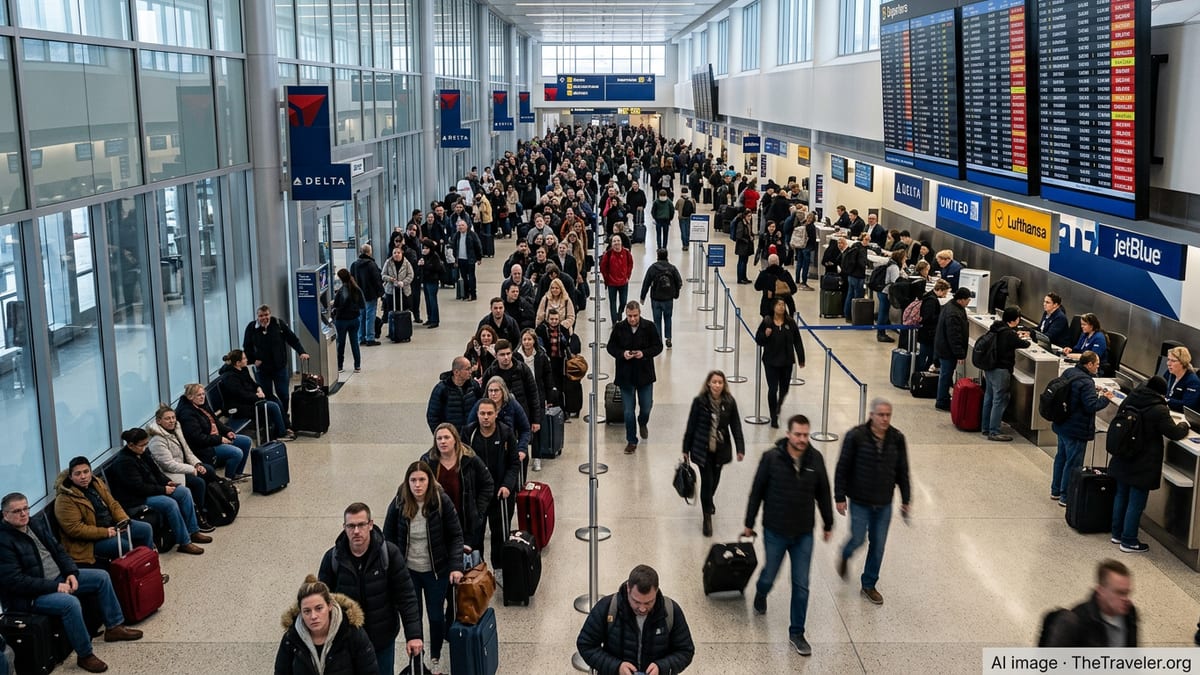
New AI platforms take center stage in Washington
According to recent broadcast coverage, a new FAA tool debuting in the Washington area this week is designed to analyze weather, airline schedules, runway capacity and other operational data in real time, with the goal of spotting bottlenecks before they ripple across the country. The system incorporates artificial intelligence techniques to sift through vast data streams faster than human planners can, then surface options to keep departures and arrivals moving.
Publicly available information from the US Department of Transportation indicates that this local deployment is part of a larger national rollout of AI-enabled traffic management. The initiative sits at the heart of a broader modernization push that seeks to replace legacy software with predictive platforms capable of handling the growth in air travel forecast for the next decade.
Initial deployment in the Washington region is significant for travelers because the area’s airports are a major choke point in the US network. Congestion there can quickly spill over to hubs from Atlanta and Chicago to Denver and Los Angeles. If the tool performs as expected, the Washington trials are expected to inform expansion to other high-traffic facilities.
While the system itself runs in the background, its impact will be felt in more consistent departure times, fewer last‑minute ground stops and a reduction in the kind of cascading delays that often strand connecting passengers far from home.
SMART and FMDS: AI at the core of airspace management
Recent briefings from the Department of Transportation describe a flagship platform known as the Strategic Management of Airspace, Routes and Trajectories, or SMART. The system is built around an AI-supported engine that centralizes roughly 200 separate data feeds, including weather models, radar tracks, airline schedules, traffic flow statistics and staffing levels in air traffic facilities.
By combining those inputs, SMART produces a visual picture of where aircraft are expected to be across the National Airspace System and how much traffic individual sectors can handle. The software forecasts where congestion or storms are likely to cause trouble and suggests schedule adjustments, reroutes or flow restrictions before problems emerge. Airline executives have publicly endorsed the effort, noting that more accurate predictions can meaningfully cut delays and cancellations during disruptive weather.
Supporting SMART is a companion backbone known as Flow Management Data and Services, or FMDS. FAA technical documentation describes FMDS as the replacement for the aging Traffic Flow Management System. It is designed to ingest real-time flight plans, position reports, airline schedules and high-resolution weather data, then use advanced modeling to balance demand with the actual capacity of airports and airspace.
The two platforms are intended to work in tandem: FMDS provides a consolidated, up-to-the-minute dataset on how the system is performing, while SMART layers AI-driven analytics on top of that information to recommend strategic actions. For travelers, that combination is expected to translate into fewer ground delay programs, more efficient reroutes around storms and a reduced risk that a local disruption will cascade into a nationwide meltdown.
Airport surface tools aim to reduce taxi delays and fuel burn
Beyond high-altitude traffic flows, the FAA is also applying more automation to the most visible part of the passenger experience: time spent waiting on the ground. The agency’s Terminal Flight Data Manager, or TFDM, is being phased in at major US airports as part of its broader NextGen modernization portfolio.
According to FAA program descriptions, TFDM includes a departure scheduler and surface metering functions that share live data between tower controllers, ramp personnel and airline operations centers. By better coordinating pushback times, runway assignments and taxi routes, the system is intended to cut the minutes aircraft spend idling in departure queues with engines running.
The benefits listed by the agency include improved departure predictability, fewer taxi-time delays, lower fuel consumption and reduced engine noise around airports. While TFDM does not rely on the same type of AI engine as SMART, it is part of the same trend toward data-driven decision support. When combined with trajectory-based planning in the air, more efficient surface operations help ensure that a thunderstorm or temporary runway closure does not trigger hours of knock-on delays.
Travelers may notice the results in more accurate boarding announcements and tighter alignment between scheduled and actual pushback times. Airlines, in turn, can make better use of aircraft and crew, which can ease some of the staffing-related disruptions that have complicated the post‑pandemic recovery in air travel.
What AI means for passengers this holiday season and beyond
Industry reports suggest that US air traffic continues to run near or above pre‑pandemic levels, with peak holiday periods in particular testing the limits of airport and airspace capacity. In that environment, delays can multiply quickly when storms or equipment issues reduce throughput at a major hub. The FAA’s AI-enabled tools are intended to give planners more lead time to respond, whether by rerouting traffic, slowing the rate of departures into constrained airspace or shifting flights to less congested routes.
For passengers, the most immediate effect may be a subtle one: fewer surprises. If planners have better visibility into how a line of thunderstorms is likely to affect New York or Dallas three or four hours in advance, they can adjust schedules and reroutes earlier, potentially turning what would have been a three-hour delay into a shorter hold or a schedule change made before travelers even arrive at the airport.
Travel news coverage notes that the FAA has also been meeting with airline leaders to align on how the SMART platform and related tools will be used operationally. Carriers see potential benefits in more reliable slot usage, lower fuel burn and a smoother experience for connecting passengers when disruptions hit. Over time, those efficiency gains could free up capacity during busy seasons without the immediate need for major new runways or terminals.
The shift does not eliminate the possibility of delays entirely. Severe weather, crew availability and mechanical problems will continue to pose challenges. However, with AI now embedded in the core of traffic management planning, the agency is betting that the network can absorb disturbances more gracefully, keeping more itineraries intact and more passengers on schedule.
Balancing innovation with safety and oversight
As the FAA expands its use of artificial intelligence, agency documents emphasize that safety remains the primary constraint on any new system. The organization has published an AI strategy and research roadmaps that focus on how to evaluate and certify machine learning tools used in aviation operations, from air traffic management aids to training simulators.
Technical guidance describes AI as a set of computational methods that mimic elements of human perception and decision-making. In the context of air traffic, that means systems that can identify patterns in traffic, weather and scheduling data, then suggest options to human managers. The agency’s research efforts are aimed at understanding how those algorithms perform, how they can fail and how to design safeguards so that human operators retain authority over critical decisions.
Publicly available planning documents also highlight the importance of transparency and accountability in AI deployments. This includes tracking how recommendations are generated, ensuring that models are trained on appropriate data and making it possible to audit system performance after major events. Research partnerships with universities and industry are exploring how AI can support tasks such as interpreting complex weather forecasts or simulating air traffic scenarios for training, while still fitting within the rigorous safety framework that governs US aviation.
For travelers, the result is likely to be an incremental shift rather than an overnight overhaul. As the new tools mature and expand nationwide, the day-to-day experience at the airport may feel less chaotic when storms roll in or traffic peaks. Behind the scenes, a growing array of AI-enabled systems will be working to keep flights moving, even as demand for air travel climbs.