


More news on this day
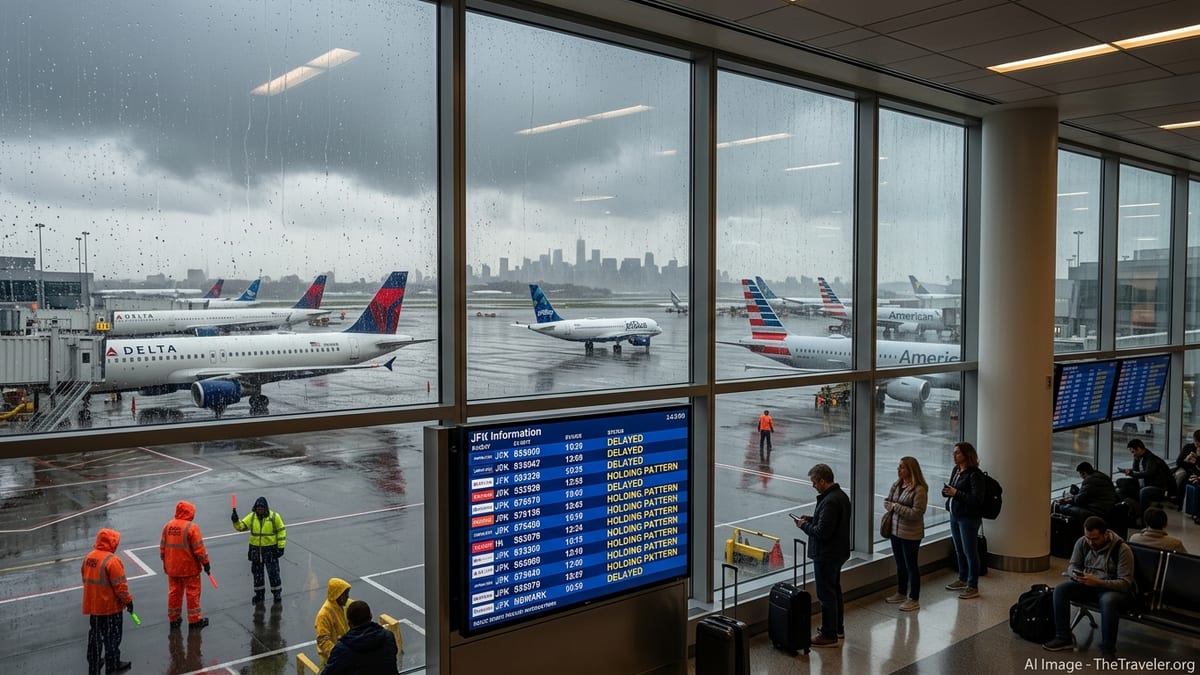
Arriving flights into the New York City area faced the prospect of weather-related holding and delays on Thanksgiving Day, after the Federal Aviation Administration (FAA) warned that high winds, rain and low clouds could slow traffic at the region’s busiest airports even as it scaled back the risk of formal ground stops.
Get the latest news straight to your inbox!
Weather Triggers Morning FAA Arrival Advisory for New York
The FAA’s morning arrival advisory for Thursday 26 November 2026 outlined potential airborne holding of up to 30 minutes for flights into the New York terminal area. The notice covered LaGuardia Airport, John F. Kennedy International Airport, Newark Liberty International Airport and nearby satellite fields from 06:00 to 22:00 Eastern, citing strong surface winds, low clouds and periods of rain as the primary constraints on arrival rates.
The 30-minute figure in the advisory reflected an operational planning estimate for possible holding, not a measured average delay for passengers. Air traffic managers use this type of estimate to signal to airlines and flight crews that arrival spacing could increase at times when weather reduces runway capacity, even if some flights still land on schedule.
Conditions across the New York metro area were shaped by a powerful coastal storm that brought a tight pressure gradient over the Mid-Atlantic and southern New England. Forecasts from the National Weather Service on Thursday highlighted a high wind warning for parts of southeastern New York and northeastern New Jersey, with gusts projected to reach 60 to 65 mph in exposed locations from late morning into the night. That combination of strong winds and low ceilings posed challenges for safely sequencing arrivals, particularly during the afternoon and evening peak.
Ground Stops Dropped for New York and Philadelphia by Midday
While early FAA planning documents acknowledged the possibility of structured delay programs or ground stops at several major Northeast airports, those scenarios were scaled back as the day progressed. In its morning national operations plan, the agency listed potential ground stops or arrival and departure delay programs for the three New York airports and for Philadelphia International Airport, reflecting uncertainty over how severely the storm might disrupt flight operations.
By around midday, an updated operations-plan advisory removed New York and Philadelphia from the list of airports where formal programs were considered possible. At that point, the FAA was no longer planning to meter traffic into those fields through nationwide ground delay programs, and it was not instructing departing flights elsewhere in the country to hold at their origin until conditions improved in the New York area.
The distinction matters for travelers. Under a ground stop, flights bound for an affected airport are held at their departure points, often leading to knock-on schedule disruptions far from the storm itself. In contrast, the New York arrival advisory on Thanksgiving primarily signaled the risk of short airborne holding near destination airports. That meant crews might be asked to enter holding patterns or slow their approach into the terminal area during periods when crosswinds or low visibility temporarily reduced the usable arrival rate, but many flights could still operate close to schedule if conditions allowed.
Washington-Baltimore Airports Remain on Watch Through Evening
Even as New York and Philadelphia dropped off the list of airports facing potential formal delay programs, the FAA’s midday operations plan continued to flag possible restrictions in the Washington-Baltimore region. An advisory in effect from noon maintained that Washington Dulles International, Ronald Reagan Washington National and Baltimore/Washington International Thurgood Marshall could require structured arrival or departure management through 19:00 Eastern, depending on the evolution of local winds and precipitation.
At the time of the updated advisory, no active terminal program was in place at those three airports, but air traffic managers left open the option of introducing a ground stop or ground delay program if crosswinds or low clouds degraded runway acceptance rates more than expected. The lingering caution for the capital region reflected the broad geographic footprint of the storm, with high wind warnings and hazardous weather outlooks extending from coastal New Jersey and Delaware southward into Maryland and Virginia.
Elsewhere in the national airspace system on Thanksgiving, the FAA’s public airport-status dashboard showed a mix of routine volume-related congestion and weather-linked slowdowns, but without a nationwide spike in restrictions. The agency emphasized that its holiday outlook provides only a general picture of where delays may occur and that travelers should continue to rely on their airlines for flight-specific information as conditions change through the day.
Early Holiday Traffic Volumes and Midday Disruption Snapshot
Thanksgiving Thursday itself is not the busiest day for U.S. air travel, but it unfolded within what the FAA had already projected to be the most heavily trafficked Thanksgiving period in 16 years. In a holiday forecast released on 23 November, the Transportation Department said it expected more than 417,000 flights across the nine-day window from 23 November to 1 December, with Tuesday 24 November identified as the single busiest day at more than 52,000 scheduled flights.
That surge in traffic placed additional importance on how weather and any localized restrictions would be managed. By early afternoon Eastern on Thanksgiving, independent tracking site FlightAware reported several hundred cancellations and more than a thousand delayed flights within, into or out of the United States. Those figures captured all causes, from airline operational issues to weather and air traffic constraints, and did not break out how many disruptions were directly attributable to the Northeast storm system.
The cancellation and delay totals represented only a snapshot in time and fluctuated throughout the day. Disruptions were also influenced by events far from New York, including earlier technical issues at individual carriers and a runway overrun in Miami that had temporarily limited runway availability there on the evening before Thanksgiving. For travelers in the New York region, though, the main operational signal remained the FAA’s warning that high winds could periodically slow arrivals, especially during the evening peak, even in the absence of a formal ground delay program.
What Thanksgiving Travelers Should Watch For Next
For passengers flying into or out of the New York area for the remainder of the holiday period, the key variables are the timing of improving weather and any subsequent air traffic recovery measures. National Weather Service forecasts on Thursday suggested that the strongest winds in the New York metro area would ease after midnight into Friday, reducing the need for the tight arrival spacing that prompted the Thanksgiving advisory.
As winds subside and ceilings lift, air traffic controllers can gradually increase arrival and departure rates at LaGuardia, JFK and Newark, helping airlines work through any residual delays or minor backlogs from Thanksgiving evening. However, the scale of national holiday traffic means that localized issues at other major hubs can still ripple into the New York schedule on subsequent days, especially for passengers on connecting itineraries.
Travelers with flights scheduled through the weekend are advised to keep monitoring their airline’s app or flight-status tools, rather than relying solely on broad forecasts. The FAA’s national airspace status dashboard can indicate whether an airport is under a formal delay program or ground stop, but it does not replace airline notifications about gate changes, rebookings or rolling schedule adjustments. With the holiday period still in progress and weather impacts lingering in pockets of the Northeast and Mid-Atlantic, staying informed about individual flights remains the most practical step for minimizing disruption.