


More news on this day
A powerful Thanksgiving Day nor’easter sweeping up the U.S. East Coast on Thursday, November 26, 2026, has disrupted holiday travel from Virginia to New England, triggering hundreds of flight cancellations and delays at major hubs, widespread power outages, coastal flooding in low‑lying communities and the unprecedented postponement of New York City’s Macy’s Thanksgiving Day Parade to Saturday.
Get the latest news straight to your inbox!
Coastal storm slams busy I‑95 corridor during peak getaway window
The storm, described by forecasters as a strong coastal low with some characteristics of a nor’easter, tracked north along the Mid‑Atlantic and New England shoreline through Thursday, overlapping with one of the busiest air and road travel days of the year. Forecast discussions from the National Weather Service highlighted a swath of heavy rain, wind gusts frequently exceeding 40 miles per hour and a long fetch of onshore flow pushing water into bays and back‑bay channels, particularly from the Delmarva Peninsula to southern New England.
As the system intensified offshore, gauges along parts of the New Jersey and New York coasts reported water levels reaching moderate to locally major coastal flood thresholds around the times of high tide. Emergency management summaries noted particular concerns for barrier island towns, bayside neighborhoods and typical low‑lying trouble spots where even routine high tides can flood streets. Photographs and video from communities such as Ocean City, New Jersey, showed water covering roadways and vehicles navigating through standing water by late morning.
Farther inland along the Interstate 95 corridor, the primary hazard for travelers was heavy rain and ponding on roads, combined in some locations with crosswinds strong enough to make driving difficult over elevated bridges. State and local transportation departments urged drivers to slow down, avoid flooded underpasses and allow extra time to reach airports and intercity rail stations, particularly around the New York metropolitan area, coastal New Jersey and southeastern New England.
States of emergency and coastal flood preparations in New York and New Jersey
In advance of the deteriorating conditions, New York Governor Kathy Hochul issued a state of emergency on Wednesday, November 25, for New York City, Long Island, Westchester County and nearby areas, citing the expected combination of heavy rain, strong winds and coastal flooding risk over the Thanksgiving holiday. The order, outlined in a late‑evening press release, activated additional state resources and coordination with local governments but did not itself impose travel bans. Officials framed the move as a preparedness measure intended to speed potential responses such as debris clearance, pumping operations and utility support if conditions worsened.
New Jersey Governor Mikie Sherrill declared a separate statewide state of emergency on Wednesday night, also ahead of the storm. That declaration referenced forecasts for potentially damaging wind gusts, bands of heavy rain and the likelihood of moderate to major coastal flooding for parts of the Jersey Shore, back bays and tidal rivers. The New Jersey measure allowed state agencies to pre‑position staff and equipment, and it made it easier to deploy resources or request federal help if necessary. Emergency managers in shore counties used the declaration to amplify local flood warnings and advise residents in flood‑prone neighborhoods to move vehicles to higher ground and to prepare for roads to become impassable around Thursday’s daytime high tides.
Federal emergency briefings on Thursday morning confirmed that both states’ emergency operations centers were actively monitoring the storm and potential impacts, including any need for shelters if prolonged power outages occurred. Although early indications suggested that many impacts would be localized rather than statewide, authorities stressed that conditions could change quickly with wind‑driven coastal flooding, especially if subsequent high tides coincided with the storm’s peak intensity.
Flight cancellations and delays ripple across major Eastern hubs
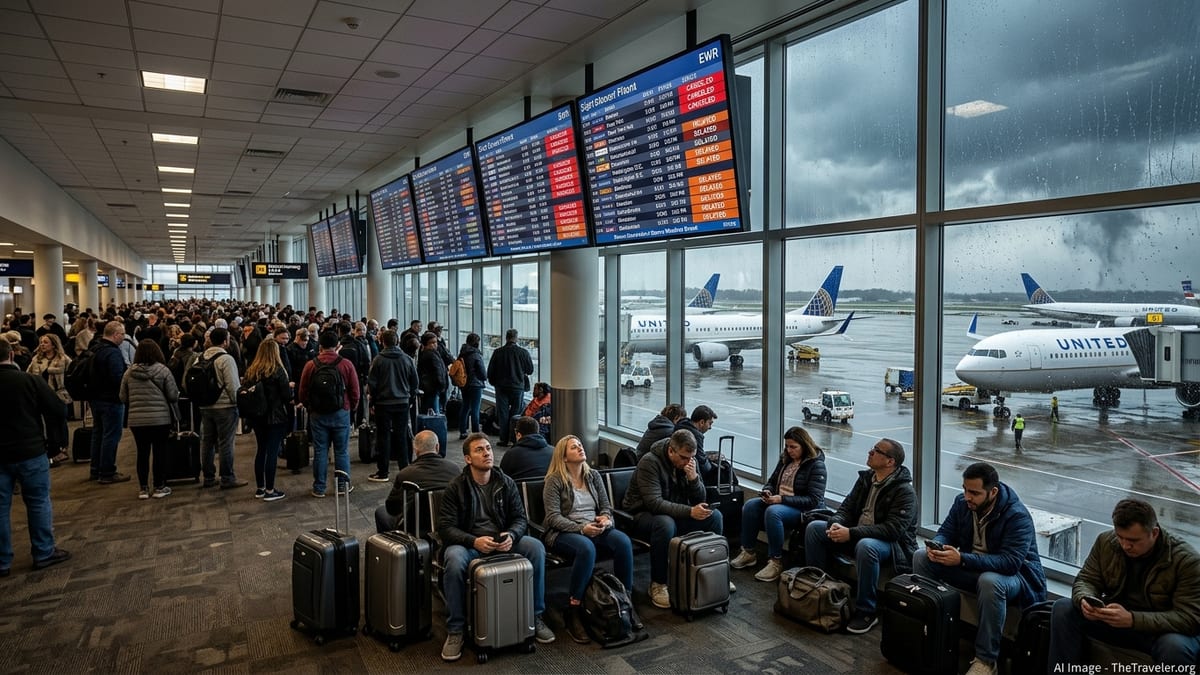
The most visible nationwide travel impact unfolded at airports. By Thursday afternoon, flight‑tracking service FlightAware reported more than 2,000 flights to or from U.S. airports delayed and over 400 canceled, with a significant concentration at large hubs along the storm‑affected corridor. Airports serving New York City, Boston, Philadelphia, Baltimore and Washington featured prominently among the hardest hit, along with some inland connecting hubs experiencing knock‑on disruptions as aircraft and crews fell out of position.
At New York’s three main airports, John F. Kennedy International, LaGuardia and Newark Liberty International, arrivals and departures faced a combination of low clouds, gusty crosswinds and saturated runways that limited how many aircraft air traffic control could safely move each hour. While not all periods saw full ground stops, the Federal Aviation Administration implemented flow‑control measures at various points, including reduced arrival rates and ground‑delay programs that pushed back departure times from other cities bound for the New York area. The result for passengers was a patchwork of rolling delays that, in many cases, stretched from under an hour to several hours.
Other airports along the Eastern Seaboard experienced similar if somewhat less severe disruptions. Boston Logan International reported clusters of delays tied to low ceilings and wind, while Philadelphia International, Baltimore/Washington International Thurgood Marshall and Ronald Reagan Washington National each saw flights held or slowed for periods as the worst of the rain bands moved through. Because many Thanksgiving itineraries involve tight connections, especially for travelers heading onward to smaller regional airports, even modest primary delays risked causing missed connections and overnight misalignments for aircraft and crews.
Major U.S. airlines had begun preparing for this scenario several days earlier. Carriers including the three largest network airlines issued flexible travel waivers for customers booked to travel on Wednesday or Thursday through key Northeast airports such as New York, Boston and Philadelphia, as well as some Mid‑Atlantic and New England regional airports. These waivers typically allowed one rebooking to a nearby date without change fees, subject to seat availability in the same cabin. The goal was to encourage passengers with flexibility to shift travel into calmer weather windows earlier in the week or into the weekend, helping to ease peak‑day congestion and reducing the number of people stranded if flights were ultimately canceled.
On‑the‑ground transport, outages and impacts on holiday plans
For travelers who did make it to the East Coast, the storm’s impacts extended beyond airport gates. Power outage monitoring services reported that more than a million utility customers nationwide were without electricity at points on Thursday morning, with a large share of those outages in the Mid‑Atlantic and Northeast regions where rain‑softened ground and strong gusts combined to topple trees and branches onto lines. By late morning, the national outage total had eased somewhat but remained in the hundreds of thousands, meaning some travelers staying in hotels or visiting family encountered darkened neighborhoods, intermittent heating issues or businesses operating on backup generators.
Intercity rail and bus operations also had to adjust. While there were no reports of a wholesale shutdown of train service along the Northeast Corridor, operators warned of possible speed restrictions where high winds or localized flooding affected tracks, and crews were positioned to clear debris where needed. Bus companies reported slower‑than‑usual schedules along coastal routes as drivers reduced speed in heavy rain and detoured around flooded or closed road segments. Travelers hoping to use regional ferries or harbor services in affected coastal areas were advised that some sailings could be canceled or rescheduled if conditions worsened, particularly where wind and wave forecasts exceeded safe operating thresholds for smaller passenger vessels.
The nor’easter also upended some of the most visible holiday traditions. On Wednesday, November 25, organizers of the Macy’s Thanksgiving Day Parade, together with New York City officials and broadcast partners, confirmed that the parade would be postponed to Saturday, November 28, at 8:30 a.m. because of the storm’s forecast high winds and steady rain. City information sites and broadcasters emphasized that safety rules around operating large balloons in strong winds left little margin once forecasters began highlighting the potential for gusts approaching 60 to 70 miles per hour at times near the parade route. The decision marked the first time in the event’s roughly century‑long history that weather had forced a postponement to a different day.
The change in date created an immediate logistical puzzle for marching bands, performance groups and visiting spectators who had planned trips around the original Thursday event. Some school and community bands that had traveled long distances began exploring whether hotel stays and flights could be extended to allow participation in Saturday’s rescheduled parade. In several cases, organizers and families indicated publicly that they were weighing added costs against the opportunity to march. Other groups, constrained by fixed return flights or school commitments, faced the possibility of having prepared for a high‑profile performance they would not ultimately join.
What travelers should watch in the next 48 hours
Forecasts from federal and local meteorologists indicate that conditions along much of the I‑95 corridor from Washington to Boston should gradually improve from late Thursday night into Friday as the core of the storm lifts away into the North Atlantic. However, even as rainfall tapers and winds slowly ease, elevated water levels in tidal rivers and back bays may lead to lingering coastal flooding in some communities on successive high tides, and some tree‑related power outages could take time to repair. Travelers planning to move through the region on Friday or Saturday should be prepared for residual transportation disruptions, particularly if they are connecting through major hubs still working to reposition aircraft and crews.
For air travelers, airline mobile apps and official websites remain the primary sources for real‑time flight status and rebooking options. Given the number of disrupted flights on Thanksgiving Day, some carriers may continue to offer limited fee waivers into the weekend for passengers whose trips originate or end in affected areas, though eligibility criteria and validity periods vary. Passengers who have not yet departed are advised to confirm that their flight is operating as scheduled before leaving for the airport and to build in additional time for check‑in, security screening and potential terminal congestion, especially at New York‑area and New England airports.
Those relying on rail, bus or ferry services should monitor operator alerts, station notice boards and local news reports for updates on schedules and any short‑notice route changes related to debris, flooding or speed restrictions. In New York City specifically, visitors who traveled primarily for the Macy’s parade will need to adjust their itineraries around the new Saturday, November 28, start time. Local authorities have signaled that standard parade‑day street closures and crowd‑control measures will apply on Saturday instead of Thursday, so travelers planning to attend or to navigate across Manhattan that morning should consult updated municipal advisories closer to the time.
Across the wider region, tourism agencies and local officials are encouraging visitors to treat Thursday as a day for indoor activities where possible and to resume most outdoor sightseeing or driving on Friday once conditions stabilize. As always during major weather events, the most reliable guidance for the next steps comes from official channels: local emergency management agencies, transportation departments, airlines, rail and bus operators, and city or state tourism offices. Their advisories over the next 24 to 48 hours will shape how quickly Thanksgiving travelers can complete disrupted journeys and how the holiday weekend ultimately unfolds for visitors along the Eastern Seaboard.