


For many people in Bosnia and Herzegovina, crossing into Croatia is not a holiday event but part of everyday life. Commuters, business owners, cross-border workers and families now face a very different border experience because Croatia, as an external Schengen frontier, applies the EU Entry/Exit System (EES) to most non-EU nationals. Understanding how this system works, what exceptions exist and which legal shortcuts do and do not apply is essential if you cross the border regularly.
Get the latest updates straight to your inbox!
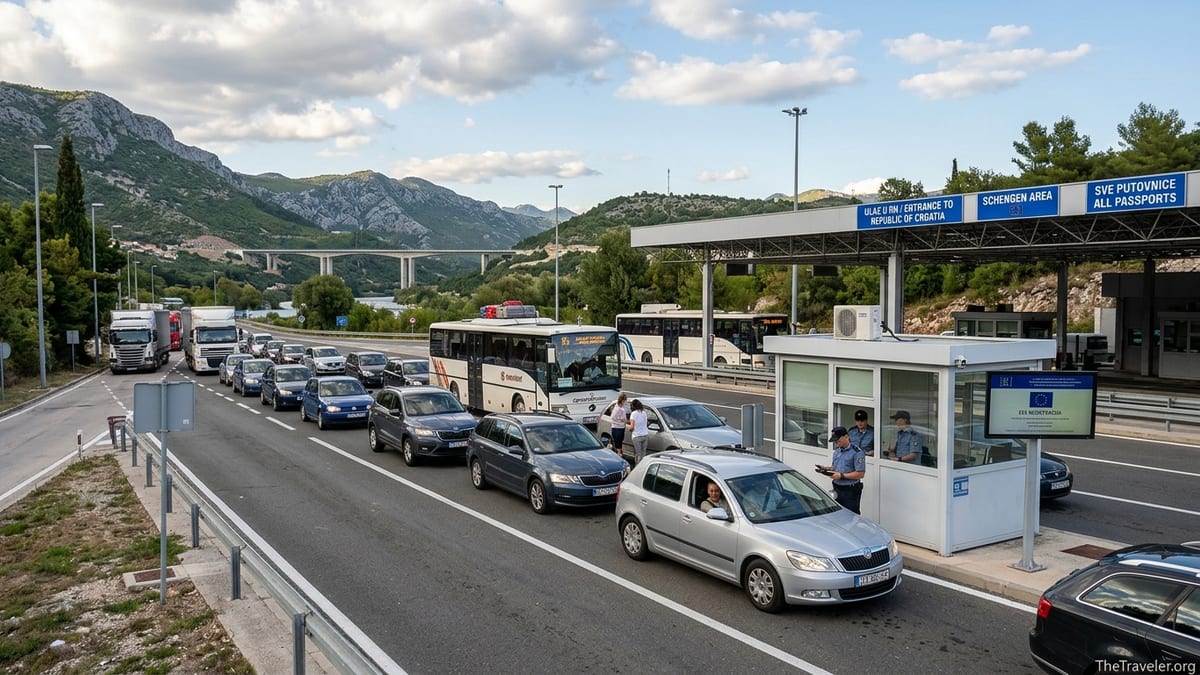
How EES Changes Regular Travel Between Bosnia and Croatia
Croatia’s land border with Bosnia and Herzegovina is part of the external border of the Schengen Area. This means that most citizens of Bosnia and Herzegovina who do not hold residence in an EU or Schengen state are treated as third‑country nationals making short stays. Their entries and exits are now recorded through the EES, a central EU database that replaces manual passport stamping and is designed to enforce short‑stay rules more precisely.
On a first EES crossing into Croatia, a traveller’s identity and biometric data are collected at the border. This normally includes passport details, a facial image and, in many cases, fingerprints. The information is stored in a personal EES file and used to register the date, place and purpose of that entry, as well as the expected length of the authorised short stay.
On later trips, border guards do not create a new file but verify the traveller against the existing EES record. This should in principle speed up repeated crossings once the initial data collection has been done. In practice, frequent travellers still report additional time at the booth while officers confirm identity and check total days of stay recorded in the system.
Because EES applies at Croatia’s external borders, travellers moving between Bosnia and Croatia many times a year will notice the system most clearly at road crossings. Air and maritime ports use the same basic procedures, but for most Bosnians who live near the frontier, the daily reality of EES is felt at highway and local road checkpoints.
Smaller Crossings, Temporary Restrictions and Why They Matter
The rollout of EES has not affected all Bosnia–Croatia border points in the same way. Bosnia and Herzegovina’s Border Police have publicly warned that some smaller crossings are currently not available for third‑country nationals who are subject to EES when entering Croatia. This specifically includes Bosnian citizens without EU residence who travel on short stays. According to recent notices, several minor road crossings have been temporarily restricted because they lack full EES facilities and staff.
For example, the Bosnian Border Police have cited selected local crossings in the Una-Sana and Herzegovina regions where, until further notice, only travellers exempt from EES or those moving in local border traffic arrangements may enter Croatia. Similar limitations have been reported at temporarily opened seasonal crossings used mainly by nearby residents. In all such cases, third‑country nationals under EES are directed to larger international crossings equipped with the full technology and staffing needed to carry out biometric checks.
The wording used by the authorities is important: the restrictions apply “until further notice”. This means the situation is inherently flexible. Some smaller crossings may be upgraded and reopened to all categories of travellers, while others may remain limited. The only reliable approach for frequent border users is to verify the status of their preferred crossing shortly before travel by checking current announcements from the Bosnian Border Police and Croatian Ministry of the Interior, or by consulting live border information services.
For people who used to rely on lightly trafficked “village” crossings to avoid queues, these changes can feel disruptive. However, attempting to use a crossing that is temporarily restricted for EES‑subject travellers risks being turned back or facing delays. Planning routes around fully equipped international crossings is now a central part of regular cross‑border life.
Repeated Crossings, the 90/180 Rule and Why Records Matter
The EES is not only a database of identities; it is also the main tool used to enforce the Schengen short‑stay rule. In simple terms, most Bosnian citizens without EU residence may spend up to 90 days in any rolling 180‑day period in the Schengen Area, which includes Croatia. Every entry and exit via an external border, including the road crossings with Bosnia and Herzegovina, is logged in EES and counted towards that 90‑day allowance.
For frequent travellers, this matters more than ever. Consider a Bosnian resident who spends almost every weekend in Croatia visiting family, and occasionally adds longer visits for work or conferences. Each of those visits is counted. If they enter Croatia on Friday evening and return to Bosnia on Sunday night, that is counted as three days of stay in most calculations, and repeated trips of this kind can quickly add up towards the 90‑day limit over several months.
EES allows Croatian border authorities to see, with much more precision than before, how many days a particular traveller has already spent in the Schengen Area in the last 180 days. If the system shows that a traveller would exceed the permitted total with a new entry, they can be refused. It is therefore important not to rely on memory or assumptions. Travellers should keep their own careful records of dates of entry and exit, taking into account all trips into any Schengen state, not just Croatia.
Because individual patterns vary, this article cannot calculate anyone’s exact allowance. Frequent travellers are strongly advised to track their days with a calendar or trustworthy calculator tool and to treat the EES record as decisive. If in doubt, reducing stays or spacing out visits before approaching the 90‑day threshold is usually the safest course.
The Croatian National Facilitation Programme for Frequent Travellers
To reduce friction for genuine frequent travellers who comply with immigration rules, Croatia operates a National Facilitation Programme for third‑country nationals. This programme is grounded in the Schengen Borders Code and Croatian implementing rules and is designed to make border checks more efficient for people who regularly cross the external border for legitimate reasons, such as work or family visits.
According to official Croatian guidance, eligible third‑country nationals can apply at designated border crossing points or at police stations inside Croatia. In general terms, applicants must show that they travel frequently and lawfully, that they pose no migration or security risk and that they have a clear pattern of cross‑border movement. Evidence may include valid travel documents, proof of regular employment or business activity linked to Croatia, documentation of family ties, and records of previous lawful entries and exits.
If accepted, a traveller in the National Facilitation Programme may benefit from streamlined checks. In practice, this can mean shorter questioning, reduced documentary checks in routine situations and, in some locations, the possibility of being directed to specific lanes or counters intended for pre‑vetted frequent travellers. The aim is not to bypass control, but to focus resources where risk is higher while allowing known, compliant travellers to be processed more quickly.
The programme has clear limits. It does not remove the requirement to be registered in EES, it does not exempt travellers from the 90/180 short‑stay rule and it does not guarantee fast passage at every crossing or on every day. The range of border points where facilitation is practically available may be limited to larger crossings with appropriate infrastructure. Rules and procedures can evolve, so readers should verify at the time of application who exactly can apply, which documents are required and what concrete benefits apply at their usual crossing points.
Other Legal Ways to Simplify Border Formalities
For some frequent cross‑border travellers, applying for residence or a long‑stay visa in an EU or Schengen state may be an option. People who hold a valid residence permit issued by an EU Member State are usually processed under different provisions of the Schengen Borders Code and are not treated as short‑stay visitors for the purpose of the 90/180‑day calculation in the same way as tourists or occasional visitors.
In practice, this can reduce the significance of the EES for daily life. A Bosnian citizen with a valid residence card from a Schengen state, for example based on employment or family reunification, will still go through border control, but the focus of checks is on confirming residence status rather than counting tourist days. That said, not every residence category is handled identically, and rules can change, so travellers in this situation should always refer to the immigration authorities of the state that issued their permit for precise information.
Another possibility for some travellers is a long‑stay national visa issued by a particular Schengen country. These visas are designed for stays beyond 90 days, such as seasonal work, study or long‑term assignments. They typically shift the legal framework away from the standard short‑stay regime. However, obtaining such a visa requires meeting strict criteria and submitting a full application through consular channels well in advance.
Because immigration status decisions are complex and individual, this article can only give general guidance. Anyone considering residence, work authorisation or a long‑stay visa as a way to regularise frequent travel should seek advice directly from official consular services, national immigration offices or qualified legal professionals rather than relying on informal advice at the border.
Choosing Border Crossings and Times to Reduce Waiting
Even when documents and status are in perfect order, time spent queuing can be significant, especially since EES was introduced. Larger international crossings such as Gradiška, Bijača–Nova Sela, Doljani–Metković, Stara Gradiška and Maljevac combine heavy local traffic with long‑distance transit between Central Europe and the Adriatic, leading to frequent congestion at peak holiday periods.
Traffic pattern data and live‑queue monitoring suggest that highway‑linked crossings that carry substantial tourist and freight flows tend to see the longest lines during summer weekends, public holidays and Friday evenings. By contrast, some medium‑sized regional crossings not directly on main motorways can experience shorter waits outside local rush hours, particularly on ordinary weekdays and outside the core summer season.
Several regional services now publish real‑time information on border queues at Croatia–Bosnia crossings, including webcams and estimated waiting times. While these tools are not perfect, they provide useful guidance on which crossings are currently most congested and which are relatively clear. Frequent travellers can often significantly reduce stress by checking conditions an hour or two before departure and being flexible enough to reroute to a nearby alternative crossing when safe and practical.
It is also wise to avoid predictable peaks. Commuters who can adjust working hours slightly may find that crossing before early‑morning rush or after the main evening wave noticeably shortens waiting times. Families visiting at weekends may wish to plan for early starts or late‑evening returns. Over time, keeping a personal log of how long specific crossings take at different hours and seasons can help in choosing the best route for regular trips.
Why “Back‑Door” Crossings Are Riskier Than Ever
In the pre‑EES era, some local travellers counted on quiet rural crossings to move quickly, or relied on informal knowledge about “lightly monitored” checkpoints. Under the new system, such strategies are increasingly risky. EES, combined with better data sharing between Croatian and Bosnian authorities, means that inconsistencies, overstays and irregular entries are more likely to be noticed and acted upon.
Official guidance from both sides stresses that all travellers must use authorised border crossing points and follow the instructions of border police. Smaller crossings that remain open only for certain categories, such as local border traffic card holders or citizens of the neighbouring states, are not a shortcut for third‑country nationals under EES. Attempting to use them contrary to the rules can result in refusal of entry, administrative sanctions and future difficulties when crossing elsewhere.
In addition, EU security and migration risk assessments have placed increasing emphasis on smuggling, trafficking and other cross‑border crime along the Western Balkans route. In response, both Croatian and Bosnian authorities periodically conduct intensified checks, including vehicle searches and interviews, especially at crossings or on days where risk is assessed as higher. For law‑abiding travellers, this may mean occasional extra delays or questions, even when paperwork is fully in order.
The safest and most efficient long‑term strategy is to treat border control as a serious legal process, not an obstacle to outsmart. Carry valid documents, respect goods and customs rules, allow extra time for travel and be prepared to explain the purpose and duration of your stay calmly when asked. Over time, travellers who demonstrate consistent compliance are more likely to experience smooth routine checks, particularly if they participate in facilitation schemes.
Practical Habits to Keep Crossings Smooth and Compliant
For frequent Bosnia–Croatia travellers living under EES, small practical habits can make a large difference. Keeping a written or digital log of each entry and exit date, with the specific border crossing used, provides a personal reference that can be compared with the EES record. Including trips to other Schengen countries in this log is important, since all such days count towards the same 90‑day total.
Travellers should carry any documents that support the declared purpose of their trip. Commuters may bring employment confirmation or work contracts, cross‑border business people may carry proof of meetings or company registration, and those visiting close family can keep copies of relevant certificates or residence documents. Having such evidence ready can reduce questioning time if an officer asks for more detail.
It is also useful to stay informed. Regulations, exceptions and the status of individual crossings have changed several times in recent years and may change again as authorities adjust to EES experience. Checking recent announcements from Bosnia’s Border Police and Croatia’s Interior Ministry, along with reliable local news reports, helps travellers avoid surprises such as sudden lane closures or changed procedures.
Finally, consider whether the Croatian National Facilitation Programme or, where appropriate, an EU residence or long‑stay solution might match your real travel pattern. Not everyone will qualify, and such steps should not be taken lightly, but for some categories of daily or monthly crossers they can transform a stressful routine into a manageable one.
Staying Confident on the Road Under EES
The introduction of the EU’s Entry/Exit System has undeniably made regular crossings between Bosnia and Herzegovina and Croatia more complex. Initial registration can take time, certain smaller crossings are temporarily off‑limits to third‑country nationals under EES, and queues at busy border points can be long during peak periods. For many whose work or family life spans the frontier, this feels like an unwelcome new burden.
At the same time, the system is now part of daily reality, and there are ways to adapt. Understanding how your days are counted, keeping accurate personal records, using authorised border crossings equipped for EES, checking live traffic information and avoiding predictable peaks all contribute to smoother trips. For those who qualify, Croatia’s National Facilitation Programme or, in some cases, EU residence or long‑stay visas can further reduce friction while keeping travel fully legal.
Most importantly, the basic message remains reassuring. With a valid passport, truthful answers, respect for the 90/180‑day rule and a willingness to plan ahead, frequent cross‑border travel between Bosnia and Croatia is still possible and workable under EES. The border may be more digital and more structured than before, but for compliant travellers, it remains open.