


More news on this day
Air travel across the Gulf’s busiest hubs has been thrown into fresh turmoil as 933 delays and 102 cancellations in a single operating window disrupted schedules at key airports, stranding travelers and complicating global connections between Europe, Asia, and Africa.
Get the latest news straight to your inbox!
Operational Strain at Major Gulf Megahubs
Recent disruption figures indicate that the brunt of the chaos has fallen on the region’s largest transit centers, including Dubai International, Abu Dhabi, Doha, and key Saudi and Bahraini gateways. These airports serve as vital links for long haul traffic, meaning even short bursts of irregular operations can reverberate across multiple continents. The latest wave of 933 delays and 102 flight cancellations has further exposed how tightly wound the Gulf’s hub-and-spoke model has become.
Publicly available data from flight tracking platforms show extended holding patterns, late arrivals, and missed departure slots clustering around peak bank times, when connecting waves are scheduled to arrive and depart in rapid succession. When even a portion of those flights runs late, gate availability, crew duty hours, and aircraft rotations quickly come under pressure, producing the kind of rolling disruptions now playing out across the network.
Published coverage from regional outlets has for months described mounting strain on ground handling teams and air traffic management as conflict-related airspace restrictions and diversions push more traffic through narrower corridors. The current spike in disruptions appears to be a culmination of these pressures, rather than a one-off incident, underscoring the vulnerability of a system that depends on near-perfect punctuality to function smoothly.
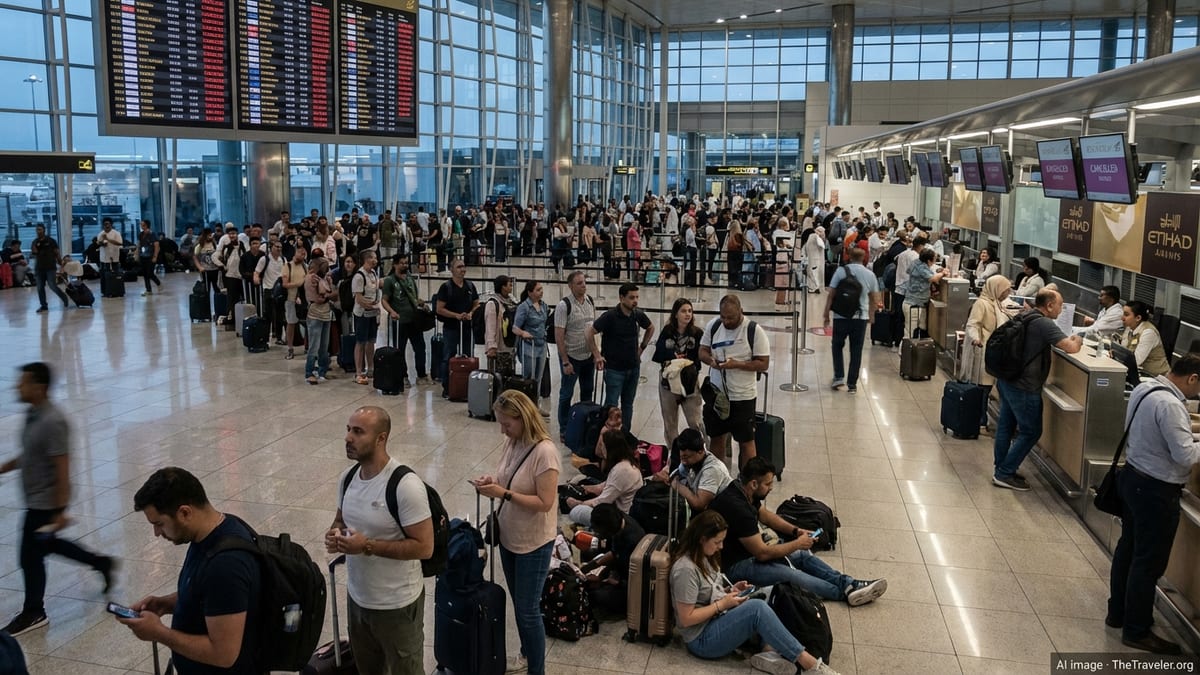
For passengers, the impact is visible in crowded transfer halls, long queues at rebooking desks, and improvised overnight stays as airlines attempt to re-stitch fragmented itineraries. While many long haul services are still operating, the knock-on effect of missed connections is turning relatively minor delays at origin airports into multi-hour or even overnight disruptions in the Gulf.
Airspace Constraints and Regional Security Tensions
A key driver of the latest wave of delays and cancellations is the complex security environment surrounding the Gulf, where intermittent airspace closures and routing restrictions have become an almost constant feature of operations. Reports indicate that closures or partial restrictions affecting Iran, Iraq, Bahrain, and adjacent sectors have periodically forced airlines to reroute traffic, adding flight time and compressing already tight schedules into smaller windows of open airspace.
According to publicly available information from aviation data providers, rerouted flights often require additional fuel, alternative alternates, and revised crew duty plans. These operational adjustments limit flexibility when irregular operations strike, making it harder to absorb disruptions triggered by weather, technical issues, or ground-side congestion at terminals.
Analysts tracking the situation note that Gulf hubs, which once benefitted from their location at the crossroads of stable overflight corridors, are now grappling with a patchwork of no-fly zones and dynamic advisories. Each new advisory can force airlines to redraw routings overnight, and when those changes collide with peak travel periods, the result can be a sharp uptick in late arrivals that cascades into missed connection windows and last-minute cancellations.
In some cases, long haul flights arriving from Europe or North America are reaching Gulf hubs outside their scheduled connection banks due to the additional flight time imposed by diversions. That leaves airlines with difficult choices between holding onward connections for late-arriving passengers or protecting schedules for aircraft that must continue to Asia, Australasia, or Africa.
Knock-On Effects for Global Transit Passengers
The latest figures on delays and cancellations in the Gulf are disproportionate not simply because of their scale, but because of the region’s outsized role in global connectivity. A disrupted departure in Dubai or Doha can break itineraries used by travelers from secondary European and African cities who rely on Gulf carriers as their primary bridge to Asia and Australasia.
Travelers have reported multi-leg journeys unraveling after a single missed connection, with through-checked luggage going astray and rebooking options limited as flights leave with minimal spare capacity during the busy summer and shoulder seasons. Social media posts and traveler forums are filled with accounts of passengers sleeping in terminals, queueing for hours for new itineraries, and struggling to obtain clear updates as operations teams work through large backlogs.
Industry observers point out that while most Gulf carriers operate relatively young fleets and maintain strong on-time performance under normal conditions, the structure of their networks makes recovery from large-scale disruption particularly complicated. The same aircraft that arrives late from Europe is often scheduled to turn quickly for Asia or Africa, and any delay ripples forward into multiple future rotations unless spare aircraft or crews can be inserted into the schedule.
Given the tight utilization of long haul widebody fleets, that kind of spare capacity is limited. As a result, even when immediate causes such as airspace closures or upstream weather have passed, the residual impact can linger for days as airlines gradually work through stranded passengers and reposition aircraft to where they are needed most.
Pressure on Airlines, Regulators, and Ground Infrastructure
Beyond the immediate disruption for travelers, the spike in delays and cancellations is intensifying scrutiny of how resilient Gulf aviation infrastructure really is. Industry commentary notes that ramp and terminal operations at several hubs are operating near capacity during peak periods, with ground handling teams facing sustained high volumes amid staffing challenges and heat-related work constraints.
Air traffic management capacity is also under the spotlight, with regional control centers required to handle dense flows of overflights that might previously have used more northerly or southerly routes. Published analyses of air traffic patterns suggest that bottlenecks at key waypoints are increasingly dictating how many flights can depart or arrive in a given window, irrespective of how much runway or terminal capacity an individual airport may have on paper.
Regulators and aviation authorities in the wider region are being urged by industry bodies and travel groups, through open letters and public statements, to prioritize investments in air traffic control systems, contingency routing options, and regional coordination mechanisms. Observers argue that better cross-border planning could help distribute traffic more evenly during periods of stress, easing the congestion that currently contributes to reactionary delays.
At the same time, customer advocacy organizations are highlighting the need for clearer and more consistent passenger care policies when delays and cancellations are linked to airspace closures or security concerns. The current situation has exposed wide variations in how airlines handle accommodation, meal vouchers, and rebooking when events are categorized as extraordinary, leaving many travelers unsure of their rights or options.
What Travelers Can Expect in the Coming Weeks
With demand for international travel through the Gulf remaining strong, analysts anticipate that operational volatility will persist in the short term, even if the most acute airspace restrictions ease. Schedules are still built around tight connection banks, and any renewed closure, weather event, or technical failure affecting a major hub could once again push delay and cancellation numbers sharply higher.
Publicly available guidance from airlines and airports in the region increasingly emphasizes the importance of monitoring flight status frequently, allowing extra time for connections, and being prepared for schedule changes at short notice. Some carriers are encouraging travelers to build longer layovers into complex itineraries, particularly when connecting between long haul flights, to reduce the risk of misconnection during congested periods.
Travel planners suggest that passengers with fixed commitments at their destination consider arriving a day early where possible, or choose routings that offer multiple daily frequencies on key sectors so that same-day re-accommodation remains a viable option if their original flight is affected. Those transiting with separate tickets are being advised to allow especially generous buffers between flights, given that airlines may prioritize through-ticketed passengers when capacity is limited during disruption.
While the figure of 933 delays and 102 cancellations highlights the current scale of the problem, industry observers stress that it is the underlying fragility of the system that should draw the most attention. As long as regional airspace remains unpredictable and hub operations run close to capacity, Gulf travelers are likely to face a heightened risk of disruption, even during periods of apparent stability.