


Connecting from an international flight to a domestic departure at Hanoi’s Noi Bai International Airport can feel confusing the first time, especially if you are tired after a long-haul journey. This guide walks you step by step through immigration, baggage reclaim, customs, the transfer from Terminal 2 (international) to Terminal 1 (domestic), security checks, and realistic connection times, using current, real-world details from the airport and major airlines.
Get the latest updates straight to your inbox!
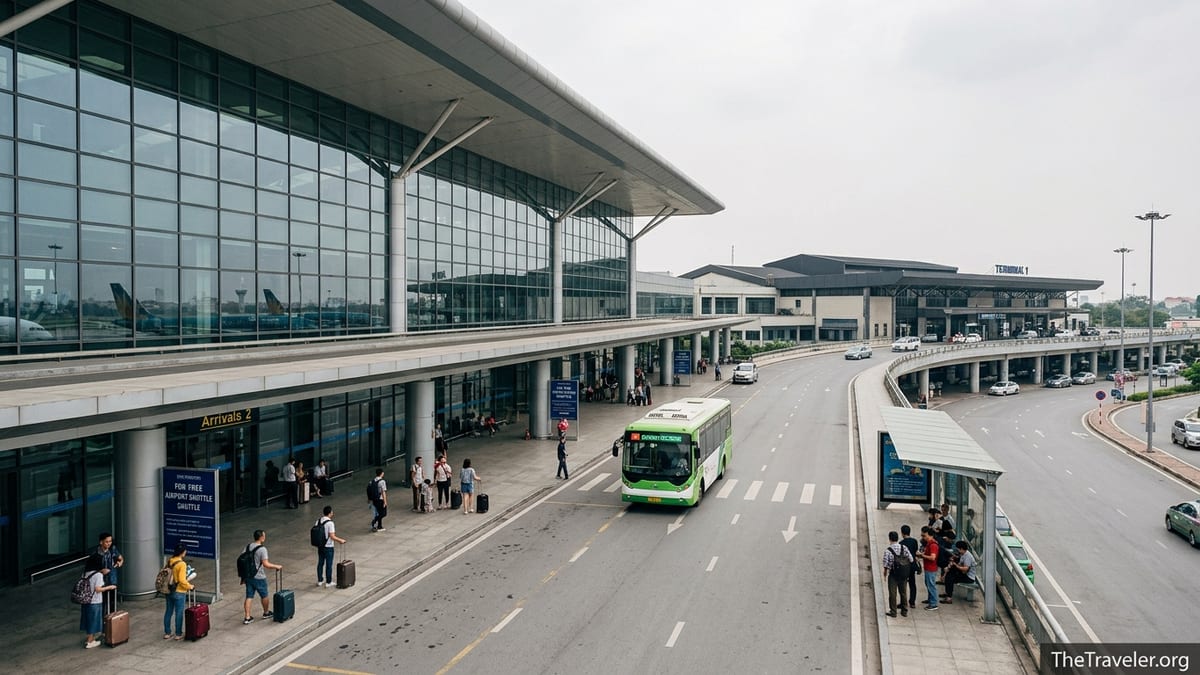
Understanding Noi Bai’s Terminals and Typical Connection Scenarios
Noi Bai International Airport serves Hanoi and northern Vietnam with two main passenger terminals. Terminal 2 handles all scheduled international flights, from carriers such as Vietnam Airlines, Korean Air, ANA, Qatar Airways and others. Terminal 1 is dedicated to domestic routes, including frequent services to Da Nang, Ho Chi Minh City, Phu Quoc and Hue on airlines such as Vietnam Airlines, Vietjet Air and Bamboo Airways. For an international-to-domestic connection, you will always arrive into T2 and then depart from T1.
Most international-to-domestic connections at Noi Bai fall into two patterns. The first is a through-ticket connection on the same airline group, for example Paris to Hanoi to Da Nang on a single Vietnam Airlines ticket. In these cases, your layover time and baggage handling are usually coordinated by the airline, although you still need to clear Vietnamese immigration and customs in Hanoi. The second pattern is a self-transfer, such as arriving from Bangkok on Thai AirAsia and then taking a separate Vietjet Air domestic ticket to Da Nang, where you handle everything yourself and must allow more buffer time.
Regardless of ticket type, all passengers entering Vietnam clear immigration and customs at their first point of entry. If Hanoi is your first stop in Vietnam, you will complete all formalities in Terminal 2 before moving to Terminal 1. If instead you entered Vietnam through another city, such as Ho Chi Minh City or Da Nang, and then flew to Hanoi, you will arrive in T1 as a domestic passenger and the process described in this guide will not apply.
Because both terminals are relatively compact compared with large hubs, and connected by a frequent, free shuttle bus, transfers at Noi Bai can be straightforward when you understand the layout. However, queues at immigration in the early morning and late evening waves, plus the need to re-check bags in T1, mean that connection times that look generous on paper can become tight in practice.
Step-by-Step: From International Arrival to Clearing Immigration and Customs
After your aircraft parks at Terminal 2, you will disembark either via an airbridge or a short bus ride to the pier. Overhead bilingual signs in Vietnamese and English guide you toward “Arrival” and “Immigration.” If you need a visa-on-arrival approval letter, you will be directed to the visa desk on the same level before immigration, otherwise you can proceed directly to the passport control hall. Airlines such as ANA and JAL describe this layout as a simple linear flow: gate to immigration on the second floor, then down to baggage reclaim and customs on the first floor.
Immigration queue times vary significantly by time of day and by the number of long-haul arrivals. In quieter mid-day periods, travelers often clear immigration in 15 to 30 minutes. During the early morning bank, when flights from Europe and Northeast Asia arrive close together, it can take 45 minutes or more. Families with children, elderly travelers or those with mobility challenges should expect to be at the slower end of that range. If you have purchased a fast-track immigration service through a ground handling agency, staff typically meet you at the arrival gate or the entrance to immigration and escort you to a priority counter where available, shortening the wait.
Once your passport is stamped, you descend one level to the baggage reclaim hall. Baggage delivery speeds also vary, but many travelers report seeing bags on the carousel 20 to 30 minutes after landing on typical long-haul flights. If you are on a through ticket with Vietnam Airlines, your bags may be tagged to your final domestic destination, but in most cases you will still collect them at T2, pass customs, then hand them to airline staff again in the connecting area or in T1. On fully separate tickets, you always pick up your bags, clear customs, and then check them in afresh for your domestic flight.
Customs in Hanoi is generally straightforward. After collecting your luggage, you walk through the customs zone where officers may ask you to scan your bags if you have goods to declare or if you are randomly selected. Most passengers simply follow the “Nothing to declare” lane and exit into the public arrivals hall. From here, you are landside in Vietnam and ready to transfer to Terminal 1 for your domestic departure.
Moving from Terminal 2 to Terminal 1: Shuttle, Walk or Taxi
Once you exit into the arrivals hall of Terminal 2, follow the signs for “Shuttle bus T1 – T2” or ask any airport staff for the free terminal bus. Noi Bai operates an official, no-charge shuttle connecting the international and domestic terminals. The airport and Vietnam National Administration of Tourism note that as of mid-2023 the service is provided by electric buses operating frequently throughout the day, typically every 10 to 15 minutes from early morning until late evening.
The shuttle stop at T2 is directly outside the arrivals hall. After passing through the sliding doors, cross the first traffic lane used by private cars and look for buses with clear markings indicating they are for inter-terminal transfer, not for downtown Hanoi. You simply queue and board; there is no ticket required and no booking system. The ride itself usually takes around 5 to 10 minutes, depending on traffic around the terminal loop. Many recent travelers report that by the time they reach the stop, a bus often arrives within a few minutes, though at very late-night or early-morning times you might wait closer to 15 minutes.
For those who prefer to walk, the distance between T2 and T1 is roughly 600 to 800 meters along internal airport roads. In theory it is walkable in about 10 minutes, but the path involves negotiating vehicle traffic, limited shaded sidewalks in places, and Hanoi’s hot, humid weather for much of the year. With luggage, most passengers find the shuttle more comfortable. A taxi or ride-hailing service such as Grab for such a short hop is technically possible but not recommended, as drivers may not be keen on such a minimal fare and the time to call and board a car often exceeds the shuttle waiting time.
When the bus arrives at Terminal 1, you disembark near the departures area. T1 is an older, busier building that houses check-in counters for Vietnam Airlines, Vietjet Air, Bamboo Airways and several smaller carriers. Look for the departure screens and airline logos to orient yourself, then head for the appropriate check-in island for your domestic flight.
Domestic Check-in, Security, and Boarding in Terminal 1
At Terminal 1 you must treat your domestic flight as a new departure process. If your connection is on a single ticket with an airline like Vietnam Airlines, you may already have a boarding pass for the onward segment. Even then, you often need to re-check your bags with staff at a transfer counter or regular check-in desk after customs, because they were released to you at T2. Airline websites make clear that on international-to-domestic connections through Noi Bai, luggage is handed back to passengers at the first port of entry and then assisted onward by staff, which still takes time in practice.
On separate tickets, you need to check in from scratch. For example, a traveler arriving from Seoul on Korean Air at 10:30 and connecting to a 13:30 Vietjet Air flight to Da Nang would go to the Vietjet check-in area, present their passport and domestic booking, and drop their luggage. Vietjet and Bamboo generally close domestic check-in counters about 40 minutes before scheduled departure, and boarding gates often close around 15 minutes before departure, so work backwards from these cut-offs when planning your transfer.
After check-in and bag drop, you proceed to the domestic security screening area. Here your carry-on bags and personal items pass through X-ray machines and you go through a metal detector, as in any airport. Queue times vary across the day. At midday on a weekday, some travelers pass security in under 10 minutes, while during peak holiday periods such as Tet or long weekends, lines can stretch to 20–30 minutes or more. There are usually separate lanes for families with children or those requiring assistance, which can sometimes be faster or slower depending on volumes.
Beyond security, domestic departures are split across several piers with numbered gates. Facilities are basic but improving, with local coffee chains, small restaurants and convenience-style kiosks selling snacks and bottled drinks. Many domestic flights at Noi Bai still board via bus gates to remote stands, especially for smaller aircraft and low-cost carriers. In these cases you will scan your boarding pass at the gate, wait in a holding lounge, then board an apron bus for a short ride to the aircraft. Plan to be at your gate no later than the boarding time stated on your boarding pass, typically 30 to 40 minutes before departure.
How Much Time to Allow: Realistic Connection Windows
The amount of time you should allow for an international-to-domestic connection at Noi Bai depends heavily on whether your flights are on a single ticket or separate bookings, the airlines involved, and your risk tolerance. As a rule of thumb, local transfer services and frequent flyers suggest that the bare minimum connection time with bags on separate tickets should be around three to four hours, while two hours can be feasible only on a protected, same-ticket connection with a full-service carrier when everything runs on schedule.
For example, consider a traveler arriving from Frankfurt on a Vietnam Airlines flight scheduled to land at 6:00 and connecting on the same ticket to a 8:10 Vietnam Airlines flight to Hue. If immigration takes 30 minutes, baggage 20 minutes, the shuttle 15 minutes including waiting and travel, and domestic check-in and security another 30 to 40 minutes, this 2-hour-10-minute layover leaves little margin for delays, but airlines may still sell it and will usually take responsibility for rebooking you if a delay causes a misconnection. By contrast, if that same traveler booked a low-cost carrier domestic flight on a separate ticket departing at 8:10, any delay through immigration or baggage could easily cause a missed flight with no protection.
Recent transfer guides focused on Noi Bai suggest that for self-transfers you should aim for at least 3.5 to 4 hours, especially in the early morning peak when several international flights arrive at once. A realistic timeline might look like this: 45 minutes for immigration in a busy period, 30 minutes for baggage, 15 minutes for customs and walking out, 15 minutes for the shuttle including waiting time, and up to 45 minutes for domestic check-in and security. That totals around 2.5 to 3 hours before you reach the domestic departure gate, leaving some buffer for late arrivals or long lines.
Low-cost carriers such as Vietjet Air publish explicit minimum transit times for international to domestic connections, often around 180 minutes, for their own through-ticket itineraries that use Hanoi as a hub. Even though these times are geared to airline operations rather than passenger comfort, they are a useful benchmark for what the airlines themselves consider workable. If your itinerary involves separate tickets, traveling with checked bags, young children, or during Vietnam’s peak holiday seasons, it is prudent to exceed those minima rather than cutting things fine.
If you have a very long layover over five or six hours, you could in theory leave the airport to rest in a nearby airport hotel or visit central Hanoi, which is about 30 to 45 minutes away by taxi in light traffic. However, when transiting with luggage and after a long-haul flight, many travelers find it simpler to remain at the airport, use a lounge if eligible, or relax in one of the coffee shops in T1 or T2 rather than risk traffic delays on the highway into the city.
Special Cases: Through Tickets, Separate Tickets, and No-Checked-Bag Connections
On a through ticket with a full-service carrier, your experience can be easier even though the physical steps are the same. For example, a passenger flying London to Hanoi to Da Nang on a single Vietnam Airlines booking checks their bags at Heathrow all the way to Da Nang. In Hanoi, they still retrieve their checked luggage at Terminal 2 after immigration, but Vietnam Airlines staff are usually present in the baggage reclaim or arrivals area to direct connecting passengers and sometimes take bags directly from them at a transfer counter. If the inbound flight is late, the airline can adjust the domestic booking or arrange alternative routing at no extra cost.
With separate tickets, all responsibility lies with you. A common scenario is a traveler booking a discounted long-haul ride to Hanoi on a foreign carrier such as Qatar Airways or Scoot, then adding a cheap domestic leg on Vietjet Air bought through a different website. In this case, if your first flight is delayed or immigration lines are unexpectedly long, Vietjet is under no obligation to wait or to rebook you on a later flight without new charges. For that reason, many seasoned travelers treat a self-transfer in Hanoi almost like two completely independent trips and plan a more generous buffer of at least four hours.
Travelers with only carry-on luggage have more flexibility. If you arrive from Bangkok at 12:00 with only a cabin bag and hold a 14:00 domestic ticket, you can walk straight from immigration to customs and then to the shuttle without waiting at baggage reclaim. In practice this can save 20 to 30 minutes, which makes a two-hour window more realistic, especially outside peak periods. However, you are still exposed to the risk of late arrival or unexpected queues, so it is unwise to rely on best-case scenarios when planning a once-a-day onward flight to a smaller destination such as Phu Quoc or Con Dao.
Another special case is when you are connecting between two domestic flights and do not change terminals, or when you enter Vietnam at a different city and then fly to Hanoi. In those situations, you will already have cleared immigration elsewhere and arrive in Hanoi as a domestic passenger, potentially remaining airside for your next flight. This guide focuses on the specific and most common pattern of entering Vietnam internationally at Noi Bai and then continuing domestically from Terminal 1.
The Takeaway
Connecting from an international arrival at Hanoi’s Noi Bai Airport to a domestic flight involves several distinct steps: clearing immigration in Terminal 2, reclaiming baggage and passing customs, transferring to Terminal 1 by free shuttle, and then completing domestic check-in, security screening and boarding. None of these steps is especially complicated, but together they require more time than many travelers first expect, particularly when flights are on separate tickets and involve checked luggage.
As a practical guideline, aim for at least 3.5 to 4 hours between scheduled arrival and departure if you are self-connecting on different tickets or using low-cost carriers. For protected connections on a single ticket with major airlines such as Vietnam Airlines, connection times around two to three hours can work, though they leave less margin for delays. Using the free terminal shuttle and preparing in advance for immigration and check-in procedures will make the transfer smoother, and arriving with realistic expectations will help you start your time in Vietnam more relaxed.
FAQ
Q1. Is 2 hours enough to transfer from international to domestic at Hanoi Noi Bai?
For a single-ticket connection on a full-service airline and only carry-on luggage, 2 hours can be workable if everything is on time. For separate tickets or if you have checked bags, 2 hours is risky and you should aim for at least 3.5 to 4 hours.
Q2. Do I have to collect my checked baggage in Terminal 2 before my domestic flight?
In almost all cases, yes. Even when bags are tagged through to your final destination, you normally collect them at Terminal 2 after immigration, clear customs, and then either hand them to airline staff at a transfer desk or re-check them at Terminal 1.
Q3. Where do I find the free shuttle between Terminal 2 and Terminal 1?
After exiting customs into the arrivals hall of Terminal 2, go outside to the curbside area and look for buses marked for transfer between T2 and T1. The shuttle is free, does not require a ticket, and usually runs every 10 to 15 minutes.
Q4. How long does the shuttle from Terminal 2 to Terminal 1 take?
The bus ride itself is short, typically around 5 to 10 minutes, but you should also allow time for waiting. In most cases, planning 15 minutes in total for the transfer is realistic.
Q5. Can I walk between the terminals instead of taking the shuttle?
Yes, the distance between Terminal 2 and Terminal 1 is walkable in about 10 minutes, but you will be on airport roads with limited shade. With luggage and in Hanoi’s climate, most travelers find the free shuttle more comfortable and convenient.
Q6. How early should I arrive at Terminal 1 before my domestic flight?
For domestic flights from Hanoi, arriving at Terminal 1 around 1.5 to 2 hours before departure is generally recommended, especially if you need to check bags. During major holidays or peak travel times, adding extra buffer is sensible.
Q7. What happens if my international flight is delayed and I miss my domestic connection?
If both flights are on a single ticket with the same airline group, the airline will normally rebook you on the next available flight at no extra charge. If your flights are on separate tickets, you will usually have to buy a new domestic ticket yourself.
Q8. Is there food and coffee available while I wait during the transfer?
Yes, both terminals have cafes and small restaurants. Terminal 2’s arrivals level has coffee shops and ATMs, while Terminal 1’s departure area offers local chains, quick meals and convenience-style kiosks once you are airside.
Q9. Do I need a visa if I am only transiting from international to domestic at Hanoi?
If you are entering Vietnam and leaving the international terminal to continue on a domestic flight, you are not a sterile airside transit passenger. You must meet Vietnam’s entry requirements, which may include a visa, visa exemption or eligible visa-free status depending on your nationality.
Q10. Are there lounges I can use during an international to domestic connection?
Yes, Terminal 2 has several airline and contract lounges for international arrivals and departures, and Terminal 1 has domestic lounges operated by airlines and independent providers. Access depends on your ticket class, frequent flyer status or whether you purchase entry or use a lounge membership program.