


Landing in Hanoi and trying to get online quickly can feel confusing, especially if it is your first time dealing with Vietnam’s strict SIM registration rules and a maze of counters in the arrivals hall. This guide walks you through exactly how to get a SIM card or eSIM at Hanoi’s Noi Bai International Airport today, what it should roughly cost, how passport registration works, and whether you are better off buying at the airport or waiting until you reach the city.
Get the latest updates straight to your inbox!
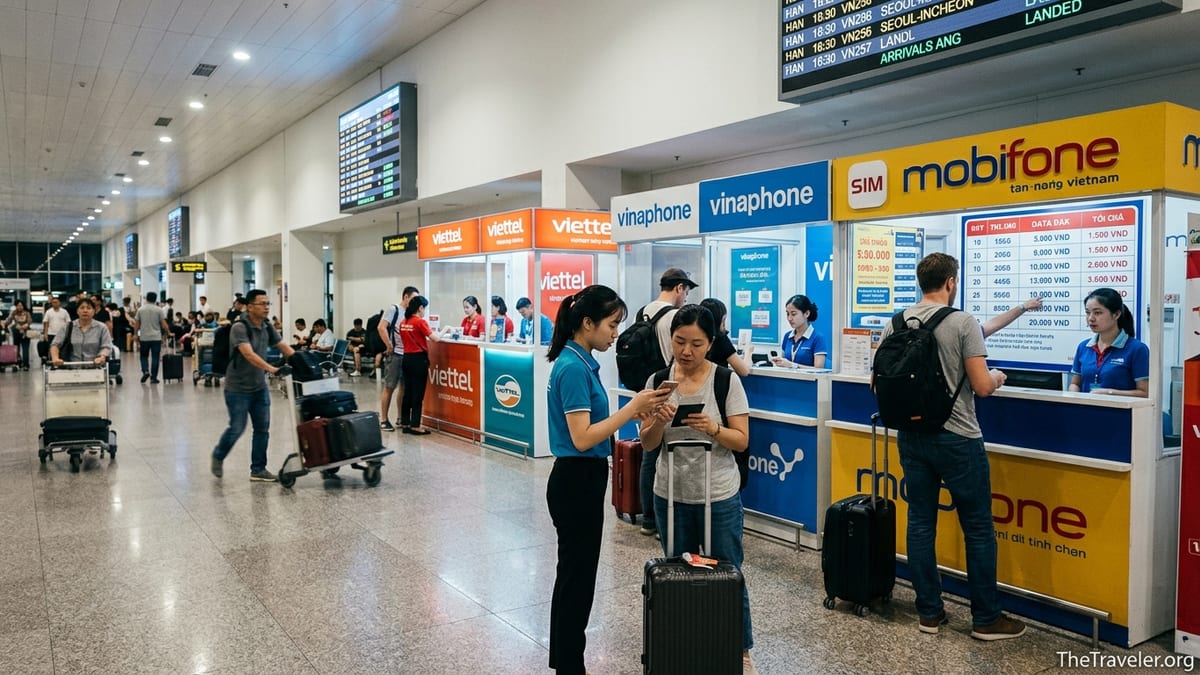
How mobile service works in Vietnam today
Vietnam has a competitive mobile market, but for visitors there are three names that matter most: Viettel, Vinaphone and Mobifone. They are the large state-backed operators that together account for the vast majority of mobile subscribers and coverage across the country. In practical terms, almost every airport kiosk or tourist plan you see at Noi Bai will be reselling service from one of these three networks, even if the brand on the sign is a travel agency or a lesser-known reseller.
Coverage and speed vary by network and by location. Recent independent tests of Vietnam’s 4G and 5G performance show Viettel and Vinaphone leading overall for 5G quality and nationwide reach, with Mobifone close behind in cities and for streaming performance. In real life this means that if you plan to stay mainly in Hanoi, Halong Bay and other well visited areas, any of the three will work. If you are heading into remote mountains like Ha Giang or rural northern provinces, Viettel usually has the edge for signal reliability.
Vietnam requires prepaid SIM cards to be registered to an individual with valid ID. For foreign visitors this usually means your passport. Recent regulations reinforce that your name, date of birth and passport number must be correctly attached to the SIM in the operator’s database before the number is fully active. Airport counters and official city stores are used to this process, but it can still add a few minutes at the counter while the staff scan your passport and enter your details.
Voice and SMS still exist, but for most short term travelers data is what matters. Typical tourist bundles now focus on high data allowances with limited or no outgoing calls, sometimes paired with free incoming calls or short local call quotas. Many travelers simply use data only plans and keep their home number on roaming for SMS codes from banks or airlines.
Where to find SIM card counters at Noi Bai Airport
Noi Bai has two main terminals: Terminal 2 handles almost all international flights, while Terminal 1 is domestic. Most international visitors will arrive at Terminal 2, pass through immigration and baggage claim on the lower level, then walk into the arrivals hall through a set of sliding doors. This is where you will see the bulk of SIM card options.
Immediately after exiting customs in Terminal 2’s arrivals hall, you will find a row of small kiosks and counters along the wall on your left and right. Some are branded directly with operator logos such as Viettel or Vinaphone, while others are travel agencies, ride hailing desks or general service counters that also sell SIMs. Opening hours can vary, but travelers arriving on late evening flights frequently report finding at least a couple of SIM kiosks still operating after midnight, especially when large international flights arrive.
The domestic Terminal 1 also has SIM points, usually small desks near the arrival exits and landside check in areas. These mainly serve local travelers, but you can also buy tourist SIMs there if you connect from an international flight elsewhere. English is spoken to a functional level at most airport counters, but detailed explanations can still be easier to obtain in the larger official stores in central Hanoi.
If you have arranged a SIM in advance through an online travel SIM provider or agency, the voucher will often direct you to a specific counter in Terminal 2 to collect your card. Some services instruct you to walk to “counter 2” or a named booth after exiting customs. In these cases, staff will already know your booking and will focus mainly on installing and registering the SIM on your phone.
Typical prices and what you actually get
Prices at Noi Bai Airport in 2026 are higher than what you would pay walking into a Viettel, Vinaphone or Mobifone shop in downtown Hanoi, but still relatively reasonable by global standards. Expect to see tourist SIM packages advertised in the range of roughly 200,000 to 350,000 Vietnamese dong for short stays, which is about 8 to 14 US dollars at recent exchange rates. Exact offers change regularly, but the structure is typically similar.
A common airport Viettel style package might include around 7 to 15 days of validity with a daily data quota such as 3 to 7 GB per day at full speed and then throttled speeds afterward. Some plans offer a large one time data pool such as 60 GB total for 15 or 30 days. Many include free domestic calls within the same network or a small bundle of voice minutes to other networks, which is handy if you need to call local hotels or drivers. International calls are usually not included and can be expensive per minute.
Independent travelers comparing offers online sometimes find better deals in the city. For example, recent reports from visitors who bought directly at a Mobifone shop in Hanoi describe paying the equivalent of about 5 US dollars for a 30 day package with generous daily data allowances. That is considerably cheaper than the same operator’s products sold through airport tourist kiosks. The trade off is that you must locate a real store, possibly queue, and communicate your needs without the streamlined “tourist package” script of airport vendors.
Reseller desks at Noi Bai sometimes sell the same underlying operator plans with added margin or bundled extras like airport transfer booking or tourist maps. While the cost difference of a few dollars may not be huge for a short trip, it adds up for longer stays or families needing multiple SIMs. If budget is a priority and you are arriving during daytime, consider using airport Wi Fi or a roaming plan for the first hour and buying your SIM in town instead.
Airport SIM versus city store: which should you choose
Deciding whether to buy your SIM at Noi Bai or wait until you reach the city depends mainly on your priorities: convenience, price, and how comfortable you are navigating Hanoi without mobile data for the first stretch. For many short stay visitors, the small “airport premium” is worth paying to walk out of arrivals with Google Maps and ride hailing apps already working.
Consider a solo traveler landing at 22:30 on a busy evening flight. After immigration and baggage claim, it is close to 23:30. Taxis and ride hailing drivers are waiting outside, and public buses into Hanoi are still departing. In this situation, buying a SIM at the first open Viettel or Vinaphone counter for around 250,000 dong and having instant data can feel like cheap peace of mind, especially if it avoids haggling over fares without a navigation app or translator.
Now imagine a family of four arriving on a midday flight, with hotel transfer already arranged and plenty of time the next morning. Paying close to 1 million dong at the airport for four tourist SIMs might not be the best value. In their case, it can make sense to put one parent on a small international roaming package for the trip from the airport, then visit a Viettel or Mobifone shop near the hotel the next day to buy two or three local SIMs or eSIMs at city prices.
If you arrive very late at night or during a quieter period and find only a couple of counters open, you may have fewer choices of operator and plan. In that case, you can take a hybrid approach: buy a short validity airport SIM or rely on a pre purchased eSIM for the first few days, then switch to a better value local plan once you have time to explore the city.
eSIM options: local and international providers
For travelers whose phones support eSIM, the choice in 2026 is broader than just physical cards at the airport. There are two main categories of eSIM for Vietnam. First, local Vietnamese carrier eSIMs from operators like Viettel, Vinaphone and Mobifone, often sold in their own stores or through partner travel agencies. Second, international eSIM platforms that sell regional or country specific data plans that roam on Vietnam’s networks.
Local eSIMs typically behave exactly like a local physical SIM: they attach directly to a Vietnamese operator with a local IP address and, in many cases, include a Vietnamese phone number. For example, Mobifone promotes travel eSIM products that give a set amount of high speed data, valid from the moment you activate them in Vietnam, and may include local call capabilities once you complete registration. These are ideal if you plan to stay in Vietnam for weeks or months, or if you value having a real local number for deliveries and banking apps.
International eSIM brands such as Airalo, Nomad, Holafly and several newer entrants offer Vietnam specific or wider Asia regional eSIMs. Recent comparison sites show prices starting from the low single digit US dollar range for small data bundles, scaling up to larger packages for heavier usage. These plans usually roam on one or more of the big three Vietnamese networks and can provide solid performance in cities, though your phone might be locked to a specific partner network depending on the provider and configuration.
One practical strategy used by many travelers is to purchase and install an international eSIM such as an Asia pack before boarding the plane. They then activate it on landing for instant data at the airport, while later in the trip they purchase a local Viettel or Mobifone eSIM or SIM in the city for better long term value and more predictable coverage in rural areas. This two step approach reduces stress at arrival while still giving you the benefits of a local plan.
Passport registration and what to expect at the counter
Vietnam’s SIM registration rules are taken seriously, and the process has tightened over recent years in response to fraud and spam concerns. At Noi Bai’s official counters and at operator stores in Hanoi you should expect to show your passport each time you buy a new SIM or eSIM profile. Staff will either photocopy or scan your passport, then enter your personal details into an online system linked to the national database.
In practice, the airport process usually takes 5 to 10 minutes per SIM once it is your turn at the counter. The staff member will ask to see your phone, insert the physical SIM or help you scan the eSIM QR code, then wait for activation. They may make a short test call or send a code to verify the line. During busy arrival waves, particularly when several international flights land at once, this can create queues of visitors waiting for registration and setup.
Some desks in the city, especially small convenience stores, still offer to sell pre registered or partially registered SIM cards. While these can look like a time saver, using a SIM that is not properly linked to your passport can lead to problems later. Unregistered or incorrectly registered numbers may be blocked or throttled, and you might have difficulty recovering the line or topping up if anything goes wrong. Sticking to official airport kiosks or branded operator shops greatly reduces these risks.
Because the law caps the number of SIMs that one person can register, operators have become stricter about ensuring the passport details match the real user. It is wise to keep your passport handy whenever you are dealing with mobile operators in Vietnam, not just at the airport but also if you extend or change plans later during your stay.
Real world examples: costs, coverage and common pitfalls
To make the decision more concrete, imagine you are arriving at Noi Bai for a 10 day holiday that includes Hanoi, Ninh Binh and Halong Bay. At the airport, you see a Viettel branded counter offering a 10 day tourist SIM with 5 GB of high speed data per day and some local calls for about 250,000 dong. You buy it, the staff registers your passport, and within minutes your phone shows a strong 4G or 5G signal. Throughout your trip your maps and social media work without issue, and even in some rural spots around Ninh Binh you keep a usable connection.
In another case, a backpacker planning a month long motorbike loop through the northern mountains might decide differently. They could install a small international eSIM at home to get 3 to 5 GB of data for the first few days, using it mainly to navigate from the airport to a hostel in Hanoi. The next day they visit a Viettel or Mobifone service center in the Old Quarter, present their passport and ask staff for a 30 day data heavy package. They end up paying roughly the equivalent of 5 to 8 US dollars for a month of large daily data limits on a network known to work better in remote valleys and border areas.
Common pitfalls include buying the first SIM you see without checking validity length, underestimating how much data you need, or not confirming whether tethering and hotspot sharing are allowed. Some cheaper tourist plans impose limits on hotspot usage, which can be frustrating if you plan to work from a laptop. Another mistake is relying only on a roaming eSIM that is locked to a weaker network in a particular region; travelers have reported situations where a partner network delivered slow or patchy service in one Vietnamese city while a local Viettel or Vinaphone SIM in the same phone immediately picked up strong 5G service.
Language barriers can also cause confusion. Package names like “7GB/day for 30 days” or “60GB total” can sound similar but behave very differently in real use. If you are a heavy user of maps, video and ride hailing, a daily quota package is often safer because you effectively get a large reset each day instead of risking burning through a one time pool early in your trip.
Should you rely on airport Wi Fi and public transport instead
Noi Bai Airport offers free Wi Fi in the terminals, which is usually good enough for messaging, quick map checks and confirming hotel pickup details. If you prefer to avoid any mobile decisions while tired from a long haul flight, you can connect to the airport Wi Fi in Terminal 2’s arrivals hall, book a ride or locate the public bus stop, and postpone buying any SIM until later that day.
Airport buses and shuttle services into Hanoi continue to operate on set schedules, and many travelers without local SIMs simply board these after asking staff for the correct stop. Once in the city, most central areas offer plenty of cafes, hotels and coworking spaces with reliable Wi Fi, giving you a comfortable environment to research and choose a mobile plan calmly.
The downside of waiting is reduced flexibility if anything goes wrong shortly after arrival, such as a driver failing to appear or a hotel reservation issue. Without immediate mobile data, you will depend on airport Wi Fi and the willingness of staff to help you place calls. For some, especially solo travelers arriving late or with limited language skills, that tradeoff feels unnecessary when an airport SIM can solve the problem for a relatively small extra cost.
Ultimately there is no single “right” approach for every traveler. The key is to understand roughly what a fair price looks like, what network you prefer and how the registration process works. Once you have those pieces in mind, you can decide at the baggage carousel whether today is an airport SIM day or a wait until town day.
FAQ
Q1. Is it better to buy a SIM card at Hanoi Noi Bai Airport or in the city?
Buying at Noi Bai is more convenient and only slightly more expensive, while city shops offer cheaper plans and more choice if you are willing to wait.
Q2. Which mobile network is best for coverage around Hanoi and northern Vietnam?
Viettel generally has the broadest coverage, especially in remote northern areas, with Vinaphone and Mobifone performing well in cities and main tourist routes.
Q3. How much should I expect to pay for a tourist SIM at Noi Bai Airport?
As of 2026, most short stay tourist SIMs at Noi Bai cost roughly 200,000 to 350,000 dong, including a week or more of generous mobile data.
Q4. Do I need my passport to buy a SIM or eSIM in Vietnam?
Yes. Vietnam’s regulations require SIMs to be registered to your identity, so airport counters and official stores will ask to see and record your passport.
Q5. Can I get an eSIM instead of a physical SIM at Noi Bai?
eSIM availability at the airport is improving but still not universal. Some operator counters and partner travel agencies can install local eSIMs on supported phones.
Q6. Will a SIM bought at Noi Bai work everywhere in Vietnam?
It will work nationwide on the underlying network, but performance can vary. Viettel tends to work best in remote regions, while all three majors are fine in cities.
Q7. Are airport SIM prices a rip off compared with city prices?
They are higher, but usually by only a few US dollars for short stays. Many travelers consider that a reasonable premium for instant connectivity on arrival.
Q8. Can I use an international eSIM like Airalo instead of buying a local SIM?
Yes. Many travelers pre install an international eSIM for immediate data, then optionally add a local Viettel, Vinaphone or Mobifone SIM later for better value.
Q9. What if I arrive late at night and the SIM counters are closed?
At least some counters typically track late international flights, but if you find everything closed you can use airport Wi Fi and your home roaming until morning.
Q10. Can I share my Vietnamese data plan as a hotspot with other devices?
Many plans allow tethering, but not all tourist bundles do. Ask the staff explicitly at purchase if hotspot use is permitted on the specific package you choose.