


More news on this day
Rail services across northern England have resumed following a large-scale power failure linked to the Manchester Rail Operating Centre, but the disruption has sharpened questions over how resilient the United Kingdom’s rail infrastructure really is to shocks and system-wide failures.
Get the latest news straight to your inbox!
Power failure cascades across key northern routes
Reports from passengers and rail operators indicate that services through Manchester Piccadilly, one of the country’s busiest hubs outside London, were heavily disrupted after a sudden loss of power affecting signalling and route control late last week. The incident was traced to the Manchester Rail Operating Centre, a facility near Ashburys that controls signalling for a wide area of north west England, including routes serving Piccadilly, Victoria, Liverpool Lime Street and Blackpool.
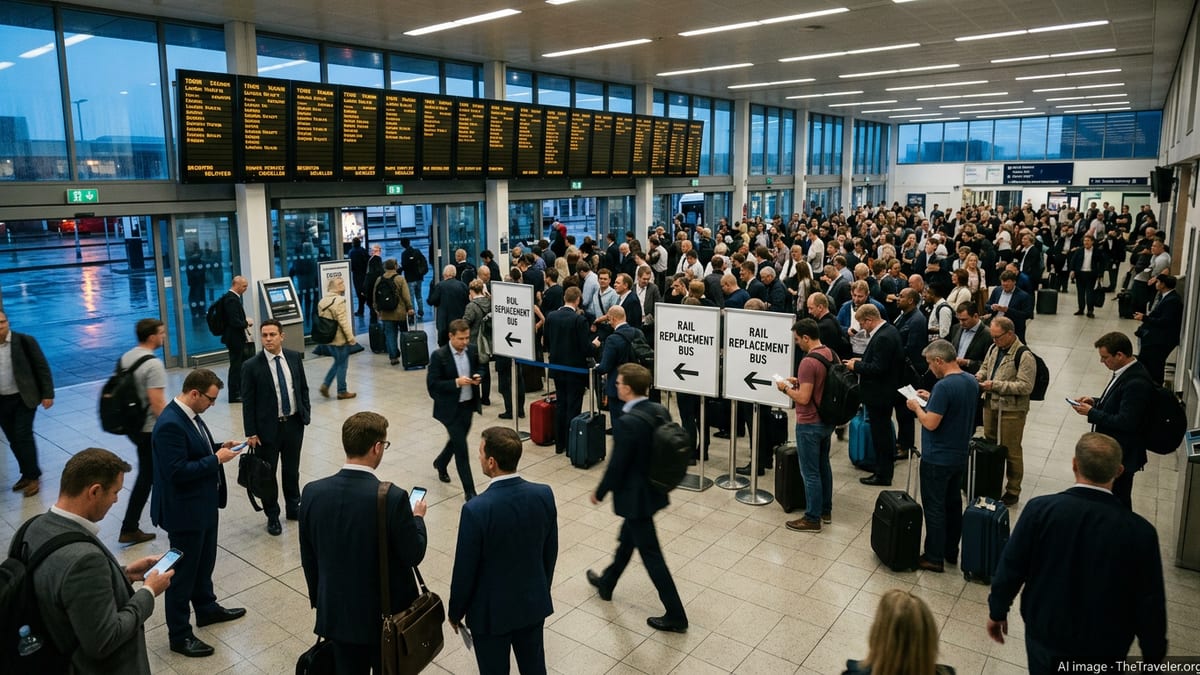
With signalling systems temporarily unavailable, trains were cancelled or severely delayed on main lines linking Manchester with cities such as Liverpool, Leeds and London. Crowded concourses, extended journey times and last-minute diversions were widely reported, with some passengers describing journeys that took several hours longer than scheduled as operators attempted to work around the loss of central control.
Normal service has since been restored, but the breadth of the impact from a single technical fault has unsettled travellers and transport observers. The event unfolded as the region was already preparing for planned engineering work and service changes, compounding the sense of fragility around northern England’s rail connectivity.
National Rail information shows that while the immediate disruption from the power failure has ended, some residual delays and minor alterations persisted into subsequent days as operators repositioned trains and staff. The knock-on effects highlighted how quickly a localised failure at a key node can reverberate across the wider network.
Single points of failure raise resilience concerns
The Manchester Rail Operating Centre was designed to consolidate and modernise signalling control over a large section of the network, replacing older local signal boxes. Concentrating control in one location can improve efficiency and reduce operating costs, but the latest disruption has focused attention on the vulnerability created when so much of the system depends on a single site.
Publicly available commentary from rail specialists has long cautioned that centralised control centres require robust backup power and failover systems to prevent exactly this type of outage. Online discussions among rail professionals after the incident highlighted surprise that a power loss could disable such a wide area, suggesting that either resilience measures were insufficient or that the failure exceeded design expectations.
The episode has added to a wider debate within the United Kingdom about the robustness of critical infrastructure to cascading shocks. Academic studies examining UK public transport networks have previously identified rail systems as complex, interdependent networks where disruptions at central hubs can propagate rapidly, especially where redundancy is limited.
For passengers, the concept of a “single point of failure” is becoming more visible. The Manchester incident followed previous episodes of large-scale disruption caused by overhead line problems, signalling faults and timetable changes, reinforcing the perception that the system struggles to absorb shocks without significant impacts on everyday travel.
Manchester’s strategic role in the rail network
Manchester sits at the heart of rail travel in northern England, acting as both a regional hub and a crucial link between Scotland, the Midlands and Yorkshire. Piccadilly alone handles tens of millions of passengers a year, with services from operators including Avanti West Coast, TransPennine Express, Northern, CrossCountry, East Midlands Railway and Transport for Wales.
The city’s rail geography amplifies the impact of any local failure. Piccadilly and Oxford Road form part of the Castlefield corridor, one of the most congested pieces of railway in the country. Studies and performance reports have described this corridor as a bottleneck where delays can quickly compound, even under normal conditions.
Manchester Victoria provides another key access point for services towards Leeds, Rochdale and the Calder Valley, but it too is subject to periodic closures and timetable changes due to planned engineering works. Current improvement projects affecting routes to and from Victoria underscore how finely balanced capacity and reliability have become in and around the city.
Against this backdrop, a sudden outage at the operating centre responsible for much of the region’s signalling effectively removes the coordinating brain of the system. The latest disruption showed how, when that coordination is lost, the redundancy offered by multiple stations and routes is limited by the shared dependence on a single control node.
Ongoing upgrades and disputed resilience strategy
The outage comes as government and industry seek to reshape rail in the North through a patchwork of schemes, including the Transpennine Route Upgrade, elements of the Northern Hub programme and revised plans under the Northern Powerhouse Rail umbrella. These projects promise more frequent services, shorter journey times and modernised infrastructure, but have faced delays, changes in scope and ongoing funding debates.
Parliamentary papers and regional transport committee reports over recent years have repeatedly raised concerns about service performance on routes through Manchester, particularly on intercity and TransPennine services. Capacity constraints, infrastructure limitations and franchise difficulties have all been identified as contributing to cancellations and delays even before unplanned incidents occur.
In theory, infrastructure upgrades should enhance resilience by adding capacity, renewing ageing assets and simplifying operations. In practice, partial implementation and extended construction periods can temporarily reduce flexibility. Passengers in Greater Manchester are currently contending with both planned closures around Victoria and Oxford Road and occasional unplanned events, producing a challenging environment for reliable travel.
The latest disruption is likely to feed into ongoing discussions about how future investment should balance capacity increases with system redundancy. Observers note that additional tracks or platforms alone may not prevent similar incidents if control, power and signalling remain concentrated without sufficient backup options.
Passenger experience and calls for clearer contingency planning
For travellers, the power failure translated into missed connections, overcrowded platforms and hurried searches for alternative routes. Social media posts and passenger accounts described long queues for replacement buses and difficulties accessing clear, timely information as the situation unfolded around Manchester and other affected stations.
Compensation rules offer some financial redress, as many passengers are entitled to refunds or partial repayments when long delays occur. However, the wider cost to business, leisure travel and public confidence in rail is harder to quantify. Regular users in the North have already been exposed to repeated warnings to “avoid travel” during strikes, weather events and previous infrastructure failures, reinforcing a sense that rail journeys can be unpredictable.
Travel advocates and local leaders have previously pressed for more robust contingency planning, including better integration with bus and light rail networks when rail lines fail. In Greater Manchester, the growing Bee Network of buses and trams is intended to provide more joined-up public transport, but the scale of the recent disruption showed how quickly alternative services can reach capacity when rail services stop suddenly.
As services settle back into their normal patterns, debate is likely to continue over whether the UK rail system, and Manchester’s role within it, is equipped to cope with both growing demand and the kind of sudden shocks that a modern, electrified and centralised network can face. The latest power failure has become a test case in how infrastructure design, operational planning and passenger information interact when the system is placed under acute stress.