


Petersburg, Alaska sits on Mitkof Island in Southeast Alaska and is not connected to the North American road network. Reaching this working fishing town means arriving by sea or air: on the state-run Alaska Marine Highway ferries, on a regional flight into Petersburg James A. Johnson Airport, or on a cruise or private vessel transiting the Inside Passage. This Petersburg is the Norwegian-rooted fishing community in Southeast Alaska, entirely different from Petersburg, Virginia or other towns with the same name in the Lower 48, so be sure you are searching schedules and tickets for the Alaska destination before you book.
Get the latest updates straight to your inbox!
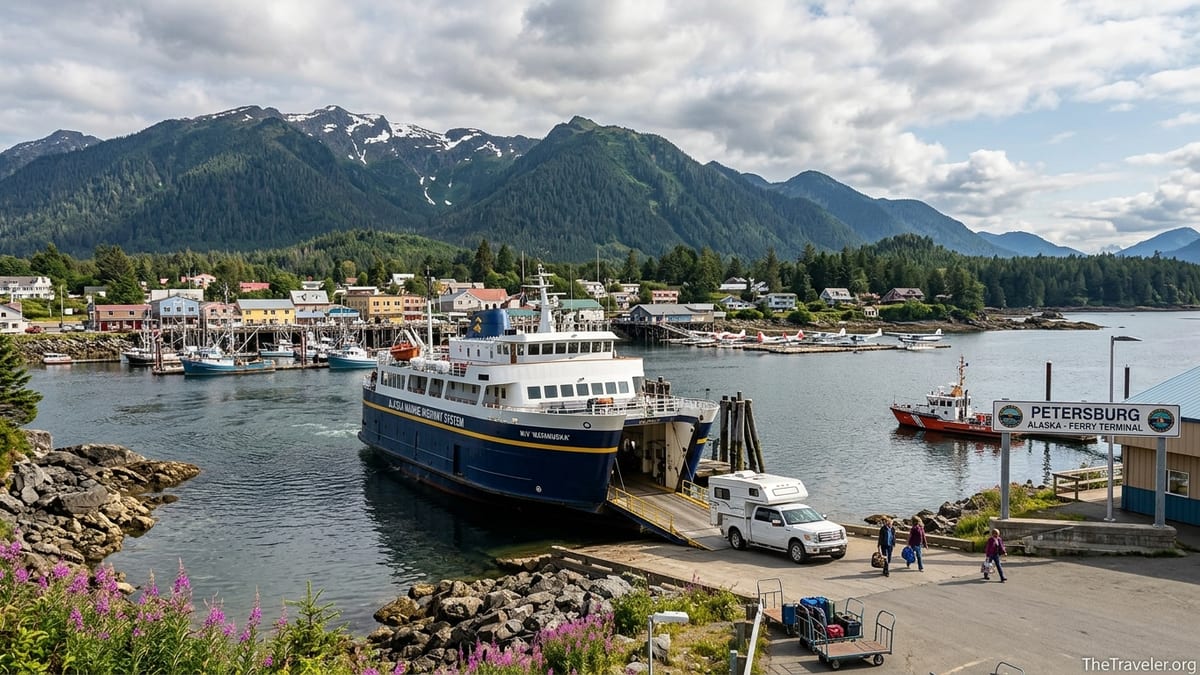
Understanding Petersburg’s Place on the Inside Passage
Petersburg lies roughly halfway between Ketchikan and Juneau on the famed Inside Passage, a sheltered marine corridor that threads through islands, narrows and channels along Alaska’s southeast coast. The town serves as a regular stop for the Alaska Marine Highway System and as a regional aviation link, but it remains small and weather-dependent compared with large coastal hubs. That combination makes Petersburg attractive for travelers seeking a quieter community, while also requiring a bit more logistical planning to get there.
There is no highway or car ferry link from mainland roads directly into Petersburg. Vehicles reach Mitkof Island on Alaska Marine Highway vessels, which connect the ferry terminal to other Southeast Alaska ports and to southern gateways such as Bellingham, Washington and Prince Rupert, British Columbia. Once on the island, Alaska Route 7 provides a modest local road system, but all long-distance arrivals and departures rely on ferries, scheduled flights or private boats.
For itinerary planning, it helps to treat Petersburg as one stop among several along the Inside Passage. Many travelers link it with Wrangell, Ketchikan, Sitka or Juneau, using a mix of ferries and flights rather than expecting a single continuous road-based journey. Because ferry and flight schedules in Southeast Alaska change seasonally and are sensitive to state budgets, demand and weather, it is essential to confirm current options rather than relying on older guidebooks.
Alaska Marine Highway Ferries to Petersburg
The Alaska Marine Highway System (AMHS) is the primary public ferry network serving Southeast Alaska communities. As of late 2026, Petersburg appears as a stop on the Southeast “mainline” route pattern that typically runs Bellingham to Ketchikan to Wrangell to Petersburg to Juneau, with additional links to Haines and Skagway in many seasons. Separate sailings also connect Petersburg with Sitka via other communities, though frequencies and vessels can change from year to year.
Using recent AMHS schedule grids for the 2026 summer and proposed winter 2026–27 seasons as a reference, travelers can expect multiple sailings per week through Petersburg during peak summer, often with at least one northbound and one southbound mainline vessel serving the port many weeks. In winter, sailings tend to thin out, sometimes to roughly one mainline call per week on key legs, and some cross-Gulf routes do not operate. Actual frequencies and sail times vary by vessel and season, so the most reliable method is to search the official booking engine by date and route and then reconfirm a few weeks before departure in case of schedule adjustments.
Distances published by the state show that Wrangell to Petersburg runs on the order of 40 to 50 nautical miles, while Petersburg to Ketchikan is closer to 90 to 100 nautical miles and Petersburg to Juneau roughly 230 to 270 nautical miles. In practice this often translates to about 3 to 4 hours between Wrangell and Petersburg, 6 to 8 hours between Petersburg and Ketchikan, and 12 to 14 hours or more between Petersburg and Juneau, depending on vessel speed, intermediate stops and tidal conditions. Travelers should treat these as approximate; always check specific sailings for precise departure and arrival times.
Vehicle and passenger fares on AMHS fluctuate with distance, cabin choices and seasonal demand. Using late 2026 examples as a snapshot, a walk-on adult fare between Petersburg and Wrangell can often fall in a rough range of 40 to 80 US dollars one way, with Petersburg to Ketchikan or Petersburg to Juneau more commonly landing in the low hundreds. Bringing a standard car or small camper can easily add several hundred dollars on top of passenger fares on longer legs. Because fares change with fuel costs, vessel, and promotions, travelers should treat these numbers as general guidance checked in November 2026 and always verify current pricing before finalizing budgets.
Booking, Check-in and Onboard Life on the Ferry
For schedule and fare research, start by searching the official Alaska Marine Highway reservations portal or calling its reservations line, then filter by your intended travel month, origin and destination. Many travelers planning multi-stop Inside Passage trips will find it useful to map out each ferry segment individually, since not all sailings call at every port and some routes require overnight or multi-day hops. Because the system periodically revises its seasonal timetables, it is wise to download or print the grid relevant to your dates and then recheck for late adjustments one to two weeks before sailing.
In high summer, especially between June and August, cabins and vehicle spaces can sell out far in advance on popular sailings. Northbound departures from Bellingham and southbound legs heading toward Bellingham or Prince Rupert that include Petersburg as an intermediate stop are particularly prone to early sell-outs for cabins and car deck space. Booking several months ahead is strongly recommended if you are traveling with a vehicle, towing a trailer or hoping for a private cabin, while foot passengers sometimes find more last-minute flexibility.
Check-in procedures differ slightly for passengers with and without vehicles. Walk-on travelers are generally asked to arrive at the terminal around 1 to 2 hours before departure, completing security and boarding on foot or via shuttle. Vehicles typically must check in earlier, often 2 to 3 hours in advance, to allow for staging and loading; oversize or special cargo may require even more lead time. Requirements can vary by port and vessel, so always follow the instructions printed on your reservation and any subsequent emails from AMHS.
On overnight or long daytime runs, travelers can either reserve a cabin or sleep in public areas. Cabins are basic but provide beds, linens and private or semi-private bathrooms, varying by ship. Without a cabin, many passengers rest in reclining lounge seats or roll out sleeping bags in designated solarium or observation lounge areas. This informal camping culture can be part of the Inside Passage experience, but noise and light levels fluctuate, so earplugs and eye masks are helpful. Food service is usually available in cafeterias or snack bars, but hours can be limited, so bringing some provisions of your own is a smart backup.
Pros and Cons of Taking the Ferry to Petersburg
The ferry route into Petersburg is one of the most scenic approaches in Southeast Alaska. Vessels sail among islands and narrows, passing forested shorelines, fishing boats and occasional whales or porpoises. For travelers with kayaks, bicycles, coolers of fish or substantial outdoor gear, the ability to keep everything in or on a personal vehicle is a major advantage, as is avoiding the weight and size constraints common on small aircraft. The ferry also allows flexible itineraries that hop from Ketchikan to Wrangell to Petersburg and beyond, with the option to disembark for several days at each port.
On the downside, AMHS sailings are limited and vulnerable to change. Budget constraints, staffing issues and maintenance needs have led in recent years to seasonal gaps, altered frequencies and vessel substitutions across the network. Travelers cannot always count on daily service or convenient times, especially outside peak summer. Weather and mechanical issues occasionally trigger delays or cancellations, and alternative sailings might be several days away, which can significantly disrupt tight itineraries.
Compared with short regional flights, ferry journeys require more time. A route that takes less than an hour in the air may require most of a day or an overnight on the ferry. However, the slower pace can be an asset for travelers who see the voyage itself as part of the trip rather than merely transport. When weighing options, consider not only ticket cost and schedule but also how much value you place on scenery, space to move around, and the ability to travel with a vehicle and bulky gear.
Flights to Petersburg James A. Johnson Airport
Petersburg James A. Johnson Airport (IATA code PSG) provides scheduled air service that links the community to other Southeast Alaska hubs. As of late 2026, Alaska Airlines lists Petersburg among its destinations, typically served with regional aircraft that connect into its broader network. Historic documents and recent route data also show that Petersburg is part of the federal Essential Air Service program, which helps subsidize service and maintain regular links with towns such as Juneau and Wrangell.
Routes and frequencies change more frequently for small markets than for major hubs, so travelers should search flights using Petersburg’s airport code and compare options across several days. Common patterns include flights that route from the Lower 48 into Seattle or Anchorage and then connect onward to Juneau, Wrangell or Ketchikan before continuing to Petersburg. Actual same-day connections from cities such as Seattle, Portland or other West Coast gateways depend on the seasonal timetable and on whether Alaska Airlines or partner carriers adjust their Southeast Alaska schedules.
Because aircraft serving Petersburg are often smaller regional jets or turboprops, baggage rules may differ from what travelers expect on large mainline flights. Standard checked-bag allowances generally still apply on tickets issued through major airlines, but strict per-bag weight limits and tighter carry-on size enforcement are common on short-haul segments. For those transporting fish boxes, camping gear or photography equipment, it is especially important to review the latest baggage policies, oversize charges and weight limits on the operating carrier’s site shortly before travel.
Weather plays a significant role in flight reliability across Southeast Alaska. Low clouds, strong winds, and poor visibility can prompt delays or diversions, particularly in autumn and winter. While official statistics vary year by year, airline advisories and local reports indicate that same-day connections can be tight if schedules leave only short layovers. To reduce stress, plan generous buffers between a Petersburg flight and any onward long-haul departure, and consider overnighting in a hub such as Juneau or Seattle before catching international or cross-country flights.
Planning Buffers, Disruptions and Travel Insurance
Given the combination of coastal weather and limited daily departures, travelers should build contingency time into any itinerary involving Petersburg. For example, if you are flying from the Lower 48 into Petersburg on the same day your small-ship cruise or lodge stay begins, aim to arrive at least one full day early. Similarly, if you are connecting from the ferry to an outbound flight, try not to schedule the flight within just a few hours of the scheduled ferry arrival, especially in shoulder seasons when storms are more frequent.
Where budgets allow, travel insurance that includes trip interruption and delay coverage can provide some financial protection if a postponed ferry or weather-delayed flight forces extra nights in a hub or a rebooking of onward tickets. Carefully check policy language for exclusions related to weather, mechanical issues or schedule changes, and confirm whether your plan treats ferry segments similarly to flights. In addition to insurance, keeping some discretionary time at the start or end of your trip can transform an unexpected delay into extra time to explore Juneau, Ketchikan or another port rather than a source of anxiety.
Travelers with firm commitments such as cruise departures, guided expeditions or work obligations should also keep an eye on operational notices posted by AMHS and regional airlines in the weeks leading up to departure. These alerts sometimes flag reduced frequencies, vessel substitutions or runway maintenance windows that could affect specific sailings or flights even when published schedules still show normal operations.
Arriving by Small-Ship Cruise or Private Vessel
Several small-ship and expedition cruise operators include Petersburg on Inside Passage itineraries, usually as a quieter alternative to the larger port calls common on big-ship routes. These vessels, often carrying roughly 30 to 250 passengers, typically dock for a half or full day, allowing time for guided walks in town, cultural and fishing heritage experiences, or nearby wildlife and glacier excursions. Because offerings vary widely by company and year, travelers should review each operator’s current itinerary notes, shore excursion list and tendering procedures before booking.
Small-ship passengers rarely manage their own logistics into Petersburg, since the cruise package usually bundles transport, port fees and guided activities. However, knowing where Petersburg sits along the route can help you plan pre- or post-cruise time elsewhere along the Inside Passage. Some itineraries begin in Juneau and end in Ketchikan or vice versa, with Petersburg as an intermediate highlight; others may connect to Sitka or more remote anchorages. Verify whether your voyage includes charter flights or hotel nights at either end, and make sure any independent travel you arrange meshes comfortably with the embarkation and disembarkation timings.
For private boaters, Petersburg’s harbor system is well developed for a community of its size. Official community and harbor information note multiple boat harbors with year-round and transient slips, along with services such as fuel, shore power, fresh water, showers and laundry at facilities like South Harbor. Recent local reports also highlight a mix of commercial, fishing and visitor traffic in summer, with transient moorage widely available but subject to daily fees and seasonal demand.
Current harbor policies request that transient vessels contact the Petersburg Harbormaster, typically via VHF channel 16 or by phone, on approach for slip assignments and instructions. Fees are generally charged by the foot, per day or month, and a local sales tax may apply. Rates have risen in recent years, with a 2026 decision to increase certain transient fees by roughly ten percent, so published figures from older cruising guides are likely outdated. Private skippers should confirm up-to-date moorage prices, fuel hours, and any specific check-in procedures directly with the harbor office shortly before arrival.
Choosing the Best Route for Your Trip
Selecting how to get to Petersburg depends on a balance of budget, time, comfort and flexibility. Ferries often make sense for travelers carrying a vehicle, bulky gear, or coolers of fish, as the car deck effectively serves as rolling storage without the strict weight and size limits imposed by airlines. Ferry cabins and public spaces also allow more movement and the chance to enjoy scenery for long stretches, which appeals to travelers treating the voyage as part of the adventure.
Flights, by contrast, are usually the best option when time is limited. A route that might take most of a day by ferry between Petersburg and a hub such as Juneau can often be covered in well under an hour in the air. For many travelers starting in the Lower 48 or overseas, booking a through-ticket to Petersburg via Seattle or Anchorage simplifies luggage handling and misconnection protection, especially when all legs are on a single airline or alliance. The trade-off is exposure to weather delays and tighter baggage rules, which can complicate plans for transporting large quantities of fish or outdoor equipment home.
Hybrid patterns can work well. One popular strategy is to fly into Juneau, spend a night or two, then board an AMHS sailing southbound that calls at Petersburg and continues on to Wrangell or Ketchikan. Another is to travel northbound by ferry from Bellingham or Prince Rupert, stopping in Petersburg mid-journey, and then fly back to the Lower 48 at the end of the trip. Combining modes gives you scenic ferry segments without committing several extra days solely to surface travel.
Accessibility and mobility are also important factors. AMHS vessels are generally designed with elevators, accessible restrooms and accommodations for travelers with limited mobility, though specific features vary by ship. Passengers who need extra time to board or who use wheelchairs or mobility aids should note their requirements at booking and again at check-in, so crew can assist with vehicle loading, cabin access or elevator use. At Petersburg James A. Johnson Airport, facilities are relatively compact, and carriers outline assistance options ranging from wheelchair service to help with boarding via ramps or lifts; these should be requested in advance through the airline or your travel agent.
Final Planning Checklist
Because transport capacity into and out of Petersburg is finite, especially in peak summer, it is wise to secure your chosen ferry segments or flights before locking in nonrefundable lodging or tour arrangements. This is particularly important if you plan to bring a vehicle on the Alaska Marine Highway or if your dates are constrained by work, school or cruise departures. Reservations made months in advance can still be adjusted later if timetables shift, but waiting too long may leave you with less convenient options or higher fares.
Closer to departure, double-check all schedules directly with AMHS and your airline rather than relying solely on printed tickets or third-party confirmations. Look for any notices of revised departure or arrival times, vessel substitutions, or operational advisories that might affect boarding procedures. For private boaters, a quick call or radio check-in with the Petersburg Harbormaster a day or two before arrival can confirm slip availability and any updated moorage or service information.
Build contingency time into your itinerary in recognition of Southeast Alaska’s dynamic weather and the limited frequency of some services. A buffer of at least one extra day before critical commitments such as international flights or cruise embarkations can greatly reduce stress. Where it fits your budget, consider travel insurance that includes coverage for delays and interruptions on both air and ferry segments.
All example schedules and fare ranges in this article are based on information available in November 2026 and are subject to change. Before you finalize your plans, recheck current timetables, prices and policies directly with ferry operators, airlines and the Petersburg harbor office. With a bit of advance planning, the journey to this roadless island town can be as memorable and rewarding as the time you spend in Petersburg itself.