


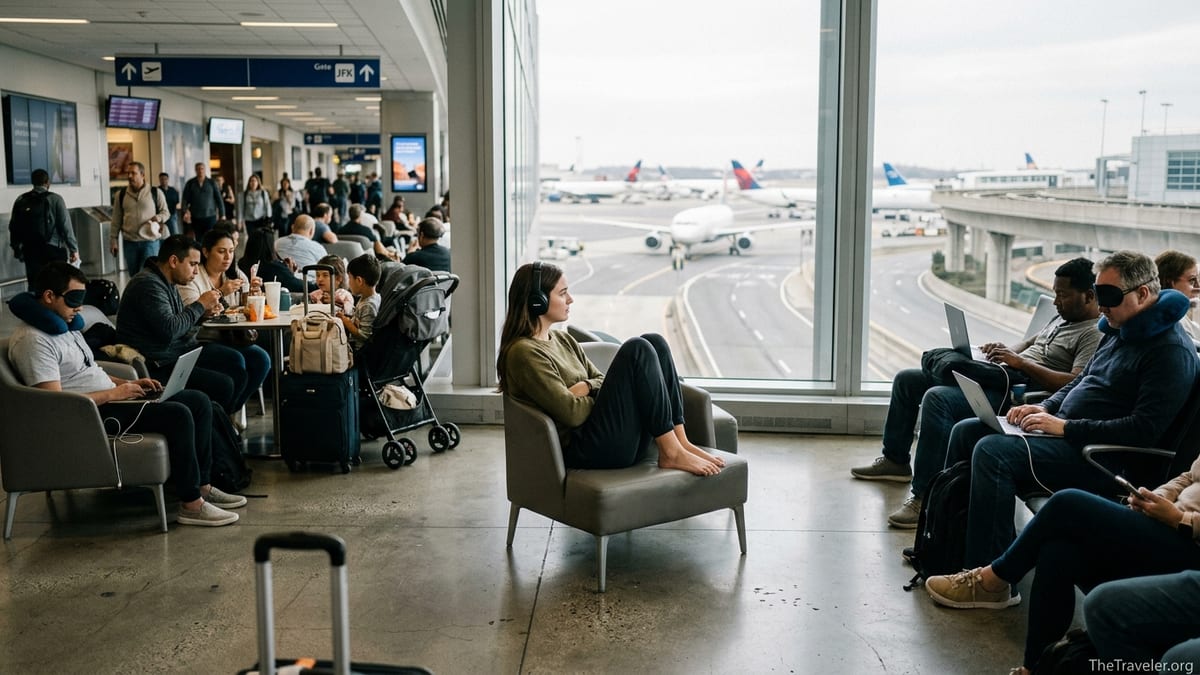
New York’s John F. Kennedy International Airport is busy, sprawling and often confusing, but a long layover here does not have to be miserable. Whether you have four hours between domestic flights or a 12-hour overnight wait on an international connection, you can turn that dead time into something surprisingly comfortable, even enjoyable, with a bit of planning and realistic expectations. This guide walks you through concrete options at JFK and nearby, so you know exactly what to do with those extra hours.
Get the latest updates straight to your inbox!
Know Your Layover Type and Time Budget
The first step to surviving a long layover at JFK is to be brutally honest about how much usable time you actually have. On paper, an 8-hour layover sounds like a mini city break. In reality, you will lose at least 1 to 1.5 hours arriving, deplaning, walking to immigration or security, and then another 2 hours on the back end to re-clear security and board your next flight. That means your “free” time might be closer to 4 hours, and that is before considering delays or construction around the airport.
As a rule of thumb, many New Yorkers consider anything under 6 hours of total layover time as “stay in the airport” territory. Travelers on forums often describe 7 hours as borderline and 8 to 10 hours as the range where a quick city visit can be realistic if flights are on time and you pack light. If you are arriving from overseas and must clear U.S. immigration and customs before your next flight, build in more buffer than you think you need, particularly during afternoon and evening peaks.
Another key factor is timing. A 7-hour layover from 10:00 in the morning to 5:00 in the afternoon feels very different from a 7-hour stretch from 11:00 at night to 6:00 in the morning. In daylight hours, shops, restaurants and transport options inside JFK and in New York City are fully open, and getting around feels safer and simpler, especially for first-time visitors. Overnight, your choices shrink, and your strategy will likely shift toward sleeping, finding a shower and minimizing stress rather than sightseeing.
Finally, check whether your itinerary is on a single ticket or involves separate bookings. If all flights are on one ticket, the airline usually bears some responsibility for misconnects. With separate tickets, you must be even more conservative with your time. In that case, even a 9-hour layover may be better spent at the airport or at the TWA Hotel next to Terminal 5 rather than gambling on a rushed trip into Manhattan.
Navigate JFK Like a Local: Terminals and AirTrain
JFK currently operates multiple active terminals, including Terminal 1, 4, 5, 7 and 8, with additional redevelopment underway. Terminals are not connected behind security, so you usually cannot walk airside from, say, JetBlue’s Terminal 5 to Delta’s operations in Terminal 4. Instead, you use the AirTrain, a free driverless train that circles the terminals and connects them with parking areas and off-airport stations.
Within the airport loop, the AirTrain is free and generally runs 24 hours a day, with trains usually every few minutes during the day. A full loop between terminals is typically under 20 minutes, and getting from one specific terminal to another can be as quick as 5 to 10 minutes platform to platform. The catch is that if you stay airside after landing, you may not always be able to access the AirTrain directly without exiting through arrivals, depending on the terminal design and the location of your connecting flight’s security checkpoint.
You only pay a fare when you ride the AirTrain to or from the two big off-airport stations, Jamaica and Howard Beach, where it connects to the Long Island Rail Road and New York City Subway. At those stations there are fare gates, and you tap a MetroCard-equivalent or OMNY contactless payment. For a layover, remember there are two distinct uses: the free “inner loop” to get between terminals, and the paid legs into the city or to nearby Queens neighborhoods.
If you are changing airlines and terminals, build in extra time for a landside transfer. For example, if you arrive in Terminal 1 on an international flight and depart from Terminal 8, you will need to clear immigration, collect and re-check bags if required, then follow signs to the AirTrain station, ride to Terminal 8 and clear security again. On a good day this might be 60 to 90 minutes. During heavy construction or when the AirTrain route is partly substituted by buses near Terminal 1, it can take longer, so do not plan any off-airport excursions unless you are confident in your buffer.
Make the Most of Lounges, Spas and Quiet Spaces
If you are staying at the airport, one of the most effective ways to improve a long layover is to buy access to a lounge or a quiet private space, even if you are not flying business class. JFK has a dense network of airline, alliance and independent lounges spread across its terminals, and as of 2026 there are more than two dozen options. For example, Terminal 4 alone houses lounges such as the Delta Sky Club, an American Express Centurion Lounge with shower suites and wellness treatments, and independent spaces like the Wingtips Lounge.
Day passes for airline lounges can vary widely. A typical range is around 50 to 80 dollars for entry to a mid-range lounge like an Admirals Club in Terminal 8, which buys you a comfortable seat, basic hot food, snacks, soft drinks, Wi-Fi and often showers. Premium lounges tied to business-class tickets are stricter, but you may be able to get access through status or high-end credit cards. For instance, the Centurion Lounge in Terminal 4 is open to eligible American Express cardholders and offers chef-designed menus, a full bar and shower rooms that can make a red-eye connection far more bearable.
For travelers who just want a private room to nap, work or take a call, Minute Suites in Terminal 4 near Gate B39 offers small enclosed suites with a daybed, desk and TV. Typical tariffs are by the hour, often in the ballpark of around 55 to 60 dollars for the first hour and slightly less for additional hours, which can be cost-effective if you split the cost with a companion. You can dim the lights, close the door and genuinely rest, which is a big upgrade from sleeping upright in a crowded gate area.
Wellness options at JFK have expanded in recent years. Terminal 4 features several XpresSpa locations where you can get a quick massage, manicure or chair treatment, which many travelers use to loosen up before long-haul flights. In Terminal 5, travelers can find smaller spa-style services as well. While an airport spa is not cheap, even a 20-minute neck and shoulder massage while your phone charges can reset you during a punishing multi-leg journey.
Sleeping, Showers and the TWA Hotel
Despite its size and traffic, JFK does not currently have extensive free “sleep pod” facilities. Overnight sleepers still tend to spread out on benches or find corners near quieter gates, especially in Terminal 5 and Terminal 4. Some areas switch to lower lighting after midnight and staff may tolerate sleeping passengers, but there is no guarantee of silence. If you must rough it, pack an eye mask, earplugs and a light layer for chilly air conditioning. Look for rows of connected seats without armrests or carpeted corners away from main corridors.
Travelers who prefer a real bed without fully committing to a night’s stay often book a daytime room at the TWA Hotel, connected directly to Terminal 5 by a short walkway and also reachable by AirTrain. The hotel offers “day stay” rooms that can be booked in blocks of several hours, useful for long daytime layovers or overnight connections where you want to sleep from, say, 11:00 at night to 5:00 in the morning. Rates fluctuate, but it is common to see daytime packages cost less than a full overnight rate, which can make sense for couples or families compared with multiple lounge passes.
The TWA Hotel is also an attraction in its own right. It occupies the restored 1960s TWA Flight Center building, complete with retro interiors, a rooftop pool overlooking the runway and a lobby with vintage departure boards. Many layover passengers check in simply to shower, nap and then enjoy a drink with runway views before returning to security. If your layover crosses normal sleeping hours and your budget allows, this can be one of the most efficient ways to maintain your sanity and arrive on your next leg feeling human.
If a hotel stay is not in the cards, some lounges provide good shower facilities. For example, major international lounges in Terminal 4 and Terminal 8 have shower suites where you can freshen up between long-haul sectors. Access might come with your business-class ticket, elite frequent flyer status or a lounge membership program, but you can sometimes buy a one-off pass. Combine a shower with a change of clothes and a proper meal, and even a 10-hour layover can feel more like a controlled rest stop than a sentence.
Eating and Drinking Smart During a Long Wait
JFK’s food options have improved significantly, though quality and atmosphere still vary by terminal. In Terminal 5, JetBlue’s home, you will find recognizable brands like Shake Shack for burgers, a range of fast-casual spots for salads and grain bowls, and coffee bars that stay open early and late. Terminal 4 offers a mix of sit-down restaurants, such as mid-range grill or bistro concepts, and quick-service counters for pizza, sandwiches and Asian noodles. Terminals 7 and 8, serving carriers like British Airways and American Airlines, have more limited but growing selections, often concentrated near central food courts.
On a long layover, it is easy to fall into the trap of snacking constantly. Airport food is costly and often salty, which can make jet lag and dehydration worse. A more strategic approach is to anchor your time around one proper meal and use smaller snacks to fill gaps. For example, on a 9-hour international layover, you might have a sit-down lunch about two hours after landing, followed by a coffee and light snack three to four hours later before going through security and boarding your next flight.
Prices at JFK are what you would expect in a major U.S. hub. A basic burger and fries meal might run 15 to 20 dollars before tax and tip, while a coffee and pastry can easily hit 7 to 10 dollars. In sit-down venues that resemble a mid-tier city restaurant, a main course can range from the high teens into the 30 dollar bracket, especially for steak or seafood. Keep an eye out for digital ordering kiosks and QR codes on illuminated cubes displayed around some terminals, which allow you to browse menus and even order to your gate, reducing the stress of wandering around with bags hunting for food.
If you plan to drink alcohol, pace yourself, especially if you are jet-lagged. A craft beer at JFK may cost 10 to 15 dollars, cocktails even more, and it is surprisingly easy to overdo it while you “kill time.” Remember that you will still need to board and sit through another flight, often in dry cabin air that amplifies the effects of alcohol. Water bottles are expensive past security, so consider carrying an empty bottle and refilling at water fountains inside the secure area to stay hydrated without constantly paying for small bottles.
When a City Dash Makes Sense and How to Do It
With a properly long layover, getting a taste of New York City can be the highlight of your trip. The key determinants are total layover length, time of day, and your comfort with managing luggage and transit. For a first-time visitor, a daytime layover of around 9 to 12 hours is a comfortable minimum if you want to reach Manhattan, walk around a bit and get back without panic. Anything shorter than 7 hours door to door, especially involving immigration and security, is usually better spent in and around the airport.
The fastest public transport into Manhattan is usually the AirTrain to Jamaica Station combined with the Long Island Rail Road into Penn Station or Grand Central. The AirTrain portion typically takes around 10 minutes from the terminals to Jamaica. From there, LIRR trains run frequently, and the ride to Midtown Manhattan is often about 20 minutes. In total, you can usually expect around 35 to 45 minutes of travel time each way on a good day, plus time to buy or tap tickets and navigate stations. That means a round trip eats roughly 1.5 hours of your layover, not counting time for airport security on the way back.
A practical example: suppose you land at JFK at 9:00 in the morning and your onward flight departs at 9:00 at night, both on one ticket. After immigration, baggage re-check and security, you might be free around 11:00. If you then catch the AirTrain and LIRR, you could be at Penn Station by around noon. That gives you about four to five hours to walk to landmarks like the High Line or Times Square, have a late lunch, and then start heading back around 4:30 or 5:00 in the afternoon. You would aim to be back at JFK no later than 6:00 or 6:30, giving you a two- to three-hour cushion.
For shorter or more cautious excursions, consider staying in Queens. From Jamaica you can hop on the E subway to neighborhoods like Jackson Heights for authentic global food, or ride the A train from Howard Beach to the Rockaways for a walk along the Atlantic shore if the weather is pleasant. These options take longer than a simple lounge stay but may satisfy the urge to see “real New York” without venturing as far as Manhattan. Whatever you choose, avoid cutting it close. Many locals and frequent flyers advise heading back to the airport with at least four hours remaining before an international departure to account for trains, possible delays and security lines.
Practical Tips: Luggage, Power, Wi-Fi and Staying Sane
Managing your luggage well can make or break a long layover. If your bags are checked through to your final destination, you only need to worry about your carry-on. If not, see if your airline or terminal offers short-term storage. Some terminals at JFK have left-luggage counters in the arrivals area where you can deposit bags for a few hours for a fee. This is particularly helpful if you plan to leave the airport or spend several hours walking around the terminals without hauling a roller bag.
Power outlets and USB ports are more common at JFK than they used to be, but they are not always evenly distributed. In older gate areas, outlets might be limited to a few wall sockets or standing charging stations that fill up quickly. Newer seating clusters in Terminals 4 and 5 incorporate power at nearly every seat. Carry a small power strip or multi-port charger if you have multiple devices, and avoid leaving electronics unattended while you stretch your legs or queue for food. Airport Wi-Fi is typically free and time-unlimited, but speeds vary by terminal and crowding.
For mental comfort, structure your layover into stages. For example, on a 10-hour wait you might spend the first hour walking the terminal to stretch and explore, the next two hours in a lounge or restaurant for food and Wi-Fi, two hours for a nap or quiet reading, then a final hour re-packing, refilling water and moving toward your gate. Breaking the time into blocks makes the hours feel more manageable and reduces the sense of endless waiting.
Safety-wise, JFK is heavily monitored and patrolled, but standard big-city airport precautions apply. Keep important documents in a secure pocket or money belt, keep an eye on bags at all times and avoid leaving valuables visible while you nap. Overnight, stick to busier, well-lit areas of the terminal rather than isolated corners. If anything feels off, move closer to staffed counters or gate areas where there is more foot traffic and cameras.
The Takeaway
A long layover at New York JFK does not have to be a test of endurance. With a realistic view of how much time you actually have, smart use of the AirTrain, and a willingness to invest a little in comfort, you can transform a dull wait into a productive pause. For many travelers, that means choosing between three broad strategies: lean into airport comforts with lounges and maybe a day room, get real rest and a shower at the TWA Hotel, or, with sufficient time, take advantage of fast rail connections to grab a quick taste of New York City.
Whichever route you pick, anchor your plan around fixed points such as baggage, immigration and security times, and always work backward from your next departure. Use concrete options available at JFK, from private suites in Terminal 4 to midtown trains from Jamaica, instead of vague ideas of “going into the city for a bit.” Do that, and your long layover can become one of the most memorable chapters of your journey instead of the longest few hours of it.
FAQ
Q1. Is my layover at JFK long enough to leave the airport and visit Manhattan?
For most travelers, a same-ticket layover of at least 9 to 10 hours in daytime is the minimum to reach Manhattan by AirTrain and Long Island Rail Road, walk around a bit and comfortably return through security.
Q2. How much time should I allow to get from JFK to Midtown Manhattan and back?
Plan on about 35 to 45 minutes each way using the AirTrain to Jamaica Station and then the Long Island Rail Road into Penn Station or Grand Central, plus extra buffer for buying tickets and navigating stations.
Q3. Does JFK have sleep pods or designated sleeping areas?
JFK does not have many classic “sleep pod” banks, but Terminal 4 has Minute Suites, which are private rooms rented by the hour, and some terminals have relatively quiet seating zones where overnight sleepers are usually tolerated.
Q4. Can I shower at JFK during a long layover?
Yes, showers are available in several airline and independent lounges in Terminals 4 and 8, and at nearby hotels such as the TWA Hotel, which offers day-use rooms where you can shower and rest between flights.
Q5. Is the AirTrain at JFK free?
The AirTrain is free when you use it only to travel between terminals, parking and certain on-airport stops. You pay a fare when you enter or exit at Jamaica or Howard Beach stations to connect with the subway or Long Island Rail Road.
Q6. What is the safest way to spend an overnight layover at JFK?
The safest and most comfortable option is usually to book a room at the TWA Hotel or a nearby airport hotel. If that is not possible, choose a well-lit, busier area of your terminal and keep valuables secure while you rest.
Q7. Are there good food options in every JFK terminal?
Food quality and variety differ by terminal, but most have at least a mix of fast-casual counters and sit-down restaurants. Terminal 4 and Terminal 5 generally offer the widest range, including recognizable burger chains, coffee shops and full-service eateries.
Q8. Can I store my luggage at JFK during a layover?
Some terminals have paid luggage storage services in the arrivals area where you can leave bags for a few hours. Availability and operating hours can change, so check ahead with your airline or the airport’s information desk.
Q9. Is it worth paying for a lounge during a long layover?
For layovers of 4 hours or longer, many travelers find a lounge day pass or membership excellent value, since it typically includes Wi-Fi, food, drinks, outlets, seating and sometimes showers and quieter spaces for work or rest.
Q10. How early should I be back at JFK before my next flight?
Aim to be back inside your departure terminal at least 2 hours before a domestic flight and 3 hours before an international one, adding extra time if you are returning from the city or traveling during peak periods.