


More news on this day
Hundreds of travelers across India and the Gulf are facing sudden cancellations, rolling delays and missed connections as a fresh wave of schedule cuts hits flights from major Indian cities to Dubai, Abu Dhabi, Riyadh’s King Khalid International Airport and other key hubs.
Get the latest news straight to your inbox!
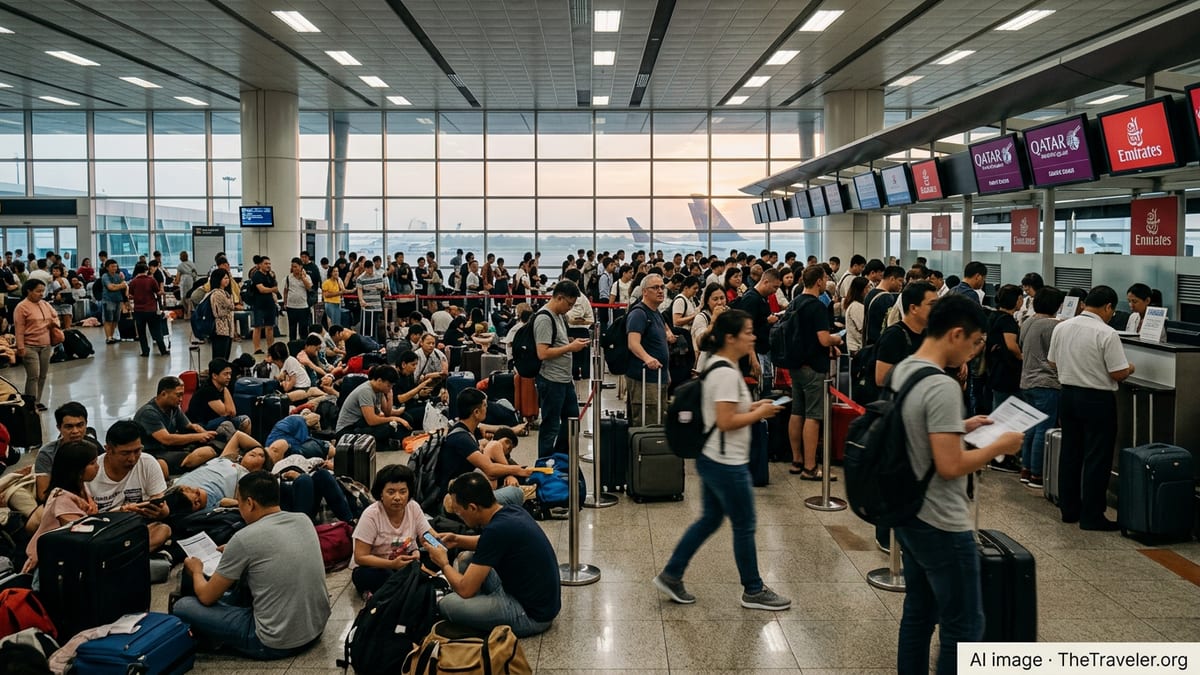
Wave of Cancellations Hits India–Gulf Routes
Publicly available flight-tracking data and local media coverage for late May 2026 indicate that more than 40 flights linking Indian metros with Gulf hubs have been canceled or heavily curtailed over a short period. Services involving Dubai International, Abu Dhabi International and Riyadh’s King Khalid International Airport appear among the most affected, with disruptions rippling across both outbound and inbound sectors.
Routes from Hyderabad, Delhi, Mumbai, Bengaluru and Ahmedabad to Gulf destinations have seen a mix of outright cancellations, last‑minute schedule changes and extended delays. While some flights are being replaced by ad hoc services, many travelers are being pushed onto later departures with limited seat availability, lengthening journeys by several hours or, in some cases, days.
The latest turbulence builds on months of intermittent disruption on India–Gulf corridors following regional tensions, airspace restrictions and operational reshuffles by carriers based in both India and the Middle East. For many passengers, the new wave of cancellations is compounding already fragile travel plans during a peak period for business trips, family visits and religious travel.
Air India, IndiGo, Akasa and Others Adjust Schedules
Across Indian carriers, publicly posted schedules, airline notices and media reports show a patchwork of changes. Air India, which has already rationalised parts of its international network in recent months, continues to operate a limited pattern of flights to Gulf destinations while selectively canceling or consolidating services from Delhi and Mumbai. Some routes that previously had multiple daily frequencies are now running at sharply reduced levels, with spare capacity absorbed by rebooked passengers from earlier cancellations.
IndiGo, India’s largest domestic carrier, has repeatedly been at the center of disruption when wider shocks hit the system. Earlier large‑scale cancellations on its Hyderabad–Gulf portfolio and other international routes have been followed by further tactical cuts as airspace constraints and congestion across the region narrow operational options. Travelers report short‑notice messages shifting flights to different times or dates, or, in some cases, routing passengers via alternate Indian hubs.
Newer entrant Akasa Air, which has been expanding into the Gulf with services from cities including Mumbai and Ahmedabad to Abu Dhabi and other destinations, is also adjusting its schedules in response to the tighter operating environment. Publicly available booking data suggest reduced frequency on some recently launched international routes, with certain departures removed from sale or marked unavailable on specific days as the airline recalibrates capacity.
Although some international carriers continue to link Indian cities with Gulf hubs, the combination of Indian and foreign airline cuts has sharply reduced the number of available seats on popular corridors, amplifying the impact of any additional flight that is canceled at short notice.
Hyderabad, Delhi, Mumbai and Bengaluru Among the Worst Affected
Hyderabad’s Rajiv Gandhi International Airport has emerged as one of the flashpoints in the current disruption. Local coverage and airport‑level updates in recent weeks describe clusters of cancellations on services to Dubai and other Gulf points, with dozens of flights scrapped over compressed time frames and many others suffering significant delays. Passenger congestion in departure halls and at airline counters has become a recurring feature when these disruptions peak.
Delhi and Mumbai, India’s two largest international gateways, are experiencing their own share of turbulence. Reports highlight curtailed schedules from both cities to Dubai, Abu Dhabi and Riyadh, alongside diversions and equipment changes. As these hubs also handle large volumes of connecting traffic from secondary Indian cities, any cancellation or delay on a Gulf‑bound service can strand travelers who have already completed a domestic leg, leaving them to seek overnight accommodation or alternative routings at short notice.
Bengaluru and Ahmedabad, important origin points for migrant workers and business travelers heading to the Gulf, are also seeing knock‑on effects. Even where direct flights continue to operate, reduced frequency and high load factors mean that rebooking options are limited when a flight is canceled. In practical terms, a single cancellation from one of these cities can leave entire planeloads competing for a handful of spare seats on subsequent departures.
The concentration of disruption on India–UAE and India–Saudi Arabia corridors is particularly impactful because many long‑haul journeys to Europe, North America and Africa are structured around connections at Dubai, Abu Dhabi and Riyadh. When those links are broken, downstream itineraries often unravel.
Underlying Pressures: Airspace Limits and Hub Congestion
Aviation advisories for early May highlight continuing restrictions across sections of Gulf and adjoining airspace, prompting carriers to reroute or cap flights through certain corridors. India–Gulf services are especially exposed to these measures because they rely heavily on tightly timed turnarounds and high aircraft utilisation. When flights need to take longer routings, or when slot availability at Gulf hubs is squeezed, the operational buffer shrinks sharply.
Regional travel analysis for the same period shows that Dubai, Abu Dhabi and Riyadh have all seen spikes in delays and cancellations as airlines respond to evolving security assessments and capacity limits. Even a relatively small reduction in available movements per hour at a busy hub can cascade into dozens of schedule adjustments across multiple carriers, with India‑origin flights among those most affected.
For Indian airlines juggling complex fleets, crew scheduling rules and maintenance demands, the need to rework flight plans around constrained airspace has added further strain. Publicly available information indicates that some carriers have opted to cancel entire rotations rather than risk extensive knock‑on delays throughout their networks, a strategy that protects overall reliability but leaves individual passengers facing abrupt changes.
Travel industry observers note that these structural pressures are unlikely to ease immediately, and that India–Gulf routes could remain vulnerable to sudden schedule swings as long as airspace and hub capacity remain finely balanced.
What Travelers Need to Know Before Heading to the Airport
For passengers booked between India and Gulf hubs in the coming days, the fast‑moving situation makes preparation critical. Airlines serving Dubai, Abu Dhabi and King Khalid are issuing rolling travel advisories, and publicly posted guidance encourages customers to check flight status repeatedly in the 24 hours before departure rather than relying on earlier confirmations.
Rebooking and refund policies vary by carrier and by the cause of disruption, but many airlines have put in place limited waiver periods for date or route changes on affected sectors. Travelers who accept voluntary changes within these windows may be able to avoid higher change fees or fare differences, though seat availability on alternative flights can be tight during peak periods.
Industry experts recommend building in longer connection times when itineraries involve transiting Gulf hubs, particularly for journeys that combine Indian and non‑Indian carriers on a single ticket. A minimum of two to three hours between flights is increasingly being suggested as a safer margin while delays remain common.
Passengers are also being advised to keep contact details updated in their airline or travel‑agency profiles so that they can receive real‑time notifications of cancellations, gate changes or rebookings. For those already stranded at airports, retaining documentation of out‑of‑pocket expenses for accommodation, meals and transport may help support later claims under airline policies or applicable passenger‑rights frameworks.