


Stand on Goat Island and you are literally in the middle of Niagara Falls. The island splits the Niagara River into the American and Bridal Veil Falls on one side and the Canadian Horseshoe Falls on the other, giving visitors a front-row seat to some of the most powerful water on the continent. But with so many overlooks, towers, and boat tours competing for attention, is Goat Island really the best place to see Niagara Falls, or simply one essential stop in a bigger experience?
Understanding Goat Island’s Unique Position
Goat Island sits directly in the Niagara River, inside Niagara Falls State Park on the U.S. side. The river rushes toward the falls, splits around the island, then plunges over three separate cataracts: the American Falls and Bridal Veil Falls on the east channel and the Horseshoe Falls on the west. That geography is what makes Goat Island so compelling. From a single compact area, you can walk to multiple viewpoints, each showing a different angle, sound, and mood of the falls.
Unlike viewpoints at street level near Prospect Point or the Canadian Table Rock area, Goat Island places you above and almost within the river’s current. Walking the paved paths toward Terrapin Point, you can feel the ground softly vibrating from the water’s force. The upper rapids roar only a few meters away, and mist drifts across the walkways depending on wind direction. This is not the classic postcard-wide panorama, but it is one of the most immersive places on the U.S. side to feel the power of Niagara.
Crucially, Goat Island is fully within Niagara Falls State Park, which is open 24 hours a day year-round, with no admission fee to stroll the island itself. You pay only for parking and optional attractions like Cave of the Winds or the Niagara Scenic Trolley. That makes it an accessible and flexible base for visitors, from quick evening visits to long summer days moving between overlooks, islands, and picnic spots.
The Views From Goat Island: Terrapin Point, Luna Island, and Three Sisters
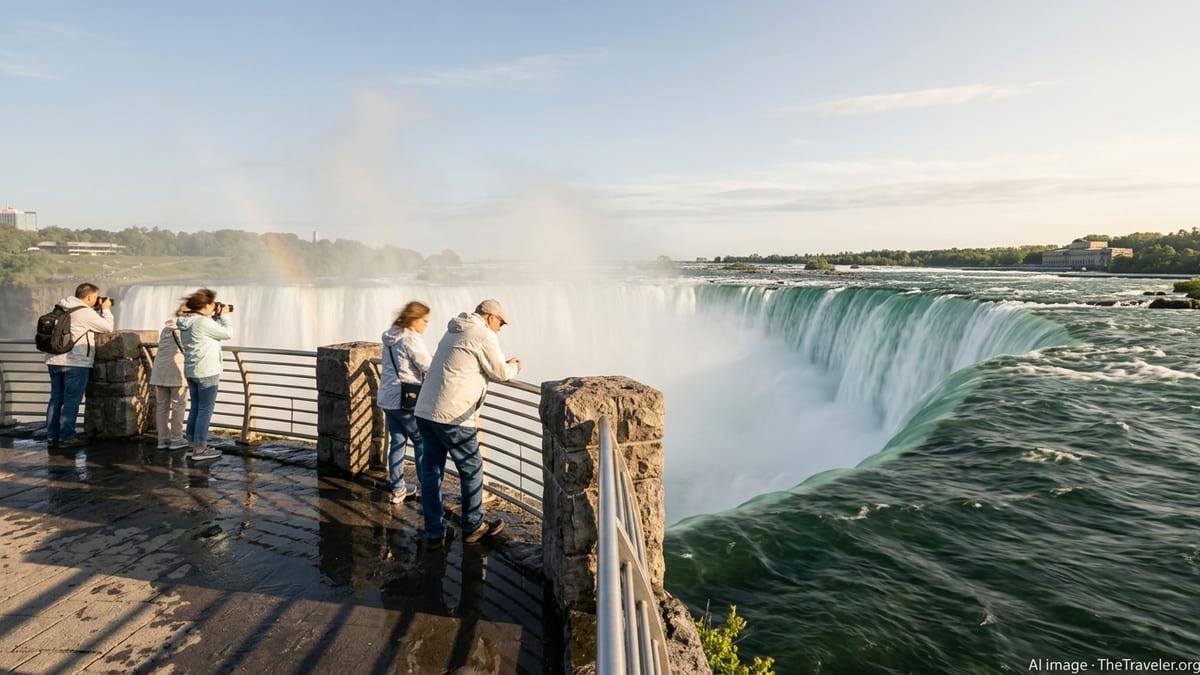
Most people come to Goat Island for its signature viewpoints. At the western tip, Terrapin Point delivers one of the best U.S. views of the Horseshoe Falls. From the overlook’s stone railing, you can peer almost straight down at the churning green water as it drops nearly 180 feet into the mist. On a summer afternoon, you might see Hornblower and Maid of the Mist boats disappearing into clouds of spray, their blue and red ponchos barely visible. On clear days, rainbows often arc through the mist below the railing, a sight that photographers love, especially around late afternoon when the sun swings behind the overlook.
On the island’s eastern side, a short walk brings you to Luna Island, a small sliver of land squeezed between the American Falls and Bridal Veil Falls. Here the experience is narrower and more vertical. You stand almost directly at the edge, watching white water break over the brink beside you. At night, when the falls are illuminated in color, Luna Island can feel surprisingly intimate given how many people visit Niagara each year. This is where many travelers realize how close you can actually get to the American and Bridal Veil Falls without a boat or tour.
Toward the southern end of Goat Island, a path crosses to the Three Sisters Islands, three small wooded islets in the upper rapids. The falls themselves are not visible from here, but the view upriver is striking. Fast, shallow water crashes over rocky shelves and channels around pockets of vegetation. Families often stop here in late afternoon to escape some of the crowds near the main overlooks, and local photographers favor this spot for long-exposure shots of the turbulent rapids at sunset or on overcast days. As a trio, Terrapin Point, Luna Island, and the Three Sisters give Goat Island a variety of perspectives rarely matched within such a walkable area.
How Goat Island Compares to Other U.S. Viewpoints
To decide whether Goat Island is the best place to see Niagara Falls, you have to compare it to the other major viewing options on the U.S. side. Prospect Point, just off the mainland, offers the classic head-on view of the American Falls. From the railings along the river and the Prospect Point Observation Tower, you can see American Falls, Bridal Veil Falls, and much of the Horseshoe Falls in one unobstructed sweep. For visitors who want that broader postcard composition, Prospect Point arguably wins.
The Observation Tower extends out over the gorge and doubles as the boarding area for Maid of the Mist. Many travelers begin their day here, taking in the wide view and then descending by elevator for the boat ride. Afterward, they often walk the riverside paths toward Goat Island. In practice, this means that Prospect Point and Goat Island work together more than they compete. You get the big-picture overview at Prospect Point, then walk onto Goat Island to get closer to the water and explore different angles.
Other U.S. spots include Whirlpool State Park and Devil’s Hole State Park farther downriver, which show the gorge, rapids, and whirlpool rather than the main falls, and the viewpoints along the Niagara Scenic Parkway. None of these match Goat Island for immediacy to the edges of the falls themselves. If your priority is to feel the water’s power up close, Goat Island is generally stronger than most alternative U.S. viewpoints, though it does not replace the wide-angle perspective offered by the Observation Tower.
Comparing Goat Island to the Canadian Side
Any honest evaluation has to admit that the most complete panoramic views of all three waterfalls come from the Canadian side at locations such as Table Rock and the grassy promenade along the Niagara Parkway. From there, visitors see the full curve of the Horseshoe Falls plus a frontal view of the American and Bridal Veil Falls, often all in a single frame. If your top priority is that high, sweeping overview, Goat Island cannot fully compete with Canada’s vantage points.
However, many travelers who have visited both sides describe the difference in terms of seeing versus feeling. On the Canadian side, you stand back and watch the spectacle unfold. On Goat Island, especially at Terrapin Point and near the edges by Luna Island, you feel embedded within the river system that produces the falls. The Horseshoe Falls, for example, are mostly visible at a diagonal from Terrapin Point, and the mist often blows across the path, dampening clothes and camera gear. You may not see as much of the arc, but what you see is more visceral and immediate.
In practice, savvy visitors with the time and the proper entry documents often visit both countries, using Goat Island to experience the falls at close range and the Canadian side for the big photographs. A typical two-day itinerary might include an evening stroll on Goat Island to see the falls illuminated, a morning at Cave of the Winds and the Three Sisters, then an afternoon crossing the Rainbow Bridge for the wide-angle views and attractions such as Journey Behind the Falls. Rather than debating which side is “best,” many repeat visitors treat Goat Island as the American cornerstone of a binational experience.
Beyond the Views: Cave of the Winds and Other Experiences
One of the strongest arguments in favor of Goat Island is that it is the launching point for Cave of the Winds, the park’s signature walk-under-the-falls experience. From an elevator near the island’s southern edge, visitors descend to the base of Bridal Veil Falls. In season, a network of wooden walkways and platforms, including the aptly named Hurricane Deck, brings you to within roughly 20 feet of the falling water. The roar is overwhelming, ponchos and sandals quickly become soaked, and the air fills with mist and spray. For many, this experience of physical proximity is the highlight of the U.S. side and something that cannot be replicated from a distant overlook.
Cave of the Winds admission, which typically includes ponchos and footwear, is priced separately from parking and other attractions. Families often schedule timed entries, building the rest of their Goat Island exploration around that slot. For example, a couple visiting in July might park on Goat Island mid-morning, walk to Terrapin Point while the light is still soft, explore Luna Island, then head to Cave of the Winds in the early afternoon when temperatures rise and getting drenched is more welcome than inconvenient.
Beyond Cave of the Winds, Goat Island also serves as a quieter walking and picnic area compared with the busier sidewalks nearer the main visitor center. There are benches along the river, shaded lawns, and views of the upper rapids that appeal to travelers looking for more than a quick photo stop. In summer, it is common to see people lingering here with takeout from nearby restaurants on the mainland, using the island’s lawns as an informal outdoor dining room before heading back to town or on to other attractions such as the Aquarium of Niagara.
Practicalities: Access, Parking, and When to Go
Goat Island is connected to the U.S. mainland by a short vehicle and pedestrian bridge. Drivers follow signs through Niagara Falls State Park to Goat Island Road and the park-operated parking lots. One of the main lots, often labeled Goat Island Lot 2, is close to Terrapin Point, Cave of the Winds, and the Top of the Falls Restaurant. Another lot near the Three Sisters Islands on the island’s eastern side offers a slightly quieter base with a short walk back toward the main overlooks. Fees vary by season and day of the week, but visitors can generally expect a flat daily rate for standard cars during peak months, with higher fees on busy weekends.
Because Goat Island parking is limited and popular, spaces can fill up by late morning on summer weekends and holiday periods. Many experienced visitors aim to arrive by mid-morning, especially in July and August, or they park earlier near Prospect Point and walk across to Goat Island on foot. The Niagara Scenic Trolley, which circulates through the park in high season for a per-person fare or day pass, also stops at Goat Island and can be useful for families with young children or older travelers who want to minimize the amount of walking between sights.
Time of day matters greatly for both crowds and photos. Early mornings, shortly after sunrise, are among the quietest times on Goat Island. The light over the upper rapids and Three Sisters can be beautiful, and parking is usually easy. Afternoons tend to bring peak crowds and the highest levels of mist near Terrapin Point, particularly on warm days when more water is released through the falls for power generation. Evenings, especially from late spring through early autumn, are ideal for those who want to see the Falls Illumination from up close. Goat Island overlooks remain accessible around the clock, allowing visitors to watch the colors change and, at certain times of year, catch scheduled fireworks displays from a vantage point near the water.
Who Will Love Goat Island Most?
The question of whether Goat Island is the best place to see Niagara Falls partially depends on what kind of traveler you are. Photographers who prioritize the single wide shot capturing all three waterfalls might rank the Canadian promenade or Prospect Point’s Observation Tower higher than Goat Island. However, those same photographers often come to Goat Island for tighter compositions of water flowing over the brink, details of the upper rapids, and moody close-ups of mist and rainbows at Terrapin Point.
Families with school-aged children tend to appreciate Goat Island because it concentrates several experiences within a manageable walking radius. Parents can combine viewpoints, the Cave of the Winds adventure, and a picnic without moving the car or crossing borders. For example, a family based in Buffalo for a weekend might spend an entire day on Goat Island and its immediate surroundings, using the trolley when kids are tired, then finishing with ice cream from a vendor near the main park areas.
Travelers seeking a more contemplative or nature-focused visit often rate Goat Island highly. Its interior paths and wooded sections feel more like a park than a tourist strip. On a midweek morning in May or October, it is not unusual to find stretches of trail where only the sound of rushing water and birds carries through the trees. For visitors who want to experience Niagara as a landscape, not just a backdrop for selfies, this quieter side of Goat Island can be its strongest selling point.
The Takeaway
Is Goat Island the best place to see Niagara Falls? It is arguably the best place on the U.S. side to feel the falls up close, thanks to its position between the channels of the river and its direct access to Terrapin Point, Luna Island, the Three Sisters, and Cave of the Winds. The island’s network of paths and overlooks lets you approach the water from multiple angles without ever leaving state park land, and its relatively green, low-rise setting preserves some of the natural character that early conservationists fought to protect.
At the same time, Goat Island is not the final word in every category. For sweeping panoramas that show all three falls at once, viewpoints such as the Prospect Point Observation Tower or the Canadian side’s riverside promenade will likely satisfy you more. For skyline views, casino hotels and tall towers across the border offer perspectives that Goat Island intentionally avoids. The island’s strength lies in intimacy, immediacy, and the sense of standing inside the river system rather than simply observing it from afar.
For many travelers, the most rewarding approach is not to crown any single spot as the definitive “best,” but to treat Goat Island as one of the essential chapters in a broader Niagara story. Start with a big-picture overlook, ride a boat into the mist if you wish, then walk the paths of Goat Island, leaning on its railings and feeling spray on your face. By the time you leave, you may decide that the island did not just show you Niagara Falls. It placed you in the middle of it.
FAQ
Q1. Is Goat Island free to visit?
Yes. Goat Island itself is part of Niagara Falls State Park and there is no admission fee to walk the island, viewpoints, and paths. You only pay for parking and optional attractions such as Cave of the Winds or the Niagara Scenic Trolley.
Q2. Is Goat Island the best place on the U.S. side to see Niagara Falls?
It is one of the best places to experience the falls up close, especially at Terrapin Point and Luna Island, and for access to Cave of the Winds. For a single wide-angle view of all three waterfalls, many visitors still prefer Prospect Point and its Observation Tower.
Q3. Can I see Horseshoe Falls from Goat Island?
Yes. Terrapin Point on the western tip of Goat Island offers a strong diagonal view of the Canadian Horseshoe Falls. You do not see the entire curve as clearly as from Canada, but you are very close to the brink and can feel the mist and vibration of the water.
Q4. What is the best time of day to visit Goat Island?
Early morning offers fewer crowds and softer light, while late afternoon and evening bring dramatic colors, mist, and the nightly illumination of the falls. Midday in summer is busiest but also popular for Cave of the Winds when warmer weather makes getting drenched more comfortable.
Q5. Is Goat Island suitable for families with young children?
Yes. The main paths are paved and relatively level, and there are railings at key viewpoints. Families often combine short walks with the Niagara Scenic Trolley and choose whether or not to do Cave of the Winds depending on children’s ages and comfort with loud noise and heavy spray.
Q6. Do I need a passport to visit Goat Island?
No. Goat Island is entirely within the United States in Niagara Falls, New York. You only need a passport or appropriate travel documents if you plan to cross into Canada for additional viewpoints or attractions.
Q7. How much time should I plan to spend on Goat Island?
For a quick visit to Terrapin Point and Luna Island, one to two hours can be enough. If you include Cave of the Winds, time at the Three Sisters Islands, photo stops, and a picnic or meal, many travelers comfortably spend half a day or more on Goat Island.
Q8. Is Goat Island accessible without a car?
Yes. You can walk to Goat Island across the pedestrian-friendly bridge from the mainland areas of Niagara Falls State Park. In season, the Niagara Scenic Trolley also stops on the island, which can help reduce walking distances for some visitors.
Q9. Can I visit Goat Island at night?
Yes. The state park, including Goat Island, is open 24 hours a day. Many visitors come after dark to see the falls illuminated and, during certain periods, to watch scheduled fireworks from the overlooks.
Q10. Is Goat Island open year-round, and what is it like in winter?
Goat Island is open in all seasons. In winter, some attractions such as the full Cave of the Winds decking may operate on a reduced basis or close for safety, but the island’s paths and viewpoints remain accessible when conditions allow, offering icy formations, lower crowds, and a very different atmosphere from summer.