


More news on this day
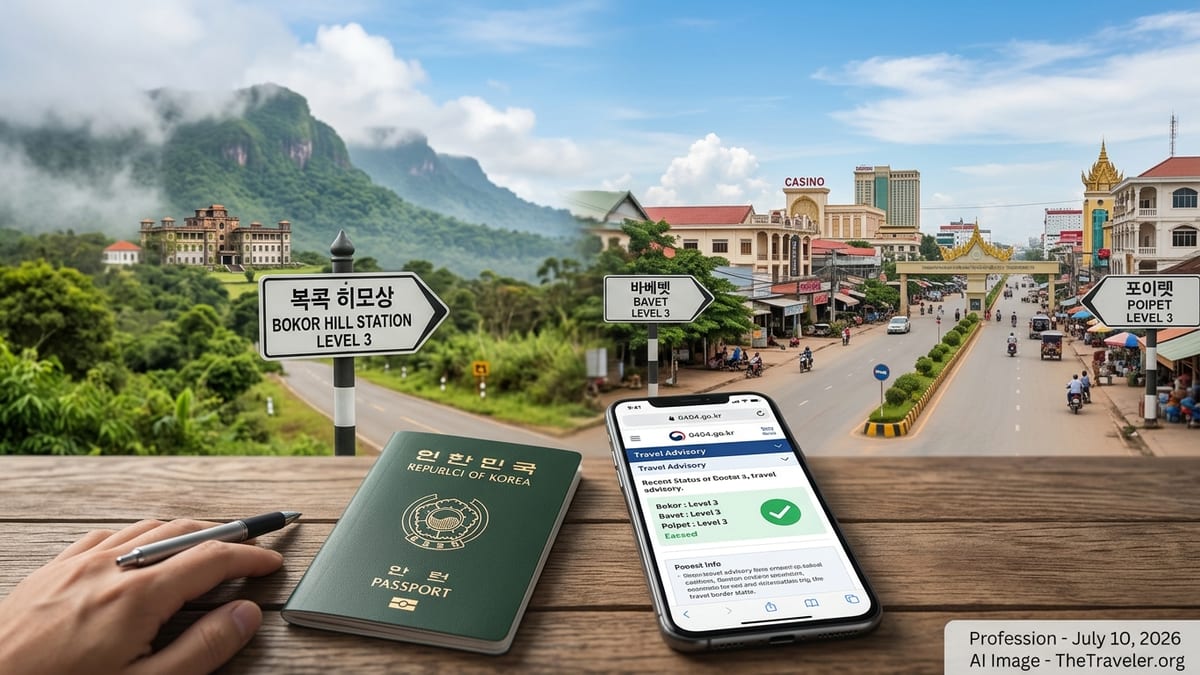
South Korea has lifted its formal travel ban on three high‑risk areas of Cambodia, downgrading Bokor Mountain in Kampot Province and the border cities of Bavet and Poipet from a Level 4 "travel prohibition" to a Level 3 alert that still advises South Korean nationals to leave or avoid the areas due to ongoing online scam and confinement risks.
Get the latest news straight to your inbox!
From Legal Ban to Strong Warning
The Ministry of Foreign Affairs (MOFA) announced the adjustment on July 10, 2026, following a decision at the 55th Passport Policy Council meeting. Officials cited improved local security conditions and a marked fall in reports of South Korean victims in scam‑related confinement cases in the first half of 2026 compared with the same period of 2025.
Under Korea’s four‑tier travel alert system, Level 4 prohibits travel and subjects violators to penalties under the Passport Act, while Level 3 advises nationals already in the area to leave and strongly discourages new travel but does not, by itself, trigger legal punishment simply for entering. The latest move therefore softens the legal consequences for Koreans who go to or remain in Bokor, Bavet and Poipet, even as the government maintains that the areas remain high risk.
MOFA’s 0404.go.kr advisory now lists the three locations under Level 3 “exit‑recommended” status, alongside other higher‑risk parts of Cambodia such as certain border stretches and the city of Sihanoukville. By contrast, most of Cambodia, including Phnom Penh and major inland destinations, remains under lower‑level alerts and was not altered by this specific July 2026 decision.
How the Level 4 Ban Emerged
South Korea first imposed Level 4 travel bans on the Bokor Mountain area, Bavet City and Poipet City on October 16, 2025, after a surge in cases involving suspected forced labor and detention linked to online scam compounds. The move followed the widely reported death of a South Korean university student near Bokor Mountain, whose case drew public attention to recruitment scams targeting young Koreans with promises of overseas jobs.
At the time, the government paired the ban with broader measures such as deploying a joint investigative team to Cambodia and tightening screening of suspicious overseas employment offers. Cambodian authorities also began cooperating more closely with Korean counterparts on raid and rescue operations in suspected scam facilities in resort and border hubs.
Even with the July 2026 downgrade, MOFA statements and Korean consular notices continue to refer to residual risks of online fraud operations, confinement and related violence in and around the three locations. Officials stress that the decision reflects relative improvement in the volume of reported Korean victims, not the elimination of criminal activity.
What the Change Means for Travelers
For South Korean travelers, the most immediate impact is legal rather than practical. Visiting Bokor, Bavet or Poipet is no longer automatically classified as a violation of Korea’s travel ban rules, which could previously expose travelers to administrative sanctions or, in some situations, criminal penalties under the Passport Act. Travelers no longer need special government permission to use their passports in these areas.
However, a Level 3 alert still carries significant weight. MOFA formally advises Koreans already in the three locations to leave as soon as circumstances allow and urges others not to travel there unless strictly necessary. Independent travelers who decide to go anyway should expect limited consular support compared with lower‑risk destinations and should plan for the possibility of sudden local crackdowns or scams that may not be immediately obvious on arrival.
The reclassification can also affect trip planning in less visible ways. Some travel insurers treat Level 3 destinations as high‑risk and may restrict coverage or exclude claims linked to scam‑related incidents. Employers, universities and mission organizations often bar official travel to Level 3 areas, and Korean or regional tour operators may decline to operate group itineraries that include Bokor, Bavet or Poipet, even while offering trips elsewhere in Cambodia.
Cambodia’s Response and Wider Safety Picture
Cambodia’s government has publicly welcomed Seoul’s decision, highlighting joint operations that have dismantled scam sites and rescued foreign workers, including Koreans, from illegal compounds. Cambodian state media reports frame the downgrade as recognition of improved security conditions in key tourist and border zones while acknowledging that efforts against transnational cybercrime are ongoing.
At the same time, Korean travel alerts for Cambodia remain relatively granular. While the three former Level 4 areas are now at Level 3, MOFA has lowered alerts for some other parts of the country, such as shifting certain Thai border provinces and parts of Sihanoukville Province to lower levels earlier in 2026. Phnom Penh and many mainstream tourism destinations sit under Level 1 or Level 2 advisories, which call for vigilance but do not recommend departure.
Foreign travelers from other countries may see different risk classifications. For example, some governments currently advise their nationals to exercise increased caution in Cambodia overall, without designating specific cities as no‑go zones. South Korean readers planning multi‑national trips should therefore check both Korean and home‑country advisories, and not assume that one system’s easing of restrictions reflects a consensus view.
What Travelers Should Check Next
Flights and visas for travel between South Korea and Cambodia remain available, and the downgrade has not introduced new entry restrictions at Cambodian airports or land borders for Korean nationals. However, those considering independent trips that route through Bokor, Bavet or Poipet should factor in the elevated risks and the possibility of rapidly changing enforcement against scam operations in those areas.
Before departure, Korean travelers should review the latest Cambodia page on MOFA’s 0404.go.kr site and any related safety notices from the Korean embassy in Phnom Penh, as travel alert levels are subject to further adjustment beyond the July 10, 2026 decision. It is also prudent to confirm how a Level 3 designation affects travel insurance cover, employer or school travel rules and any package tour terms, especially where cancellation or route changes might be needed at short notice.
Given the continued presence of scam‑related crime in parts of Cambodia’s border and resort hubs, MOFA advises Koreans abroad to be cautious about unsolicited job offers, high‑pay remote work proposals and invitations to visit casino or online gaming complexes. Travelers who experience or witness suspected confinement or scam activity in Bokor, Bavet, Poipet or elsewhere in Cambodia are urged to contact local police and the Korean consular emergency line without delay.