


Choosing between Lanzarote and Fuerteventura is less about which Canary Island is "better" and more about which one matches the way you like to travel. One is a compact, art‑infused volcanic sculpture dotted with family resorts and easy excursions. The other is a long, low ribbon of sand and wind, made for surfers, kiters and anyone who wants space, big skies and huge beaches. This guide walks you through the key differences, from Timanfaya’s lava fields to Corralejo’s dunes, from Papagayo’s coves to the surf schools of the north shore, to help you decide where to book your next trip.
Get the latest updates straight to your inbox!
First glance: how Lanzarote and Fuerteventura feel on the ground
Landing in Lanzarote, the first thing you notice is the black. Black lava fields, black stone walls protecting vines, black sand coves punctuated by whitewashed villages and low‑rise resorts. The island is relatively compact, so from a base in Puerto del Carmen or Playa Blanca you can reach Timanfaya National Park, the wine area of La Geria, and the César Manrique art sites in 30 to 40 minutes by car. It feels curated and deliberate, with strict building rules that have kept the skyline low and the aesthetic cohesive.
Fuerteventura, by contrast, feels bigger and emptier. Here the dominant colors are beige and turquoise: long sandy plains, desert‑like hills and wide beaches that seem to run for tens of kilometers. Driving from Corralejo in the north to Morro Jable in the south takes around two hours, and much of that journey passes through bare, almost treeless interior. That sense of space is a big part of its appeal, especially for windsurfers, kitesurfers and repeat winter visitors who come for the reliable trade winds and wide open shores.
In practical terms, this means a first‑time visitor who wants a “do a bit of everything” holiday often finds Lanzarote easier to navigate in a week. Fuerteventura suits travelers who are happy to settle into one or two bases, accept longer drives and spend most of their time on or near the beach. Both islands share similar flight connections from mainland Europe and the UK, and both have resort areas ranging from quiet apartment complexes to family hotels with kids’ clubs.
Budget wise, recent visitor‑spend comparisons suggest Lanzarote comes out slightly pricier on average per day than Fuerteventura, mostly because you are more likely to pay for organized excursions and entry‑fee attractions, whereas Fuerteventura’s headline act is free: its beaches and wind.
Volcanic drama vs desert dunes: Timanfaya, Papagayo and Corralejo
If you are drawn to dramatic volcanic scenery, Lanzarote is the clear winner. Timanfaya National Park covers roughly a quarter of the island in a quilt of craters and lava flows. Public access is tightly regulated to protect the landscape, but a classic half‑day visit typically includes driving the LZ‑67 road through the park, parking at the Montañas del Fuego visitor area and taking the official coach tour along the Ruta de los Volcanes. From resort bases like Puerto del Carmen, most organized tours cost roughly what you would expect for a half‑day national park excursion and include hotel pickup, park entry and the coach route through the lava fields.
Combine that with a stop in La Geria, where vines grow in individual hollows scooped from black ash and protected by semicircular stone walls, and you have a day that feels unlike typical European beach destinations. Add César Manrique landmarks such as Jameos del Agua or the Mirador del Río viewpoint on another day and Lanzarote starts to feel like an art and landscape gallery as much as a sun destination.
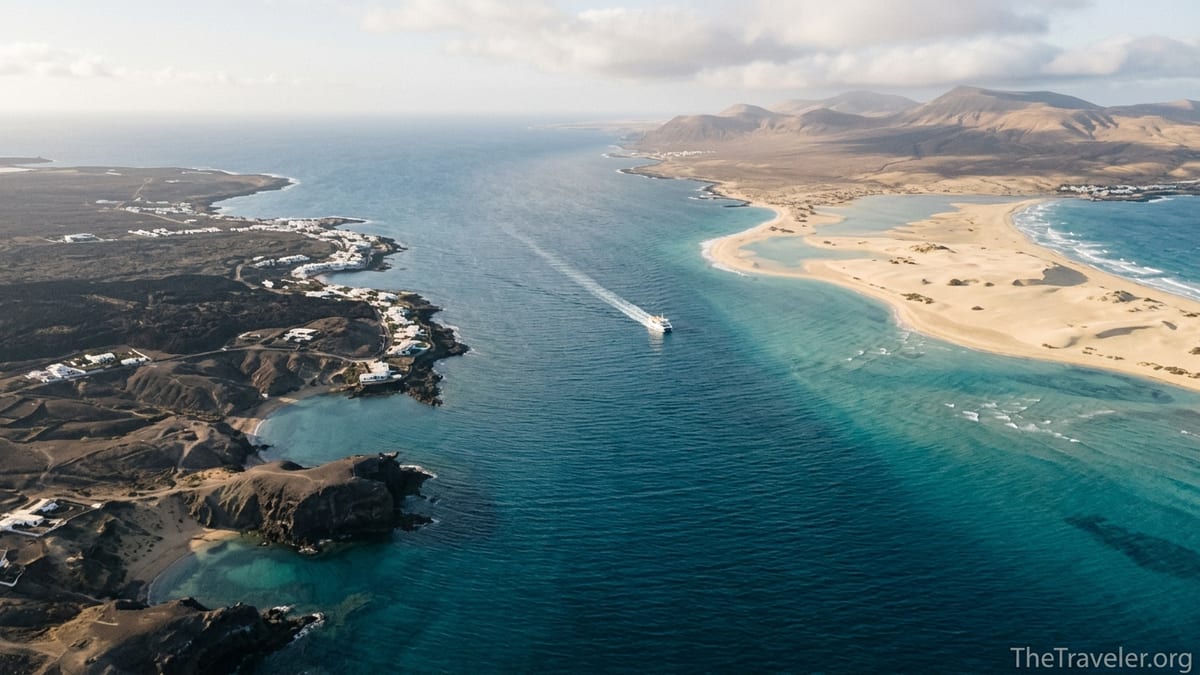
Fuerteventura’s natural showpiece is different. Rather than cones and craters, its signature landscape is the Corralejo Natural Park, a swathe of cream‑colored dunes just south of the town of Corralejo. Driving the coastal road, you see waves on one side and rolling sand on the other, with pull‑off points where people park to walk onto the dunes or down to long, shifting beaches. There is no entry gate: you simply park and wander. The experience is more about big skies and desert‑meets‑sea vistas than about concentrated volcanic drama.
For travelers who want both, the regular ferry between Playa Blanca in Lanzarote and Corralejo in Fuerteventura takes about 35 to 45 minutes across the Bocaina Strait. It is perfectly feasible to base yourself in Playa Blanca, hire a car, and take a day trip to Corralejo to see the dunes and stroll the old port, or to stay in Corralejo and hop over to Lanzarote for a Timanfaya bus tour.
Beaches, wind and water: where to swim, sunbathe and surf
Both islands have excellent beaches, but they offer a very different experience. Lanzarote’s headline stretch is the cluster of coves known as Papagayo at the island’s southern tip, a protected natural area reached via a rough track from Playa Blanca, with a small parking fee per vehicle. Here you find a series of horseshoe bays with golden sand, turquoise water and cliffs that shield you from the prevailing wind. Many visitors bring a cool box and spend the day swimming and snorkeling in the calm, clear water before returning to Playa Blanca for dinner.
Elsewhere on Lanzarote, Playa Grande in Puerto del Carmen, Playa de las Cucharas in Costa Teguise and the town beach in Playa Blanca offer easy family‑friendly swimming with lifeguards in season, sunbeds and nearby restaurants. On the north coast, Playa de Famara is a long, wild, often windy bay with impressive cliffs and reliable surf. Several surf schools in the nearby village run beginner lessons and surf camps, and the beach’s gradual slope and consistent whitewater make it a favorite for those first green waves.
Fuerteventura, whose very name is associated with strong wind, is the Canary Island of superlative beaches. Around Corralejo, “Flag Beach” at the edge of the dunes is a hub for windsurf and kitesurf schools, yet on calmer days there are still pockets of swimmers and sunbathers. On the northwest coast, near El Cotillo, small coves protected by natural lava reefs create shallow lagoons that are popular with families and less confident swimmers, especially at mid to high tide.
Further south, the beaches of Costa Calma and Sotavento run for many kilometers, with wide, tidal shallows and sandbars. The same steady trade winds that host international windsurfing and kitesurfing competitions in summer also mean you should expect whitecaps and a constant breeze for much of the year. If your ideal holiday is lying motionless on a windless beach, Lanzarote’s south or Fuerteventura’s extreme south around Jandía are more comfortable. If you came for wind sports or simply prefer cooler air while sunbathing, Fuerteventura’s east coast is hard to beat.
Surfing, kitesurfing and other active days
For pure wave quality, many surf guides name Lanzarote as the standout island in the archipelago, particularly in winter, thanks to powerful reef breaks on its north shore. For most visiting surfers, however, the decision between Lanzarote and Fuerteventura comes down to their level and the type of trip they want. Beginners often gravitate to Famara on Lanzarote, where multiple surf schools operate daily lessons using soft‑top boards on the forgiving beach break. You can base yourself in Famara village and walk to the sand in minutes, or stay in a resort town and book day lessons with transfers included.
Fuerteventura’s surf scene is more spread out. Corralejo is the main hub, with surf shops and schools offering trips to whichever spot suits the conditions that day, from the north shore reefs to west coast beaches like Playa del Castillo or stretches near El Cotillo. The benefit is variety; the drawback is that you rely more on daily transport to reach the breaks. For kitesurfers and windsurfers, Fuerteventura generally has an edge, thanks to stronger and more consistent winds at spots like Flag Beach and Sotavento, where dedicated centers rent equipment and run courses from beginner to advanced.
If you prefer other activities, Lanzarote offers more variety off the water. There are marked hiking trails through lava fields outside Timanfaya’s strict core, coastal walks around the Papagayo headlands, and cycling routes across the island’s quieter center. Organized excursions might combine a camel ride near the Timanfaya entrance with a coach tour, or a half‑day vineyard visit with tastings in La Geria.
On Fuerteventura, non‑water activities tend to center on jeep safaris into the interior, e‑bike rides along coastal tracks or ferries to the small island of Lobos from Corralejo, where you can hike, snorkel in clear coves and climb the low volcanic cone for views back toward Lanzarote and the Corralejo dunes.
Resort styles, nightlife and who each island suits
Lanzarote’s main resort areas are Puerto del Carmen, Costa Teguise and Playa Blanca, all with paved promenades, clusters of bars and restaurants, and a mix of hotels and apartment complexes. Nightlife tends toward relaxed bars, live music venues and a few late‑opening clubs in Puerto del Carmen, rather than large‑scale party districts. Families often favor Playa Blanca for its calmer vibe, choice of all‑inclusive hotels and proximity to Papagayo, while Puerto del Carmen offers a livelier strip with British and Irish pubs, cocktail bars and late dining.
Fuerteventura’s main resort towns are Corralejo in the north, Caleta de Fuste near the airport, and Costa Calma and Morro Jable/Jandía in the south. Corralejo combines a low‑rise old town around the harbour, a small town beach, and newer accommodation stretching toward the dunes. At night, surf bars, small venues with live music and a handful of late‑opening spots draw a mixed crowd of surfers, digital nomads and holidaymakers. Caleta de Fuste is more purpose‑built and family‑oriented, with a sheltered bay and several large hotels, while the southern resorts lean toward long beachfront hotels, German and Scandinavian visitors, and a quieter, early‑to‑bed atmosphere outside peak season.
As a rule of thumb, couples and groups who want a blend of scenery, food and low‑key nightlife lean toward Lanzarote, particularly Puerto del Carmen or Costa Teguise. Families with younger children appreciate Lanzarote’s compact size and short transfer times, as well as attractions like aquariums and small waterparks close to resorts. Fuerteventura is a strong choice for families with older kids and teenagers who want surf lessons, bodyboarding, or time at the Acua Water Park in Corralejo combined with big‑beach days.
Solo travelers may prefer Corralejo or Famara for easy connections with surf schools and a built‑in community of other active visitors, while those seeking a calmer escape might choose a small apartment complex in Playa Blanca or a rural casa in Lanzarote’s interior villages like Yaiza or Mácher.
Car rental, getting around and practicalities
On both islands, renting a car transforms what you can see in a week. Public buses do connect major towns and resort areas, but services to beaches like Papagayo or more remote coves and viewpoints are limited. Car rental at both Arrecife Airport in Lanzarote and Fuerteventura Airport is competitive, with multiple local and international companies. Outside peak holiday periods such as Easter and August, small hatchbacks are often available for a modest daily rate, especially if booked in advance; prices rise in school holiday weeks and at short notice.
Lanzarote’s smaller size means that, from a single base such as Puerto del Carmen, you can reach Timanfaya, Papagayo, the northern villages and the César Manrique sites via straightforward drives on well‑marked roads, usually in under an hour. This is appealing for nervous drivers or those who only want to rent a car for a day or two. In practical terms, a common pattern is to rely on resort buses and walking for most of the week, then hire a car locally or book excursions for the key sights.
In Fuerteventura, the distances are longer and the interior roads feel more remote, but driving is generally uncomplicated, with light traffic outside town centers. If you base yourself in Corralejo and want to explore both the north shore and the far south around Jandía, a car for several days is highly recommended. Many visitors alternate beach‑only days near their base with longer drives to explore, for example, the historic inland town of Betancuria or the southern beaches beyond Costa Calma.
Between the islands, the Corralejo to Playa Blanca ferry route is busy year‑round. Foot passengers can usually book on relatively short notice, but travelers with rental cars should always check that their contract allows inter‑island travel and factor in the extra cost of taking a vehicle across. For many, it is simpler to treat visits to the other island as foot‑passenger day trips, using local excursions or taxis on arrival.
Which island for which traveler?
If you imagine your ideal day as waking up in a seafront apartment, grabbing a coffee, then joining a surf lesson before an afternoon of tapas and a sunset stroll, both Lanzarote and Fuerteventura could work. The nuance is in the setting. Lanzarote gives you that surf day in Famara one day, then a bus tour through Timanfaya and a vineyard visit the next, followed by an art‑and‑architecture day exploring Manrique’s creations. It favors travelers who want variety in a compact package and do not mind paying entry fees for curated experiences.
Fuerteventura is a better fit if your priorities are long beaches, consistent wind and a slower, more elemental rhythm. A typical week in Corralejo might alternate surf school days, a trip to the dunes, a ferry to Lobos and at least one long drive down to Sotavento or Jandía to walk for miles along near‑empty sand. It suits repeat winter visitors, remote workers looking for sun and space, and sporty travelers more than sightseers.
For a one‑week family holiday with younger children and grandparents in tow, Lanzarote usually wins for its short driving times, range of excursions, and sheltered beaches like those in Playa Blanca and Papagayo. For a group of friends who all want to try surfing, kitesurfing or windsurfing and are happy with a simpler nightlife of beach bars and taco joints, Fuerteventura, especially Corralejo or Costa Calma, probably edges it.
If you truly cannot choose and have at least nine or ten days, consider splitting your time: start with four nights in Playa Blanca on Lanzarote for Timanfaya and Papagayo, then ferry to Corralejo for four or five nights focused on surfing, dunes and the windier beaches. This two‑island approach gives you a clear sense of their different personalities and makes good use of the short sea crossing.
The Takeaway
In the Lanzarote vs Fuerteventura debate, neither island is objectively superior. Lanzarote is the volcanic gallery: sculpted, compact, rich in viewpoints, art and organized excursions, with enough beaches to keep most visitors happy. Fuerteventura is the beach and wind kingdom: long, low, quiet away from its resort towns, dominated by sand, surf and open horizons.
If you want easy day trips, dramatic lava landscapes, a coherent island aesthetic and family‑friendly resorts with lots to do within short drives, Lanzarote is likely the better match. If you crave space, big beaches, stronger winds, a more low‑key atmosphere and days shaped by the water more than by ticketed attractions, Fuerteventura will probably feel closer to your idea of paradise.
Whichever you choose, you can always plan a day trip across the Bocaina Strait to sample the other. But knowing whether your heart leans toward black lava and design or dunes and wind will help you make the right call before you even book your flight.
FAQ
Q1. Which island is better for a first-time Canary Islands trip, Lanzarote or Fuerteventura?
Lanzarote is usually better for a first visit because it is more compact, with a clear set of standout sights like Timanfaya, Papagayo and César Manrique’s attractions, all reachable with relatively short drives or organized excursions.
Q2. Is Fuerteventura really much windier than Lanzarote?
Fuerteventura is generally windier, especially along the east coast around Corralejo, Costa Calma and Sotavento, which is why it is so popular for windsurfing and kitesurfing. Lanzarote still gets trade winds but has more sheltered spots like Papagayo and Playa Blanca.
Q3. Where should I go if I mainly want to surf?
Both islands work well for surfing. Beginners often choose Lanzarote’s Famara for its forgiving beach break and surf camps, while Fuerteventura’s Corralejo area gives access to a wider variety of spots and is better if you also want strong wind for kitesurfing or windsurfing.
Q4. Are the beaches better in Lanzarote or Fuerteventura?
If by “better” you mean longer and more numerous, Fuerteventura wins, with huge sandy stretches like Sotavento and Jandía plus the Corralejo dunes. Lanzarote’s beaches are fewer but include beautiful coves like Papagayo and convenient town beaches in major resorts.
Q5. Which island is more suitable for families with young children?
Lanzarote is often more convenient for families with younger kids thanks to shorter driving distances, sheltered beaches in Playa Blanca, and plenty of easy excursions such as Timanfaya bus tours and visits to Manrique’s attractions.
Q6. What about nightlife: is one island more lively than the other?
Neither island is a full‑scale party destination, but Lanzarote’s Puerto del Carmen has the liveliest strip of bars and small clubs. Corralejo in Fuerteventura offers a relaxed mix of surf bars and live music, while southern Fuerteventura is generally quieter in the evenings.
Q7. Do I need to rent a car on Lanzarote or Fuerteventura?
A car is not essential if you plan to stay mostly in a resort and book a couple of excursions, but renting one for at least a few days greatly increases your options on both islands. Lanzarote’s compact size makes short rentals particularly effective, while Fuerteventura’s longer distances reward having a car for more of your stay.
Q8. Can I visit both Lanzarote and Fuerteventura in one trip?
Yes. Ferries run regularly between Playa Blanca in Lanzarote and Corralejo in Fuerteventura, with a crossing of around 35 to 45 minutes. With 9 to 10 days, many travelers split time between the two, using one island as a base for volcanoes and art, and the other for dunes and surf.
Q9. Which island is better outside the main summer season?
Both islands are popular in winter thanks to mild temperatures. Active travelers often favor Fuerteventura between autumn and spring for wind sports, while sightseers and families may prefer Lanzarote, where cooler air makes exploring Timanfaya, La Geria and viewpoints more comfortable.
Q10. Is Timanfaya National Park worth prioritizing over the Corralejo dunes?
They offer very different experiences. Timanfaya is a concentrated volcanic landscape visited via regulated bus routes and viewpoints, and is a must‑see if you choose Lanzarote. Corralejo’s dunes are more open and informal, ideal for long walks and beach days. If you can, it is worth planning your trip to experience both.