


More news on this day
Eleven people were injured when a Southern Rail passenger train derailed near Lewes in East Sussex on Thursday, overturning several carriages, triggering a major emergency response and halting services on one of southern England’s busiest regional corridors.
Get the latest news straight to your inbox!
Passenger service from London derails outside Lewes
Publicly available information shows that the incident involved a Southern Rail service running from London Victoria to Eastbourne that left the tracks close to Lewes railway station on the afternoon of 13 August 2026. The train was reportedly carrying around 150 passengers when multiple carriages derailed and at least some rolled onto their sides beside the line.
Images and videos shared on social media and in early news coverage show at least four carriages off the rails, with several lying on their flanks on a stretch of line bordered by embankments and trees. Passengers can be seen standing beside the overturned train as emergency workers move along the track.
Reports indicate that a combination of onboard staff and fellow passengers helped people to evacuate using doors and emergency exits before specialist rescue teams reached the scene. The position of the train outside the station created access challenges, with responders appearing to work both from the track and from nearby land.
Early accounts from the scene describe a sudden jolt followed by violent shaking as the rear portion of the train left the rails. Some passengers reported luggage and personal items being thrown around the interior as the carriages tipped.
Injuries reported and major incident response
According to published coverage, at least 11 people were treated for injuries in connection with the derailment. Two of those were initially described as seriously hurt, while others sustained what were reported as minor or moderate injuries including cuts, bruises and possible fractures.
A major incident was declared locally, prompting the deployment of a large number of emergency vehicles to the area around Lewes. Photos from the scene show fire engines, ambulances and police vehicles positioned near the station and along access points to the railway. Air ambulance helicopters were also reported in the vicinity as part of the precautionary response.
Medical teams assessed passengers at a triage point set up near the line before arranging transport to nearby hospitals where required. Public information issued during the evening stressed that, despite the scale of the crash and the dramatic images of overturned coaches, there were no immediate reports of fatalities.
Rail staff and local transport operators began working to reunite stranded passengers with their belongings and to arrange alternative onward travel from Lewes and other affected stations. Support was also offered for those experiencing shock and distress as a result of the incident.
Disruption across the south coast rail network
The derailment occurred on a key section of the network that links London with Brighton, Eastbourne and a number of south coast destinations. In the hours following the crash, services through Lewes were suspended and significant disruption spread across the wider Southern and Thameslink networks.
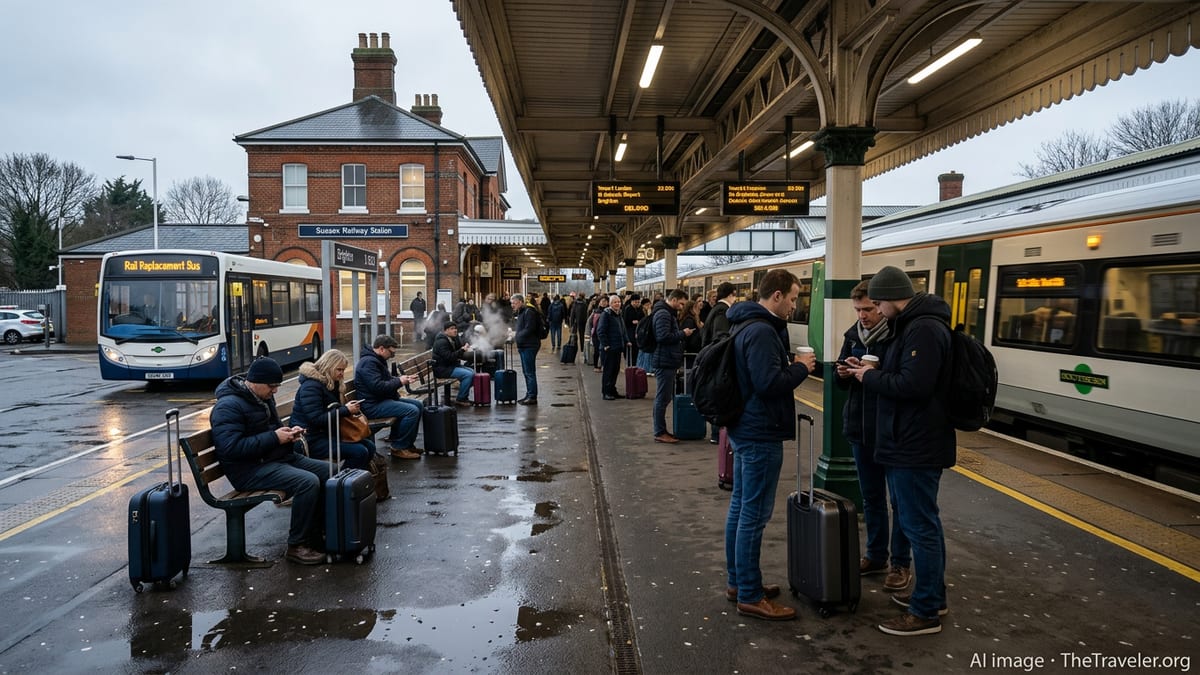
Public travel updates indicated that trains between London and Eastbourne, Hastings and Brighton were cancelled or heavily delayed, with some services starting and terminating short of their usual destinations. Bus replacement services were brought in on certain routes while rail teams worked to secure the site and begin the complex recovery of the derailed train.
Operators advised passengers to avoid non essential travel on lines passing through Lewes and to check for the latest timetable changes before setting out. Crowding was reported at a number of nearby stations as commuters and holidaymakers attempted to re route journeys or wait out cancellations.
Local tourism and hospitality businesses are expected to feel short term effects from the interruption, particularly in peak summer season when visitors rely heavily on rail access to coastal towns and national park destinations around the South Downs.
Early focus on track conditions and recent weather
The precise cause of the derailment has not yet been determined, but several early accounts have pointed to possible issues with the track formation and recent weather conditions. Images from the scene appear to show distorted rails and disturbed ballast on the curve where the rear coaches left the line.
Some reports have suggested that heavy rain in the days leading up to the incident may have contributed to ground movement or a localised landslip affecting the stability of the trackbed. Rail infrastructure owners have previously highlighted the growing challenge posed by extreme weather, with saturated soil, washouts and embankment failures all identified as risks to safe operations.
Safety specialists typically examine a wide range of factors after a derailment of this kind, including the condition of rails, sleepers and ballast, the performance of drainage systems, the speed and handling of the train, and any recent maintenance or inspections carried out in the area. Investigators also review onboard data recorders and signalling logs to reconstruct the train’s movement in the moments before the crash.
Published commentary from transport analysts notes parallels with other recent weather related incidents on Britain’s railways, although it remains too early for any definitive link to be drawn in the Lewes case. Formal findings are expected to take months as technical teams study the site and equipment involved.
Investigation and safety review underway
An in depth investigation has been launched to establish how the derailment occurred and what measures may be needed to prevent a recurrence. In the United Kingdom, incidents of this nature are typically examined through parallel internal inquiries by the rail operator and infrastructure owner, alongside an independent safety investigation by national rail accident specialists.
According to available guidance, the first priority is to make the site safe, secure the wreckage and protect physical evidence before recovery and repair work begins. Specialists then carry out detailed surveys of the track, signalling equipment and rolling stock, supported by engineering analysis and interviews with staff and passengers.
Investigators are expected to consider whether any operational rules, inspection regimes or engineering standards require revision in light of what is learned at Lewes. Their findings may lead to recommendations on topics such as landslip monitoring, speed restrictions during severe weather, or the design and maintenance of embankments on busy passenger routes.
Residents in Lewes and regular rail users across southern England will be watching closely for updates on both the cause of the crash and the timetable for restoring full services. For now, the priority remains caring for the injured, supporting those affected and stabilising a vital piece of infrastructure at the height of the summer travel season.