


More news on this day
Malaysia’s long awaited East Coast Rail Link is edging toward the finish line, with passenger services scheduled to begin in phases from January 2027 in a move expected to reshape how residents and visitors travel between Kuala Lumpur and the country’s eastern seaboard.
Get the latest news straight to your inbox!
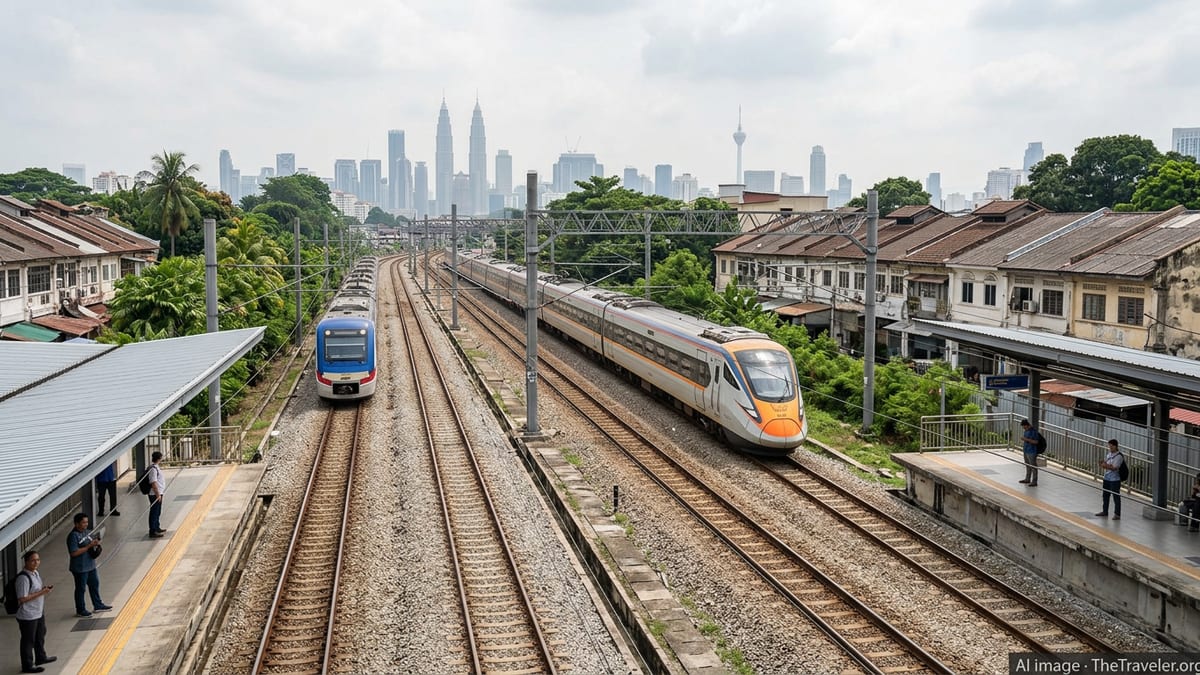
Phased launch to connect Kota Bharu and Kuala Lumpur
Publicly available information from project owner Malaysia Rail Link and recent government documents indicate that the 665 kilometre standard gauge line is on track for full construction completion by the end of 2026, paving the way for commercial operations to start the following January. Initial services are planned on the core passenger corridor linking Kota Bharu in Kelantan with the Gombak Integrated Transport Terminal on the outskirts of Kuala Lumpur.
The first operational phase is expected to cut the end to end journey between Kota Bharu and the capital region to around four hours, compared with typical road journeys that can take eight hours or more during busy holiday periods. The new route will pass through key East Coast towns including Kuala Terengganu, Dungun and Kuantan, bringing long distance rail back to a region that has historically relied on highways and buses.
Subsequent phases are planned to extend full through services westwards to Port Klang via Serendah and Kapar, creating a continuous rail spine from the South China Sea to the Strait of Malacca. Planning documents show that the western section from Gombak to Port Klang is targeted for completion around 2028, following the earlier start of services on the Kota Bharu to Gombak stretch.
Project updates circulating in local media and industry presentations through 2025 and 2026 describe overall progress rates above 80 per cent, with key milestones such as the excavation of all main tunnels already achieved. The delivery and testing of new electric multiple unit trainsets, manufactured in China with some final assembly in Kuantan, are highlighted as the next visible steps before trial operations begin.
High speed intercity travel for Malaysia’s East Coast
The ECRL has been designed as a fully electrified railway with passenger trains capable of operating at up to 160 kilometres per hour. Once in service, the line is expected to reduce travel times dramatically between Kuala Lumpur, Kuantan and the state capitals along the East Coast, offering an alternative to flying or long drives on the East Coast Expressway.
Journey time projections shared in official briefings suggest that Kuala Lumpur to Kuantan could be reduced to around two hours by rail, positioning the Pahang coastal city as a more viable weekend and short break destination for residents of the Klang Valley. The same corridor is being promoted in tourism materials as a faster link to beach resorts near Cherating and the islands off Terengganu and Kelantan.
The line will feature around 20 stations, combining dedicated passenger stops in major urban areas with several primarily freight oriented facilities serving industrial parks and ports. The integration of the ECRL passenger station at Gombak with the existing Kelana Jaya Line light rail terminus and the new Gombak integrated bus terminal is expected to provide a multimodal gateway into central Kuala Lumpur.
Travel analysts note that the ability to interchange between intercity rail, urban rail and express buses at a single hub could significantly shift long distance travel patterns, particularly during festive seasons when road congestion between the Klang Valley and the East Coast traditionally spikes.
Freight ‘land bridge’ to link Kuantan Port and Port Klang
Beyond passenger services, the rail link is being positioned as a strategic freight corridor that will connect Kuantan Port on the East Coast with Port Klang on the West Coast. Government and port authority reports describe this as a domestic land bridge that could shorten shipping times for selected cargoes moving between the South China Sea and the Indian Ocean.
ECRL freight trains are planned to operate at up to 80 kilometres per hour, with five dedicated cargo hubs in Pahang alone linking industrial zones directly to the ports. Official publications emphasise that this configuration is intended to support automotive exports, petrochemicals and other export oriented industries clustered around Kuantan and Gebeng.
By providing a rail based alternative to the existing road corridors, planners expect the project to relieve some heavy vehicle pressure on the East Coast Expressway and on routes feeding into Klang Valley. Logistics operators following the project note that the ability to move containers across the peninsula without transiting the congested shipping lanes through the Straits of Malacca could be an additional selling point for certain trade routes.
Regional development agencies have highlighted the potential for the ECRL to anchor new industrial and logistics parks along its alignment, particularly near Kuantan Port City and the Kota SAS area. Investors are being encouraged to view the railway as core infrastructure that will underpin manufacturing expansion on the East Coast in the second half of the decade.
Tourism and community access along the new corridor
Travel industry observers in Malaysia are already framing the ECRL as a new backbone for domestic tourism on the East Coast. With stations planned near major coastal towns, island gateways and cultural centres, the line is expected to make it easier for visitors to combine city breaks in Kuala Lumpur with beach and nature based itineraries.
Destinations such as Cherating, Kuala Terengganu and the wider Terengganu coastline are frequently cited in public discussions as likely early beneficiaries of faster access from the capital. Improved connectivity is also expected to support travel to the Kelantan and Terengganu interiors, where homestays and community based tourism initiatives have been growing.
At the same time, local media commentary has noted that communities along the route are looking for clarity on station locations, feeder bus services and future transit oriented development around new hubs. Municipal plans in several districts reference the railway as a catalyst for town centre renewal, with calls for careful integration to avoid car dependent sprawl around out of town stations.
Environmental and social impact assessments conducted during earlier project phases also highlighted the need to manage construction and operations in sensitive forest and coastal areas. Subsequent design revisions and mitigation measures have been presented as part of the project’s ongoing implementation, with attention from conservation groups and local residents likely to continue as opening day approaches.
What travellers can expect from the 2027 rollout
As January 2027 draws closer, attention among travellers is turning to likely ticket prices, service frequencies and on board amenities. Although detailed fare structures have not yet been published, public presentations point to air conditioned coaches, reserved seating and digital ticketing as baseline features, in line with other modern intercity rail services in the region.
Given that sections of the line will initially operate as a single track railway with passing loops, early commentary suggests that service patterns may begin conservatively, with a focus on reliability and punctuality during the first months of operation. Over time, capacity could be increased as demand patterns become clearer and operational experience grows.
For international visitors, the most direct benefit is likely to be a smoother overland route between Kuala Lumpur and coastal destinations on the South China Sea, complementing existing domestic flights to airports in Kuantan, Kuala Terengganu and Kota Bharu. Travel planners are already anticipating new package offerings that combine the ECRL with urban rail lines in Kuala Lumpur and connecting bus services to resort areas.
With construction milestones continuing to be reported and rolling stock deliveries under way, the coming year is set to determine how quickly Malaysia’s new East Coast corridor can transition from a headline infrastructure project into a practical option in day to day travel planning for residents and tourists alike.