


More news on this day
Travel across the Gulf and wider region faced fresh turmoil this week as Kuwait International Airport recorded 114 delayed departures and arrivals alongside seven flight cancellations, disrupting routes linking the United Arab Emirates, India, Egypt, Jordan and other key markets.
Get the latest news straight to your inbox!
Ripple Effects From Kuwait’s Fragile Recovery
Publicly available flight-tracking data and airport timetables indicate that Kuwait International Airport, which has been rebuilding its network after earlier regional airspace closures, experienced a concentrated wave of disruption that affected more than one hundred services in a single operating window. The 114 delays and seven cancellations were spread across both arrivals and departures, hitting a mix of full-service and low-cost carriers.
Operational data show that flights serving major hubs in the United Arab Emirates, including Abu Dhabi and Dubai, were among those delayed, along with services to key South Asian and North African destinations such as India and Egypt. Connections to Amman in Jordan and other Levant points were also affected, leading to knock-on delays for onward journeys.
The disruption comes as carriers have been gradually restoring schedules through Kuwait following months of reduced activity linked to regional security concerns and infrastructure damage. Recent reporting from regional outlets has described a phased normalization of operations at Kuwait International Airport, while also noting that the situation remains sensitive to changes in regional risk assessments and airline capacity constraints.
Aviation analysts note that when an airport is operating close to its limits after a period of disruption, even relatively small changes in aircraft or crew availability can trigger a chain reaction of delays, as aircraft scheduled for multi-leg rotations are forced to operate late or be reassigned.
Key Routes Affected Across UAE, India, Egypt and Jordan
According to aggregated schedules and day-of-operations data, the latest disruption at Kuwait International Airport struck a wide mix of regional routes rather than being confined to a single airline or country pair. Services linking Kuwait with the United Arab Emirates, particularly high-frequency flights to Abu Dhabi and Dubai, reported late departures and arrivals, narrowing connection windows for passengers heading to Europe, North America and Southeast Asia.
Flights between Kuwait and multiple Indian cities were also hit, with delays recorded on services to major metros and secondary gateways that serve large expatriate communities. Travel industry observers indicate that even moderate delays on these routes can rapidly cascade, as many passengers are traveling on tightly sequenced itineraries that involve onward domestic or regional flights in India.
Connections to Egypt and Jordan, including routes into Cairo and Amman, were similarly affected. These flights are key for both labor traffic and family travel, and schedule disruptions can create additional strain during peak travel periods. In several cases, delays on inbound flights into Kuwait led to late turnarounds on outbound sectors, magnifying the operational impact throughout the day.
Flight-tracking platforms show that some aircraft operating to and from Kuwait during the disruption period ran late over multiple consecutive legs, illustrating how a single delayed departure in the morning can translate into knock-on issues well into the evening on complex multi-stop rotations.
Operational Strain After Months of Regional Volatility
The latest wave of delays and cancellations comes in the context of a Middle East aviation network that has been repeatedly stressed in 2026 by security incidents, temporary airspace closures and capacity reductions. Published coverage on regional air travel has highlighted how airports in Kuwait and neighboring states have needed to adjust routings, buffers and turn times to account for evolving risk assessments and changing overflight permissions.
Kuwait International Airport itself has been the subject of extensive reporting this year following damage to parts of its infrastructure and the temporary suspension of regular passenger operations earlier in the year. While authorities have since moved to restore traffic, industry updates and airline notices continue to describe schedules as subject to rapid revision, particularly for transit-heavy itineraries.
Airlines serving Kuwait have issued a series of advisories and revised schedules in recent months, including reductions in transit traffic and the rerouting of some long-haul flights away from traditional Gulf connection patterns. Travel forums and passenger reports have described a patchwork of rebookings, extended layovers and last-minute cancellations affecting journeys that would previously have been routine.
Against this backdrop, the cluster of 114 delays and seven cancellations at Kuwait International Airport underscores the fragility of the current operating environment. While most flights eventually departed or arrived on the day, the level of disruption highlights how thin the margin for error has become for carriers and airports across the region.
Passenger Impact and Airline Responses
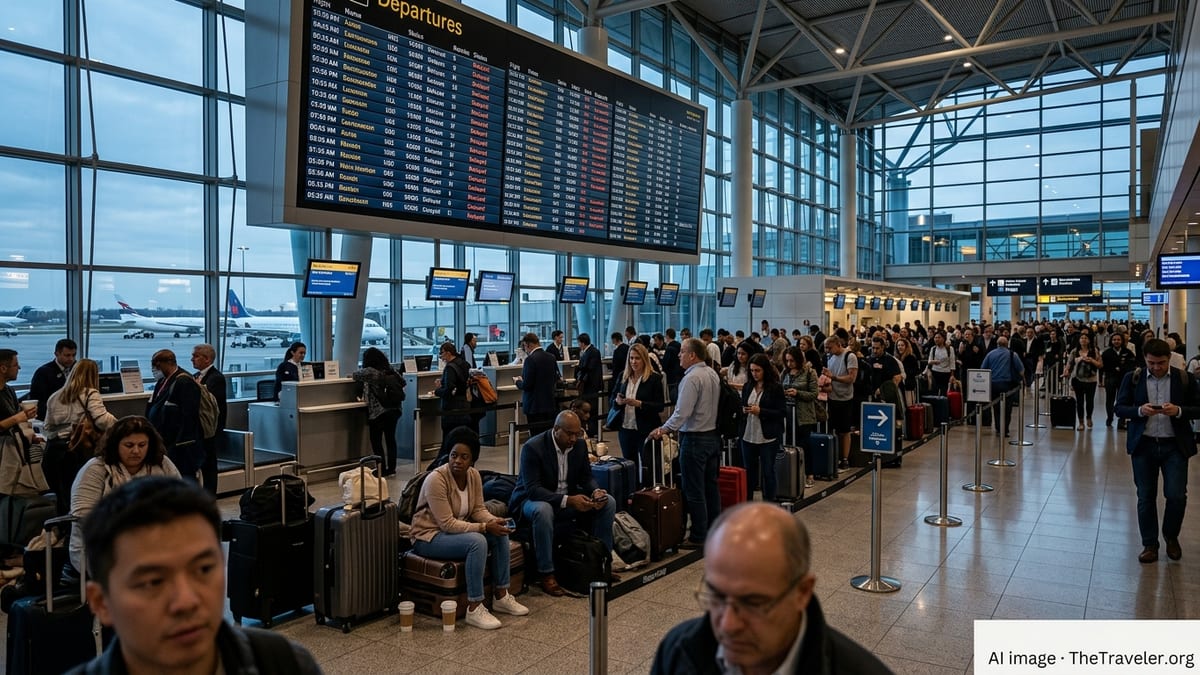
Travelers passing through Kuwait during the disruption period reported extended waits at departure gates and busy transfer areas as airlines worked to resequence flights and reassign aircraft. Based on publicly shared passenger accounts and travel-industry commentary, some itineraries involving Kuwait as a connecting hub required same-day rebooking or overnight accommodation, particularly where missed onward connections in the UAE or South Asia could not be recovered.
In cases where flights were among the seven cancellations recorded, passengers were generally offered options such as rebooking on later services, rerouting through alternative hubs or seeking refunds, according to airline advisories and customer-facing guidance. However, high overall demand and constrained capacity across the Gulf meant that replacement seats were not always immediately available, especially on popular routes to India and Egypt.
Customer-experience reports suggest that travelers who had booked via travel agencies or online platforms with 24-hour support found it easier to secure alternative routings than those attempting to manage changes directly at the airport. Consumer advocates have continued to emphasize the importance of documenting disruption times and preserving boarding passes and receipts, as eligibility for compensation or reimbursement varies widely by carrier, ticket type and jurisdiction.
Industry observers note that airlines operating through Kuwait have been refining their handling procedures since the earlier regional shutdowns in 2026, including strengthening communication channels, expanding self-service rebooking tools and coordinating more closely with ground-handling partners. Even so, the sudden concentration of delays at Kuwait International Airport has shown how quickly standard contingency plans can be stretched in a volatile operating climate.
Outlook for Travelers Planning Gulf and South Asia Trips
For travelers with upcoming itineraries that include Kuwait International Airport or connections via the UAE, India, Egypt or Jordan, recent disruptions serve as a reminder to treat schedules as subject to change and to build additional flexibility into trip planning. Travel advisories and airline updates currently encourage passengers to monitor their flight status closely in the 24 to 48 hours before departure and again on the day of travel.
Frequent-flyer guidance and travel-agency briefings recommend selecting itineraries with longer minimum connection times when routing through Gulf hubs, particularly when moving between different airlines or alliances. Where possible, passengers are also urged to keep contact details updated in airline and booking profiles to ensure they receive real-time notifications of any schedule changes.
Analysts following Middle East aviation trends caution that while Kuwait International Airport is gradually regaining stability, the broader regional network remains exposed to sudden shifts in security conditions, airspace restrictions and fuel-price volatility. These factors can translate rapidly into timetable adjustments, aircraft swaps or short-notice cancellations affecting routes across the UAE, India, Egypt, Jordan and beyond.
Industry commentary suggests that, in the near term, travelers should continue to expect a higher-than-normal risk of disruption on itineraries touching Kuwait and nearby hubs. Flexible tickets, comprehensive travel insurance and contingency plans for missed connections are likely to remain important tools for anyone navigating the region’s air corridors in the coming weeks.