


More news on this day
Thousands of passengers across the Middle East and Asia are facing rolling delays and cancellations as regional security tensions, airspace restrictions and airport disruptions converge to create one of the most severe schedule shakeups of the summer travel season.
Get the latest news straight to your inbox!
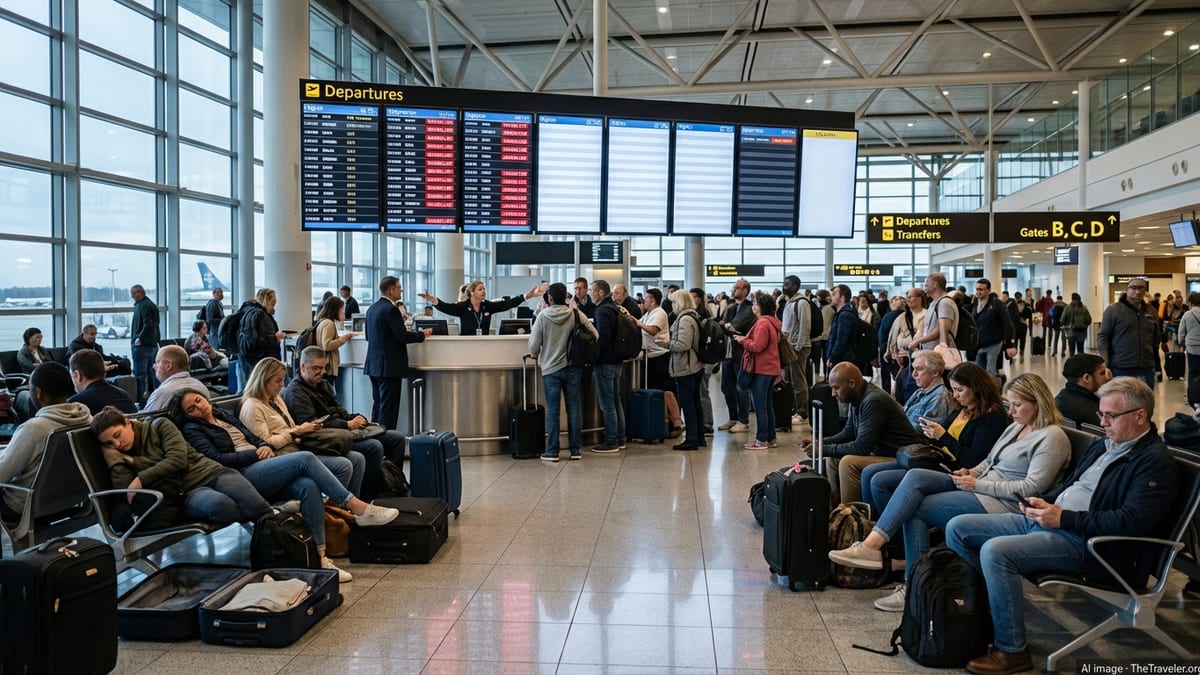
Regional security tensions ripple through airline schedules
Publicly available flight-tracking data and regional aviation coverage indicate that a new wave of flight disruption has built up this week across key Middle East and Asian hubs, including Dubai, Abu Dhabi, Riyadh, Jeddah, Kuwait and several South and Southeast Asian gateways. A combined 6,951 delays and 472 cancellations have been logged over a short window, affecting widebody and narrowbody operations on trunk routes linking Europe, Asia and Africa.
The spike comes against the backdrop of an ongoing conflict environment centered on Iran and the Gulf, which has triggered rolling airspace restrictions over parts of Iran, Iraq and neighboring states. Aviation analyses describe how these closures force long-haul flights to detour around key corridors, adding time and cost while reducing schedule flexibility. For heavily banked hub operations used by Emirates, Etihad and Saudia, even relatively small air traffic control constraints can cascade into large numbers of missed connections, rolling delays and ultimately outright cancellations.
Recent reporting from regional outlets describes selective airport closures and short-notice operational pauses, notably at Bahrain International Airport and smaller Saudi airports, as contributing factors. At the same time, major UAE hubs in Dubai and Abu Dhabi remain open and broadly operational, but they are absorbing diverted traffic and dealing with knock-on congestion in already busy summer peak conditions.
Industry commentary suggests that, while airlines have grown more adept at managing disruption since the pandemic, the current pattern is unusual because it combines security-driven airspace changes with intense seasonal demand and already tight aircraft and crew availability. That mix has reduced the margin for recovery after each incident, allowing delays and cancellations to accumulate day after day.
How Emirates, Etihad and Saudia are being hit
Flag carriers Emirates, Etihad Airways and Saudia sit at the center of the current disruption because of their role as super-connectors between Europe, Asia and Africa. Network information from these airlines indicates that they continue to operate the vast majority of scheduled services, but with persistent pockets of irregular operations on routes touching sensitive airspace or secondary regional airports.
In the United Arab Emirates, Gulf-based reports describe Emirates largely maintaining its long-haul schedule through Dubai International Airport, while warning passengers that flight times and routings remain subject to last-minute change. The carrier has been operating near pre-crisis capacity on many routes, which means that when an aircraft goes out of rotation because of an extended delay, it can be difficult to find spare capacity to absorb affected passengers within the same day.
Etihad, operating through Abu Dhabi’s Zayed International Airport, has faced a combination of security-related airspace adjustments and routine technical issues. Regional coverage on July 16 described how an Etihad service to Bahrain was forced to return to Abu Dhabi after Bahrain airport disruption, with subsequent flights on the route cancelled or rescheduled. Other Etihad long-haul flights to Asia have also reported delays of several hours, creating missed connections for travellers heading onward to Europe, North America and Africa.
In Saudi Arabia, disruption has centered on specific airports rather than the entire network. Travel advisories in recent days have highlighted repeated cancellations and delays at regional gateways such as Abha and select domestic routes, affecting Saudia and low-cost affiliates. These issues, combined with tighter controls on certain cross-border services, have produced a higher-than-usual number of short-haul cancellations even as flagship long-haul operations through Jeddah and Riyadh remain mostly intact.
Regional and Asian carriers feel the knock-on impact
The disruption is not limited to Gulf super-connectors. Published coverage from regional outlets and international wire services shows that airlines across Asia and Europe have adjusted schedules into and over the Middle East, sometimes suspending individual routes for weeks at a time. Selected European carriers have extended suspensions of flights to Doha, Dubai, Riyadh, Tel Aviv and Beirut or are operating reduced frequencies, while continuing to avoid airspace over Iran, Iraq, Syria and Israel.
Low-cost and hybrid carriers that rely on tight turnarounds are particularly exposed. Data highlighted by regional travel sites shows that airlines such as Air Arabia, flyadeal and other regional operators have racked up clusters of delays and short-notice cancellations on routes linking Gulf hubs with secondary cities in India, Pakistan, Central Asia and East Africa. Because these airlines use high daily utilization of each aircraft, one prolonged delay early in the day can disrupt an entire rotation chain.
Asian hubs have also begun to feel the strain. Reports from Manila, Singapore and major Indian airports describe longer-than-normal ground times for flights arriving from or departing to the Gulf, in part because of rerouting and in part because of new document checks and health or security forms introduced by some governments for passengers transiting through affected regions. In several cases, outbound departures to Abu Dhabi, Dubai or Riyadh have been held on the ground awaiting updated routing clearances, contributing to the overall tally of 6,951 delays.
At the same time, some regional airlines are cautiously rebuilding capacity. International reporting notes that Turkish Airlines, for example, has resumed or expanded flights to several Middle East destinations after earlier suspensions, while still operating around restricted airspace. This gradual restoration underscores the fragmented nature of the current landscape, where some corridors are reopening even as others remain constrained.
What stranded and transiting passengers are experiencing
The most immediate impact of the current disruption is being felt by passengers mid-journey, particularly those relying on tight connections through hub airports. Social media posts and traveller forums over the past month describe missed onward flights in Abu Dhabi, Dubai and Riyadh, as well as last-minute reroutes that add 12 hours or more to total travel time. Some passengers report being rebooked in different cabins or routed via third-country hubs when non-stop or direct options are withdrawn.
Travel commentary from across the region highlights that, unlike during the height of the pandemic, most airports remain fully open and airlines are still operating large schedules. This means that the typical passenger experience is not of empty terminals but of crowded departure halls, long lines at customer service desks and fully booked alternative flights. Where hotels are provided due to long delays or missed connections, availability in peak summer periods can be tight, particularly near major hubs.
Another concern is communication. While major Gulf carriers provide real-time updates through apps and email, passengers on multi-airline itineraries sometimes receive conflicting or delayed information as different systems refresh at different speeds. Travel agents and online booking platforms are reporting increased demand for manual assistance with rebooking, especially when one leg of a multi-stop itinerary is cancelled but others remain technically active.
For travellers starting their journeys in South or Southeast Asia, the disruption can manifest as repeated schedule changes in the days leading up to departure. Some passengers have reported receiving multiple revised itineraries as airlines juggle aircraft rotations and respond to new airspace guidance, making it harder to plan time-sensitive trips such as business travel, medical journeys or tight holiday windows.
Key guidance for travelers with upcoming trips
Given the scale of the current disruption, aviation and consumer-travel experts are urging passengers with upcoming trips through the Middle East and Asia to adopt a more cautious planning approach. Public advisories from Gulf-based media recommend checking flight status frequently in the 24 to 48 hours before departure and arriving earlier than usual at major hubs to account for extended security and document checks.
For those yet to book, specialists in the region suggest allowing longer connection times when routing through Dubai, Abu Dhabi, Riyadh or Jeddah, and considering overnight stops rather than minimum connecting times where practical. Flexible tickets that permit free date or routing changes can be particularly valuable in the current environment, as can comprehensive travel insurance that covers disruption linked to airspace closures or security incidents.
Passengers already holding tickets with Emirates, Etihad, Saudia or affected regional airlines are being advised by publicly available airline guidance to use digital tools wherever possible. Apps and online portals typically allow travellers to select alternative flights, request refunds or track baggage, reducing reliance on airport service desks during peak disruption periods. Many carriers also publish real-time operational updates and waivers that temporarily relax change fees on specific routes.
Looking ahead, industry analysis suggests that irregular operations tied to security and airspace issues may persist well into the current summer season and possibly beyond. While airlines are actively restoring capacity where conditions allow, the combination of geopolitical uncertainty and intense travel demand means that passengers transiting the Middle East and Asia should be prepared for continued volatility, even if the absolute number of daily cancellations and delays gradually declines from the current peak of 6,951 delays and 472 cancellations.