


More news on this day
Hours after the Federal Aviation Administration ordered a rare nationwide ground stop on November 13, passengers passing through Washington’s Reagan National Airport found themselves at the center of a fast-changing aviation shutdown that left departure boards frozen, terminals crowded and travel plans suddenly in doubt.
Get the latest news straight to your inbox!
A rare halt to departures across the United States
Publicly available FAA advisories show that at 3:54 p.m. Eastern time on November 13, a command center directive halted most flight departures nationwide because of a widespread communications outage affecting air traffic control centers. The order, which reports indicate originated around Chicago’s O’Hare and Midway airports before expanding across the country, marked only the third nationwide ground stop in U.S. history, following the September 11, 2001 attacks and a systems failure in January 2023.
According to published coverage from national and regional outlets, the FAA cited “extraordinary circumstances” and “reasons of safety,” pointing to frequency and telecommunications problems inside the National Airspace System. The advisory system used by airlines and airports recorded a series of escalating messages on Friday afternoon before a nationwide freeze on new departures was put in place.
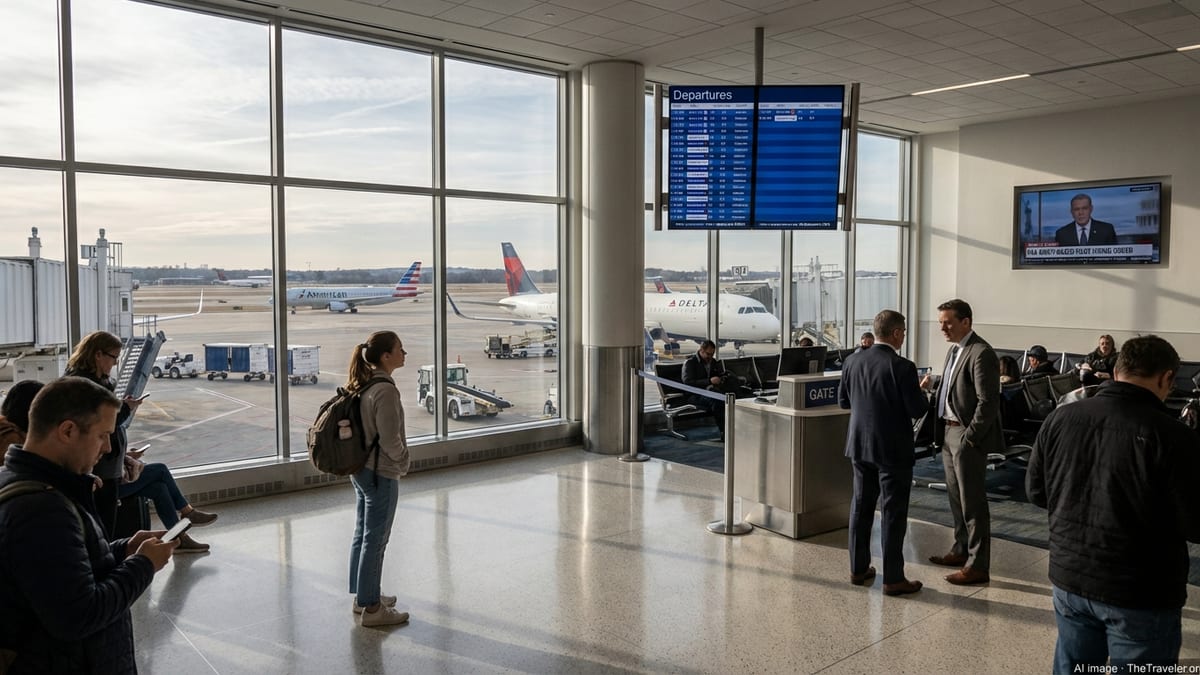
In the Washington region, publicly accessible airport alerts show that Reagan National, Dulles International and Baltimore/Washington International all warned travelers to expect delays and to check directly with their airlines. Images distributed by major news organizations and local broadcasters showed crowds gathering around departure boards at Reagan National as the scale of the disruption became clear.
By later in the evening, an updated FAA advisory indicated that the nationwide order had been lifted, but schedules at busy hubs, including Reagan National, remained heavily backlogged as airlines attempted to restart operations and cycle aircraft and crews back into position.
At Reagan National, confusion, long waits and packed gates
Local public radio reporting from the concourses at Reagan National on Friday described passengers learning about the halt in different ways, from airline staff announcements at crowded gates to notifications within mobile apps as departure times slid back in 30 minute and 60 minute increments. Some travelers had already boarded when pilots announced they would not be cleared to depart until the ground stop was lifted.
Photographs from the airport published by national and international outlets show passengers clustered around display boards in Terminal B and C, where rows of flights to cities such as Boston, Atlanta, Chicago and Charlotte shifted to delayed or remained without departure times for extended periods. The images also show travelers lining terminal windows to watch aircraft parked along the ramp, with few pushbacks underway compared with a typical late afternoon rush.
Publicly available accounts from travelers on social media platforms and message boards indicate that some passengers at Reagan National were advised to deplane and return to the gate area as crews waited for updated guidance. Others reported being told to remain onboard with seat belts unfastened while aircraft held their positions away from the runway system.
Airport information distributed on Friday emphasized that security screening and concessions inside the terminals remained open, even as flight operations slowed dramatically. That combination left many travelers at Reagan National trying to find seating in already busy gate areas, while others sought out restaurants and power outlets in anticipation of waits that stretched to several hours.
Mixed reactions from passengers caught mid-journey
The sudden halt to departures produced a range of responses among passengers connecting through or departing from Reagan National. Publicly viewable comments posted by travelers described frustration at missed connections and family events, but also resignation that communication problems affecting air traffic control left few options other than waiting for conditions to stabilize.
Some passengers in Washington who were booked on short regional routes reported online that they began pricing out same day rail tickets or intercity bus services to reach destinations in the Northeast Corridor. Others indicated they stayed with their original itineraries after airlines warned that rebooking windows around the busy November travel period were already tightening as flights filled.
Reports from travel industry outlets and airline statements show that carriers introduced limited waivers, allowing affected customers to change flights within a defined date range without incurring standard change fees or fare differences on certain routes. For passengers at Reagan National whose trips originated on Friday afternoon or evening, those waivers opened alternatives such as shifting to daytime departures over the weekend, when more information about the communications failure was expected to be available.
Despite the disruption, publicly available coverage from the Washington region indicates that some travelers expressed relief that the issues were caught within the traffic management system rather than during flight. Commentary circulating among aviation professionals and nervous flyers alike emphasized that halting departures, though highly disruptive, is one of the most visible tools available to keep aircraft safely separated when communications become unreliable.
Technical outage raises questions for Washington’s hometown airport
Early explanations compiled from FAA statements and transportation coverage suggest that aging telecommunications hardware in parts of the air traffic control network may have played a role in Friday’s outage. A summary of official advisories, shared publicly by aviation observers, points to legacy switches and routers that reportedly became overloaded by data, disrupting the exchange of information between facilities that manage en route traffic.
The incident unfolded as federal agencies continue broader efforts to modernize air traffic control systems, including the gradual introduction of more digital tools to manage crowded airspace. Analysis published by national magazines in the hours after the ground stop noted that Washington airspace is among the most complex in the country, given security restrictions around the District of Columbia and the proximity of Reagan National to the U.S. Capitol and the Pentagon.
Reagan National already operates under slot controls and perimeter rules that restrict most nonstop flights to destinations within 1,250 miles, a framework designed to manage noise and congestion in tightly constrained airspace and on relatively short runways along the Potomac River. Travel and aviation industry analysts have previously highlighted how those limits, combined with strong demand for seats into central Washington, leave little slack in the schedule on normal days, complicating recovery when unexpected systemwide events occur.
With a national ground stop now added to the list of recent aviation disruptions, commentators are raising renewed questions about whether investments in modernization are keeping pace with the growth in air travel. For Reagan National, which serves millions of passengers each year and functions as a primary gateway to the federal government, the outage underscored how a problem originating far from Washington can quickly ripple through its tightly choreographed operations.
What travelers through Reagan National should expect next
As of November 14, publicly available flight tracking data and airline schedules show that departures and arrivals at Reagan National have resumed, but with lingering delays and scattered cancellations as carriers reposition aircraft and crews. Some early morning services operated close to schedule, while mid morning and afternoon departures reflected the knock-on effects of aircraft arriving late from other parts of the country.
Published guidance from airlines encourages passengers scheduled to fly into or out of Reagan National over the weekend to monitor their carrier’s app or website closely and to arrive earlier than usual, especially if they have checked bags or need to clear security during peak times. With residual delays, travelers with tight connections at other hubs may face additional risk of missed onward flights.
For those who experienced long waits on Friday, consumer advocates note in public commentary that the cause of the disruption, as currently described, is likely to fall into categories considered outside airline control, limiting eligibility for compensation beyond rebooking assistance and, in some cases, meal vouchers. Recent federal rulemaking affecting delay and cancellation reporting has not yet fully taken effect, leaving airlines and passengers to navigate existing policies as they sort through claims.
Travel industry observers suggest that passengers using Reagan National in the coming days build extra flexibility into plans, whether by scheduling longer connection times, considering nonstop trains for shorter regional trips, or avoiding last flights of the day on routes with limited frequencies. While the nationwide ground stop has been lifted, the experience at Washington’s closest airport to downtown served as a vivid reminder that highly centralized aviation systems can still be brought to a standstill by a single, opaque technical failure.