


More news on this day
A rare nationwide ground stop across the United States on Friday, November 13, abruptly froze departures for thousands of flights, stranding an estimated 1.5 million passengers and exposing persistent weaknesses in the country’s air traffic infrastructure.
Get the latest news straight to your inbox!
What happened during the nationwide ground stop?
On the afternoon of November 13, the Federal Aviation Administration ordered a sweeping halt to virtually all departures from US airports after a serious communications failure hit multiple regional air traffic control centers. Publicly available advisories show that the order cited “extraordinary circumstances” and safety concerns, instructing all airports to stop departures while inbound international flights were managed on a case by case basis.
Data from flight-tracking services and airline operations indicate that roughly 11,000 flights within, into, or out of the United States were scheduled to depart after the order took effect, affecting around 1.5 million travelers. By Friday evening, more than 10,000 flights had been delayed and over 1,400 canceled, with disruptions still cascading into Saturday schedules as aircraft and crews fell badly out of position.
While some long-haul international services already in the air were allowed to continue toward major hubs, many domestic and short-haul flights were held at gates or taxiways for hours. In several cases, aircraft that had just departed were turned back to their origin airports, leaving passengers stuck on planes or reentering terminals to rebook onward connections.
The ground stop was gradually lifted later in the evening as communications capacity was restored and traffic levels were carefully increased. However, the immediate operational shock meant that airports across time zones remained crowded with stranded travelers into the night.
A telecommunications outage at the heart of the crisis
According to published coverage, the trigger for the nationwide halt was a telecommunications outage that disrupted communications between key air traffic control facilities and aircraft. Reports referencing internal airline briefings point to problems in network routers that support controller communications and data flows, with failures cascading across multiple regions rather than remaining confined to a single center.
Federal transportation briefings and media reports emphasized that there was no evidence of a cyberattack or malicious activity behind the failure. Early indications describe a technical breakdown in legacy communications systems that remain heavily relied upon for managing US airspace, despite years of planned upgrades and billions of dollars in approved funding.
The episode follows earlier high-profile failures in the US aviation system, including a January 2023 outage in a critical pilot-notification database that also led to a short-lived nationwide pause in departures, and regional disruptions caused by severed fiber lines and aging equipment. Industry analyses published before the latest stoppage had already highlighted the fragility of the air traffic communications network and the slow pace of modernization.
This time, the fallout was magnified by the scale of the outage, its spread across several air traffic regions, and the volume of traffic on a busy November Friday, when airports were already handling dense schedules ahead of the US holiday travel period.
Airports and airlines scramble as passengers are stranded
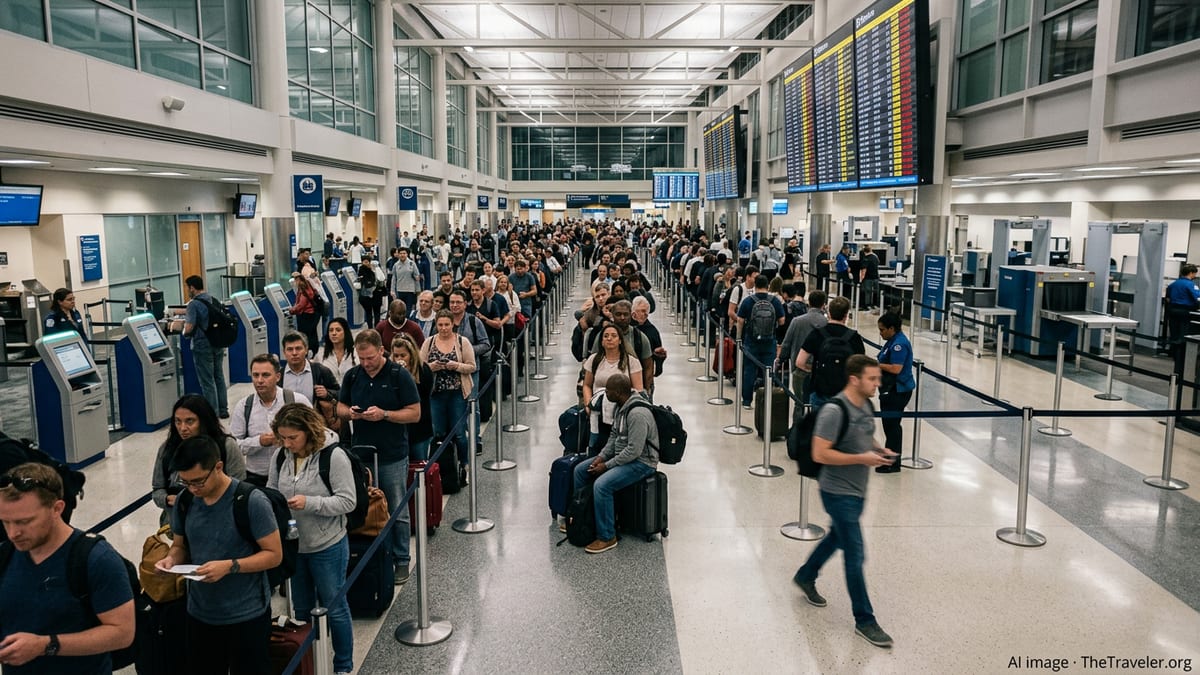
From Los Angeles and Seattle to Chicago, New York and smaller regional hubs, terminals quickly filled with passengers watching departure boards flip from “on time” to “delayed” and “canceled.” Local airport reports described lines snaking through check in halls as travelers tried to rebook or seek clarification, often receiving information from flight-tracking apps before formal announcements reached gate areas.
At major hubs such as Chicago O’Hare and Los Angeles International, where the ground stop was first felt in the early afternoon, almost every departure on the board shifted into delay or cancel status within hours. Regional airports reported dozens of grounded passengers and idle aircraft as local staff waited for updated guidance on when flights could depart and how much traffic controllers could safely handle once communications were partially restored.
Airlines moved quickly to publish change-fee waivers and flexible rebooking options for affected travelers, particularly for those with journeys scheduled on Friday night and early Saturday. However, the sheer number of disrupted flights meant that same day alternatives were scarce in many markets, with some travelers told to expect departures a day or more later as carriers rebuilt their schedules.
Other transport modes felt a knock on effect. Rail operators reported increased call volumes as people sought last minute alternatives on busy intercity routes, while rental car desks at larger airports saw spikes in demand from travelers opting to drive rather than wait for uncertain new departure times.
How this compares with past US airspace shutdowns
Nationwide ground stops affecting all US departures remain exceptionally rare. Public data indicates that this incident is only the second full scale halt of domestic departures since the September 11, 2001 attacks. The previous modern system-wide pause took place in January 2023, when a corrupted database supporting pilot safety notices led to a temporary shutdown of departures while systems were reset.
In both cases, the immediate cause was rooted in technical failure rather than intentional interference. However, aviation analysts note important differences. The 2023 event centered on a specific data system, while the November 13, 2026 ground stop originated in broader communications failures that limited controllers’ ability to manage aircraft movements safely across wide swathes of US airspace.
The new incident also unfolded in a technology environment that is more interconnected than even a few years ago, with a growing reliance on complex data networks, cloud services, and, increasingly, artificial intelligence assisted tools for airspace management. Commentaries in specialist and general media have underlined that while these innovations promise more efficient routing and capacity, they also raise questions about resilience and single points of failure.
Longstanding concerns over aging hardware and delayed infrastructure projects add to the picture. Recent government travel reports and budget requests have detailed multi-billion dollar funding gaps in upgrading air traffic control communications, radar, and backup systems, suggesting that vulnerabilities identified in earlier disruptions have not yet been fully resolved.
What it means for travelers and the months ahead
For travelers caught in Friday’s disruption, the most immediate consequences are missed connections, abandoned weekend plans, extra hotel nights, and crowded rebooking lines. Given the scale of the ground stop, industry schedule data indicates that knock on delays and scattered cancellations will continue into at least Saturday, November 14, as airlines reposition crews and aircraft and congestion works its way out of the system.
Passengers with upcoming US itineraries over the next several days are being advised, in widely shared guidance from airlines and travel platforms, to monitor their carrier apps closely, reconfirm early morning departures, and build more buffer time into connecting itineraries. Those traveling for tightly timed events such as cruises, tours, or international connections may face particular risk if residual delays compound at busy hubs.
In the medium term, the November 13 shutdown is likely to intensify attention on the resilience of US aviation infrastructure. Public statements and budget discussions in recent months have already focused on replacing outdated communications networks and accelerating the rollout of newer traffic management systems. The latest chaos, with 1.5 million travelers stranded on a single day, is expected to add urgency to debates over how quickly those projects are funded and completed.
For now, the episode stands as another reminder of how heavily modern travel depends on invisible but vulnerable digital systems. When those systems fail at scale, the result is an instant nationwide gridlock that ripples far beyond airports, reshaping business trips, holidays, and everyday journeys across an entire country.